

 EnglishEN
 ItalianoIT
 DeutschDE
 EspañolES
 PortuguêsPT
 РусскийRU
Gros Turbo Reprogrammation Stage 3 : Matériel, Calibration et Résultats
Le « Big Turbo remap Stage 3 » est un calibrage d'ECU entièrement personnalisé, conçu pour fonctionner en tandem avec les principales modifications matérielles, offrant des gains de puissance de 50–70% ou plus au-delà des performances d'origine. Il ne s'agit pas d'un flash agressif appliqué à un moteur standard. Qu'est-ce que le « Big Turbo remap Stage 3 », exactement ? Il s'agit du niveau le plus élevé de l'ECU tuning, qui nécessite un turbocompresseur plus grand, un système d'alimentation en carburant amélioré, des composants internes renforcés et un recalibrage complet des cartographies au-delà des limites d'usine. Le résultat est un véhicule fondamentalement transformé, prêt pour la piste ou pour des performances routières extrêmes.
Quelles mises à niveau matérielles sont nécessaires pour un stage 3 remap équipé d'un gros turbo ?
Le stage 3 est une calibration ECU entièrement personnalisée conçu pour se synchroniser avec le matériel gros turbo et les améliorations associées. L'étalonnage de l'ECU n'est fiable qu'à la hauteur du matériel qui le sous-tend. Chaque composant de la chaîne de transmission de puissance doit être capable de supporter les charges thermiques et mécaniques accrues que le réglage exigera.
Les améliorations matérielles suivantes sont obligatoires, non facultatives :
- Turbocompresseur Une unité turbo "big turbo" améliorée ou hybride remplace l'unité d'origine. Les turbos hybrides conservent le carter d'origine mais utilisent une roue de compresseur plus grande et des internes en billette. Les remplacements complets de turbos "big turbo" utilisent une unité complètement différente, dimensionnée pour le niveau de puissance visé.
- Injecteurs de carburant et pompe à carburant : Des injecteurs à plus grand débit et une pompe à carburant plus puissante sont nécessaires pour maintenir des rapports air/carburant corrects à des pressions élevées de boost. Les injecteurs d'origine atteignent leur limite bien en deçà des besoins en carburant du Stage 3.
- Intercooler Un intercooler avant (FMIC) de grande taille remplace l'unité d'origine pour gérer les températures d'air suralimenté nettement plus élevées produites par un turbo plus gros.
- Mécanisme interne du moteur : À des niveaux de puissance supérieurs à 400–450 CV, des pistons et des bielles forgés remplacent les composants OEM moulés. Les pièces internes moulées se fissurent sous les charges de détonation soutenues que les calibrations de Stage 3 peuvent générer en cas de problème.
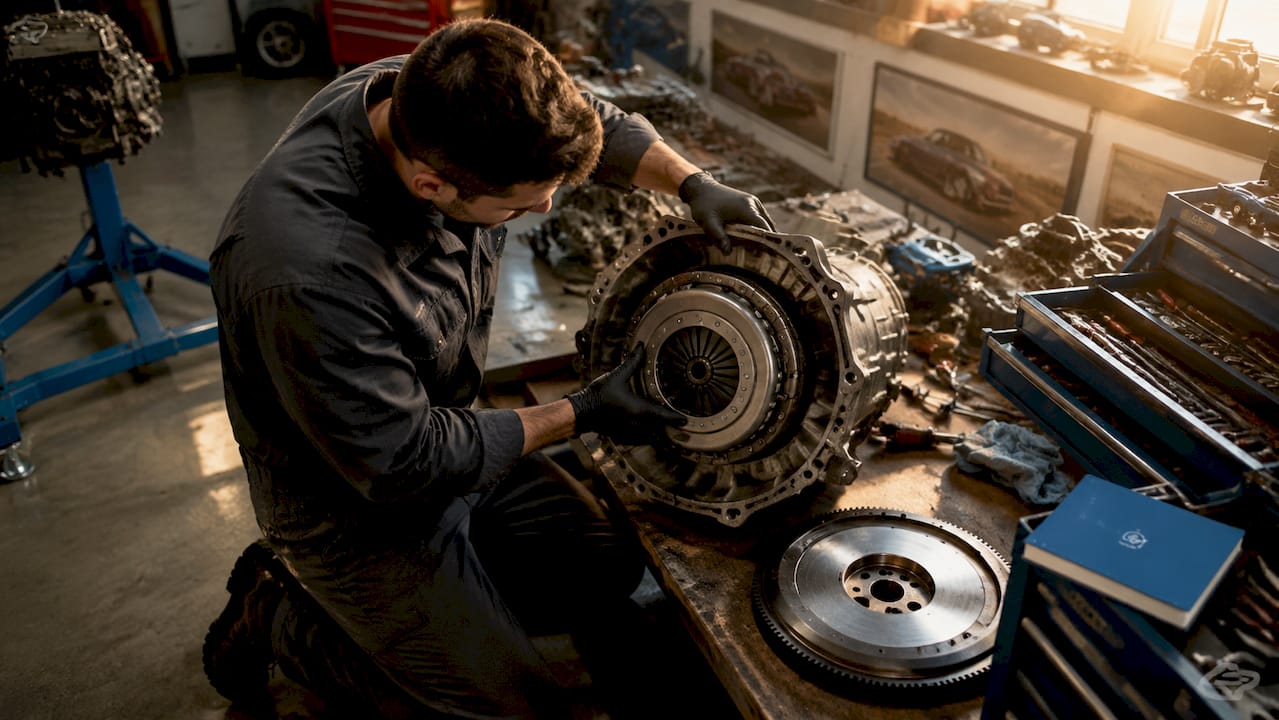
- Embrayage et volant moteur : L'embrayage d'origine ne peut pas supporter le couple d'un montage Stage 3. Un kit d'embrayage renforcé et un volant moteur allégé sont des exigences standard.
- Système d'échappement : Un échappement de performance complet réduit la contre-pression et permet au turbo plus gros de monter en régime efficacement. Le le système d'échappement affecte directement le temps de réponse du turbo vitesse et débit constant de boost.
- Système de refroidissement : Un radiateur et un refroidisseur d'huile améliorés gèrent la charge thermique supplémentaire. Des courses à haute puissance prolongées surchaufferont un système de refroidissement standard en quelques minutes.
Embrayage renforcé, volant moteur et composants de refroidissement sont aussi critiques que le turbo lui-même. Sauter l'une d'entre elles crée un maillon faible que le calibrage ne peut pas compenser.
Astuce de pro : Avant de commander un fichier de reprogrammation Stage 3, auditez chaque composant de la construction par rapport au niveau de puissance cible. Passez en revue le Prérequis matériels du Stage 2 Comme référence de base, puis identifier quel renforcement supplémentaire votre plateforme spécifique nécessite pour les charges de Stage 3.
En quoi le modèle stage 3 diffère-t-il des modèles stage 1, stage 2 et tuning ?
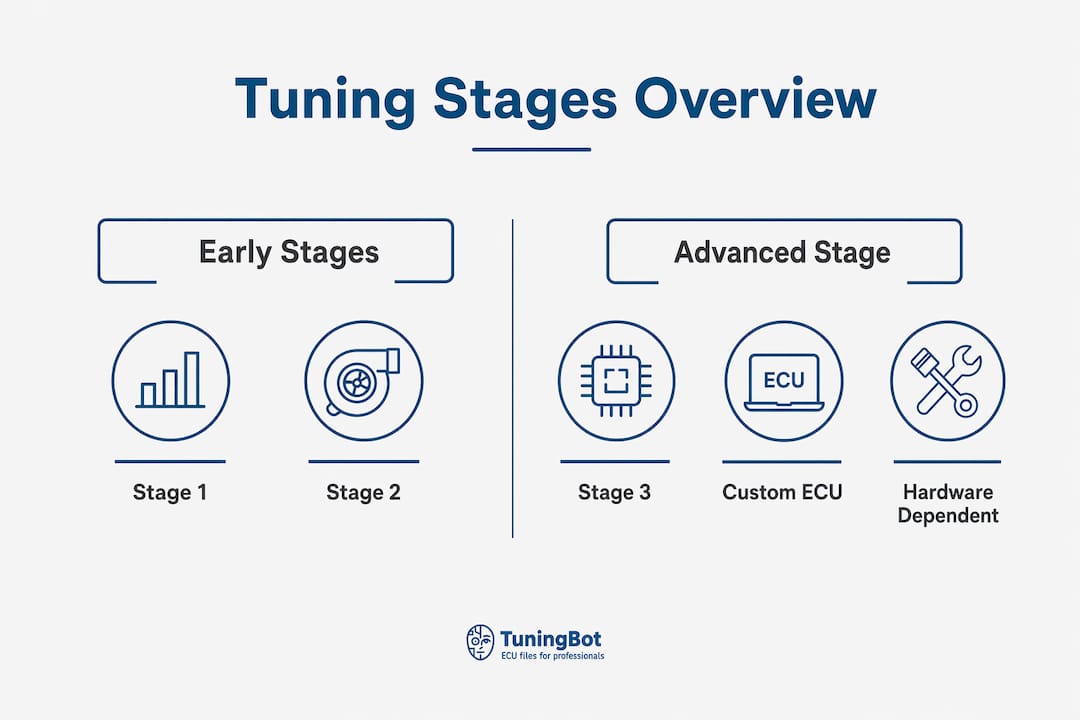
Les phases 1 et 2 du projet tuning s'inscrivent dans le cadre de l'architecture matérielle du fabricant d'équipement d'origine (OEM). Ce n'est pas le cas du Stage 3. Cette distinction détermine tous les aspects liés à la complexité, au coût et au temps nécessaires.
| Réglage | Changements principaux | Gain de puissance typique | Complexité de la calibration |
|---|---|---|---|
| Première Stage | Logiciel ECU uniquement, pas de matériel | 10–30%, modèle haut de gamme | Bas : ajuster les cartes existantes dans les limites du fabricant |
| Stage 2 | Logiciel plus matériel additionnel (admission, échappement, intercooler) | 20–50% au-dessus du niveau de stock | Mode « Medium » : réajustement du rapport boost et alimentation en carburant dans la plage étendue prévue par le constructeur |
| Stage 3 | Révision complète du matériel plus recalibrage complet de l'ECU | 50–70%+ en stock | Élevé : redimensionner tous les axes au-delà des limites d'usine, logique de protection personnalisée |
Au niveau 1, les remap règlent la pression, le débit de carburant et le calage de l'allumage du boost dans le cadre de la structure de cartographie existante de l'ECU d'origine. Le niveau 2 ajoute du matériel prêt à monter et étend modérément ces cartographies. Le Stage 3 nécessite que le tuner reconstruise le calibrage de A à Z autour d'une spécification matérielle totalement différente.
Le calendrier de réalisation reflète cette complexité. Une reprogrammation complète de niveau 3 nécessite entre 4 et 8 heures de travail effectif, incluant les diagnostics, l’élaboration initiale du calibrage, les essais sur route, l’enregistrement des données au banc d’essai et l’affinage itératif de la cartographie. Les mises au point de niveau 1 sur les remap sont souvent réalisées en moins d’une heure. Cette différence de temps traduit la différence de profondeur du travail de calibrage requis.
Le Stage 3 introduit également des considérations de fiabilité qui n'existaient pas sur les modèles stage antérieurs. Le tuner doit tenir compte du comportement du moteur sous une charge soutenue à des températures élevées, et pas seulement de la puissance de pointe atteinte lors d'un essai au banc.
Quelles stratégies de calibrage de l'ECU permettent d'obtenir un résultat satisfaisant pour le stage 3 remap ?
Le Stage 3 (tuning) correspond à la mise en œuvre de la mise à l'échelle du matériel et des calculateurs électroniques (ECU)., et non pas simplement une augmentation de la pression boost. L'ECU doit être recalibré pour gérer des conditions de fonctionnement totalement différentes. Chaque système de contrôle du logiciel de gestion du moteur doit être mis à jour afin de tenir compte des capacités et des limites du nouveau matériel.
Les principales étapes d'étalonnage d'un remap « Stage 3 » à gros turbo suivent le processus suivant :
- Réglage de l'axe dans WinOLS : Les plages de valeurs des tables de consultation de l'ECU concernant la pression boost, le nombre d'injecteurs et la pression de rampe doivent être étendues au-delà des limites d'usine. WinOLS permet une analyse détaillée de la mémoire de l'ECU modification pour dimensionner ces tableaux pour le débit d'air des turbos plus gros et la capacité de livraison du système de carburant amélioré.
- Ajustement de la cartographie de contrôle de la suralimentation : Les cartographies de demande de pression boost, les cartographies de cycle de service de la soupape de décharge et les seuils de protection « overboost » ont toutes été réécrites afin de s'adapter aux caractéristiques de débit du nouveau turbocompresseur.
- Recalibrage de la stratégie de ravitaillement : Les réglages des injecteurs, les pressions cibles du rail d'injection et les valeurs cibles lambda ont été mis à jour afin de s'adapter aux injecteurs et à la pompe à carburant à plus haut débit. Un apport de carburant incorrect à forte charge est le moyen le plus rapide d'endommager le moteur.
- Cartographies de demande et de limite de couple : Les limiteurs de couple d'usine limitent la sortie bien en deçà de ce que le matériel de Stage 3 peut produire. Ces tables doivent être redimensionnées pour permettre au moteur de délivrer son plein potentiel sans déclencher de coupures de protection.
- Logique de protection thermique et mécanique : La sensibilité du capteur de cliquetis, les cartographies de protection liées à la température du liquide de refroidissement et les seuils de pression d'huile sont recalibrés afin de tenir compte de la nouvelle plage de fonctionnement. La gestion du boost et de l'injection de carburant en cas de charges prolongées nécessite une coordination précise des cartographies afin d'éviter tout dommage au moteur.
- Cycles logiques itératifs, ajuster et retester : Plusieurs itérations incrémentales de tests sur route et d'enregistrement sur banc d'essai sont requis pour confirmer la stabilité. Chaque cycle identifie les domaines où l'étalonnage doit être affiné avant la prochaine exécution.
Astuce de pro : Lors de la révision d'un fichier de calibration Stage 3, vérifiez que le Flux de travail professionnel pour l'ECU remapping comprend la correction et la vérification checksum. Un fichier checksum non corrigé après la mise à l'échelle de la carte entraînera le rejet du fichier par l'ECU ou le passage en mode de secours mode au démarrage.
Le Système de turbocompresseur integration C'est l'étape la plus exigeante sur le plan technique de ce processus. L'ECU doit traiter le nouveau turbo comme s'il s'agissait de l'unité d'origine, ce qui nécessite d'intégrer sa courbe boost spécifique, ses caractéristiques de réponse et ses limites de pression dans chaque tableau concerné.
Quels gains de puissance et quels résultats concrets peut-on attendre ?
Le Stage 3 tuning permet d'obtenir des gains de puissance compris entre 50 et 70%+ par rapport à la version de série, le chiffre exact dépendant de la plateforme, du turbo choisi et de la qualité du matériel associé. Il ne s'agit pas là de chiffres théoriques. Des montages réels réalisés sur des plateformes de performance courantes démontrent ce que permettent d'obtenir des calibrages de niveau 3 correctement execués.
Les résultats documentés du monde réel incluent :
- Volkswagen Golf R (MK7/MK8) : Les configurations « Big Turbo » de niveau 3 sur le moteur EA888 développent régulièrement plus de 450 HP. La puissance d'origine est d'environ 300 HP, ce qui représente un gain de plus de 50%.
- Audi S3 (8V/8Y) : La même plateforme EA888 répond de manière similaire. Avec un gros turbo hybride ou complet, des internes forgés et une mise à niveau complète du système d'alimentation en carburant, 450–500 ch sont atteignables avec un fichier ECU correctement calibré.
- Ford Focus ST (2.0T EcoBoost) : Le Stage 3 tuning permet de presque doubler le couple disponible sur la plateforme EcoBoost, transformant ainsi une « hot hatch » de 250 HP en une véritable bête de course de plus de 400 HP.
Le tableau ci-dessous résume les résultats typiques observés sur ces plateformes :
| Véhicule | Puissance des stocks | Stage 3 Cible | Matériel essentiel |
|---|---|---|---|
| VW Golf R (EA888) | ~300 CV | 450+ ch | Turbocompresseur hybride, internes forgés, échangeur frontal |
| Audi S3 (EA888) | ~310 ch | 460–500 ch | Gros turbo, injecteurs renforcés, bielles forgées |
| Ford Focus ST (EcoBoost) | ~250 ch | 400–430 ch | Gros turbo, échappement complet, embrayage renforcé |
La conduite quotidienne est une préoccupation légitime à ces niveaux de puissance. Une cartographie Stage 3 bien calibrée gère la livraison de couple progressivement, évitant les surtensions de puissance vives et incontrôlables que produisent les préparations mal réglées. Cela dit, la plupart des préparations Stage 3 sont optimisées pour une utilisation sur piste ou une conduite sportive sur route. La qualité de roulement, la consommation de carburant et la maniabilité à basse vitesse d'un véhicule d'origine ne seront pas préservées.
La fiabilité dépend entièrement de la qualité du matériel et de l'étalonnage. Un réglage de niveau 3 sur des composants d'origine entraînera une panne du moteur. Ne pas mettre à niveau le matériel avant d'appliquer un réglage de niveau 3 est l'une des erreurs les plus courantes et les plus coûteuses en matière de performance tuning.
L'essentiel
Un gros turbo de niveau 3 (remap) nécessite une installation complète du matériel (egr) et un réglage sur mesure de l'ECU pour offrir des gains de puissance fiables de 50 à 70%, voire plus, par rapport à la version de série.
| Point | Détails |
|---|---|
| Le stade 3 dépend du matériel | Chaque système majeur doit être mis à niveau avant que le calibrage commence, y compris le turbo, le carburant et les composants internes. |
| Les gains de puissance sont substantiels | Il faut s'attendre à une puissance supérieure de 50 à 701 TP50T+ par rapport à la puissance d'origine ; les modèles Golf R et Focus ST dépassent régulièrement les 450 HP. |
| La profondeur de calibration est cruciale | La mise à l'échelle des cartes WinOLS, l'ajustement du limiteur de couple et les réécritures de la logique de protection sont tous requis. |
| Le traitement prend de 4 à 8 heures | Les diagnostics, l'enregistrement sur banc d'essai et le peaufinage itératif de la cartographie définissent le flux de travail de la scène 3. |
| Le matériel de stock tombera en panne | Appliquer un réglage Stage 3 sans améliorations matérielles entraîne des dommages catastrophiques au moteur. |
Le Stage 3 correspond à une intervention « integration », et non à un fichier de réglage.
La plupart des montages de niveau 3 que j'ai examinés et qui ont échoué présentaient une caractéristique commune : le tuner considérait le calibrage comme l'élément principal et le matériel comme secondaire. Cette approche est erronée. Le fichier ECU constitue la dernière étape d'un montage qui doit être mécaniquement au point avant même que tout travail de calibrage ne commence.
Le piège le plus courant que je vois le plus souvent est l'application d'une optimisation Stage 3 à un moteur qui a du matériel Stage 2. Le turbo peut être amélioré, mais les injecteurs sont d'origine, ou l'embrayage n'a pas été remplacé, ou l'intercooler est toujours l'unité OEM. Chacune de ces lacunes crée un point de défaillance que la calibration ne peut pas contourner. L'ECU peut demander le bon remplissage, mais si les injecteurs ne peuvent pas le fournir, le moteur tourne pauvre sous charge.
L'investissement en temps et en ressources pour une préparation digne de ce nom de niveau 3 est considérable. Le matériel seul, sur une Golf R ou une Focus ST, atteint généralement plusieurs milliers d'euros avant même qu'une seule heure de calibration ne soit enregistrée. La calibration elle-même, effectuée correctement avec de multiples sessions sur banc d'essai et des ajustements itératifs, s'ajoute à ce coût. Rogner sur l'un ou l'autre de ces aspects produit un résultat peu fiable.
Ce que je trouve le plus sous-estimé, c'est la valeur de la phase de test itératif. Les préparateurs qui se précipitent vers une cartographie finale après une ou deux passes au banc d'essai sacrifient la stabilité. Les préparations qui résistent sur des milliers de kilomètres sur piste sont celles où le préparateur a passé du temps à affiner la logique de protection et la gestion thermique, pas seulement à courir après les chiffres de puissance maximale. Examiner Guide de planification du matériel pour les modèles tuning et stage Avant de commencer une construction, c'est du temps bien employé.
— Équipe technique de TuningBot
Comment TuningBot soutient votre préparation de turbocompresseur volumineux Stage 3
TuningBot fournit des fichiers de calibration d'ECU professionnels conçus spécialement pour les constructions Stage 3 à gros turbo sur une large gamme de plateformes, y compris les ECU Bosch, Continental, Delphi et Marelli. Les fichiers sont livrés via un flux de téléchargement direct avec le support d'ingénieurs, sans crédits prépayés requis.
Que vous calibriez une Golf R EA888, une Focus ST EcoBoost ou une plateforme diesel avec un turbo hybride, TuningBot's Optimisez votre service de fichiers couvre l'ensemble des paramètres de réglage : recalibrage de la commande boost, stratégie d'injection, réglage du limiteur de couple et logique de protection. La plateforme prend en charge les principaux outils tuning, notamment Alientech KESS3, AutoTuner et Magic Motorsport. Pour les ateliers gérant plusieurs montages de niveau 3, le Matrice de couverture des services de l'ECU comprend une prise en charge étendue des calculateurs (ECU) et des paramètres de calibrage mis à jour pour les dernières configurations matérielles.
FAQ
Qu'est-ce qu'un « big turbo remap Stage 3 » ?
Le « Big Turbo remap Stage 3 » est un calibrage d’ECU entièrement personnalisé, conçu autour d’un turbocompresseur plus puissant et d’améliorations matérielles associées, offrant des gains de puissance de 50 à 70%+ par rapport à la version de série. Il nécessite un recalibrage complet de la cartographie au-delà des limites d’usine, et non une simple augmentation de boost.
Puis-je utiliser un réglage « stage 3 » avec les composants internes d'origine du moteur ?
Non. L'application d'un calibrage Stage 3 à des composants internes d'origine entraîne une défaillance du moteur. Des pistons forgés, des bielles forgées et un système d'alimentation en carburant amélioré sont obligatoires avant de charger tout calibrage Stage 3.
Combien de temps faut-il pour terminer un stage 3 remap ?
Une reprogrammation complète de niveau 3 (remap) prend entre 4 et 8 heures, ce qui comprend le diagnostic, l'étalonnage initial, les essais sur route, l'enregistrement des données au banc d'essai et l'affinage itératif de la cartographie. Les mises au point de niveau 3 réalisées à la hâte, sans passer par ce processus, donnent des résultats instables.
Quel logiciel utilise-t-on pour créer un stage 3 remap file ?
WinOLS est la référence du secteur pour les travaux d'étalonnage de niveau 3. Il permet à tuners d'étendre les axes des tables de consultation de l'ECU pour la pression boost, le débit d'injection et la pression de rampe au-delà de la structure de cartographie d'usine, afin de s'adapter au matériel à gros turbo.
Le modèle stage 3 remap est-il adapté à une utilisation quotidienne ?
Les constructions de stade 3 peuvent être conduites quotidiennement, mais elles sont optimisées pour une utilisation à hautes performances. La consommation de carburant augmente, la maniabilité à basse vitesse change et la fiabilité à long terme dépend entièrement de la qualité du matériel et du travail d'étalonnage.