

 EnglishEN
 ItalianoIT
 DeutschDE
 EspañolES
 PortuguêsPT
 РусскийRU
La modification remapping, connue dans les milieux professionnels sous le nom d’ECU remapping ou de « calibration de l’ECU », est l’une des méthodes les plus efficaces pour améliorer la puissance, la consommation de carburant et la réactivité de l’accélérateur d’un véhicule sans remplacer le moindre composant mécanique. De nombreux propriétaires associent encore cette pratique à un risque ou à une perte de garantie, mais la réalité est plus nuancée. Lorsqu’elle est réalisée correctement par des professionnels qualifiés à l’aide d’outils de calibration adaptés, la calibration remapping permet d’obtenir des gains mesurables que les cartographies d’usine laissent délibérément de côté. Ce guide explique le fonctionnement du processus, présente les différents types de stage existants, décrit ce à quoi vous pouvez raisonnablement vous attendre et indique comment éviter les écueils qui donnent à cette pratique une réputation injustifiée.
Table des matières
- Points clés à retenir
- Qu'est-ce que le code remapping et comment le calculateur électronique (ECU) contrôle votre moteur ?
- Remap stages : ce que comprend chaque niveau
- Avantages concrets de l'ECU tuning
- Risques, sécurité et critères de qualité d'un remap
- Déterminer si le modèle remapping convient à votre véhicule
- Mon point de vue sur les cartes d'usine et les raisons pour lesquelles remapping est mal compris
- ECU professionnel remapping avec TuningBot
- FAQ
Points clés à retenir
| Point | Détails |
|---|---|
| Boîtiers ECU remapping et tuning | Le remappage modifie directement les paramètres principaux du moteur au sein du logiciel de l'ECU, contrairement aux boîtiers tuning qui trompent l'ECU de manière externe. |
| Les niveaux de scène déterminent les besoins en matériel | Le stage 1 fonctionne sur un véhicule d'origine ; les stages 2 et 3 nécessitent des améliorations matérielles de support avant que le fichier ECU ne soit modifié. |
| Les gains de carburant et de puissance sont mesurables | L'optimisation de l'injection de carburant via le système remapping peut permettre d'obtenir des gains de puissance par rapport au 60% et de réduire la consommation de carburant de 30 à 40%. |
| Bilan de santé avant toute intervention remap | Une inspection minutieuse du véhicule avant le remap permet d'éviter toute sollicitation excessive du moteur et de réduire le risque de dommages, même si le dossier est par ailleurs bien rédigé. |
| Le modèle professionnel tuning l'emporte à chaque fois sur le modèle à monter soi-même | Des cartes mal calibrées causent des dommages au moteur et annulent les garanties ; des services professionnels vérifiés éliminent cette variable. |
Qu'est-ce que le code remapping et comment le calculateur électronique (ECU) contrôle votre moteur ?
L'unité de contrôle du moteur (ECU) est le « cerveau » logiciel qui régit le fonctionnement de votre moteur. Elle gère le calage de l'injection, l'avance à l'allumage, la pression du turbocompresseur boost, les limites de couple et les régimes maximaux, le tout sur la base d'un ensemble de tables de consultation et de cartographies d'étalonnage définies par le constructeur. Ces cartographies d'usine ne sont pas conçues pour offrir des performances optimales. Elles sont élaborées pour respecter les réglementations antipollution sur différents marchés, s'adapter à un carburant de qualité inférieure, réduire les réclamations au titre de la garantie et établir une distinction entre les niveaux de finition d'une même plateforme moteur.
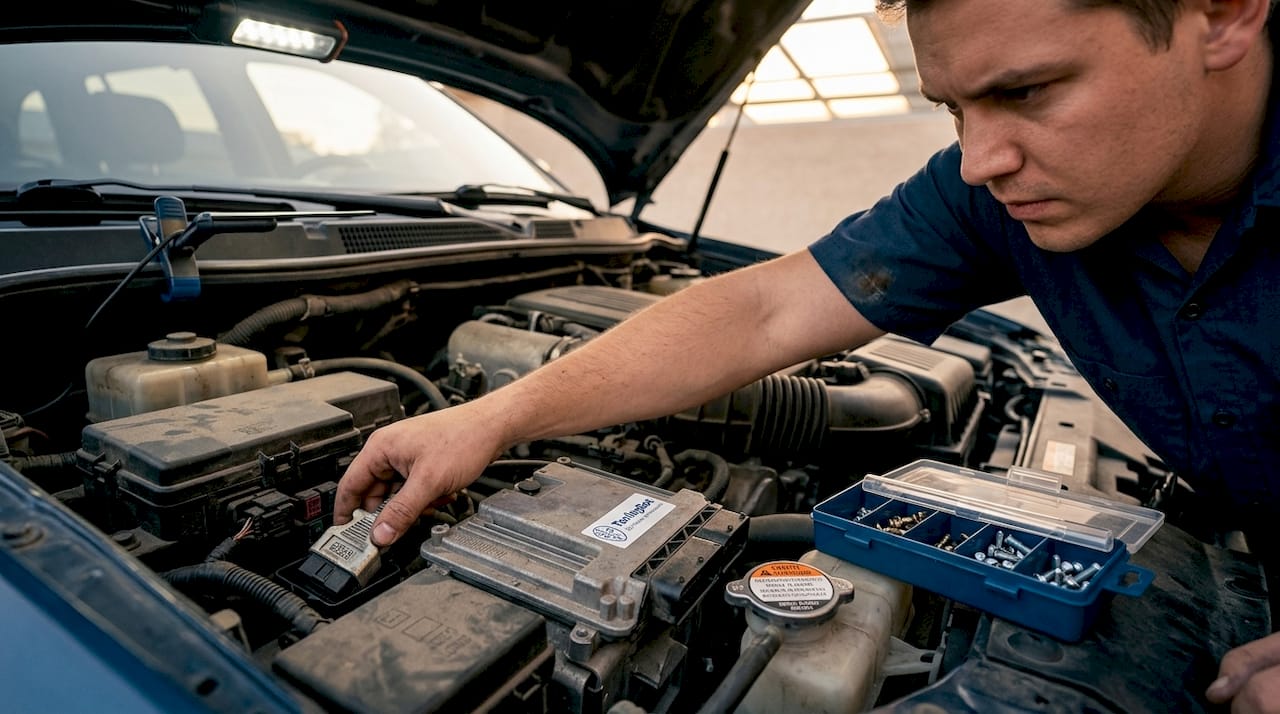
Le processus « Car remapping » consiste à lire ces données d'usine, à « modifier » les paramètres d'étalonnage pertinents, puis à réécrire la nouvelle cartographie dans l'ECU. Il en résulte un moteur fonctionnant plus près de ses limites mécaniques réelles, réglé en fonction de la qualité du carburant, du climat et des objectifs de performance d’un véhicule spécifique, plutôt que selon une moyenne mondiale aussi large que possible.
Le remapping modifie les paramètres fondamentaux directement au sein du logiciel de l'ECU, ce qui constitue la différence fondamentale entre un remap et un boîtier externe tuning. Un boîtier tuning intercepte les signaux des capteurs et transmet de fausses données à l'ECU, ce qui amène ce dernier à réagir comme si les conditions étaient différentes de ce qu'elles sont en réalité. Le remappage réécrit les données sources, de sorte que l’ECU fonctionne à partir d’entrées précises, calibrées en fonction d’une nouvelle cible. La différence en termes de comportement routier, de sécurité et de fiabilité à long terme est significative.
Un processus remapping professionnel suit une séquence structurée. Voici comment il se déroule généralement :
- Bilan de santé préalable à la version remap. Le tuner recherche les codes d'erreur, vérifie les fuites du boost, inspecte les composants du système d'alimentation en carburant et s'assure que le moteur est en bon état mécanique avant d'intervenir sur le calculateur.
- Fichier ECU lu. À l'aide d'un outil tel que l'Alientech KESS3 ou l'AutoTuner, le tuner se connecte au port OBD ou directement au calculateur (ECU) et récupère le fichier d'étalonnage actuel.
- Carte modification. Le module tuner règle le calage et la pression d'injection, les courbes d'avance à l'allumage, les valeurs de consigne du module boost, les limiteurs de couple ainsi que tous les paramètres pertinents liés aux émissions, en fonction de l'objectif défini par le module tuning.
- Écriture et flash de fichiers. Le fichier modifié est réécrit dans l'ECU via la même interface.
- Test sur route ou sur banc. Le véhicule est soumis à des essais en charge afin de vérifier l'absence de cliquetis, le bon fonctionnement du système boost et la régularité de la puissance sur toute la plage de régime.
Astuce de pro : Avant d'envoyer un fichier ECU pour étalonnage, vérifiez toujours que le numéro de série du calculateur et la version logicielle correspondent bien au fichier sur lequel vous travaillez. Une incompatibilité à ce stade (stage) est la principale cause d'échec des tests remap, bien plus que n'importe quelle autre variable. Pour une description détaillée de ce processus, consultez Comment un appareil professionnel tuner lit les données de l'ECU.
Remap stages : ce que comprend chaque niveau
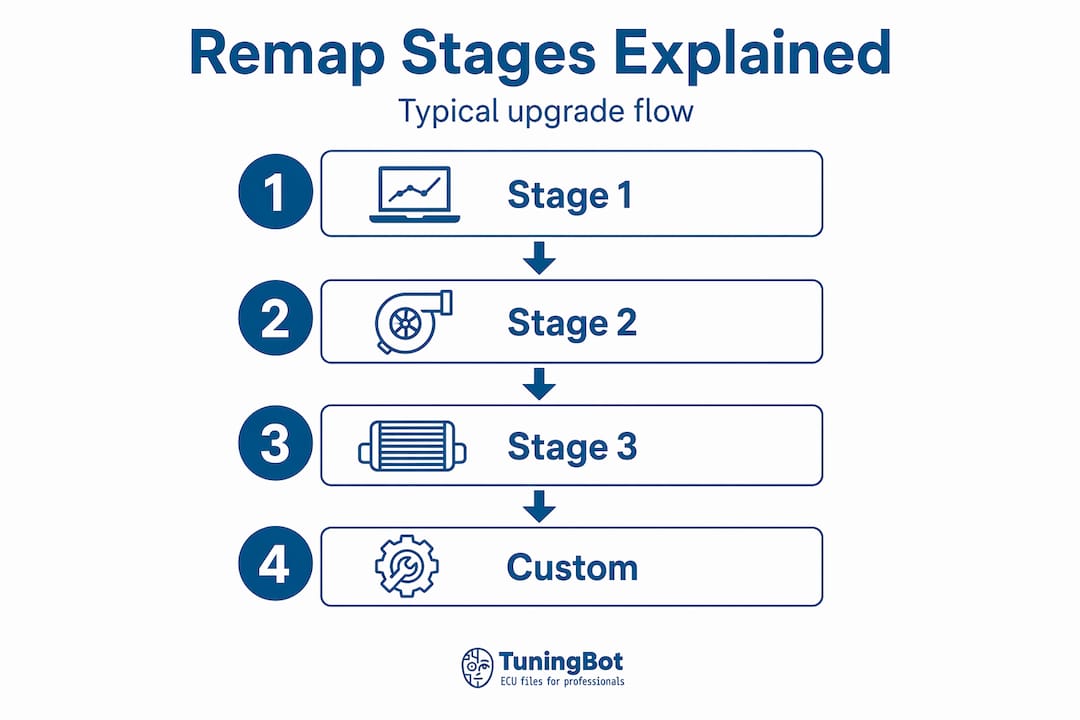
Les moteurs remap ne sont pas tous identiques. Le secteur utilise un système de classification stage pour décrire dans quelle mesure le matériel modification prend en charge la modification du calibrage de l'ECU. Comprendre cette distinction permet d'éviter les attentes irréalistes et les incompatibilités matérielles.
- Première Stage Il s'agit d'un réglage purement logiciel effectué sur un véhicule de série non modifié. Il permet d'ajuster les paramètres boost, l'injection de carburant et le calage de l'allumage dans les limites de sécurité du matériel d'origine. Les réglages de niveau 1 restent dans les limites de sécurité d'usine et sont généralement ceux qui compromettent le moins la garantie, en particulier sur les moteurs diesel et essence turbocompressés. Les gains typiques vont de 20 à 40 % sur les plateformes turbocompressées.
- Stage 2 Ce système suppose que les composants matériels modifications sont déjà installés, à savoir, en général, un refroidisseur intermédiaire optimisant les performances, un système d’admission amélioré et un système d’échappement à débit accru. Le calibrage de l’ECU est ensuite programmé pour tirer parti de l’amélioration du débit d’air et de la gestion thermique apportées par ces composants.
- Stage 3 implique des modifications matérielles importantes, internes ou à induction forcée, y compris des turbos améliorés, des systèmes d'alimentation en carburant et parfois un renforcement de la transmission. L'étalonnage de l'ECU et parfois du TCU à ce niveau est très spécifique à la combinaison exacte de pièces installées.
| Stage | Matériel requis | Gain de puissance typique | Niveau de risque |
|---|---|---|---|
| Première Stage | Véhicule en stock | 20 à 40% | Bas |
| Stage 2 | Intercooler, admission, échappement | 40 à 60% | Modéré |
| Stage 3 | Turbo, améliorations du système de carburant | 60%+ | Haut sans soutien professionnel |
Astuce de pro : Les moteurs diesel, en particulier ceux équipés de turbos à géométrie variable, offrent souvent les résultats les plus impressionnants en Stage 1 par rapport au coût, car les cartographies OEM sont délibérément conservatrices pour respecter les normes d'émissions Euro ou EPA. Un Solution ECU remap de Marelli couvre bon nombre de ces plateformes diesel en détail.
Parmi les types de moteurs courants qui réagissent bien au remapping, on trouve les moteurs diesel turbocompressés modernes (2.0 TDI, 3,0 TDI), les moteurs essence turbocompressés (2,0 TFSI, 1,6 T), ainsi que les applications à turbocompresseur « twin-scroll », pour lesquelles le contrôleur boost offre la plus grande marge de manœuvre.
Avantages concrets de l'ECU tuning
Les performances de l'ECU tuning sont largement reconnues, mais l'argument de l'efficacité est tout aussi convaincant et souvent négligé par les passionnés qui ne s'intéressent qu'aux chiffres de puissance.
En matière de puissance, l’optimisation de l’injection via le remapping peut permettre des gains de puissance supérieurs à 60% et réduire la consommation de carburant de 30 à 40 % lorsque le réglage améliore l’efficacité de la combustion plutôt que de se contenter d’augmenter la charge. Cela compte autant pour les conducteurs quotidiens que pour les voitures de circuit. Une fourgonnette diesel remap conçue pour délivrer son couple à bas régime, par exemple, atteindra plus rapidement sa puissance de traction, ce qui signifie que le conducteur aura moins besoin d’accélérer pour maintenir sa vitesse sur autoroute, ce qui réduit directement la consommation de carburant.
Voici un résumé des avantages concrets les plus constants :
- Augmentation de la puissance de pointe et du couple sur toute la plage de régime, pas seulement en haut.
- Réponse d'accélérateur améliorée, particulièrement à charge partielle où les cartographies d'origine sont intentionnellement peu réactives
- Meilleure économie de carburant en conduite à régime stable grâce à une combustion plus complète
- Capacité de remorquage améliorée grâce à une augmentation du couple dans la plage de régime faible à moyen
- Suppression ou réglage des dispositifs de limitation installés en usine, tels que les limiteurs de vitesse ou les rev limiter, lorsque la loi le permet et que cela est approprié
- Une cartographie tuning personnalisée, adaptée au style de conduite et aux conditions réelles, qui améliore la longévité du moteur par rapport à une cartographie conçue pour les scénarios globaux les plus défavorables.
À elle seule, l'amélioration de la réactivité de l'accélérateur modifie les sensations de conduite. Les systèmes de gestion du couple d'origine réduisent délibérément la réactivité afin de protéger les composants de la transmission et d'adoucir les changements de vitesse pour le conducteur lambda. Un remap bien calibré ajuste cette courbe de gestion du couple sans supprimer entièrement les seuils de protection.
Risques, sécurité et critères de qualité d'un remap
Un remap mal exécuté entraîne des dommages au moteur et annule les garanties du constructeur. Cette affirmation ne doit pas être une raison pour éviter le remapping. Elle doit plutôt inciter à choisir avec soin la personne chargée de rédiger le fichier. Comprendre les causes de défaillance du modes simplifie le processus de sélection.
Les risques les plus courants comprennent :
- Détonation ou cliquetis dus à un calage d'allumage trop avancé dans la cartographie modifiée
- Overboosting dû à des cibles boost trop ambitieuses qui dépassent la capacité du refroidisseur intermédiaire ou du moteur
- Erreurs d'alimentation provoquant une combustion pauvre et des dommages aux pistons sous charge
- Écrire un fichier dans un moteur mécaniquement compromis, ce qui amplifie les points de contrainte existants
- Utiliser des remap file génériques ou partagés à la place de ECU personnalisé remapping calibré pour le véhicule spécifique
Un contrôle de l'état du véhicule avant toute intervention remap est indispensable. Des injecteurs usés, des capteurs de débit d'air défaillants, des fuites boost et des bougies d'allumage usées ont tous une incidence sur la façon dont le moteur réagit à une cartographie modifiée. Résoudre ces problèmes en premier lieu est une pratique courante pour tout professionnel compétent en tuner.
Sur le plan juridique, le ministère de la Justice américain annoncé en janvier 2026 qu'elle ne poursuivrait plus tuners au pénal pour altération du système OBDII. Les sanctions civiles prévues par la loi sur la qualité de l’air (Clean Air Act) restent toutefois applicables, en particulier pour les modifications liées aux émissions, telles que le retrait du filtre à particules diesel (DPF) ou la suppression du système de recirculation des gaz d’échappement (EGR) sur les véhicules immatriculés pour la circulation routière. Comprendre cette limite fait partie intégrante d’une pratique responsable en tant que professionnel ou atelier.
Parmi les signes indiquant qu’une intervention remap a été mal réalisée, on peut citer un ralenti irrégulier après la mise à jour, un mauvais comportement au démarrage à froid, des ratés d’allumage intermittents en charge, l’apparition de nouveaux codes d’erreur qui n’existaient pas auparavant, ainsi qu’une puissance qui semble « plate » ou irrégulière. N’importe lequel de ces symptômes justifie une analyse immédiate du journal de données et une révision du fichier. Pour une analyse plus approfondie des attentes réalistes, consultez le Fiabilité de l'ECU tuning ressource de TuningBot.
Déterminer si le modèle remapping convient à votre véhicule
Le modèle remap ne convient pas à tous les véhicules ni à toutes les situations de propriété. Définir dès le départ les bons critères permet de gagner du temps et de l'argent.
Les candidats idéaux comprennent :
- Moteurs diesel et essence turbocompressés produits après 2005, où le calibrage de l'ECU présente la plus grande marge de manœuvre au-dessus de la cartographie d'usine
- Véhicules hors garantie constructeur où le propriétaire assume l'entière responsabilité de l'étalonnage
- Véhicules utilitaires et véhicules de remorquage où la livraison de couple et l'amélioration de l'économie de carburant ont une valeur financière directe
- Conduite sur circuit ou performances — configurations orientées performance où le propriétaire comprend les compromis entre puissance et durée de vie des composants
Situations dans lesquelles la technique remapping doit être reportée ou évitée :
- Moteurs ayant parcouru un kilométrage élevé, avec des alésages usés, des injecteurs usés ou des turbos défaillants. Un remap monté sur un moteur usé accélère l'usure au lieu d'améliorer les performances.
- Véhicules sous garantie constructeur active si le propriétaire n'est pas prêt à accepter le risque de garantie, car la plupart des constructeurs peuvent détecter les changements de calibrage
- Les moteurs à aspiration naturelle présentant de faibles taux de compression, pour lesquels les gains apportés par le système remapping sont minimes par rapport aux plateformes turbocompressées
- Véhicules pour lesquels les décisions relatives à la personnalisation matérielle n'ont pas encore pris en compte la manière dont le remap interagit avec d'autres « modifications » prévues
Le rapport coût-performance penche généralement en faveur du remapping sur les plateformes turbocompressées. Un kit diesel de niveau 1 (remap), dont le prix varie entre $300 et $600, permet de réduire la consommation de carburant de 8 % sur un véhicule parcourant 25 000 miles par an. Il est ainsi amorti en un à deux ans grâce aux seules économies de carburant, sans même tenir compte de l'amélioration des performances. Lorsque d’autres améliorations des performances du véhicule sont prévues, le remap doit être installé en dernier ou être réajusté après chaque ajout de matériel afin de refléter la configuration réelle du moteur.
Astuce de pro : Si votre véhicule doit faire l'objet de plusieurs modifications, discutez du plan de développement complet avec votre tuner avant la première mise à jour. Un fichier créé en connaissant la configuration matérielle finale permet d'économiser les frais de révision et d'éviter de devoir supprimer ultérieurement une cartographie intermédiaire.
Mon point de vue sur les cartes d'usine et les raisons pour lesquelles remapping est mal compris
J'ai passé des années à examiner des fichiers de calibration d'ECU sur des dizaines de plateformes, et la chose la plus constante que j'ai trouvée est à quel point les cartographies d'usine sont délibérément conservatrices. Les constructeurs ne sacrifient pas les performances par accident. Ils gèrent simultanément la responsabilité, la conformité aux émissions, la variabilité de l'indice d'octane du carburant dans 50 pays et les intervalles d'entretien. La cartographie d'usine est un compromis d'ingénierie, pas une cible de performance.
Concrètement, cela signifie qu’un remap bien programmé ne “ pousse pas le moteur au-delà de ses limites ”. Cela revient à supprimer des contraintes qui n’ont jamais été nécessaires pour votre moteur, la qualité de votre carburant et vos conditions d’utilisation spécifiques. Le matériel du moteur a été conçu avec une marge de manœuvre supérieure à celle jamais utilisée par la cartographie d’usine. Les préparateurs qui comprennent cela travaillent avec prudence dans le respect de cette marge de manœuvre. Ceux qui ne le comprennent pas recherchent la puissance à tout prix sans vérifier que le calibrage reste stable dans des conditions réelles d’utilisation.
La plus grande erreur que je constate chez les passionnés est de considérer la qualité d’un remap comme un simple produit interchangeable et de choisir un tuner en se basant uniquement sur le prix. Un fichier générique bon marché issu d’une base de données partagée et un fichier personnalisé élaboré à partir de données vérifiées au banc d’essai pour la même famille de moteurs ne sont pas des produits équivalents. La différence apparaît trois mois plus tard sur un journal de données ou lors d’un test de performance. Investissez dans la qualité du fichier, pas seulement dans le processus de flashage.
L'avenir de l'ECU tuning s'oriente vers l'étalonnage à distance et des ECU dotés d'un cryptage plus poussé, ce qui renforcera les obstacles techniques pour le modèle d'entrée de gamme tuners tout en stimulant la demande pour des plateformes offrant une prise en charge matérielle approfondie et des bibliothèques de fichiers vérifiées.
— Équipe technique de TuningBot
ECU professionnel remapping avec TuningBot
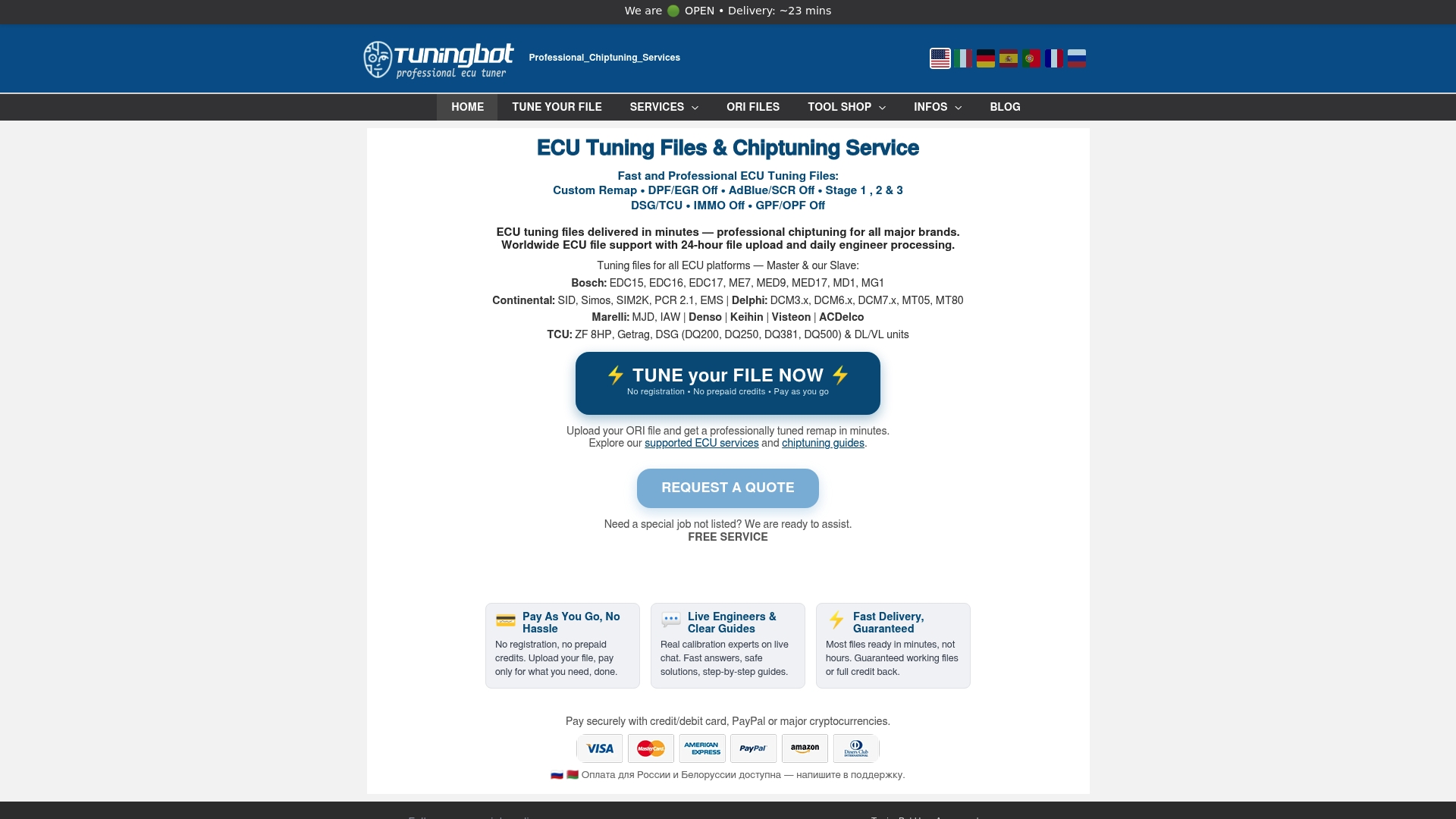
TuningBot propose des services professionnels de gestion des fichiers remapping pour les calculateurs ECU et TCU, destinés aux ateliers et aux véhicules tuners, quel que soit leur niveau de complexité stage, allant des calibrages diesel de niveau 1 aux configurations complètes de niveau 3 avec DSG tuning et réglages des composants antipollution. La plateforme prend en charge tous les principaux matériels ECU, notamment Bosch, Marelli, Delphi, Continental et Denso, et est entièrement compatible avec des outils tels que Alientech KESS3, Accordeur automatique, Magic Motorsport Flex, et PCMFlash. Les fichiers sont livrés par de vrais ingénieurs, sans crédits prépayés ni inscription requise. TuningBot's 2026 solutions mises à jour comprennent une couverture matérielle élargie et des protocoles d'étalonnage révisés pour l'ensemble des variantes d'ECU désormais prises en charge. Pour les ateliers qui ont besoin de fichiers remapping fiables, vérifiés par des ingénieurs et fournis dans des délais professionnels, commencez par le Couverture des services ECU pour confirmer la prise en charge, puis envoyez le fichier original via Reprogrammer le fichier.
FAQ
Qu'est-ce que la voiture remapping, en termes simples ?
La « Car remapping » désigne le processus consistant à « modifier » les données d’étalonnage stockées dans l’ECU d’un véhicule afin de modifier la manière dont le moteur gère le carburant, le calage de l’allumage et la pression boost. L’objectif est d’améliorer la puissance, le rendement énergétique, ou les deux, selon l’objectif tuning visé.
La voiture remapping entraîne-t-elle l'annulation de votre garantie ?
La plupart des garanties constructeur ne couvrent pas les dommages résultant de modifications apportées au calibrage de l'ECU, et les concessionnaires sont en mesure de détecter les fichiers modifiés à l'aide d'outils de diagnostic. Les modifications de niveau 1 (remaps) présentent le risque le plus faible en matière de garantie, mais les propriétaires doivent vérifier la position de leur constructeur avant de procéder.
Quelle puissance le moteur remapping peut-il fournir ?
Les gains de puissance dépendent du type de moteur et du niveau de réglage (stage). Les moteurs diesel et essence turbocompressés gagnent généralement entre 20 et 40 % au niveau 1, tandis que les réglages de niveau 2 et 3, associés à un matériel adapté, peuvent dépasser de plus de 60 % la puissance d'origine.
Quelle est la différence entre un boîtier remapping et un boîtier tuning ?
Le remappage modifie directement les données d'étalonnage internes du calculateur, tandis qu'un boîtier tuning intercepte les signaux des capteurs de manière externe afin de manipuler la réponse du calculateur. Le remappage offre des résultats plus précis et plus stables, car le calculateur fonctionne à partir de données correctement étalonnées plutôt que de données de capteurs falsifiées.
La voiture remapping est-elle homologuée aux États-Unis ?
La modification de l'ECU remapping visant à améliorer les performances sur des paramètres non liés aux émissions est généralement autorisée. Depuis janvier 2026, le ministère américain de la Justice ne poursuit plus pénalement les cas de falsification du système OBDII, mais les mesures civiles prévues par la loi sur la qualité de l’air (Clean Air Act) s’appliquent toujours aux modifications liées aux émissions sur les véhicules immatriculés pour la circulation routière.