
 EnglishEN
 ItalianoIT
 DeutschDE
 EspañolES
 PortuguêsPT
 РусскийRU
Bien configurer dès le départ votre atelier de tuning stage 1, c'est faire la différence entre un service qui renforce votre réputation et un service qui vous expose à des risques. La demande en matière de services professionnels liés aux calculateurs remapping et aux ateliers tuning ne cesse de croître, en particulier pour les services de « Stage 1 » bien structurés. La « Stage 1 » constitue le point d’entrée pour la plupart des clients, et c’est à ce stade que de nombreux ateliers gagnent des clients à long terme ou les perdent définitivement. Ce guide aborde les outils, les processus, les protocoles de sécurité et la structure opérationnelle dont vous avez besoin pour fournir des résultats « Stage 1 » cohérents et professionnels.
Table des matières
- Points clés à retenir
- Configuration de l'atelier de réglage de scène 1 : outils et matériel
- Le processus tuning étape par étape
- Produitiser votre service de Stage 1
- Dépannage et sécurité continue
- Mon avis sur ce qui distingue vraiment les bonnes boutiques des autres
- Améliorez votre atelier grâce aux fichiers professionnels tuning
- FAQ
Points clés à retenir
| Point | Détails |
|---|---|
| Stage 1 est uniquement logicielle | Aucune configuration matérielle n'est requise, ce qui en fait un service rapide et accessible pour les utilisateurs quotidiens. |
| La qualité de l'équipement détermine les résultats | L'utilisation d'appareils de diagnostic adaptés, d'outils d'enregistrement des données et d'interfaces de programmation des calculateurs est indispensable pour garantir la sécurité de l'opération execution. |
| Les vérifications de santé préalables à la mise en service sont obligatoires | Effacer les codes d'erreur et vérifier le niveau d'huile, les filtres et le système de refroidissement avant toute intervention sur un remap permet de protéger à la fois le moteur et votre réputation. |
| Définir la portée de votre service par écrit | Sans limites claires sur les exigences de carburant et les seuils de santé, les litiges clients et les réglages dangereux sont des résultats prévisibles. |
| La journalisation des données distingue les professionnels | La journalisation de base et post-réglage dans des conditions comparables est ce qui distingue un réglage vérifié d'une carte copiée. |
Configuration de l'atelier de réglage de scène 1 : outils et matériel
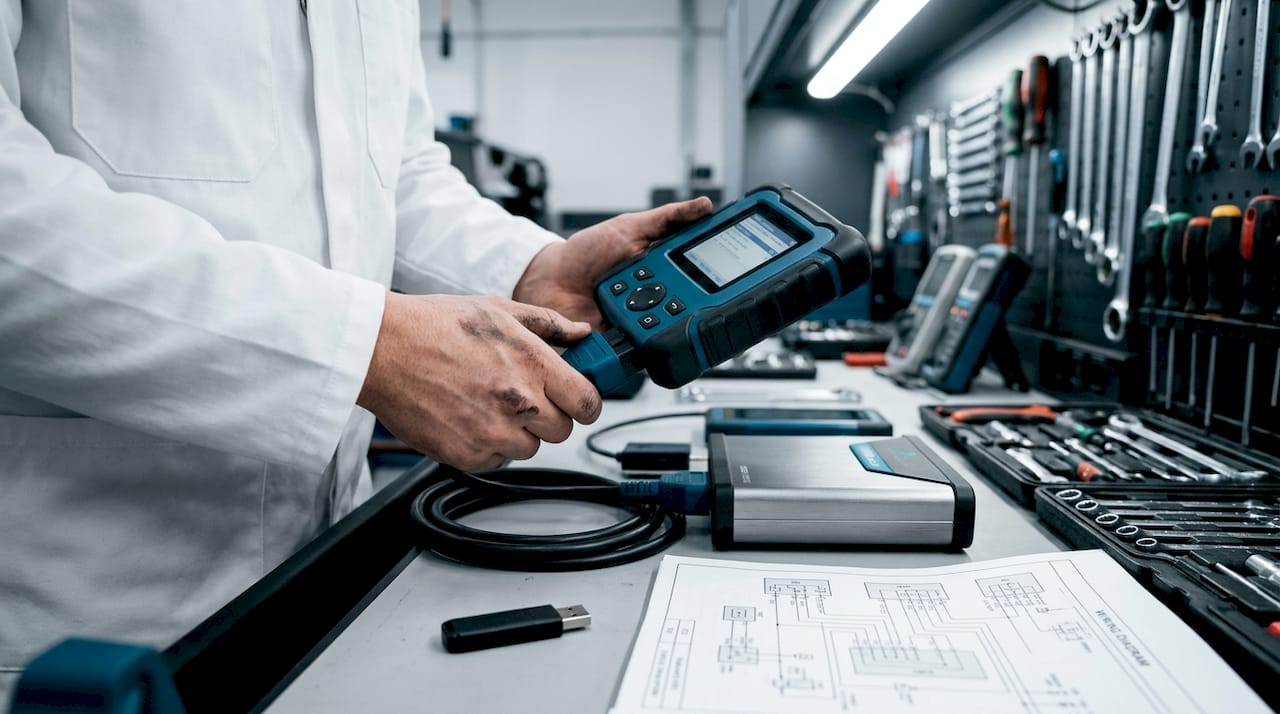
Un réglage de niveau 1 consiste en une mise à jour logicielle de l’ECU remap qui modifie l’allumage, la pression boost et la cartographie du carburant, tout en conservant l’intégralité du matériel d’origine. Cette simplicité est un atout en termes de cadence, mais elle ne réduit en rien les exigences techniques imposées à votre atelier. C'est votre parc d'outillage qui détermine si vous pouvez executer en toute sécurité et à grande échelle.
Outils de diagnostic et de programmation d'ECU
Votre scanner de diagnostic doit aller au-delà de la simple lecture des codes d'erreur. Une plateforme professionnelle de diagnostic complet du système doit prendre en charge le codage des calculateurs, les fonctions de reprogrammation le cas échéant, la cartographie topologique, les données en temps réel et les commandes bidirectionnelles. La capacité de test bidirectionnelle vous permet d’envoyer des commandes pour vérifier activement les composants, et non pas simplement de lire des données passives. Cette distinction est importante lorsque vous devez confirmer la réponse des injecteurs, le comportement du papillon des gaz ou la fonction de commande du boost avant et après un remap.
Votre chaîne d'outils de programmation doit prendre en charge les protocoles et les connexions modes requis par les plateformes d'ECU sur lesquelles vous travaillez, y compris les flux de travail OBD, banc d'essai, démarrage, J2534 et VCI, le cas échéant. La prise en charge des familles d’ECU courantes telles que Bosch, Continental, Delphi, Marelli et Denso est essentielle si votre atelier intervient sur plusieurs marques de véhicules.
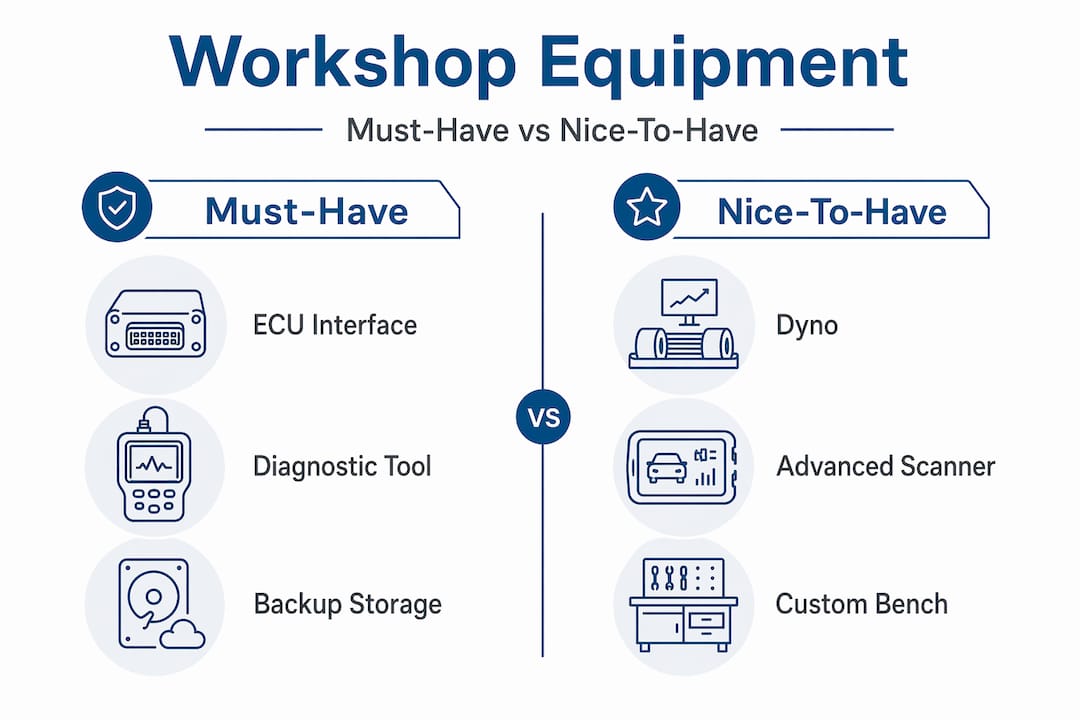
Comparaison d'équipement : indispensable vs. souhaitable
| Équipement | Catégorie | Coût estimé |
|---|---|---|
| Interface professionnelle de programmation d'ECU | Indispensable | de $800 à $2 500 |
| Scanner de diagnostic complet du système avec codage ECU | Indispensable | de $1 500 à $3 500 |
| Logiciel d'enregistrement de données avec surveillance du rapport air/carburant (AFR) et du cliquetis | Indispensable | de $200 à $800 par an |
| Sonde et manomètre AFR à large bande | Indispensable | $150 à $400 |
| Banc d'essai au rouleau | Un plus | De $15 000 à $60 000+ |
| Ordinateur portable tuning dédié, équipé d'un logiciel d'étalonnage | Indispensable | de $800 à $1 500 |
| Système de sauvegarde et de gestion sécurisée des données du fichier ECU | Indispensable | de $100 à $500 par an |
Un banc d'essai n'est pas strictement nécessaire pour les interventions de niveau 1 sur des véhicules de série, mais il améliore considérablement vos capacités de vérification et vous permet de proposer une nouvelle prestation facturable. Si votre budget est limité, privilégiez dans un premier temps l'achat d'un scanner de diagnostic et d'une interface de programmation. En attendant, vous pouvez effectuer un enregistrement des données sur route à l'aide de capteurs à large bande de qualité et d'un logiciel d'enregistrement.
Astuce de pro : Veillez à toujours conserver une sauvegarde du fichier d'ECU d'origine avant d'écrire tout réglage. Enregistrez-la dans un système de fichiers étiqueté et associé au client afin de pouvoir restaurer rapidement le calibrage d'origine si nécessaire.
Le processus tuning étape par étape
Le Stage 1 «Safe Stage 1 tuning» nécessite un étalonnage prudent des cartographies, l'enregistrement des données et la surveillance du cliquetis afin de maintenir les marges de sécurité tout au long du processus. C'est en sautant l'une des Stages de ce processus que les ateliers s'exposent à des problèmes, tant pour eux-mêmes que pour leurs clients.
Inspection préalable du véhicule. Recherchez tous les codes d'anomalie actifs et enregistrés. Résolvez tous les codes d'anomalie (DTC) avant de poursuivre. Vérifiez l'état de l'huile, le filtre à air, l'état des bougies d'allumage et le niveau du liquide de refroidissement. Un véhicule dont les bougies sont usées ou dont l'huile est périmée réagira de manière imprévisible à une augmentation de la pression d'admission boost ou de l'avance à l'allumage.
Enregistrement des données de référence. Exécutez le véhicule dans des conditions constantes et répétables et enregistrez le rapport air-carburant (AFR), les comptes de cliquetis, la température du liquide de refroidissement, la température de l'air d'admission et la livraison de couple. Cette référence vous donne un point de repère pour chaque comparaison post-réglage et signale toute faiblesse mécanique existante avant que vous ne touchiez à la calibration.
Appliquer un dosage initial prudent de remap. Commencez par des avances d'allumage modérées et des augmentations de pression modest boost. Ne chargez pas de carte de réglage agressive lors de la première écriture. Un profil de couple progressif réduit le risque de déclencher un cliquetis ou un mode de secours mode lors du premier cycle de conduite.
Journal des données sous charge immédiatement après la première écriture. Effectuez un essai routier contrôlé ou un test au banc d'essai avec le véhicule et enregistrez les mêmes paramètres que ceux de votre référence. Surveillez attentivement les valeurs cibles de l'AFR. Les moteurs à essence doivent maintenir un rapport lambda compris entre 0,85 et 0,90 à pleine charge. Tout écart vers un mélange pauvre ou tout épisode de cliquetis nécessite un réétalonnage immédiat avant la remise du véhicule au client.
Vérifier le contrôle de cliquetis et la livraison de couple. Vérifiez l'activité du capteur de cliquetis sur toute la plage de régime. Confirmez que la stratégie de retard du cliquetis de l'ECU n'avance pas activement l'allumage dans des conditions de fonctionnement normales. Un retard excessif sous charge indique que la cartographie est trop agressive pour le grade de carburant ou l'état du moteur.
Test routier final ou vérification au banc d'essai. Un minimum de deux passages à pleine charge dans des conditions contrôlées devrait confirmer des résultats stables et reproductibles. Documentez les chiffres de puissance et de couple si un dynamomètre est disponible, car ces données soutiennent la communication client et renforcent la confiance.
Scan des défauts après réglage. Effacer tous les DTC incidencels générés pendant le processus et confirmer qu'aucun nouveau défaut n'est présent à la livraison.
L'erreur la plus courante lors des travaux de niveau 1 consiste à appliquer une cartographie générique, copiée-collée, sans enregistrement des données. Une cartographie qui fonctionne sur un véhicule ne fonctionnera pas nécessairement sur un autre équipé du même model, en raison des différences de qualité de carburant, d'usure du moteur, de conditions ambiantes et de l'historique de calibrage propre à chaque calculateur.
Astuce de pro : Enregistrez au moins trois séries de données distinctes à pleine charge après le réglage et comparez-les pour vérifier leur cohérence. Les variations d'un essai à l'autre peuvent indiquer un problème mécanique que le remap a mis en évidence plutôt que provoqué.
Produitiser votre service de Stage 1
Il n'existe pas de norme universelle définissant ce qu'implique le Stage 1, ce qui signifie que votre atelier présente à la fois un risque et une opportunité. Le risque est l'ambiguïté menant à des litiges. L'opportunité est qu'un emballage de services clair et bien défini vous différencie des ateliers qui fonctionnent sans structure.
Définissez votre service de Stage 1 avec une documentation d'envergure qui couvre les points suivants :
- Exigence de qualité du carburant : Spécifiez l'indice d'octane minimum pour lequel le réglage est calibré. Une cartographie 98 RON sur du carburant 91 RON provoquera un cliquetis. Mettez ceci par écrit et obtenez la reconnaissance du client.
- Pré-régler les portes de santé : Énumérez les conditions qui doivent être remplies avant de procéder à l'intervention remap. Les codes d'erreur, les intervalles d'entretien et l'état du circuit de refroidissement constituent les principaux critères à respecter.
- Résultats de puissance attendus : Fournir une plage, pas une garantie. Les gains de puissance varient en fonction de l'état du véhicule, de la qualité du carburant et des conditions ambiantes.
- Divulgation de garantie : Énoncez clairement les implications pour la garantie du fabricant et vos propres conditions de garantie de main-d'œuvre.
- Exigences de maintenance post-réglage : Précisez les intervalles de vidange d'huile et les fréquences de contrôle des bougies d'allumage applicables après le modèle remap.
Proposer le Stage 1 sous forme de service rapide ne nécessitant aucun matériel offre un potentiel de débit, mais uniquement si des mesures de sécurité sont systématiquement mises en œuvre. Un service qui dure deux heures et génère entre $300 et $600 par véhicule n’est viable que si votre taux de défauts est proche de zéro. Cela exige une rigueur dans les processus, et pas seulement des compétences techniques.
Integrate votre flux de travail tuning à votre système de gestion d'atelier afin que chaque véhicule dispose d'un dossier associé contenant le fichier ECU d'origine, le journal de référence, le journal post-réglage et le contrat de service signé. Cette documentation vous offre une protection juridique et favorise la fidélisation de la clientèle lorsque le client revient pour une mise à niveau de niveau 2.
Dépannage et sécurité continue
Reconnaître les symptômes d'un réglage problématique à un stade précoce permet d'éviter que des problèmes de calibration mineurs ne dégénèrent en réclamations pour dommages moteur. Les problèmes les plus courants après un réglage et leurs indicateurs diagnostiques sont :
- Claquement et avance à l'allumage réduite L'ECU retarde l'allumage en charge. Enregistrez les données du capteur de cliquetis et comparez-les par rapport à la référence. Si le retard est excessif, réduisez l'avance à l'allumage dans la cartographie ou enquêtez sur la qualité du carburant.
- Activation du circuit mode : L'ECU limite le boost ou la puissance de sortie en raison du dépassement d'un seuil de défaut. Recherchez les codes d'anomalie (DTC) liés à la pression boost, au débitmètre d'air massique (MAF) ou à la position du papillon. Un fonctionnement en mode dégradé (mode) après un réglage de niveau 1 indique généralement une fuite au niveau de la boost, un capteur MAP défaillant ou une carte qui dépasse les seuils d'anomalie de l'ECU.
- Livraison de couple erratique : Une puissance de sortie incohérente sous charge indique souvent un problème d'alimentation en carburant. Vérifiez le rapport cyclique des injecteurs dans les données du journal et assurez-vous que la pression de carburant est stable sous demande.
- Température du liquide de refroidissement élevée : Une mélodie qui augmente la charge sur le moteur augmente également la charge thermique. Si les températures du liquide de refroidissement dépassent la plage de fonctionnement d'origine, le système de refroidissement nécessite une attention particulière avant que la mélodie ne puisse être considérée comme sûre.
Une journalisation adéquate des données et un profilage progressif du couple sont les clés pour éviter les défaillances imprévisibles et bâtir la confiance des clients au fil du temps.
La sensibilisation des clients fait partie intégrante de votre protocole de sécurité. Les clients qui comprennent les exigences relatives à la qualité du carburant et l’importance de respecter les intervalles d’entretien sont moins susceptibles de créer des conditions susceptibles de compromettre le réglage. Une fiche d’une page remise après le réglage, traitant du carburant, des intervalles de vidange d’huile et des points à surveiller, permet d’éviter la plupart des pannes courantes avant même qu’elles ne surviennent.
Sur le plan juridique, documentez tout. Un accord de service signé reconnaissant que le client comprend les implications de la garantie et les exigences en matière de carburant est votre première ligne de défense en cas de litige.
Mon avis sur ce qui distingue vraiment les bonnes boutiques des autres
J’ai analysé les résultats de nombreuses opérations tuning, et la tendance est constante. Les ateliers qui se forgent une solide réputation ne sont pas nécessairement ceux qui disposent des équipements les plus coûteux. Ce sont ceux qui considèrent chaque réglage comme un problème de données, et non comme un problème de temps.
J'ai constaté à maintes reprises que la pression pour remettre rapidement les véhicules en circulation conduit tuners à ne pas enregistrer les données de référence ou à appliquer des cartographies sans vérifier le comportement au cliquetis. Le réglage peut sembler correct lors d’un bref essai routier. Il peut même afficher de bons résultats sur un banc d’essai. Mais trois mois plus tard, le client revient se plaindre, et il n’y a aucune donnée d’enregistrement permettant de diagnostiquer la cause du problème ou de justifier le travail effectué.
La vérité inconfortable est que l'interprétation de l'AFR, des seuils de cliquetis et des courbes de couple en temps réel constitue la véritable compétence dans ce métier. L'interface de programmation de l'ECU n'est que le mécanisme de livraison. Les ateliers qui investissent dans le développement de cette littératie diagnostique et de calibration surperforment constamment les ateliers qui s'appuient sur des cartographies préétablies et espèrent le meilleur.
Mon autre opinion ferme : définissez la portée de votre service avant de prendre la première réservation. L'absence d'une norme universelle de « Stage 1 » n'est pas une technicité. C'est la source de la plupart des litiges clients que j'ai vus. Notez ce que vous ferez et ne ferez pas, ce que le client doit fournir et quelle est la plage de résultats attendus. Cette clarté est ce qui rend un atelier évolutif plutôt que constamment réactif.
Le marché est en croissance. La demande est réelle. Mais les ateliers qui tireront le plus de valeur de cette croissance seront ceux qui construiront des processus reproductibles et vérifiables dès le premier jour.
— Équipe technique de TuningBot
Améliorez votre atelier grâce aux fichiers professionnels tuning
La création d'un service professionnel de niveau 1 nécessite plus que les bons outils. Elle nécessite l'accès à des fichiers de calibration développés et vérifiés par des ingénieurs expérimentés. TuningBot fournit fichiers ECU remapping professionnels pour les ateliers proposant des services de niveau 1 et avancés tuning sur toutes les principales plateformes d'ECU, notamment Bosch, Continental, Delphi, Marelli et Denso. Vous pouvez consulter la liste des plateformes prises en charge dans le Couverture du service d'ECU TuningBot ou soumettre un fichier via Reprogrammer le fichier. Les fichiers sont mis à disposition rapidement, sans inscription ni crédits prépayés, et la plateforme est conçue pour s'adapter aux processus de travail des ateliers professionnels. Que vous souhaitiez étendre votre installation tuning pour voitures ou développer un atelier tuning de performance existant, TuningBot vous offre une ressource de calibrage fiable pour soutenir votre travail technique.
FAQ
Qu'est-ce qu'un atelier pour une reprogrammation Stage 1 nécessite ?
La mise en place d'un atelier de préparation de niveau 1 nécessite une interface de programmation d'ECU, un scanner de diagnostic complet doté d'une capacité bidirectionnelle, un logiciel d'enregistrement de données et un capteur AFR à large bande. Un ordinateur portable tuning dédié et un système de gestion de fichiers sécurisé sont également indispensables pour un fonctionnement professionnel.
Faut-il un banc d'essai pour le Stage 1 du tuning ?
Un dynamomètre n'est pas requis pour les travaux de Stage 1 sur le matériel d'origine, mais il améliore considérablement la précision de la vérification et ajoute un service facturable. L'enregistrement de données sur route avec des capteurs wideband de qualité est une alternative acceptable pour les ateliers qui débutent.
Comment vérifier qu'un réglage de type Stage 1 est sans danger ?
Pour garantir la fiabilité de la vérification, il est nécessaire d'enregistrer les données de référence et celles post-réglage dans des conditions comparables, tout en surveillant de près les cibles de rapport air-carburant (AFR), l'activité du capteur de cliquetis et la transmission du couple. Tout retard dû au cliquetis ou tout écart vers un mélange pauvre à pleine charge nécessite un recalibrage avant que le véhicule ne soit restitué au client.
Pourquoi les ateliers devraient-ils définir la portée du service du Stage 1 par écrit ?
Puisqu'il n'existe pas de norme universelle pour le Stage 1, les accords de service écrits couvrant les exigences en carburant, les seuils de santé et les plages de résultats de puissance protègent l'atelier sur le plan juridique et fixent des attentes précises pour le client dès le départ.
Quels sont les problèmes les plus courants liés au modèle tuning de niveau 1 ?
Les problèmes les plus courants sont le cliquetis et le retard d'allumage dus à des cartographies trop agressives ou à un carburant à faible indice d'octane, le mode « limp » du mode déclenché par des défauts du boost ou des capteurs, ainsi qu'une distribution irrégulière du couple causée par des problèmes d'alimentation en carburant ou d'injecteurs. Tous ces problèmes peuvent être diagnostiqués grâce à un enregistrement adéquat des données après réglage.