

 EnglishEN
 ItalianoIT
 DeutschDE
 EspañolES
 PortuguêsPT
 РусскийRU
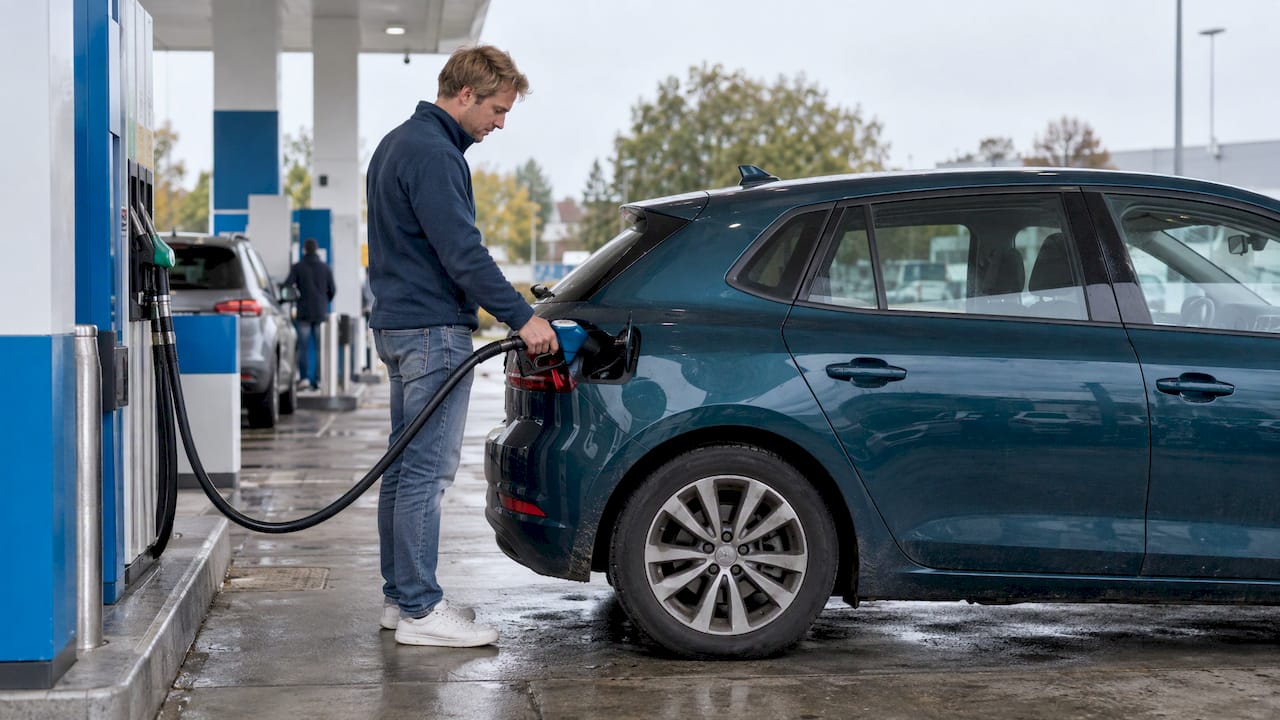
Fuel economy tuning is the recalibration of ECU maps (fueling, ignition timing, boost, torque limiters and gear selection) to reduce consumption under light and moderate load. Measured gains are modest and vehicle-specific, and they depend on the driver as much as on the file. Done as an individual calibration on a sound engine, an economy-focused file is a legitimate workshop service. This guide covers what changes in the maps, what testing has measured, how to scope a file, and which emissions rules to check before you quote a job.
TL;DR
- Economy gains come from cruise and part-load calibration (less fueling and boost under light load, better torque delivery at low rpm), not from higher peak power.
- Published results range from about 1-2% to double digits, but the large figures come from single-vehicle or heavily controlled studies. Quote customers a range, never a promise.
- A performance file usually raises consumption under load. An economy file and a Stage 1 file are different products with different targets.
- Driving style, tire pressure and maintenance can outweigh the file, so record the baseline before you flash.
- In the US, altering emissions-related calibration can fall under Clean Air Act tampering rules. Confirm the legal status of every file before you accept the order.
Table des matières
- What fuel economy tuning actually changes
- What testing has measured
- Economy file or Stage 1: choosing the right product
- A workflow that makes the result measurable
- Emissions rules to check before you quote
- Our perspective
- Order an economy calibration
- FAQ
- Sources
What fuel economy tuning actually changes
A factory calibration is a compromise between emissions certification, durability across climates and fuel qualities, warranty exposure, noise and cost. That leaves margin in several maps, and an economy calibration works on that margin rather than on peak output.
The parameters that matter most:
- Fueling under light load. On a turbocharged engine, trimming injected quantity and boost at part load lowers consumption at cruise. One UK remapping provider describes economy remaps as cutting fuelling and boost under light load, while performance maps raise torque and consumption under heavy load (Tuner Birmingham). Treat that as a description of the method rather than a measured result.
- Angle d'allumage. Advancing timing toward the knock limit on petrol engines improves thermal efficiency. This is where the best-documented gains sit, and it depends on fuel octane and charge temperature.
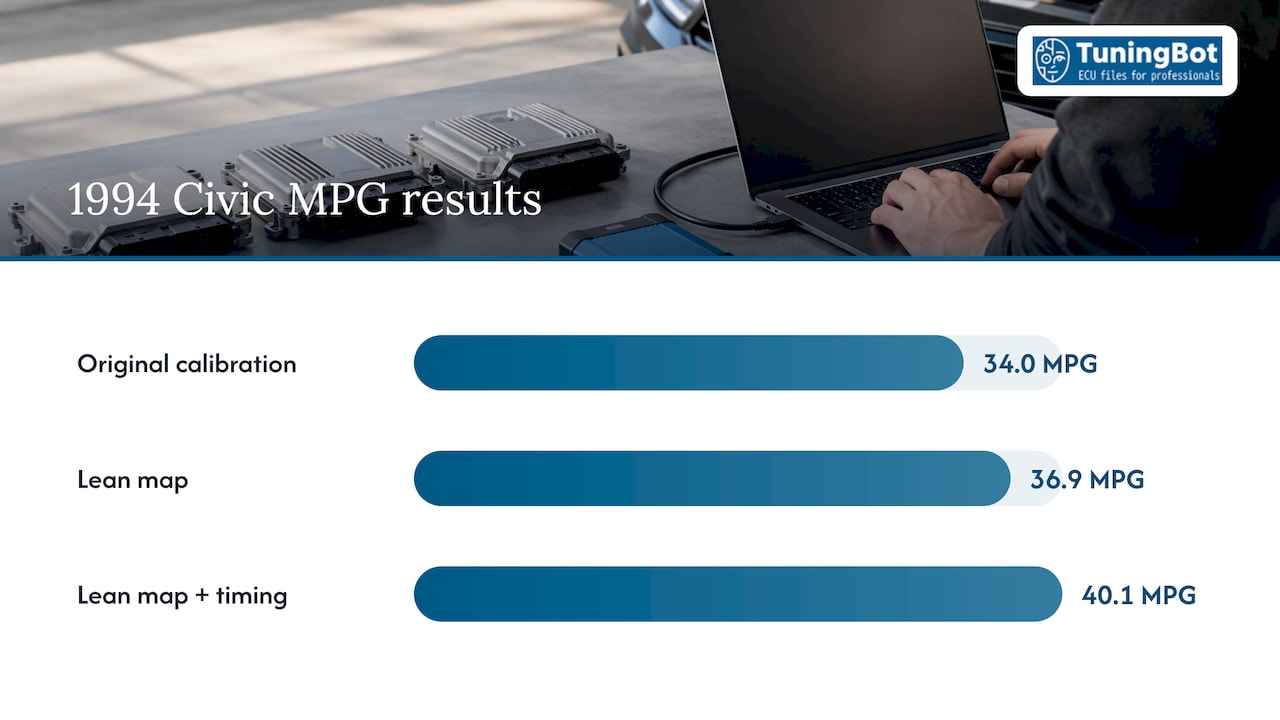
- Air-fuel ratio. Leaning the cruise map, as in the Oregon Tech work described below, reduces fuel use but needs knock and exhaust gas temperature monitoring.
- Torque request and pedal mapping. Smoother pedal response at low load reduces the unintended throttle input that drives consumption in everyday driving.
- Gearbox logic. Shift points and torque converter lock-up on automatic and DSG units determine how long the engine stays in an efficient rpm band. Gearbox calibration is a separate file from the engine map.
- Start & Stop and idle behavior. Strategy changes here affect urban consumption, in either direction depending on how the vehicle is used.
Each change has a downside if overdone. Leaner mixtures raise exhaust temperature, advanced timing raises knock risk, and reduced fueling at cruise can cause hesitation when the driver asks for torque. That is why the calibration has to be individual to the engine and its hardware.
What testing has measured
The evidence is mixed, and the spread is the useful part for anyone quoting a customer.
| Source | Vehicle and method | Result |
|---|---|---|
| Oregon Tech report, 2015 | 1994 Honda Civic DX with a programmable ECU | Lean map raised average economy from 34.0 to 36.9 MPG; adding advanced ignition timing raised it to 40.1 MPG |
| National Academies, 2011 | Engine with altered cylinder head and calibration | Fuel consumption reduction of about 5% against the original engine |
| NACFE, 2015 | Fleet trucks, programmable engine parameters | 5-8% over OEM defaults when tailored to operations; 3-5% from setting a few key parameters such as road speed and idle reduction |
| Car and Driver, 2011 | Plug-in fuel-saving gadgets on a Mazda 3 and a Jeep Grand Cherokee | +2% at 35 mph and +1% at 70 mph for the best-claiming device against a claimed 25% |
Two lessons follow. First, real calibration work on engine parameters has produced measurable gains in controlled settings: roughly 5% in the National Academies engine work, and 5-8% in the NACFE fleet report when parameters were tailored to the operation. Second, gadgets that claim to “condition” the ECU without changing the maps do not. Consumer Reports reached the same conclusion after 500 miles of testing a gas-saving device, noting that the vehicles already use computer-controlled ignition timing designed to meet emissions standards. The gap between a gadget and a calibrated file is the maps themselves.
The NRDC’s 2012 assessment is the cautious counterpoint: it found no engineering basis to conclude that reprogramming can deliver more horsepower and better fuel economy at the same time, and said any gain could come at the expense of power output or catalyst life (NRDC). That framing is useful for scoping. An economy file trades peak output for efficiency at cruise, and it should be sold as that.
Why the same file gives different results
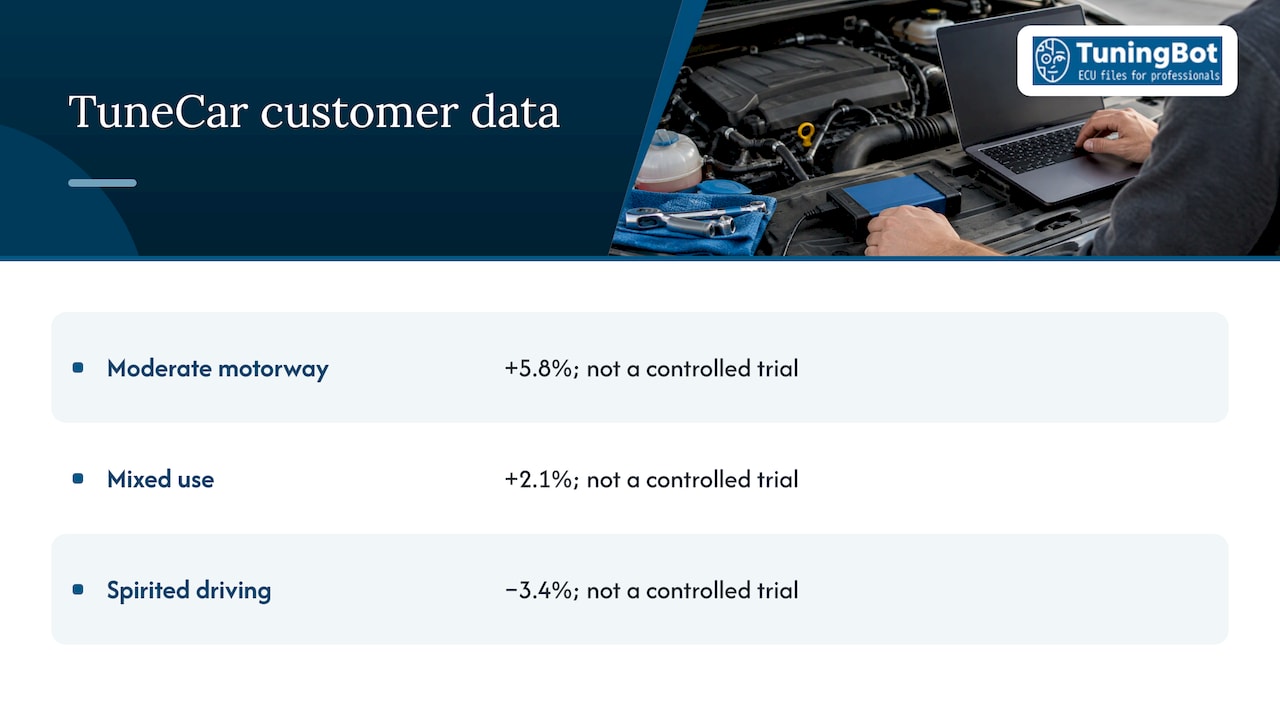
A 2026 data set from a UK tuning company reports average changes by driver type: about +5.8% for moderate motorway drivers, +2.1% for mixed use and -3.4% for spirited drivers (TuneCar Solutions). It is one company’s customer data rather than a controlled trial, but the pattern matches what workshops see: extra torque invites more throttle.
The NRDC also noted that the effect of reprogramming on mileage can be hard for a driver to perceive, given variation in driving skill, fuel, vehicle condition and road conditions. Customers who judge the result from a single tank will draw the wrong conclusion in either direction.
Economy file or Stage 1: choosing the right product
A Stage 1 performance file raises torque across the load range. Even when the customer drives gently, the larger torque request and fueling targets show up wherever the driver uses the additional output. A study of a 1.3 L Euro 6 diesel after a template Stage 1 modification found the fuel dose against requested torque had increased by about 8%, with NOx, PM and HC all higher than factory calibration (Combustion Engines, 2026). The authors attributed the result to a fixed-percentage template applied without regard to the specific injectors, turbocharger, cooling system or DPF.
That finding is the argument for individual calibration rather than against calibration. For workshops, the practical rule is to match the product to the customer’s goal:
| Customer goal | Suitable file | Utilisation typique |
|---|---|---|
| Lower consumption at cruise, smoother drivability | ECO Tuning (consommation et agrément) | Fleet and high-mileage vehicles, motorway commuters |
| More torque and power | Stage 1 or Premium Stage 2 | Performance customers who accept higher load consumption |
| Better automatic or DSG behavior | Reprogrammation complète de la boîte | Vehicles where shift logic keeps rpm high |
| Urban consumption | Start & Stop strategy review | Check local rules and customer preference first |
Notre Liste de prix officielle du tuning ECU shows ECO Tuning (Fuel Economy & Drivability) at €49.99 per file and Full Gearbox Tuning at €49.99 per file. Stage 1 Tuning (Performance) is also €49.99 per file.
A workflow that makes the result measurable
Customers judge fuel economy tuning by numbers, so build the numbers into the job.
- Check the baseline condition. Tire pressure, air filter, spark plugs, oil grade and wheel alignment affect consumption on their own. Fueleconomy.gov reports that aggressive driving can lower gas mileage by roughly 15% to 30% at highway speeds and 10% to 40% in stop-and-go traffic, which is larger than most calibration gains.
- Log a baseline. Record fuel use over a fixed route or at fixed speeds, plus the customer’s current average. Note ambient temperature and fuel brand.
- Read the original file and log the engine. Check long-term fuel trims, knock activity, boost control and exhaust gas temperature for hardware that already runs outside its margins.
- Specify the file. State the target (cruise economy, drivability, gearbox) and the hardware: injectors, turbocharger, intercooler, particulate filter, fuel grade.
- Flash, then verify the checksum. Checksum handling depends on the ECU family, and our Guide de correction checksum covers the workflow.
- Re-log under the same conditions. Compare against the baseline on the same route, not against memory.
- Review after a full tank cycle. Adjust parameters if trims, knock or temperatures moved in the wrong direction.
Inspecting the engine bay is part of step 3. A clean engine bay with safe steps makes oil seepage, damaged connectors and vacuum leaks visible before you flash. Leaks and a poor sensor signal distort fuel trims and would otherwise be blamed on the new map.
Emissions rules to check before you quote
Economy calibration changes the fueling and timing maps that emissions certification depends on, so legality depends on the market and on what the file touches.
In the United States, the EPA states that tampering with a vehicle’s emissions control system is illegal under the Clean Air Act, and that this includes replacing or altering software or calibrations that control engine operation, sometimes called “tuning” (EPA). The agency has pursued tuning companies: its 2018 consent agreement with Evans Tuning alleged the sale of at least 103 defeat devices, 98 of them performance tuning products (EPA). A January 2026 announcement reported that the Department of Justice will no longer criminally prosecute diesel deleting, while civil penalties under the Clean Air Act remain, at $45,268 per tampered engine and $4,527 per defeat device sale (Fleet Maintenance).
In Europe, tampering with emissions control systems is illegal and operators can be fined (Transport Engineer). In the UK, remapping is legal when the vehicle still complies with road-safety and emissions rules (Money.co.uk), and the RAC notes that remaps can affect warranties and insurance, and that vehicles must still pass MOT emissions requirements (RAC).
For workshop owners, the safe-use points are:
- Keep the emissions hardware and its monitoring functional on road vehicles. Confirm with the customer where and how the vehicle will be used before ordering any emissions-system file.
- Tell customers that a remap can affect the manufacturer warranty and that insurers expect disclosure.
- Keep a record of the original file so the vehicle can be returned to stock.
- Check local roadworthiness and emissions inspection rules for your market.
The Transport Engineer piece quotes a Ricardo executive warning that aftermarket remaps overfueling the full-load portion of the curve increase particulate production and DPF clogging. Economy calibration points the other way: less fueling under light load, with full-load fueling kept within the limits of the hardware.
Our perspective
Fuel economy is the part of ECU calibration where an individual file matters most. A fixed percentage applied to every map will raise fueling where the engine does not need it. A file written for one engine’s injectors, turbocharger, cooling and exhaust aftertreatment keeps the changes where the hardware can support them.
We design ECO Tuning (Fuel Economy & Drivability) files around cruise and part-load behavior: smoother torque delivery, fueling matched to demand and drivability that does not depend on heavy throttle. Our engineers work from the original file the workshop uploads, and the order specifies the vehicle, the ECU and the goal, so the calibration starts from the right base.
We recommend that workshops treat the result as measurable work. Log before and after, compare on the same route and report gains to the customer as a range tied to driving style. That is how an economy file earns repeat business.
Files are usually delivered in minutes, with no registration and no prepaid credits required. If a service is not technically possible, it is replaced by an alternative solution or credited to your account. Workshops can order one file or many, and engineers are available when a vehicle needs adjustment.
TuningBot Technical Team
Order an economy calibration
If you have a customer vehicle that suits an economy-focused calibration, téléverser le fichier d'ECU original and specify the target. Our ECO Tuning (Fuel Economy & Drivability) service is €49.99 per file, with Full Gearbox Tuning at €49.99 per file for automatic and DSG units. We support the major ECU and TCU families, including Bosch, Continental, Delphi, Marelli, Denso, Siemens, Keihin and ZF, and the main tuning tools, including Alientech KESS3, Autotuner, Magic Motorsport, CMD, Dimsport and PCMFlash.

See the full Liste de prix officielle du tuning ECU and tune now. For background on calibration methods, read our professional remapping guide et car remapping overview.
FAQ
Can ECU tuning improve fuel economy?
Yes, under the right conditions. Controlled work has measured roughly 5% from engine calibration changes in the National Academies research and 5-8% over defaults in fleet trucks, while a single-vehicle Oregon Tech study reached larger gains with lean and advanced-timing maps. Results depend on the vehicle, the file and how the vehicle is driven.
Does a Stage 1 tune increase fuel consumption?
It can, mainly under load. A Stage 1 file raises torque and fueling targets, and drivers tend to use the extra output. A Stage 1 file at steady cruise can behave differently, which is why an economy-focused file is the better match for customers whose goal is lower consumption.
How much fuel can a customer realistically expect to save?
Quote a range rather than a figure. Plug-in gadgets tested by Car and Driver delivered 1-2%, tailored parameter sets in fleets reached 5-8%, and one UK data set shows averages from -3.4% to +5.8% by driving style. Measure on a fixed route before and after.
Is fuel economy tuning legal?
It depends on the market and on what the file changes. In the US, the EPA treats altering emissions-related calibrations as tampering under the Clean Air Act. In the UK, remapping is legal when the vehicle still meets road-safety and emissions rules. Check your local regulations before accepting an order.
Sources
- Oregon Tech report: Methods to Increase Fuel Efficiency in Post-Production Vehicles
- National Academies: Assessment of Fuel Economy Technologies for Light-Duty Vehicles
- NACFE: Confidence Report on programmable engine parameters
- Car and Driver: Fuel-Saving Devices Debunked
- Consumer Reports: Gas Saving Devices
- NRDC assessment of ECU reprogramming
- Combustion Engines: Chiptuning impact on emissions in driving tests
- Fueleconomy.gov: Driving More Efficiently
- EPA: Tampering and Aftermarket Defeat Devices
- EPA: Evans Tuning, LLC Consent Agreement
- Fleet Maintenance: DOJ and diesel deleting civil penalties
- Transport Engineer: aftermarket engine tuning
- Money.co.uk: Car remapping
- RAC: What is remapping a car?
- Diamondbrite: clean engine bay guide