

 EnglishEN
 ItalianoIT
 DeutschDE
 EspañolES
 PortuguêsPT
 РусскийRU

EGR stuck open means the exhaust gas recirculation valve cannot close as required. Unwanted recirculation can cause rough running, hesitation, stalling or reduced power, but symptoms alone do not identify the failed component. Diagnosis must distinguish valve position, actual gas flow, electrical control and restrictions elsewhere in the system.
EGR stuck open: symptoms depend on the engine
An EGR system meters exhaust gas into the intake charge to influence combustion and emissions. Its operating schedule depends on engine type, temperature, load and the installed emissions strategy. It is incorrect to assume that every engine requests no EGR at idle or always closes it at high load.
Excess recirculation can destabilize combustion, but an open valve does not guarantee continuous flow under every condition: the pressure difference and the rest of the gas path also matter. Similarly, a closed-position signal does not independently prove that the valve seals.
On some applications, a valve that remains open produces an obvious idle complaint; on others, the strongest evidence may be an airflow discrepancy or a monitored fault. Black smoke, poor acceleration and increased consumption can have several causes. None is a reliable EGR diagnosis on its own.
Delphi’s EGR overview describes several valve types and their operation. Use it as background, then follow the diagnostic procedure for the actual engine rather than transferring one operating example to every vehicle.
Distinguish an open valve from other EGR faults
| Finding | Possible explanation | Required distinction |
|---|---|---|
| Position does not follow a supported command | Binding, actuator trouble, wiring or feedback fault. | A position discrepancy does not uniquely identify carbon deposits. |
| Position follows, but expected flow response is absent | Restricted passages, unsuitable pressure conditions or a measurement problem. | Valve movement is not a direct measurement of gas flow. |
| Flow appears present when closure is required | Incomplete sealing or an incorrect inferred-flow signal. | Check the physical path and the sensors used by the diagnostic strategy. |
| P0401 is stored | The monitor detected insufficient recirculation under its enabling conditions. | The code does not by itself condemn the valve. |
Reduced recirculation can increase engine-out NOx under conditions where EGR is intended to operate. It does not follow that every stuck-closed valve causes audible knock, or that a stuck-open valve always produces lower tailpipe NOx. Engine design, combustion stability and aftertreatment behavior affect the result.
Check deposits, actuation and the surrounding circuit
Soot and oil deposits can restrict passages or interfere with movement. Other possibilities include damaged gearing, failed actuation, wiring faults, poor connections or an incorrect feedback signal. Vacuum-operated systems add supply hoses, control valves and diaphragms to the diagnostic picture.
HELLA’s technical guide distinguishes system designs and describes pneumatic and electrical checks. Its application examples are not universal voltage, resistance or vacuum specifications.
Identify whether the engine uses high-pressure EGR, low-pressure EGR or a combination. Coolers, bypasses, throttles and pressure sensors differ between layouts. A fault in a related flap should not automatically be called a stuck EGR metering valve. For example, the descriptions for P00E3 et P00E4 concern an exhaust heat-exchanger bypass valve; confirm the vehicle-specific code interpretation.
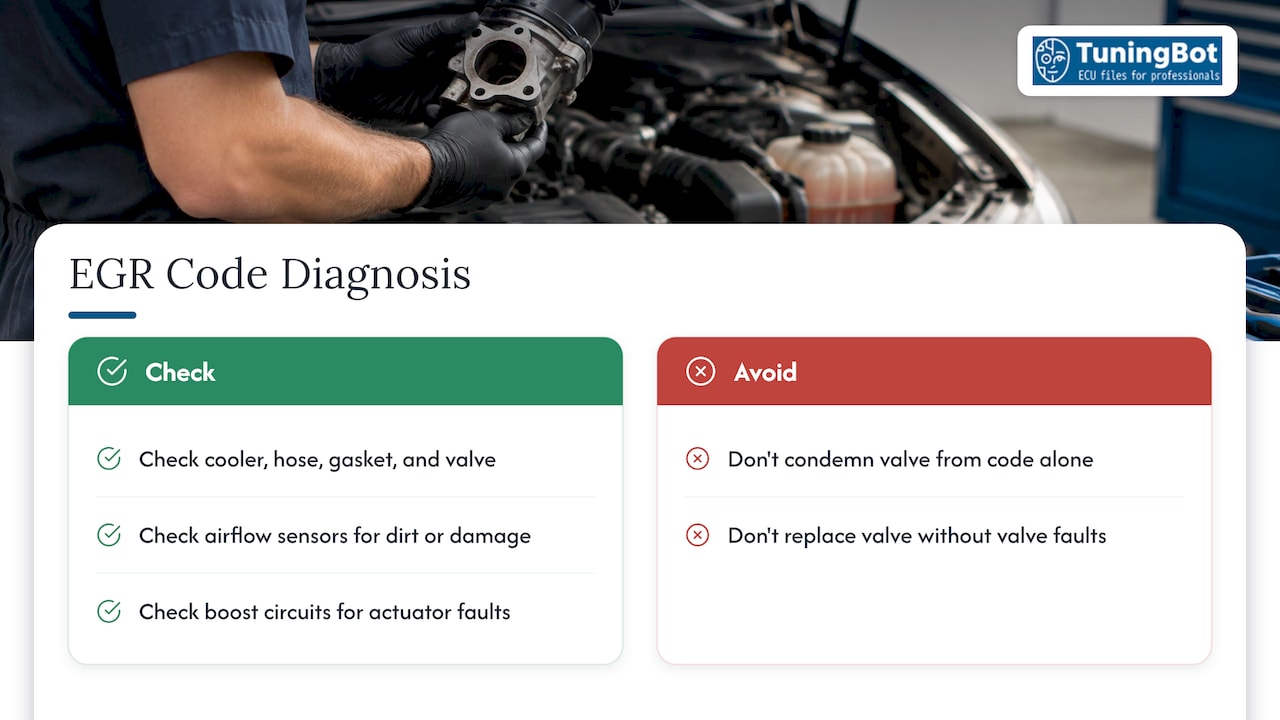
Build a diagnosis before removing parts
- Preserve the evidence. Record codes, their status, freeze-frame data and the conditions of the complaint before clearing anything.
- Identify the system. Use the engine code, wiring diagram and current service procedure to establish the relevant valve, sensors and flow route.
- Check supplies and connections. Test power, ground, wiring and vacuum where applicable using the specified method.
- Compare command and feedback. Use only supported actuator tests under their stated prerequisites. Confirm what the displayed percentage means and whether feedback is available.
- Assess flow independently. Evaluate the expected airflow or pressure response using the manufacturer’s criteria, then inspect restrictions or leakage where the evidence points.
Do not apply a fixed sequence of percentage commands, a universal engine speed or a direct battery feed to an unidentified actuator. Scan-tool output tests may be limited by temperature, engine state or other conditions. A missing response can reflect an unmet test prerequisite as well as a hardware fault.
Flow monitoring may use airflow, pressure or other information rather than a dedicated flow sensor. Check signal plausibility before treating a calculated flow value as a physical measurement. A valve can move normally while the cooler or passage remains obstructed.
Clean or replace according to the applicable procedure
Cleaning is appropriate only where the component manufacturer permits it and the diagnosed fault can be corrected that way. Do not force an electronic valve through its travel, immerse its electronics or copy a solvent, soaking time or compressed-air setting from a different engine.
The original Mercedes-Benz cleaning document et Cummins ISL instructions are application-specific references. Their procedures should not be generalized into a rule that every movable valve can be cleaned or every seized valve has the same repair route.
Address the cause of recurrent deposits or contamination where identified. Follow the specified gasket, fastener and cooling-system requirements. Perform adaptation or basic settings only where the replacement procedure requires them, then verify operation under the relevant monitor conditions. Clearing the warning light is not proof of repair.
Keep software work separate from mechanical repair
A manufacturer software update may be relevant when a service bulletin applies to the exact vehicle and symptom. Suppressing a fault code, however, does not restore a leaking valve, blocked cooler or failed actuator. A calibration change cannot physically seal a valve stuck open.
For wider context, the diesel NOx reduction guide discusses the surrounding emissions system. Changes must be assessed against the applicable vehicle and jurisdiction requirements; the EPA tampering guidance explains the U.S. framework. Diagnosis and restoration of correct operation remain distinct from disabling the system.
Questions fréquemment posées
Does an open EGR valve always cause exhaust flow?
No. Flow also depends on the pressure difference and the condition of the gas path. Valve position alone is not a direct measurement of recirculation.
Does P0401 prove the EGR valve has failed?
No. Insufficient-flow monitoring can be affected by restrictions, actuation problems or incorrect sensor information. Diagnose the circuit before replacing the valve.
Can a stuck EGR valve always be cleaned?
No. Cleaning must be permitted for the specific component and suitable for the diagnosed fault. Follow its procedure rather than forcing the mechanism or applying a generic solvent treatment.
Pour en savoir plus
The following retained references include general explanations and model-specific procedures. Use each within its stated application and publication context.
- TechASSIST Bulletin 01: The crucial role of the EGR valve
- Master Tech Prep: driveability faults in EGR systems
- AutoZone: Symptoms of a bad EGR valve
- HELLA: Electrical exhaust gas recirculation valve
- Samarins: EGR valve problems and testing
- Ancel: Faulty EGR valve
- HELLA: EGR valve product range
- TechASSIST EGR leaflet
- EGR valve and flap faults
- Underhood Service: Ford EGR-ESM diagnosis
- Service manual: EGR systems description
- Apex Technation: EGR system diagnosis
- Soot deposits and slag leads to premature wear
- NHTSA: MaxxForce EGR diagnostics