

 EnglishEN
 ItalianoIT
 DeutschDE
 EspañolES
 PortuguêsPT
 РусскийRU
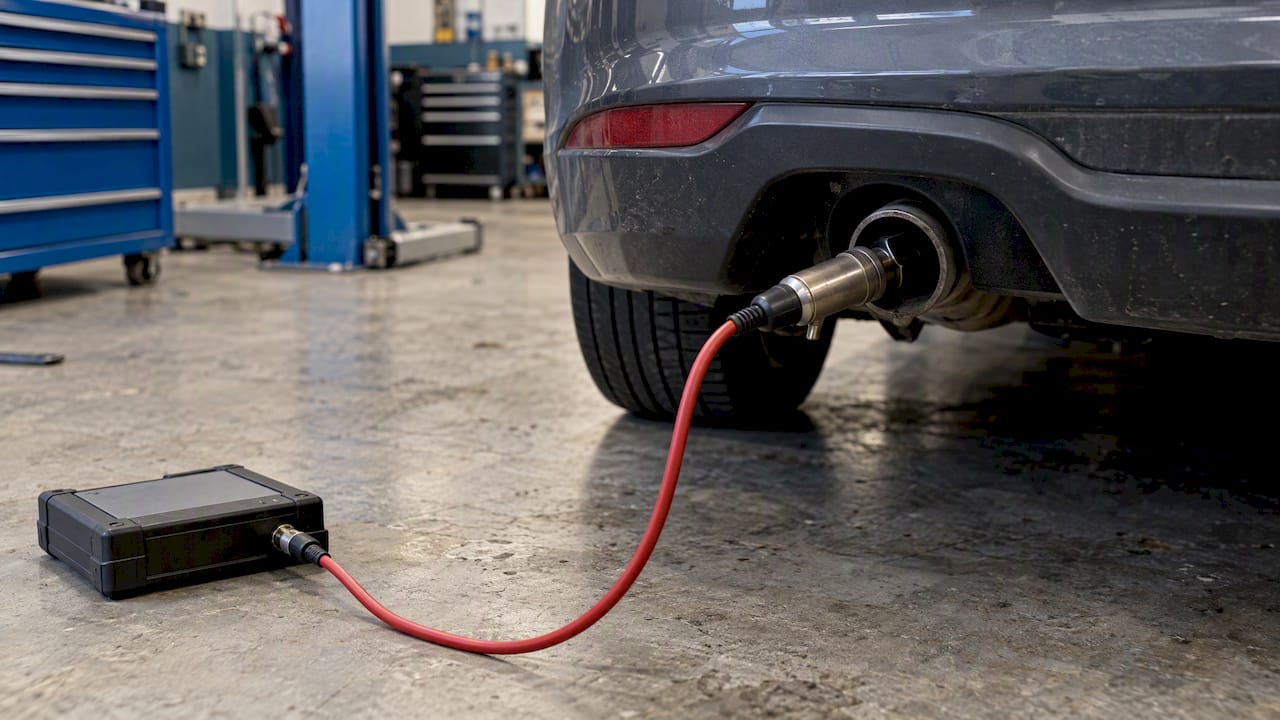
Air fuel ratio compares the mass of air with the mass of fuel. Lambda expresses that ratio relative to the stoichiometric requirement of the fuel being used. Understanding the distinction helps a workshop interpret sensor readings, select the correct display settings and assess fueling without copying a universal target table.
Air fuel ratio and stoichiometry
AFR is a mass ratio, not a volume ratio. An AFR of 14.7:1 means 14.7 units of air mass for one unit of fuel mass. Stoichiometric AFR describes the theoretical air requirement for complete combustion of a specified fuel; it is not a guarantee that all fuel burns completely in a real cylinder.
The retained AFR definition sheet provides introductory context. For a given fuel, a higher AFR is leaner and a lower AFR is richer. Comparing two fuels requires their separate stoichiometric values.
About 14.7:1 is a commonly used gasoline reference, not an exact value for every pump blend. Oxygenates and hydrocarbon composition change the actual requirement. Likewise, natural gas, diesel and ethanol blends should not be assigned a single universal value from a reference chart.
Convert between lambda and AFR
Lambda = AFR ÷ stoichiometric AFR. Conversely, AFR equals lambda multiplied by the relevant stoichiometric AFR. Lambda 1 is stoichiometric, below 1 is rich and above 1 is lean.
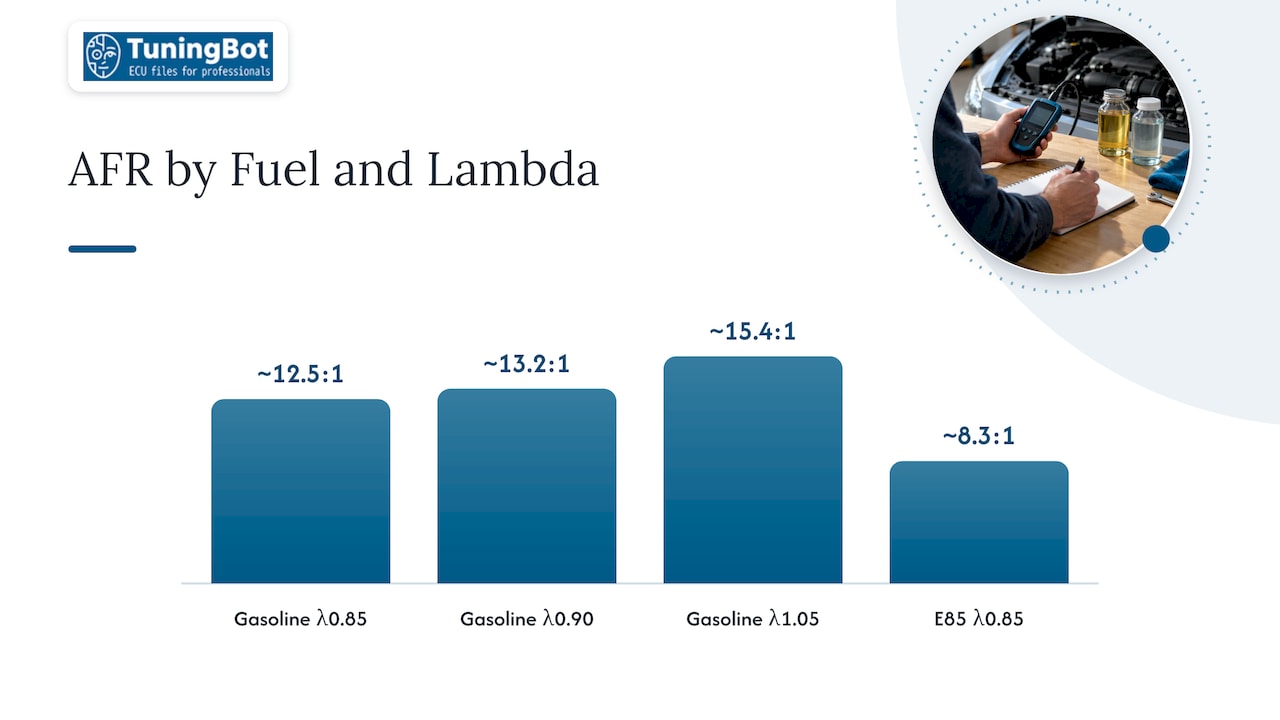
| Assumed stoichiometric AFR | Lambda | Calculated AFR |
|---|---|---|
| 14.7:1 | 0.85 | 12.50:1 |
| 14.7:1 | 0.90 | 13.23:1 |
| 14.7:1 | 1.05 | 15.44:1 |
| 9.8:1 | 0.85 | 8.33:1 |
These are arithmetic examples, not recommended engine targets. The 9.8:1 example is valid only when that stoichiometric constant is appropriate. The same lambda on two fuels indicates the same relative richness, not identical combustion temperature, knock tolerance or best-power behavior.
The original HPA AFR reference sheet remains useful for conversions. Treat its fuel values and operating examples as reference material rather than specifications for an unidentified engine.
Account for blend composition and display scaling
E85 is not a guarantee of exactly 85% ethanol in the tank. The U.S. Department of Energy’s E85 overview describes seasonal and geographic blend variation. That variation changes stoichiometric AFR and other fuel properties, so a fixed E85 AFR constant cannot describe every fill.
The retained NREL E85 handling handbook provides blend background. For calibration, record the fuel composition information actually available and how the ECU uses it. Our flex-fuel guide covers related checks.
Many wideband displays convert lambda into a gasoline-scaled AFR using a fixed constant. That is a display convention, not necessarily a faulty sensor reading. For example, lambda 0.85 can display about 12.5 on a 14.7 scale even when the engine runs an ethanol blend. Label the scale clearly and avoid confusing displayed gasoline-equivalent AFR with the fuel’s actual mass ratio.
Understand the sensor and controller
A conventional narrowband oxygen sensor is useful for detecting the transition around stoichiometry. It does not quantify a rich full-load mixture accurately. A compatible wideband sensor and controller support a broader measurement range, but the range and accuracy depend on the actual equipment.
Haltech’s sensor explanation introduces the distinction. Its illustrative ranges should not be applied to every product. The Bosch LSU 4.9 datasheet, for example, specifies that sensor’s operating range, controller requirements and environmental limits.
The sensor evaluates exhaust-gas conditions; it does not directly weigh the intake air and injected fuel. Misfire can leave oxygen in the exhaust and produce a lean indication even when insufficient fuel is not the cause. Exhaust leaks, pressure, sensor condition, installation and transport delay can also affect interpretation.
Check controller status and the logger’s analog scaling or digital channel definition. An incorrect voltage-to-lambda conversion can produce plausible but wrong numbers. The retained Performance Trends UEGO overview provides additional measurement context.
Closed loop does not mean stoichiometric only
Closed-loop fueling uses sensor feedback to correct toward a target. Open-loop operation lacks that active feedback correction for the relevant condition. Neither term, by itself, identifies the target richness or engine load.
A wideband-equipped ECU can support closed-loop control at rich targets and high load when its strategy allows it. Haltech’s O2-control documentation illustrates configurable enable conditions and correction limits. It is therefore incorrect to assume that all engines switch to open loop at full throttle.
Fuel trims must be interpreted with their operating region, learning state and allowed correction. A fixed percentage is not a universal fault threshold. Check fuel pressure, injector characterization, air measurement and sensor evidence before changing base tables to absorb an unexplained error.
Choose targets from the engine and operating strategy
Many gasoline systems with three-way catalysts operate near lambda 1 over relevant conditions. Other combustion concepts and operating modes differ. Under high load, the target depends on fuel, combustion design, thermal management, knock behavior, injection system and emissions requirements.
Leaner does not always mean hotter, and richer does not always mean safer. Temperature, combustion stability and emissions do not change monotonically with AFR. Excessive enrichment can impair combustion or introduce other problems, so a boost-based lookup table is not a universal protection strategy.
Diesel combustion is heterogeneous: a globally lean mixture can still contain locally rich regions that form soot. Overall lambda therefore cannot describe every cylinder region or replace smoke, thermal and pressure-related assessment. Avoid the blanket claim that every diesel operates lean in every mode.
Le lambda-target guide, spark advance guide et diesel smoke-limiter guide explain related calibration considerations. A requested lambda is a command; validate the delivered result under controlled, relevant conditions.
Keep the calibration record interpretable
Record the ECU software, fuel information, sensor/controller setup, AFR display constant, active corrections and test conditions. Compare target and measured lambda with the measurement delay understood. Diagnose unexpected deviations rather than assuming every lean indication needs more fuel.
Keep the original file and logs, verify the supported programming and checksum workflow, and document the checks completed. Confirm file-service scope using the current service information; measurement quality and vehicle validation remain essential parts of the job.
Questions fréquemment posées
What is the difference between AFR and lambda?
AFR is the air-to-fuel mass ratio. Lambda divides that ratio by the stoichiometric AFR of the fuel, so lambda 1 means stoichiometric.
Is 14.7:1 correct for every gasoline blend?
No. It is a common reference value. The actual stoichiometric ratio depends on the composition of the fuel.
Does gasoline-scaled AFR make an E85 wideband reading wrong?
Not necessarily. It can be a valid display convention derived from lambda. Identify the display constant and do not confuse it with the fuel’s actual mass ratio.
Must an engine run open loop at full load?
No. A suitable wideband-equipped system can use closed-loop control at rich targets and high load when its strategy allows it.
Does a lean sensor indication always mean insufficient fuel?
No. Misfire, exhaust leaks and measurement or scaling problems can affect the indication. Diagnose the cause before changing fuel delivery.
Sources and further reading
Related TuningBot reading
- Cartos d'injection : carburant, couple et calibration ECU
- Optimisation du couple diesel : 7 vérifications critiques
- EGR off : logiciel, matériel et limites du diagnostic
- Conversion speed density : capteurs, VE et validation
- Fiabilité de l'ECU tuning : pas de garantie 100% | TuningBot
- ECU ID Explained: Calibration ID & Identification Number
- DTC Codes Database – 17,000+ Fault Codes
- Édition des tables DTC : définitions, portée et vérification
- Correction du checksum du fichier ECU : un guide professionnel