

 EnglishEN
 ItalianoIT
 DeutschDE
 EspañolES
 PortuguêsPT
 РусскийRU
Lambda target tuning guide workflows should begin with the exact ECU fueling model, fuel type, injector characterization, fuel-pressure strategy and lambda feedback available on the platform. There is no universal lambda table shape or fixed target for idle, cruise, naturally aspirated full load or forced induction. A professional calibration first verifies the base fuel model and sensor data, then sets lambda targets from combustion, knock, exhaust-temperature, catalyst/aftertreatment and component limits for the actual engine.
TL;DR:
- Do not use universal lambda numbers such as 1.03–1.05 cruise or 0.78–0.85 boost as default targets.
- Verify injector/fuel characterization, fuel pressure, airflow/load model and sensor accuracy before interpreting target-versus-measured error.
- Closed-loop strategy, target-table structure and offset logic vary by ECU.
- A richer target is not automatically safer or more powerful.
- Validate representative operating points with ECU-specific logs rather than one fixed dyno/road sequence.
Lambda Target Tuning Guide: Fuel Model, Injectors and Closed-Loop Control
A lambda target is only one input to the fueling calculation. Some ECUs use VE-style models, others use airmass/torque models, injector models, pressure compensation and closed-loop corrections in different combinations.
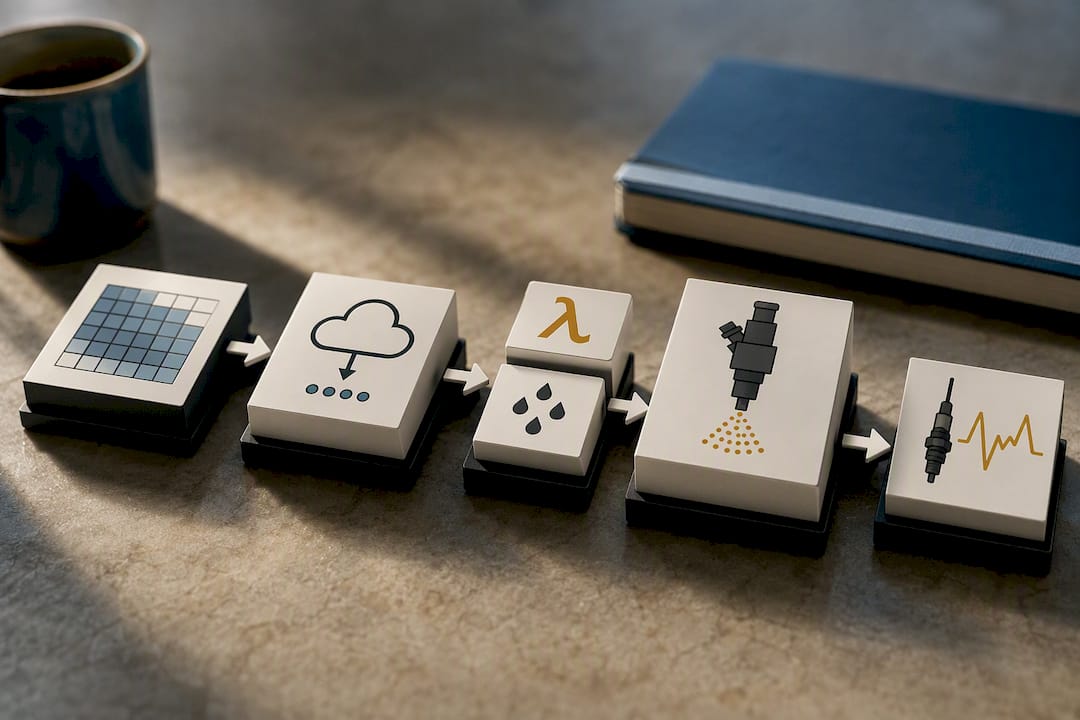
Lambda targets, offsets, enrichment tables and mode-specific targets vary widely by ECU. Do not assume every production ECU uses one base table plus one offset table or supports two switchable target maps.
Closed-loop fueling can correct mixture where the ECU enables it, but correction limits, sensor type, operating region and adaptation logic are platform-specific.
Before touching a single target cell, confirm:
- Injector flow data matches the actual injectors at your fuel pressure and not generic manufacturer defaults
- Injector deadtime tables cover your battery voltage range accurately
- Base VE calibration has been logged and corrected against a wideband across the full map
- Wideband sensor calibration and heater function are current and verified
Skip this step and every target change you make afterward is built on a guess.
Lambda Target Tuning Guide: Choosing Targets by Operating Zone
| Operating zone | What should determine the target |
|---|---|
| Au repos | Combustion stability, catalyst strategy, cam overlap, fuel type and closed-loop control. |
| Cruise / light load | Emissions/catalyst requirements, economy strategy, combustion stability and legal use. |
| Moderate load | Torque response, knock margin, exhaust temperature and fuel-system behavior. |
| NA full load | Best torque/power, knock, EGT, component temperature and fuel characteristics. |
| Forced induction | Boost/load, charge temperature, compression, fuel, ignition, knock/turbine/catalyst temperature and fuel-system capacity. |
| Deceleration | DFCO, catalyst-temperature management, drivability and emissions logic. |
Published lambda ranges are context for specific engine/fuel combinations, not universal starting maps.
Lambda Target Tuning Guide: Professional Calibration Workflow
Before writing a single target value, confirm your pre-checks are complete: injector characterization at operating fuel pressure, a corrected VE baseline, current wideband calibration, and functioning knock and EGT sensors logging in real time. Every step after this assumes those four items are solid.
- Identify the exact ECU fueling architecture, fuel type, injector/fuel-pressure model and active lambda-control strategy.
- Capture a matched baseline of commanded versus measured lambda plus relevant load, fuel-pressure, airflow, knock and temperature channels.
- Define the objective for each zone: emissions, economy, drivability, torque/power or component protection.
- Change only the active lambda target/enrichment strategy and interpolate smoothly where required.
- Validate progressively under repeatable conditions and compare target-versus-measured response.
- Stop and diagnose if measured mixture does not follow the command.
- Keep a known-good source/release revision and document the validated changes.
Related reading on reading ECU logs like a professional covers which channels matter most when you’re deciding whether a cell passed or failed.
Lambda Target Tuning Guide: Diagnosing Target vs Measured Lambda
When commanded and measured lambda diverge, first confirm sensor accuracy and time alignment, then inspect fuel delivery, airflow/load modeling, active target selection and closed-loop correction.
Next, check fuel delivery basics: rail pressure stability under load, injector deadtime accuracy, and any flow table errors that show up as a consistent offset across multiple cells rather than a single bad point. On the ECU side, verify closed-loop correction limits aren’t clipped, confirm which lambda table is actually active, and rule out an accidental offset table stacking on top of your base targets.
| Symptôme | Likely Cause | First Fix |
|---|---|---|
| Measured lambda won’t move despite target change | Injector flow/deadtime error or VE mismatch | Recheck injector data and VE baseline |
| Trims pinned at correction limit | Base fuel model off by more than closed-loop range | Widen correction limits only after confirming VE |
| Lambda tracks at idle but drifts under load | Sensor lag or exhaust reversion at sample point | Verify sensor placement and heater function |
| Knock present at a “safe” target cell | Charge temperature or timing, not fuel alone | Cross-check EGT and knock logs before richening further |
A dedicated fuel map tuning guide walks through VE correction in more depth if this is where you’re stuck. As a rule: fix the fuel model before you trust any target sweep built on top of it.
Lambda Target Tuning Guide: Common Calibration Mistakes
A common mistake is assuming every ECU uses a VE-based fuel model and trying to solve every lambda error in the target table.
- Assuming every ECU uses a VE-based fueling model.
- Copying lambda targets from another engine or fuel.
- Richening reactively to knock without diagnosing timing, boost/load, charge temperature or fuel quality.
- Ignoring fuel-pressure/injector limits when measured lambda goes lean under load.
- Using an inaccurate or poorly located lambda sensor as ground truth.
- Changing correction limits/adaptations to hide a base-model error.
Professional file review, like the checks built into TuningBot’s remapping workflow, exists precisely to catch these before a calibration goes out the door.
Lambda Target Tuning Guide: Workshop Priorities
A lambda target tuning guide should note that there is no universal lambda-tuning edit order, but the fuel model, sensors and hardware should be validated before using target-table changes to chase a measured error.
— Équipe technique de TuningBot
How TuningBot Supports Lambda Calibration Workflows
TuningBot can provide calibration files for supported ECU workflows where lambda/fueling strategy changes are available in the exact software.
For related technical context, use the verified Guide de réglage de la carte de carburant et ECU : Remappage pour les professionnels.
Before ordering, check Couverture des services ECU, le Liste de prix publique et Services de l'ECU.
Submit a supported source file through Reprogrammer le fichier after confirming the ECU and calibration objective.
This article stays technical and informational so commercial ECU/remap keywords remain concentrated on TuningBot’s service and order pages.
Sources and Further Reading
- EFI Mastery — Lambda Target Selection — external technical reference retained unchanged.
- HP Academy — Lambda Target Discussion — external technical discussion retained unchanged.
- Tractor performance guide — external reference retained unchanged.
- TuningBot — Fuel Map Tuning Guide — verified internal fueling reference.
- TuningBot — ECU Remapping for Professionals — verified internal calibration reference.
- TuningBot — ECU Service Coverage — verified internal coverage reference.
FAQ
What Is Lambda in ECU Tuning?
Lambda is the ratio of measured air-fuel ratio to the stoichiometric ratio of the fuel. Lambda 1.00 is stoichiometric; below 1 is richer and above 1 is leaner.
Is an 11.5:1 AFR Rich or Lean?
An AFR number cannot be classified safely without knowing the fuel’s stoichiometric AFR. Convert AFR to lambda first.
What Is the Lambda Tuning Method?
Lambda tuning defines mixture targets for operating regions, then validates whether the ECU fuel model and hardware achieve those targets. The exact tables and feedback strategy vary by ECU.
What Is a Good Lambda Reading for Cruise?
There is no universal cruise lambda. Catalyst requirements, fuel, combustion system, load, emissions strategy and economy objective determine the appropriate target.
When Should I Use a Lambda Offset Table Instead of Editing the Base Target?
Use an offset/correction table only if that exact ECU strategy is active and the calibration intent calls for a condition-specific correction.