

 EnglishEN
 ItalianoIT
 EspañolES
 PortuguêsPT
 FrançaisFR
 РусскийRU

Unter dem Begriff “TDI-Motor remapping” versteht man den Vorgang der Neuprogrammierung der ECU-Software eines Dieselmotors zur Anpassung von Parametern wie dem boost-Druck, dem Einspritzzeitpunkt und den Drehmomentgrenzen, um Leistung und Wirkungsgrad zu verbessern. Der branchenübliche Begriff für diesen Vorgang lautet „ECU-Kalibrierung“, wobei „remapping“ der in Werkstätten weit verbreitete Fachbegriff ist. Hersteller konservativ abstimmen um den weltweit unterschiedlichen Kraftstoffqualitäten und klimatischen Bedingungen gerecht zu werden, was bedeutet, dass die meisten TDI-Motoren das Werk mit erheblichem ungenutztem Potenzial verlassen. Ein „Stage 1“-Tuning an einem 2,0-TDI-Motor liefert in der Regel 30–50 PS und 60–90 Nm an zusätzlichem Drehmoment ohne jegliche Hardware-Änderungen. Professionelle Standards, einschließlich IMI-akkreditierter Kalibrierungsverfahren, sind die Grundvoraussetzung für den sicheren und zuverlässigen Betrieb des TDI-Motors tuning.
Inhaltsverzeichnis
- Was ist der TDI-Motor remapping und wie funktioniert er?
- Leistungs- und Effizienzsteigerungen durch einen TDI remap
- Sicherheit, Zuverlässigkeit und Risiken des TDI-Motors remapping
- Wie schneidet das Modell remapping im Vergleich zu den tuning-Boxen und Hardware-Modifikationen ab?
- So gehen Sie vor, um einen TDI remap zu erwerben
- Wichtige Erkenntnisse
- Die Einschätzung des technischen Teams von TuningBot zum TDI remapping
- Die ECU-tuning-Dienstleistungen von TuningBot für TDI- und Diesel-Plattformen
Was ist der TDI-Motor remapping und wie funktioniert er?
Das ECU-Remapping schreibt die im Motorsteuergerät eines Fahrzeugs gespeicherten Logiktabellen neu. Die ECU steuert alle wichtigen Motorfunktionen: den boost-Druck des Turboladers, die Kraftstoffeinspritzmenge und den Einspritzzeitpunkt, Drehmomentbegrenzer, Drosselklappen-Reaktionskurven sowie rev limiters. Eine Änderung dieser Werte verändert das Verhalten des Motors unter Last.
Der Prozess folgt einer definierten Reihenfolge:
- Gesundheitscheck vor remap. Ein Techniker sucht mit einem Diagnosewerkzeug nach vorhandenen Fehlercodes und überprüft den Zustand des Turbos, der Einspritzdüsen und des AGR-Systems. Das Remapping eines mechanisch kompromittierten Motors beschleunigt die Beschädigung.
- ECU-Daten lesen. Die Original-ECU-Datei wird über den OBD-Anschluss oder – bei neueren Fahrzeugen – über einen Bench- oder Bootzugang (Boot-mode) mit Tools wie Alientech KESS3 oder AutoTuner eingelesen. Diese Datei bildet die Grundlage für alle Kalibrierungsarbeiten.
- Erstellung benutzerdefinierter Karten. Ein Kalibrator verändert die entsprechenden Datentabellen innerhalb der Binärdatei. Ladedruckkennfelder, Einspritzkennfelder, Drehmomentmanagement-Tabellen und Drosselklappenkennfelder werden so angepasst, dass sie als System zusammenwirken.
- Dateiüberprüfung und -schreibung. Die modifizierte Datei wird auf Checksum-Integrität überprüft, bevor sie zurück in das Steuergerät geschrieben wird. A remap file-Kalibrierung Ein Fehler an diesem stage kann dazu führen, dass das Fahrzeug nicht anspringt oder die Steuereinheit beschädigt wird.
- Probefahrt und Validierung. Das Fahrzeug wird unter Last gefahren, um zu bestätigen, dass die Kalibrierung im gesamten Drehzahlbereich wie erwartet funktioniert.
Die vollständiger remapping-Prozess Das Auslesen und Beschreiben des Steuergeräts dauert 5 bis 30 Minuten, hinzu kommen 1 bis 3 Stunden für die Diagnose und die Probefahrt. Diese Gesamtzeit verdeutlicht, wie wichtig die Validierung ist – es geht nicht nur um die Bereitstellung der Dateien.
Pro-Tipp: Fordern Sie immer eine Kopie der ursprünglichen ECU-Datei an, bevor ein Update durchgeführt wird. Sollte etwas schiefgehen, dauert die Wiederherstellung der Werkskalibrierung nur wenige Minuten.

Das Remapping unterscheidet sich grundlegend von tuning-Plug-in-Geräten. Ein tuning-Gerät fängt die Sensorsignale zwischen dem Steuergerät und den Motorkomponenten ab und veranlasst das Steuergerät so, mehr Kraftstoff zuzuführen oder boost. Remapping steuert die ECU-Logik direkt um, was bedeutet, dass Sicherheitsstrategien, Drehmomentmanagement und Schutzgrenzwerte alle Teil der modifizierten Kalibrierung sind. Das ist ein struktureller Unterschied, kein marketingtechnischer.
Leistungs- und Effizienzsteigerungen durch einen TDI remap
Ein „Stage 1 remap“ sorgt bei den meisten modernen TDI-Motoren für messbare Leistungssteigerungen, ohne dass dabei Hardware verändert werden muss. Die Leistungssteigerungen variieren je nach Hubraum und Grundleistung, das Muster ist jedoch plattformübergreifend einheitlich.
| Motor | Aktie Macht | Typische Remap-Verstärkung | Typischer Drehmomentzuwachs |
|---|---|---|---|
| 1.6 TDI | 90–115 PS | 20–35 PS | 40–60 Nm |
| 2.0 TDI | 115–150 PS | 30–50 PS | 60–90 Nm |
| 3.0 TDI | 200–250 PS | 40–80 bhp | 80–120 Nm |
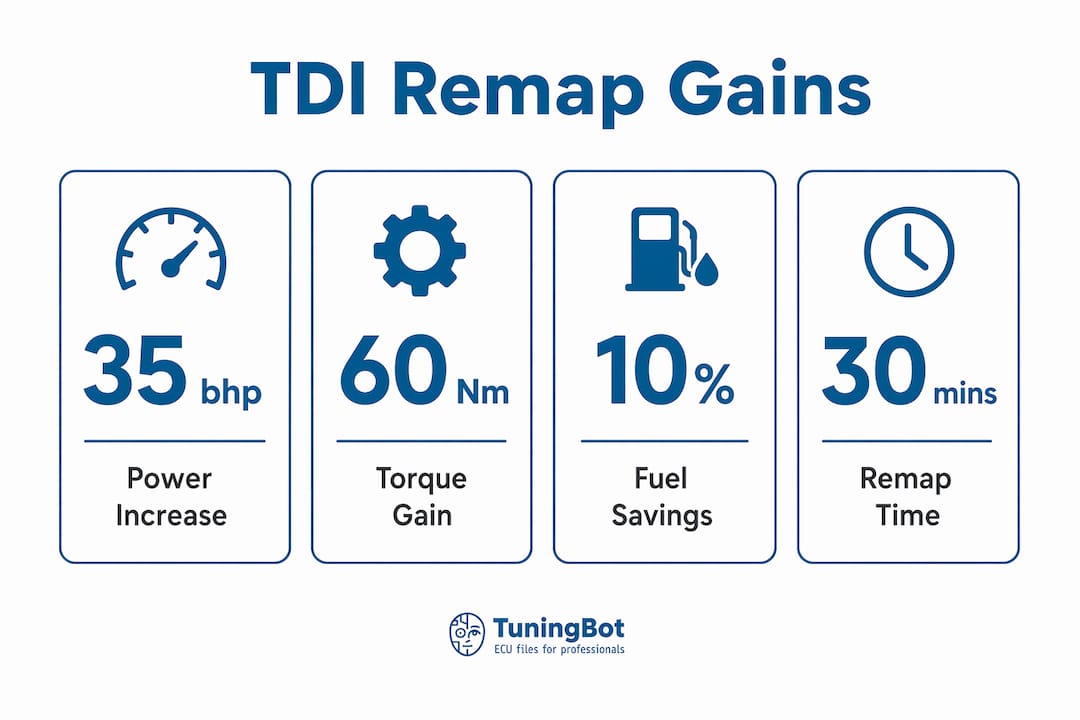
Für die meisten Fahrer sind die Drehmomentzuwächse wichtiger als die Spitzenleistungswerte. Dieselmotoren entwickeln ihr bestes Drehmoment im mittleren Drehzahlbereich, typischerweise zwischen 1.500 und 3.000 U/min. Ein remap, der das Drehmoment in diesem Bereich erhöht, sorgt dafür, dass sich das Fahrzeug beim Überholen, beim Einfädeln auf die Autobahn und beim Ziehen von Anhängern deutlich kraftvoller anfühlt. Die Leistungsangaben auf dem Papier verbessern sich zwar, aber was man tatsächlich spürt, ist das Ansprechverhalten im jeweiligen Gang.
Zu den wichtigsten Vorteilen, die bei TDI-remapping-Anwendungen genannt werden, gehören:
- Verbesserte Drosselklappenreaktion. Die Kennlinie der Drosselklappe des Steuergeräts wird angepasst, um die Verzögerung zwischen Pedalbetätigung und Turbo-Ansprechverhalten zu reduzieren.
- Besserer Kraftstoffverbrauch bei Reisegeschwindigkeit. Optimized fueling and turbo management reduce the amount of fuel needed to maintain highway speeds.
- Stronger mid-range torque. The torque curve is reshaped to deliver more pull between 1,800 and 3,000 RPM.
- Smoother power delivery. Torque limiters that cause flat spots in the stock map are raised or removed, producing a more linear power curve.
Fuel economy improvements are real but conditional. Drivers who use the extra torque aggressively will see little change in consumption. Drivers who use the improved mid-range torque to shift earlier and cruise at lower RPM often report measurable gains at the pump.
The same principles apply to related diesel platforms. CDTI engine remapping on Vauxhall and Opel engines, dCi engine remapping on Renault diesels, and TDCi engine remapping on Ford diesel applications all follow the same ECU calibration logic. The ECU hardware and software architecture differ by manufacturer, but the process of reading, modifying, and rewriting calibration tables is consistent.
Sicherheit, Zuverlässigkeit und Risiken des TDI-Motors remapping
A professional remap does not damage engines. A poor remap does. The distinction matters because the risks are real and the consequences are expensive.
The primary failure modes from bad remapping are:
- Excessive exhaust gas temperatures (EGT). Over-fueling raises EGT beyond safe limits, accelerating wear on the turbocharger, DPF, and exhaust valves.
- Injector over-fueling. Pushing injectors beyond their rated duty cycle shortens their service life significantly.
- Turbo overspin. Raising boost beyond the turbo’s mechanical limit causes bearing failure, often without warning.
- Hardware fatigue from generic files. Off-the-shelf remap files may cause high exhaust gas temperatures that lead to hardware fatigue, and the damage often goes unnoticed until component failure occurs.
Preserving emissions equipment is equally important. Mild Stage 1 remaps of 10–15% output gains are safe for daily use when emissions equipment like the DPF and AdBlue system remains intact. Removing or bypassing these systems may be legal in some motorsport contexts but creates compliance and reliability issues for road vehicles.
Custom maps account for local fuel quality, vehicle condition, and intended use. Generic maps risk injector and turbo damage because they apply aggressive fueling and boost targets without knowing the vehicle’s actual condition or the fuel quality available in the region.
Pro-Tipp: Ask your tuner whether the map was written specifically for your vehicle’s ECU hardware version and mileage, or whether it is a generic file applied to your car. The answer tells you everything about the quality of the work.
IMI accreditation is the recognized professional standard in the UK tuning industry. Globally, the equivalent benchmark is a tuner who can demonstrate custom calibration work, dyno testing, and EGT monitoring during the tuning process.
Wie schneidet das Modell remapping im Vergleich zu den tuning-Boxen und Hardware-Modifikationen ab?
Remapping and tuning boxes both increase power, but they operate at different levels of the system.
| Methode | Wie es funktioniert | Safety strategies | Customization |
|---|---|---|---|
| ECU remap | Rewrites ECU logic tables directly | Full, integrated into the map | High, tailored to vehicle and use case |
| Tuning box | Intercepts sensor signals | None, ECU receives false data | Low, preset modules |
| Hardware der Stage 2 | Remap plus upgraded hardware | Remap updated for new parts | Highest, requires full recalibration |
Remapping rewrites ECU logic rather than emulating signals, which allows the calibrator to include safety limits and protection strategies that tuning boxes cannot provide. A tuning box that raises boost by sending false MAP sensor data to the ECU bypasses the ECU’s own protection logic entirely.
Stage 1 remapping works within the factory hardware limits. Stage 2 tuning combines a remap with hardware upgrades such as a larger intercooler, uprated injectors, or a performance exhaust. The remap is then recalibrated to match the new hardware’s capabilities. Effective remaps tailor power delivery for specific uses like towing or motorway driving in ways that plug-in modules cannot replicate.
For enthusiasts running TFSI, TSI, or GTDI petrol engines, the same ECU calibration principles apply. TFSI engine remapping on Audi and Volkswagen Group petrol turbos and GTDI engine remapping on Ford EcoBoost engines follow identical processes. The calibration targets differ because petrol engines use different fueling and ignition strategies, but the ECU read, modify, and write workflow is the same.
So gehen Sie vor, um einen TDI remap zu erwerben
Getting a quality remap requires preparation and clear communication with your tuner. Follow this sequence to protect your investment:
- Define your goal. Daily commuting, towing, track days, and motorway cruising each require a different torque curve shape. Tell your tuner exactly how you use the vehicle.
- Complete a mechanical health check. Confirm the turbo, injectors, EGR valve, and DPF are all serviceable before booking. A remap on a worn turbo accelerates its failure.
- Verify the tuner’s credentials. Ask for evidence of IMI accreditation, custom calibration capability, and dyno or road testing procedures. Request customer references for the same engine platform.
- Confirm the ECU reading method. OBD, bench, or boot-mode access each carry different risk profiles. Your tuner should explain which method applies to your vehicle and why.
- Review the completed map. A professional tuner will show you before-and-after data: boost targets, torque curves, and EGT readings from the test drive.
- Post-remap diagnostics. Run a fault code scan after the remap is complete. A clean scan confirms the ECU accepted the new calibration without generating errors.
Verständnis what a remap file contains helps you ask better questions and evaluate the quality of the work. The calibration file is not a single number. It is a set of multi-dimensional tables that govern every aspect of engine behavior across load and RPM.
For workshops and professional tuners, TuningBot provides calibrated ECU files for TDI, dCi, CDTI, TDCi, and other diesel platforms, with support for Bosch, Continental, Delphi, and Marelli ECU hardware. The Leitfaden zu professionellen remapping-Techniken covers the full calibration workflow for workshop use.
Wichtige Erkenntnisse
TDI engine remapping is the most direct method for extracting the performance and efficiency that manufacturers deliberately leave unused in factory ECU calibrations.
| Punkt | Einzelheiten |
|---|---|
| Definition of remapping | ECU remapping rewrites factory calibration tables for boost, fueling, and torque management. |
| Typical Stage 1 gains | A 2.0 TDI gains 30–50 bhp and 60–90 Nm without hardware changes. |
| Safety depends on quality | Custom maps written for your specific vehicle and fuel quality prevent injector and turbo damage. |
| Remap vs tuning box | Remapping rewrites ECU logic with integrated safety strategies; tuning boxes only intercept sensor signals. |
| Process timeline | ECU read and write takes 5–30 minutes; full diagnostics and testing adds 1–3 hours. |
Die Einschätzung des technischen Teams von TuningBot zum TDI remapping
The most common mistake we see is treating remapping as a commodity purchase. Enthusiasts compare prices, pick the lowest number, and then wonder why the car feels no different or, worse, develops a fault three months later. A remap is a calibration service. The price reflects the engineer’s time, the quality of the tooling, and the depth of the testing. Cutting that cost cuts all three.
The second mistake is remapping a vehicle that needs maintenance. A turbo with worn bearings will not survive a boost increase. Injectors at 80% efficiency will be pushed past their limit by a fueling map written for healthy hardware. The remap does not cause the failure. The failure was already waiting. The remap just accelerates the timeline.
What actually works is straightforward: define your use case, prepare the vehicle mechanically, choose a tuner who writes custom files and tests them properly, and communicate clearly about how you drive. A remap calibrated for motorway cruising and towing looks different from one calibrated for spirited driving. Both are valid. Neither is interchangeable.
TDI remapping done correctly is one of the highest-value modifications available for a diesel vehicle. The gains are real, the process is well-established, and the risks are manageable when the work is done by someone who knows the platform. Approach it as a technical upgrade that requires care, and it will deliver exactly what it promises.
— TuningBot Technisches Team
Die ECU-tuning-Dienstleistungen von TuningBot für TDI- und Diesel-Plattformen
TuningBot provides professional ECU remapping files for TDI, dCi, CDTI, TDCi and many other diesel platforms. Every file is calibrated by engineers with direct knowledge of the ECU hardware, diesel torque strategy, boost control, fuel system limits and emissions-related safety logic.
Workshops and individual tuners can upload an ECU file directly through TuningBot with no registration and no prepaid credits required. Pricing is clear through the public ECU-Tuning-Preisliste, and supported ECU/vehicle combinations can be checked through the ECU-Service-Abdeckung page before starting a job.
TuningBot supports major ECU brands including Bosch, Continental, Delphi and Marelli, and works with tools such as Alientech KESS3, AutoTuner and Magic Motorsport. For diesel platforms, the service range includes Stage 1 and Stage 2 remapping, DPF Off, EGR Off und DSG/TCU tuning across supported applications.
FAQ
Was ist der TDI-Motor remapping, einfach ausgedrückt?
TDI engine remapping is the process of rewriting the ECU’s software to adjust boost pressure, fueling, and torque limits beyond the conservative factory settings. The result is more power, better torque, and often improved fuel efficiency.
Wie viel Leistung bringt ein TDI remap zusätzlich?
Ein remap der Stage 1 an einem 2,0-TDI-Motor sorgt in der Regel für eine Leistungssteigerung um 30–50 bhp und ein um 60–90 Nm höheres Drehmoment, ohne dass dafür Hardware-Änderungen erforderlich sind. Größere 3,0-TDI-Motoren können um 40–80 bhp an Leistung gewinnen.
Ist der TDI-Motor remapping für den täglichen Gebrauch geeignet?
Ein professionell kalibriertes Stage-1-remap-Tuning, bei dem die DPF- und AdBlue-Systeme erhalten bleiben, ist für den täglichen Einsatz unbedenklich. Leistungssteigerungen von 10–15% liegen innerhalb der mechanischen Toleranz der werkseitigen TDI-Hardware, sofern sich das Fahrzeug in einem guten Zustand befindet.
Was ist der Unterschied zwischen einem remap- und einem tuning-Gehäuse?
A remap rewrites the ECU’s logic tables directly and includes integrated safety strategies. A tuning box intercepts sensor signals to trick the ECU, with no access to the ECU’s protection logic.
Funktioniert remapping bei dCi-, CDTI- und TDCi-Motoren auf dieselbe Weise?
Ja. dCi, CDTI und TDCi sind Bezeichnungen für Dieselmotoren von Renault, Vauxhall/Opel bzw. Ford. Alle verwenden ECU-Kalibrierungstabellen für boost, die Kraftstoffzufuhr und das Drehmomentmanagement, und alle reagieren auf denselben professionellen remapping-Prozess.