

 ItalianoIT
 DeutschDE
 EspañolES
 PortuguêsPT
 FrançaisFR
 РусскийRU
TDI engine remapping is defined as the process of rewriting a diesel engine’s ECU software to adjust parameters like boost pressure, fuel injection timing, and torque limits for improved power and efficiency. The industry standard term for this process is ECU calibration, though “remapping” is the widely used workshop term. Manufacturers tune conservatively to accommodate varying global fuel qualities and climates, which means most TDI engines leave the factory with significant untapped potential. A Stage 1 remap on a 2.0 TDI engine typically delivers 30–50 bhp and 60–90 Nm of additional torque without any hardware changes. Professional standards, including IMI-accredited calibration methods, are the baseline requirement for safe and reliable TDI engine tuning.
Table of Contents
- What is TDI engine remapping and how does it work?
- Performance and efficiency gains from a TDI remap
- Safety, reliability, and risks of TDI engine remapping
- How does remapping compare to tuning boxes and hardware mods?
- How to approach getting a TDI remap
- Key Takeaways
- The TuningBot Technical Team’s view on TDI remapping
- TuningBot’s ECU tuning services for TDI and diesel platforms
What is TDI engine remapping and how does it work?
ECU remapping rewrites the logic tables stored in a vehicle’s Engine Control Unit. The ECU governs every major engine function: boost pressure from the turbocharger, fuel injection quantity and timing, torque limiters, throttle response curves, and rev limiters. Changing these values changes how the engine behaves under load.
The process follows a defined sequence:
- Pre-remap health check. A technician scans for existing fault codes using a diagnostic tool and checks the condition of the turbo, injectors, and EGR system. Remapping a mechanically compromised engine accelerates damage.
- ECU data reading. The original ECU file is read via the OBD port or, for newer vehicles, through bench or boot-mode access using tools like Alientech KESS3 or AutoTuner. This file is the baseline for all calibration work.
- Custom map writing. A calibrator modifies the relevant data tables within the binary file. Boost maps, fueling maps, torque management tables, and throttle maps are all adjusted to work together as a system.
- File verification and writing. The modified file is checked for checksum integrity before being written back to the ECU. A remap file calibration error at this stage can cause a no-start condition or ECU damage.
- Test drive and validation. The vehicle is driven under load to confirm the calibration performs as expected across the full RPM range.
The full remapping process takes 5–30 minutes for the ECU read and write, plus 1–3 hours for diagnostics and test driving. That total time reflects the importance of validation, not just file delivery.
Pro Tip: Always request a copy of the original ECU file before any remap is written. If anything goes wrong, restoring the factory calibration takes minutes.

Remapping differs fundamentally from plug-in tuning boxes. A tuning box intercepts sensor signals between the ECU and engine components, tricking the ECU into delivering more fuel or boost. Remapping rewrites ECU logic directly, which means safety strategies, torque management, and protection limits are all part of the modified calibration. That is a structural difference, not a marketing one.
Performance and efficiency gains from a TDI remap
A Stage 1 remap produces measurable gains on most modern TDI engines without touching any hardware. The gains vary by engine displacement and base output, but the pattern is consistent across the platform.
| Engine | Stock Power | Typical Remap Gain | Typical Torque Gain |
|---|---|---|---|
| 1.6 TDI | 90–115 bhp | 20–35 bhp | 40–60 Nm |
| 2.0 TDI | 115–150 bhp | 30–50 bhp | 60–90 Nm |
| 3.0 TDI | 200–250 bhp | 40–80 bhp | 80–120 Nm |
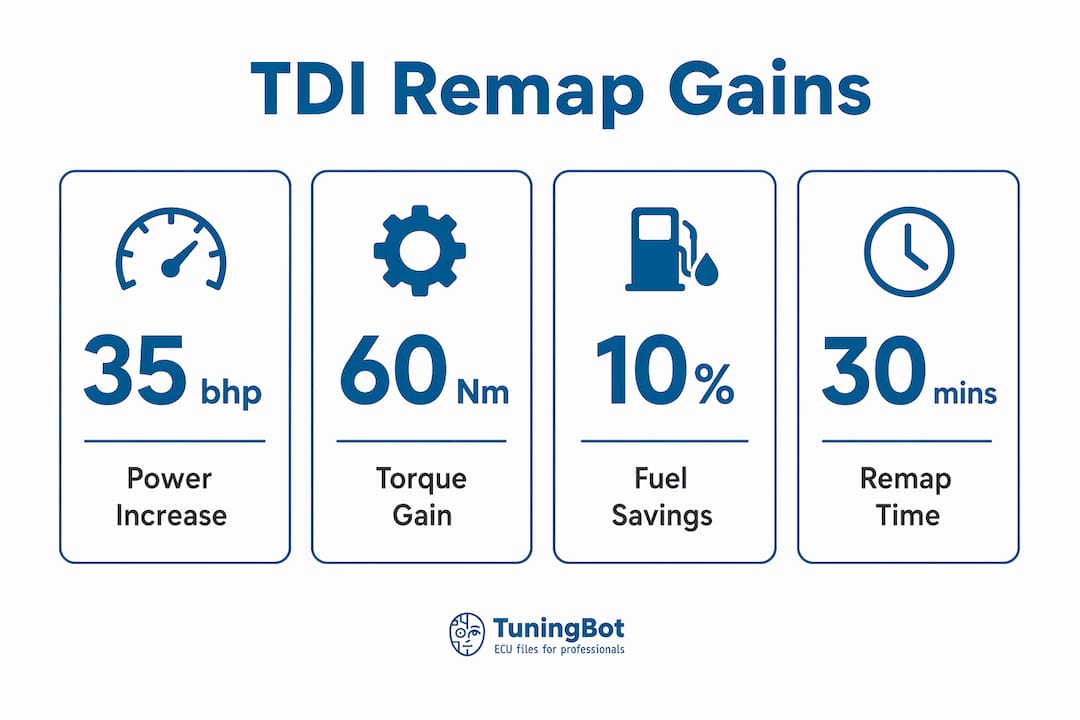
The torque gains matter more than the peak power numbers for most drivers. Diesel engines produce their best torque in the mid-range, typically between 1,500 and 3,000 RPM. A remap that raises torque in this band makes the car feel significantly stronger during overtaking, motorway merging, and towing. The power figure on paper improves, but the in-gear response is what you actually feel.
Key benefits reported across TDI remapping applications include:
- Improved throttle response. The ECU’s throttle map is adjusted to reduce the lag between pedal input and turbo response.
- Better fuel economy at cruise. Optimized fueling and turbo management reduce the amount of fuel needed to maintain highway speeds.
- Stronger mid-range torque. The torque curve is reshaped to deliver more pull between 1,800 and 3,000 RPM.
- Smoother power delivery. Torque limiters that cause flat spots in the stock map are raised or removed, producing a more linear power curve.
Fuel economy improvements are real but conditional. Drivers who use the extra torque aggressively will see little change in consumption. Drivers who use the improved mid-range torque to shift earlier and cruise at lower RPM often report measurable gains at the pump.
The same principles apply to related diesel platforms. CDTI engine remapping on Vauxhall and Opel engines, dCi engine remapping on Renault diesels, and TDCi engine remapping on Ford diesel applications all follow the same ECU calibration logic. The ECU hardware and software architecture differ by manufacturer, but the process of reading, modifying, and rewriting calibration tables is consistent.
Safety, reliability, and risks of TDI engine remapping
A professional remap does not damage engines. A poor remap does. The distinction matters because the risks are real and the consequences are expensive.
The primary failure modes from bad remapping are:
- Excessive exhaust gas temperatures (EGT). Over-fueling raises EGT beyond safe limits, accelerating wear on the turbocharger, DPF, and exhaust valves.
- Injector over-fueling. Pushing injectors beyond their rated duty cycle shortens their service life significantly.
- Turbo overspin. Raising boost beyond the turbo’s mechanical limit causes bearing failure, often without warning.
- Hardware fatigue from generic files. Off-the-shelf remap files may cause high exhaust gas temperatures that lead to hardware fatigue, and the damage often goes unnoticed until component failure occurs.
Preserving emissions equipment is equally important. Mild Stage 1 remaps of 10–15% output gains are safe for daily use when emissions equipment like the DPF and AdBlue system remains intact. Removing or bypassing these systems may be legal in some motorsport contexts but creates compliance and reliability issues for road vehicles.
Custom maps account for local fuel quality, vehicle condition, and intended use. Generic maps risk injector and turbo damage because they apply aggressive fueling and boost targets without knowing the vehicle’s actual condition or the fuel quality available in the region.
Pro Tip: Ask your tuner whether the map was written specifically for your vehicle’s ECU hardware version and mileage, or whether it is a generic file applied to your car. The answer tells you everything about the quality of the work.
IMI accreditation is the recognized professional standard in the UK tuning industry. Globally, the equivalent benchmark is a tuner who can demonstrate custom calibration work, dyno testing, and EGT monitoring during the tuning process.
How does remapping compare to tuning boxes and hardware mods?
Remapping and tuning boxes both increase power, but they operate at different levels of the system.
| Method | How it works | Safety strategies | Customization |
|---|---|---|---|
| ECU remap | Rewrites ECU logic tables directly | Full, integrated into the map | High, tailored to vehicle and use case |
| Tuning box | Intercepts sensor signals | None, ECU receives false data | Low, preset modules |
| Stage 2 hardware | Remap plus upgraded hardware | Remap updated for new parts | Highest, requires full recalibration |
Remapping rewrites ECU logic rather than emulating signals, which allows the calibrator to include safety limits and protection strategies that tuning boxes cannot provide. A tuning box that raises boost by sending false MAP sensor data to the ECU bypasses the ECU’s own protection logic entirely.
Stage 1 remapping works within the factory hardware limits. Stage 2 tuning combines a remap with hardware upgrades such as a larger intercooler, uprated injectors, or a performance exhaust. The remap is then recalibrated to match the new hardware’s capabilities. Effective remaps tailor power delivery for specific uses like towing or motorway driving in ways that plug-in modules cannot replicate.
For enthusiasts running TFSI, TSI, or GTDI petrol engines, the same ECU calibration principles apply. TFSI engine remapping on Audi and Volkswagen Group petrol turbos and GTDI engine remapping on Ford EcoBoost engines follow identical processes. The calibration targets differ because petrol engines use different fueling and ignition strategies, but the ECU read, modify, and write workflow is the same.
How to approach getting a TDI remap
Getting a quality remap requires preparation and clear communication with your tuner. Follow this sequence to protect your investment:
- Define your goal. Daily commuting, towing, track days, and motorway cruising each require a different torque curve shape. Tell your tuner exactly how you use the vehicle.
- Complete a mechanical health check. Confirm the turbo, injectors, EGR valve, and DPF are all serviceable before booking. A remap on a worn turbo accelerates its failure.
- Verify the tuner’s credentials. Ask for evidence of IMI accreditation, custom calibration capability, and dyno or road testing procedures. Request customer references for the same engine platform.
- Confirm the ECU reading method. OBD, bench, or boot-mode access each carry different risk profiles. Your tuner should explain which method applies to your vehicle and why.
- Review the completed map. A professional tuner will show you before-and-after data: boost targets, torque curves, and EGT readings from the test drive.
- Post-remap diagnostics. Run a fault code scan after the remap is complete. A clean scan confirms the ECU accepted the new calibration without generating errors.
Understanding what a remap file contains helps you ask better questions and evaluate the quality of the work. The calibration file is not a single number. It is a set of multi-dimensional tables that govern every aspect of engine behavior across load and RPM.
For workshops and professional tuners, TuningBot provides calibrated ECU files for TDI, dCi, CDTI, TDCi, and other diesel platforms, with support for Bosch, Continental, Delphi, and Marelli ECU hardware. The professional remapping techniques guide covers the full calibration workflow for workshop use.
Key Takeaways
TDI engine remapping is the most direct method for extracting the performance and efficiency that manufacturers deliberately leave unused in factory ECU calibrations.
| Point | Details |
|---|---|
| Definition of remapping | ECU remapping rewrites factory calibration tables for boost, fueling, and torque management. |
| Typical Stage 1 gains | A 2.0 TDI gains 30–50 bhp and 60–90 Nm without hardware changes. |
| Safety depends on quality | Custom maps written for your specific vehicle and fuel quality prevent injector and turbo damage. |
| Remap vs tuning box | Remapping rewrites ECU logic with integrated safety strategies; tuning boxes only intercept sensor signals. |
| Process timeline | ECU read and write takes 5–30 minutes; full diagnostics and testing adds 1–3 hours. |
The TuningBot Technical Team’s view on TDI remapping
The most common mistake we see is treating remapping as a commodity purchase. Enthusiasts compare prices, pick the lowest number, and then wonder why the car feels no different or, worse, develops a fault three months later. A remap is a calibration service. The price reflects the engineer’s time, the quality of the tooling, and the depth of the testing. Cutting that cost cuts all three.
The second mistake is remapping a vehicle that needs maintenance. A turbo with worn bearings will not survive a boost increase. Injectors at 80% efficiency will be pushed past their limit by a fueling map written for healthy hardware. The remap does not cause the failure. The failure was already waiting. The remap just accelerates the timeline.
What actually works is straightforward: define your use case, prepare the vehicle mechanically, choose a tuner who writes custom files and tests them properly, and communicate clearly about how you drive. A remap calibrated for motorway cruising and towing looks different from one calibrated for spirited driving. Both are valid. Neither is interchangeable.
TDI remapping done correctly is one of the highest-value modifications available for a diesel vehicle. The gains are real, the process is well-established, and the risks are manageable when the work is done by someone who knows the platform. Approach it as a technical upgrade that requires care, and it will deliver exactly what it promises.
— TuningBot Technical Team
TuningBot’s ECU tuning services for TDI and diesel platforms
TuningBot provides professional ECU remapping files for TDI, dCi, CDTI, TDCi and many other diesel platforms. Every file is calibrated by engineers with direct knowledge of the ECU hardware, diesel torque strategy, boost control, fuel system limits and emissions-related safety logic.
Workshops and individual tuners can upload an ECU file directly through TuningBot with no registration and no prepaid credits required. Pricing is clear through the public ECU tuning price list, and supported ECU/vehicle combinations can be checked through the ECU Service Coverage page before starting a job.
TuningBot supports major ECU brands including Bosch, Continental, Delphi and Marelli, and works with tools such as Alientech KESS3, AutoTuner and Magic Motorsport. For diesel platforms, the service range includes Stage 1 and Stage 2 remapping, DPF Off, EGR Off and DSG/TCU tuning across supported applications.
FAQ
What is TDI engine remapping in simple terms?
TDI engine remapping is the process of rewriting the ECU’s software to adjust boost pressure, fueling, and torque limits beyond the conservative factory settings. The result is more power, better torque, and often improved fuel efficiency.
How much power does a TDI remap add?
A Stage 1 remap on a 2.0 TDI engine typically adds 30–50 bhp and 60–90 Nm of torque without any hardware modifications. Larger 3.0 TDI engines can gain 40–80 bhp.
Is TDI engine remapping safe for daily driving?
A professionally calibrated Stage 1 remap that preserves the DPF and AdBlue systems is safe for daily use. Output gains of 10–15% are within the mechanical tolerance of factory TDI hardware when the vehicle is in good condition.
What is the difference between a remap and a tuning box?
A remap rewrites the ECU’s logic tables directly and includes integrated safety strategies. A tuning box intercepts sensor signals to trick the ECU, with no access to the ECU’s protection logic.
Does remapping work the same on dCi, CDTI, and TDCi engines?
Yes. dCi, CDTI, and TDCi are diesel engine designations from Renault, Vauxhall/Opel, and Ford respectively. All use ECU calibration tables for boost, fueling, and torque management, and all respond to the same professional remapping process.