

 EnglishEN
 ItalianoIT
 EspañolES
 PortuguêsPT
 FrançaisFR
 РусскийRU
“Drive-by-Wire remapping” bezeichnet den Vorgang der elektronischen Neukalibrierung der Drosselklappensignalzuordnung zwischen dem Gaspedal und dem ECU, um das Ansprechverhalten der Drosselklappe zu verbessern, Verzögerungen zu reduzieren und das Fahrverhalten individuell anzupassen. Im Gegensatz zu älteren mechanischen Systemen verwenden moderne Fahrzeuge elektronische Sensoren und Steuergeräte, um die Eingaben des Fahrers zu interpretieren, was bedeutet, dass die Gasannahmekurve vollständig softwaredefiniert und uneingeschränkt einstellbar ist. Der Fachbegriff für diesen Vorgang lautet „Kalibrierung der elektronischen Drosselklappensteuerung (ETC)“, obwohl in der Praxis meist der Begriff „Drive-by-Wire remapping“ verwendet wird. Das Verständnis dessen, was „Drive-by-Wire remapping“ ist und wie es sich von einem einfachen Drosselklappensteuergerät unterscheidet, ist der Ausgangspunkt für jeden Fachmann, der sich mit dem modernen Motormanagement befasst.
Inhaltsverzeichnis
- Wie funktioniert die Drive-by-Wire-Technologie in modernen Fahrzeugen?
- Was ist „Drive-by-Wire remapping“ im Vergleich zu einem Gasreaktionsregler?
- Was sind die Vorteile und Herausforderungen des Drive-by-Wire-Systems remapping?
- Wie man „Drive-by-Wire“ remapping in der Praxis umsetzt
- Wichtige Erkenntnisse
- Die Sichtweise des tuner auf „Drive-by-Wire“ remapping
- Wie TuningBot das professionelle Drive-by-Wire-System remapping unterstützt
- FAQ
- Empfohlen
Wie funktioniert die Drive-by-Wire-Technologie in modernen Fahrzeugen?
Drive-by-Wire (DbW) ersetzt herkömmliche mechanische oder hydraulische Gestänge durch elektronische Sensoren, ECUs und Aktuatoren zur Steuerung von Drosselklappe, Lenkung und Bremsen. Das Gaspedal enthält einen Positionssensor, der den Fußdruck in ein elektronisches Signal umwandelt. Dieses Signal wird an den ECU weitergeleitet, der den richtigen Öffnungswinkel der Drosselklappe berechnet und einen Befehl an einen Elektromotor an der Drosselklappe sendet. Das Ergebnis ist eine vollständig elektronische Drosselklappensteuerung Schleife ohne physisches Kabel zwischen Ihrem Fuß und dem Motor.
Diese Architektur ermöglicht den Herstellern eine präzise Steuerung darüber, wie das Fahrzeug die Eingaben des Fahrers interpretiert. Der ECU kann je nach Fahrmodus Modus, Motortemperatur oder Traktionsbedingungen unterschiedliche Drosselklappen-Kennfelder anwenden. DbW-Systeme müssen konform sein nach den funktionalen Sicherheitsstandards von ISO 26262 Stufe D, der höchsten Klassifizierung in der Autosicherheit, um das Risiko von Elektronikausfällen zu steuern. Diese Norm erfordert redundante Sensoren und ein fehlertolerantes Design, damit das Fahrzeug die Kontrolle behält, falls eine Komponente ausfällt.
Drive-by-Wire geht weit über das Gaspedal hinaus. Steer-by-Wire und Brake-by-Wire Eliminieren Sie zusätzliche mechanische Komponenten, wodurch das Fahrzeuggewicht reduziert und softwaredefinierte Fahreigenschaften über alle Bedienelemente hinweg ermöglicht werden. Haptische Feedback-Systeme simulieren den physischen Widerstand, den mechanische Verbindungen einst von Natur aus boten. Ohne dieses synthetische Feedback berichten Fahrer von einem entkoppelten Gefühl, das das Vertrauen untergräbt.
Schlüsselkomponenten in einem DbW-Drosselklappensystem:
- Gaspedalstellungssensor (APPS): Wandelt den Pedalwinkel in ein Spannungssignal um, typischerweise zweikanalig zur Redundanz.
- ECU-Drosselklappen-Kennlinie: Die Nachschlagetabelle, die den Pedalpositions Prozentsatz in den Drosselklappenöffnungs-Prozentsatz übersetzt.
- Elektronische Drosselklappe (ETB) Ein elektrisch angetriebenes Ventil, das den Lufteinlass physisch öffnet und schließt.
- Drosselklappenstellungssensor (TPS) Ermittelt die tatsächliche Stellung des Drosselklappengehäuses und leitet diese Information zur Regelung an den ECU weiter.
- Haptischer Feedback-Aktor Erzeugt einen Widerstand im Pedal, um bei hochwertigen DbW-Implementierungen ein mechanisches Gefühl zu simulieren.
Pro-Tipp: Bei der Diagnose einer trägen Gasannahme an einem E-Gas-Fahrzeug (Drive-by-Wire) sollten APPS und TPS immer gleichzeitig aufgezeichnet (data-logged) werden. Eine Abweichung zwischen dem Soll- und Ist-Wert der Drosselklappenposition deutet auf einen Hardwarefehler und nicht auf ein Kalibrierungsproblem hin.
Was ist „Drive-by-Wire remapping“ im Vergleich zu einem Gasreaktionsregler?
Drive-by-Wire remapping passt die Drosselklappen-Kennlinie des ECU direkt an und verändert so, wie die Motorsteuerungssoftware die Pedaleingabe über den gesamten Betriebsbereich interpretiert. Ein Gasannahme-Controller, manchmal auch als „Pedalbox“ bezeichnet, fängt das Signal zwischen dem Pedalsensor und dem ECU ab und verschiebt die Kennlinie elektronisch, ohne in die Software des ECU einzugreifen. Beide Ansätze verändern die wahrgenommene Gasannahme, wirken jedoch auf grundlegend unterschiedlichen Ebenen des Systems.
Gaspedal-Tuning-Module Die Pedalsignale werden abgegriffen, um die Drosselklappenkurve anzupassen, ohne jedoch die Kraftstoff- oder Zündkennlinien zu verändern. Eine Pedalbox sorgt dafür, dass sich die ersten 20% des Pedalwegs wie 40% verhalten, wodurch eine direktere Anfangsreaktion erzielt wird. Der Motor erhält weiterhin die gleiche maximale Kraftstoff- und Luftzufuhr wie bisher. Der Gewinn ist rein wahrnehmungsbezogen, nicht mechanischer Natur.
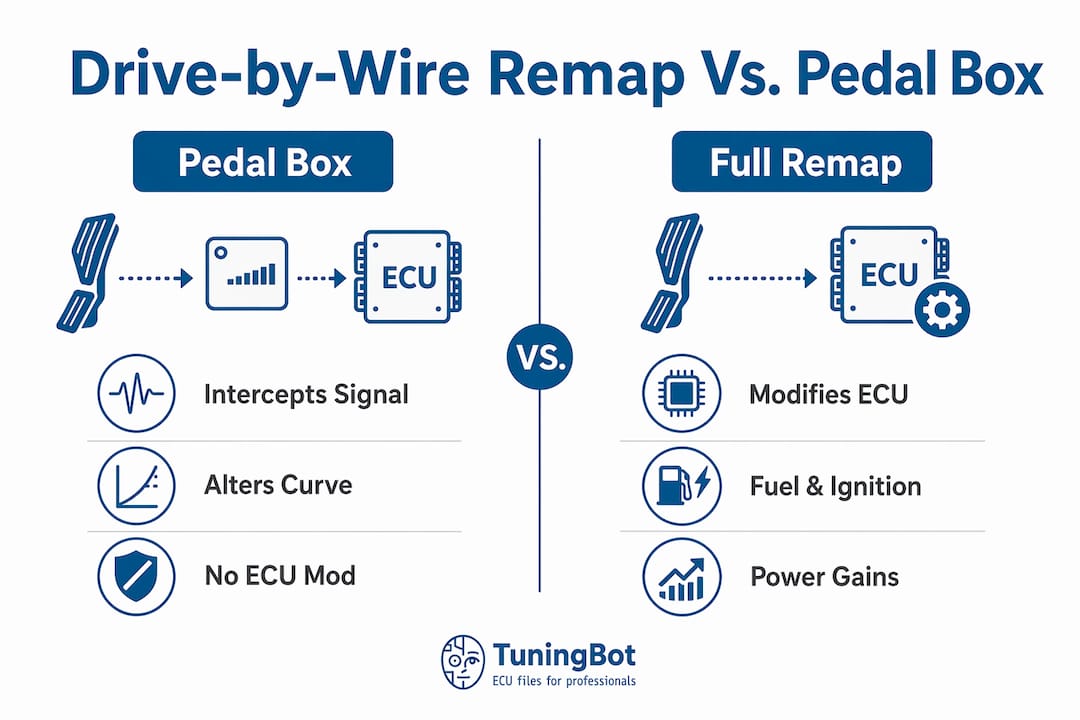
Das Komplettpaket „ECU remapping“ passt Kraftstoffzufuhr, Zündzeitpunkt, boost-Druck und Drosselklappen-Kennlinie gemeinsam als kalibriertes Paket an. Hardware-Steuergeräte kosten zwischen $150 und $400, während komplette ECU-remap-Pakete je nach Plattform ab $500 erhältlich sind und echte Leistungssteigerungen bieten. Dieser Preisunterschied spiegelt den Arbeitsaufwand wider: Ein remap-mod-Paket optimiert die gesamte Motorsteuerungsstrategie und nicht nur einen einzelnen Signalabgriffpunkt.
| Merkmal | Gaspedal-Tuning-Gerät | Vollständig ECU remap |
|---|---|---|
| Ändert die ECU-Software | Nein | Ja |
| Ändert Kraftstoffzufuhr und Zündung | Nein | Ja |
| Echte Leistungssteigerung | Nein | Ja |
| Gaskurvenanpassung | Ja | Ja |
| Umkehrbarkeit | Plug-and-Play-Entfernung | Erfordert ein neues Flashen |
| Typische Kosten | $150–$400 | $500 und höher |
Die beiden Ansätze schließen sich nicht gegenseitig aus. Beides kombinieren bietet gleichzeitig ein verbessertes Fahrgefühl und echte Leistungssteigerungen. Ein tuner könnte den remap durch den ECU ersetzen, um die Leistung der Stage 1 zu erreichen, und eine Pedalbox hinzufügen, um das anfängliche Gasgefühl auf der Rennstrecke zu verbessern, ohne den remap erneut anzupassen.
Pro-Tipp: Verwenden Sie niemals einen auf die aggressivste Stufe „Modus“ eingestellten Gasansprechregler bei einem frisch mit „remap“ umgerüsteten „ECU“, ohne zuvor die Ergebnisse aufzuzeichnen. Die kombinierte Wirkung kann dazu führen, dass die Drosselklappenstellung bei niedrigen Drehzahlen über das hinausgeht, was die Kraftstofftabellen des remap vorsehen, was zu einer zu mageren Gemischzusammensetzung führt.
Was sind die Vorteile und Herausforderungen des Drive-by-Wire-Systems remapping?
Der Hauptvorteil der „Drive-by-Wire“-Einstellungen von remapping liegt in der Beseitigung der werkseitig vorgegebenen Gasverzögerung. Die Kalibrierungen der Erstausrüster sind bewusst konservativ gehalten. Die Hersteller stimmen die Drosselklappen-Kennfelder auf die Einhaltung der Abgasnormen, ein gleichmäßiges Verhalten des Automatikgetriebes und eine breite Marktakzeptanz über verschiedene Kraftstoffqualitäten und Höhenlagen hinweg ab. Eine professionelle remap-Abstimmung beseitigt diese Kompromisse für ein bestimmtes Fahrzeug, einen bestimmten Fahrer und einen bestimmten Einsatzfall.
Die Vorteile des Drive-by-Wire-Systems gehen über das reine Ansprechverhalten hinaus. DbW ermöglicht Personalisierung of steering effort, braking feel, and throttle response for different driving modes. A remapped ECU can carry multiple throttle maps: a relaxed city curve, a linear sport curve, and an aggressive track curve, all selectable without hardware changes. That level of customization was impossible with a mechanical throttle cable.
Key advantages of a professional drive-by-wire remap:
- Throttle lag elimination: Removes the delay between pedal input and engine response caused by conservative OEM mapping.
- Custom driving modes: Multiple throttle curves stored in the ECU for city, sport, and track use.
- Integration with stability systems: Remapped throttle maps work with adaptive cruise control and traction control without triggering conflicts.
- Torque management refinement: Adjusts how the ECU limits torque during gear changes for smoother power delivery.
- Fuel efficiency gains: A linear throttle map reduces the tendency to over-press the pedal, which can lower fuel consumption in normal driving.
The risks are real and specific. Improper remapping can trigger diagnostic trouble codes or limp mode due to a mismatch between pedal input and expected engine behavior. If the throttle map is modified without corresponding adjustments to fueling and torque limits, the ECU detects an inconsistency and defaults to a safe operating mode.
“Drive-by-wire systems are complex software-driven networks that must be rigorously calibrated to interpret driver intent safely and predictably.” The computing network nature of DbW is frequently underestimated. It is not simply cables replaced by wires. Cybersecurity risks and system complexity increase with every software modification, and any remap that bypasses OEM safety thresholds creates liability for the tuner.
Warranty implications are a practical concern for workshops. Any ECU modification that alters factory calibration can void the manufacturer’s powertrain warranty. Tuners should document every change and advise clients accordingly before starting work.
Wie man „Drive-by-Wire“ remapping in der Praxis umsetzt
A professional drive-by-wire remap follows a structured workflow. Skipping steps creates calibration errors that are difficult to trace after the fact. The process below reflects current professional practice for ECU throttle calibration.
- Baseline-Datenerfassung. Record APPS voltage, TPS position, throttle demand percentage, and engine load across a full drive cycle before touching the ECU. This establishes the factory behavior and identifies any existing faults.
- ECU reading. Use a supported tool such as Alientech KESS3, AutoTuner, or Magic Motorsport to read the full ECU binary. Confirm the ECU ID and software version before modifying any maps.
- Throttle map identification. Locate the throttle demand table in the ECU binary. On Bosch EDC17 and MED17 platforms, this is typically a 16×16 or 20×20 axis map indexed by pedal position and engine speed.
- Karte modifizierung. Adjust the throttle curve to remove the factory dead zone in the first 15–25% of pedal travel. Maintain the OEM maximum throttle ceiling to preserve safety thresholds. Cross-reference fueling and torque maps to confirm consistency.
- Checksum correction and validation. Recalculate all checksums before writing the file. An incorrect checksum causes an immediate ECU fault on startup. The remap file-Kalibrierungsverfahren requires binary verification at every stage.
- Post-remap data logging. Repeat the baseline drive cycle and compare APPS to TPS response. Confirm the new curve delivers the intended response without overshoot or oscillation.
- Haptic feedback verification. On vehicles with active pedal feedback, confirm the resistance profile still matches driver expectations. Calibration requires balancing enhanced responsiveness with preserving natural mechanical feel to avoid a disconnected driving sensation.
The most common pitfall is modifying the throttle map in isolation. The ECU cross-references throttle demand against torque request, fueling, and transmission shift points. A throttle map that demands 80% throttle at 40% pedal travel will conflict with a torque limiter set for 40% demand. The result is a flat spot or a DTC, not a performance gain.
Pro-Tipp: On turbocharged platforms, always check the boost request map after modifying the throttle map. A more aggressive throttle curve increases boost demand earlier in the RPM range. If the boost map is not adjusted to match, the turbo will spool faster than the fueling table expects, causing a lean spike.
Combining a throttle response controller with a full ECU remap gives the best of both approaches. The remap handles fueling, boost, and torque management for real power gains. The pedal box fine-tunes the initial pedal feel without requiring another ECU reflash. This combination is particularly effective on daily-driven vehicles where the driver wants track-level response in sport mode but a relaxed feel in traffic.
Wichtige Erkenntnisse
Drive-by-wire remapping delivers genuine performance gains only when the throttle map is calibrated as part of a complete engine management strategy, not as an isolated signal adjustment.
| Punkt | Einzelheiten |
|---|---|
| DbW replaces mechanical linkages | Electronic sensors and ECUs control throttle, requiring ISO 26262 Level D compliance for safety. |
| Remapping vs. pedal box | Full ECU remaps modify fueling and ignition for real power gains; throttle controllers only shift the pedal signal curve. |
| Cost and scope differ | Throttle controllers cost $150–$400; full ECU remaps start at $500 and cover the entire engine management strategy. |
| Calibration workflow matters | Data logging, checksum correction, and post-remap validation are required steps, not optional checks. |
| Combining both approaches | Pairing a remap with a throttle controller delivers power gains and refined pedal feel without additional reflashing. |
Die Sichtweise des tuner auf „Drive-by-Wire“ remapping
Drive-by-wire remapping is where software-defined vehicles become genuinely interesting for tuners. The ability to store multiple throttle personalities in a single ECU binary, and switch between them based on a dashboard input or a CAN bus signal, represents a level of vehicle personalization that mechanical systems could never approach. We have worked on platforms where a single calibration session produced three distinct driving characters from the same hardware.
The part that gets underestimated is the feedback loop. DbW’s true value lies in vehicle behavior personalization, but that value disappears if the haptic feedback feels artificial or the throttle curve overshoots. Drivers are sensitive to pedal feel in ways they cannot always articulate. A remap that looks perfect on a dyno can feel wrong on the road if the synthetic feedback profile does not match the new throttle curve.
The cybersecurity dimension is the area we expect to define the next phase of professional remapping. DbW demands vigilance against cybersecurity threats and requires rigorous calibration to maintain predictable control. As vehicles move toward fully software-defined architectures, the attack surface for ECU modifications grows. Workshops that treat remapping as a purely mechanical skill will find themselves unprepared for that shift. The tuners who understand the full computing network behind a DbW system will be the ones clients trust with their vehicles.
Our advice: approach every drive-by-wire remap as a systems calibration job, not a map edit. Read the full binary, understand how throttle demand interacts with torque management and fueling, and validate every change with data logging. The car remapping fundamentals have not changed. The complexity of the systems they apply to has.
— TuningBot Technisches Team
Wie TuningBot das professionelle Drive-by-Wire-System remapping unterstützt
TuningBot helps workshops handle drive-by-wire remapping as part of a complete ECU calibration workflow, not as an isolated pedal-signal adjustment. Engineers review throttle request maps together with fueling, ignition, torque management and boost control so the final file remains coherent across the full engine-management strategy.
Before starting a job, workshops can check transparent pricing on the TuningBot Preisliste, verify supported platforms through ECU-Service-Abdeckung, Überprüfung verfügbar ECU-Dienste, and then upload the original ECU file directly through Datei tunen. The workflow is direct: no prepaid credits, no registration barrier and no unnecessary dealer-gatekeeping.
For Bosch, Continental, Delphi, Marelli and Denso ECUs, TuningBot supports the professional toolchains workshops already use, including Alientech KESS3, AutoTuner, Magic Motorsport, CMD, Dimsport and PCMFlash. That makes TuningBot a practical file-service layer for tuners who need fast, engineer-backed calibration without breaking their existing read/write workflow.
FAQ
Was versteht man unter „Drive-by-Wire remapping“ in einfachen Worten?
Drive-by-wire remapping is the process of modifying the ECU’s throttle map to change how the vehicle responds to accelerator pedal input. It removes factory-imposed lag and allows custom throttle curves for different driving modes.
Erhöht das Drive-by-Wire-System remapping die Leistung?
Eine Änderung der Drosselklappen-Kennlinie allein führt nicht zu einer Leistungssteigerung. Erst eine vollständige Anpassung von ECU, remapping und boost, die neben der Drosselklappen-Kennlinie auch die Kraftstoffzufuhr und den Zündzeitpunkt regelt, führt zu echten Leistungssteigerungen.
Was ist der Unterschied zwischen einer Pedalbox und einem kompletten ECU-remap-Set?
Eine Pedalbox fängt das Gaspedal-Signal ab und verschiebt die Kennlinie, ohne die ECU-Software zu beeinflussen; die Kosten liegen zwischen $150 und $400. Ein vollständiges ECU-remap-mod-Upgrade optimiert die Motorsteuerungssoftware für echte Leistungssteigerungen, beginnend bei $500.
Kann das Drive-by-Wire-System remapping Fehler verursachen oder Limp mode auslösen?
Ja. Eine fehlerhafte Kalibrierung, bei der die Drosselklappenstellung nicht mit der Kraftstoffzufuhr oder den Drehmomentgrenzen übereinstimmt, kann Fehlercodes oder Limp mode auslösen. Eine korrekte Neuberechnung von checksum und die Datenerfassung nach remap verhindern dies.
Welche Sicherheitsnorm gilt für Drive-by-Wire-Systeme?
DbW-Systeme müssen ISO 26262 Stufe D entsprechen, der höchsten funktionellen Sicherheitsklassifizierung für Kraftfahrzeuge, die redundante Sensoren und ein fehlertolerantes Design erfordert, um den Verlust der Fahrzeugkontrolle zu verhindern.