

 EnglishEN
 ItalianoIT
 DeutschDE
 EspañolES
 PortuguêsPT
 FrançaisFR
Блок управления Bosch Системы управляют функциями двигателя и трансмиссии, такими как впрыск топлива, зажигание, управление подачей воздуха, координация крутящего момента, контроль выбросов и диагностика. Точная архитектура зависит от семейства ЭБУ, производителя автомобиля и года выпуска model. Перед считыванием или программированием файла ЭБУ Bosch сервисная мастерская должна определить версию аппаратного и программного обеспечения, семейство процессоров, метод доступа и стратегию безопасности.
Что такое ЭБУ Bosch и чем он управляет?
Услуга Блок управления двигателем Bosch является центральным контроллером системы управления двигателем. Он считывает данные с датчиков, контролирующих положение дроссельной заслонки, частоту вращения коленчатого вала, уровень кислорода, детонацию, температуру всасываемого воздуха и температуру охлаждающей жидкости, а затем соответственно управляет исполнительными механизмами системы впрыска, зажигания и дроссельной заслонки.
Основные функции, управляемые ЭБУ Bosch, включают:
- Время и продолжительность впрыска топлива через системы с распределенным, непосредственным впрыском и топливной рампой Common Rail
- Угол опережения зажигания оптимизированный для каждого цилиндра на основе обратной связи от датчика детонации
- Управление воздухообменом с помощью электронной системы управления дроссельной заслонкой и изменения фаз газораспределения
- Контроль выбросов с помощью системы регулирования с замкнутым контуром lambda и рециркуляции отработавших газов
- Бортовая система диагностики Мониторинг работоспособности компонента monitoring и фиксация кодов неисправностей
Помимо управления процессом сгорания, электронный блок управления (ECU) также отвечает за функции security, блокировки безопасности и обмен данными по шине CAN с блоками управления коробкой передач, системой ESP и системой управления кузовом modules.
Как система управления на основе крутящего момента Bosch контролирует работу двигателя
Крутящий момент служит ключевым критерием для реализации всех требований к двигателю в стратегии управления Bosch. Вместо того чтобы рассматривать положение дроссельной заслонки как прямую команду, ЭБУ преобразует каждый запрос водителя и системы в потребность в крутящем моменте, а затем рассчитывает наиболее эффективное соотношение воздуха и топлива для его обеспечения.
Эта архитектура дает несколько практических преимуществ:
- Арбитраж по иску водителя: положение педали акселератора становится запросом крутящего момента, а не прямой командой дроссельной заслонки
- Система integration: Система курсовой устойчивости и трекшн-контроль вмешиваются в крутящий момент, не противореча намерениям водителя
- Оптимизация выбросов: процесс сгорания управляется таким образом, чтобы обеспечить требуемый крутящий момент с минимально возможным количеством вредных выбросов
- Управление режимом простоя и катализатор: Внутренние функции, такие как нагрев катализатор, создают собственные требования к крутящему моменту, которые обрабатываются тем же центральным координатором
Для тюнеров понимание этой структуры имеет решающее значение. Изменение карт подачи топлива или зажигания без учета ограничений модели крутящего момента часто приводит к срабатыванию механизмов ограничения крутящего момента, которые сдерживают рост мощности. Полная версия remap решает проблему Типы карт ЭБУ которые влияют на работу координатора крутящего момента, а не только продолжительность впрыска.
Как архитектура программного обеспечения ЭБУ Bosch обеспечивает кроссплатформенность tuning
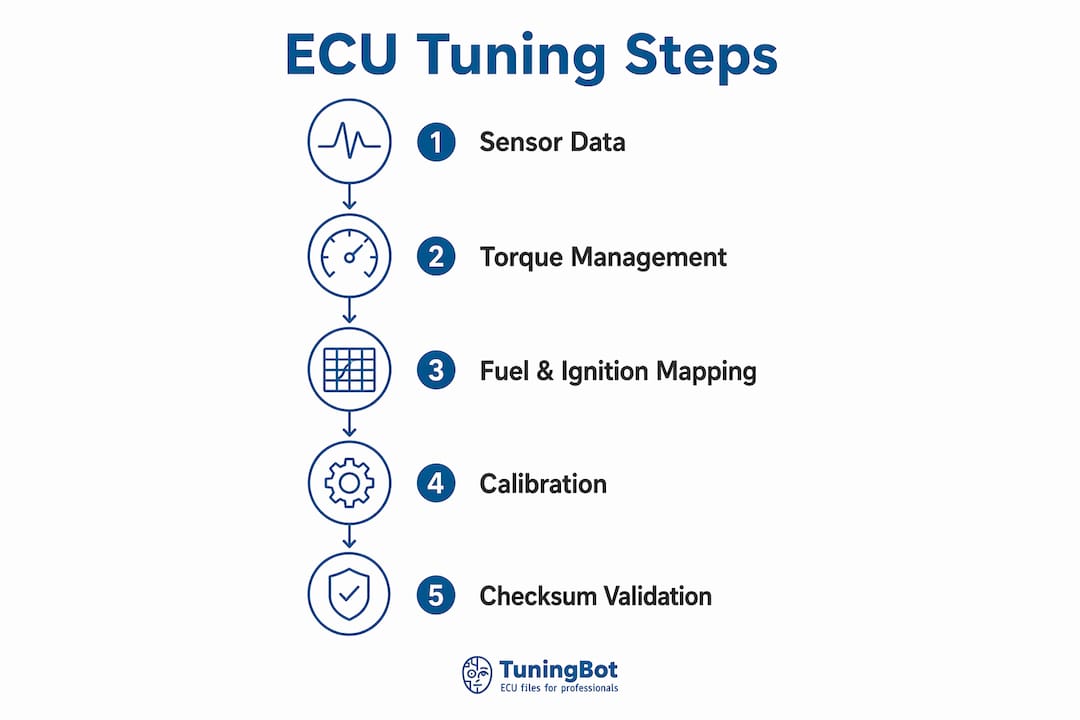
Многие электронные современные блоки управления Bosch используют многоуровневую архитектуру программного обеспечения modular и могут включать компоненты AUTOSAR, однако точная структура программного обеспечения зависит от поколения, проекта автопроизводителя и семейства электронных блоков управления.
Ключевые архитектурные особенности включают:
- Операционная система реального времени ERCOS: стандартная ОС для автомобильной продукции Bosch, используемая без изменений во всей линейке продукции EMS
- Многоуровневая структура программного обеспечения: абстракция аппаратного обеспечения отделяет интерфейсы датчиков и исполнительных механизмов от логики базовой калибровки
- Физическая прозрачность: функции строятся вокруг измеряемых физических величин, что делает калибровочные данные переносимыми между аппаратными вариантами
- Соответствие стандарту AUTOSAR: Стандартизированные интерфейсы обеспечивают совместимость программного обеспечения разных производителей и сокращают время разработки
Данные калибровки обычно хранятся в выделенных диапазонах адресов, однако способ их отделения от кода executable зависит от конкретной реализации. Некоторые электронные блоки управления используют несколько областей памяти Flash, сжатые сегменты или защищенные контейнеры.
Аппаратное обеспечение ЭБУ Bosch, микроконтроллеры и security для специалистов по tuning
Во многих вариантах моделей MED17 и EDC17 используются микроконтроллеры Infineon TriCore, хотя конкретный процессор, структура памяти и функции security варьируются в зависимости от версии аппаратного обеспечения.
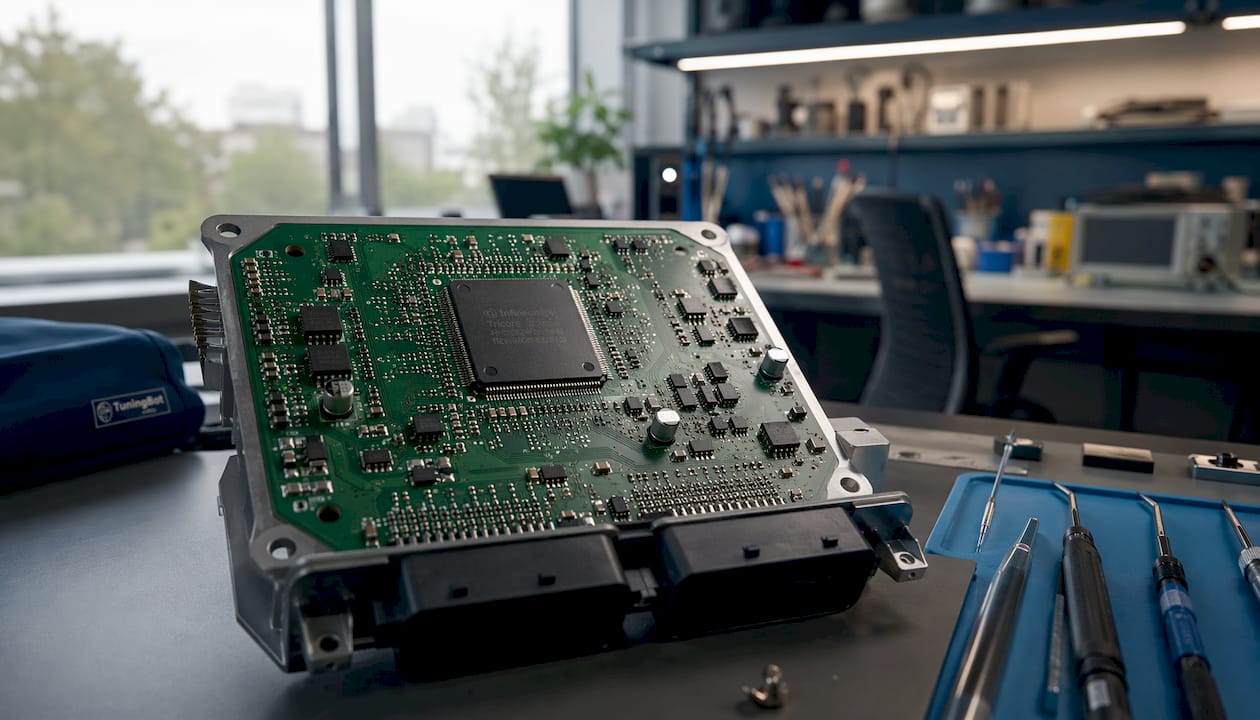
Bosch ECU model numbers follow a systematic naming convention. In MED17, “M” denotes Motronic, “E” indicates electronic throttle control, “D” signals direct injection, and “17” identifies the Tricore-based generation. In diesel units, “EDC” stands for Electronic Diesel Control, with subsequent letters specifying injection type.
Security considerations for tuning professionals:
- RSA-based firmware signing: newer Bosch ECUs use cryptographic signing that causes checksum errors or startup failure if firmware is modified without proper signing or bootloader patching
- Checksum validation: every calibration write must pass checksum verification before the ECU accepts the file
- Boot Mode access: Tricore-based units require physical PCB-level pin connections during a reset to access flash memory via debug interfaces, bypassing the operating system entirely
- Hardware identification first: understanding the exact hardware variant determines processor type, flash size, and pinout before any firmware work begins
Совет: Always identify the full ECU part number before selecting a tuning tool or file. The sub-variant suffix on a MED17 or EDC17 determines which boot protocol and signing method applies.
For a deeper look at the microchip architecture inside these units, the hardware differences between Tricore generations have direct implications for tool compatibility.
Как интегрированные электронные блоки управления (ECU) меняют систему управления всем автомобилем
The automotive industry is moving toward integrated ECUs that combine multiple control functions into fewer, more powerful units. Rather than a dedicated ECU per system, integrated controllers manage powertrain, chassis, and ADAS functions from a single hardware platform.
Trends shaping this shift include:
- Reduced component count: fewer discrete ECUs lower weight, wiring complexity, and failure points
- ADAS integration: advanced driver assistance functions require real-time coordination between powertrain, braking, and steering that distributed ECU architectures handle poorly
- Connected vehicle functions: over-the-air updates and vehicle-to-infrastructure communication demand centralized processing
- Tuning and diagnostic implications: as integration increases, isolating calibration data from safety-critical code becomes more complex, raising the technical bar for professional tuners
Распространенные модели электронных блоков управления Bosch models и их типичные области применения
Bosch produces distinct ECU families for gasoline and diesel applications, each identified by a systematic prefix.
Gasoline ECUs (Motronic series):
- ME7: port fuel injection with electronic throttle; widely used in late 1990s and early 2000s VAG, BMW, and Porsche applications
- MED17: direct injection gasoline; the dominant platform across modern VAG, BMW, Ford, and Hyundai-Kia vehicles
- MG1: gasoline with transmission integration; common in BMW applications requiring combined engine and gearbox management
- MEV17: gasoline with Valvetronic variable valve lift; specific to BMW N-series engines
Diesel ECUs (EDC series):
- EDC15: early common rail and pump-nozzle diesel; found in VAG TDI and PSA HDi engines from the late 1990s
- EDC16: second-generation common rail; covers VAG, BMW, Mercedes-Benz, and Fiat diesel applications from the mid-2000s
- EDC17: Tricore-based; the current standard for Euro 5 and Euro 6 diesel engines across most European manufacturers
Diesel fuel system health directly affects ECU calibration outcomes. The Bosch CP4 high-pressure pump is a common failure point on EDC17-equipped vehicles, and pump condition should be confirmed before any remap.
Диагностика и методы поиска неисправностей блоков управления Bosch
Bosch ECUs store fault codes as DTCs (Diagnostic Trouble Codes) accessible via the OBD-II port using any ISO 15765-4 compliant scan tool. Beyond generic OBD codes, Bosch ECUs carry manufacturer-specific DTCs that reveal component-level faults invisible to generic readers.
Effective diagnostic workflow for Bosch ECUs:
- Read all stored and pending DTCs before clearing, to capture intermittent faults
- Check live data streams for lambda sensor response, fuel trim values, and boost pressure against expected ranges
- Verify adaptation values such as idle fuel trim and throttle body adaptation, which drift after component replacement
- Confirm power and ground integrity at the ECU connector before condemning the unit itself
- Use freeze frame data to identify the operating conditions present when a fault was logged
Услуга Руководство по программированию ЭБУ from TuningBot covers the full diagnostic and programming sequence for professionals working with Bosch hardware.
Что можно и что нельзя изменять при «tuning» блока управления Bosch
Bosch ECU calibration data sits in a defined flash memory region, separate from operating system code. This separation makes targeted remapping possible without touching core firmware, provided the tuning tool reads and writes the correct memory addresses.
Modifiable parameters in a standard Bosch remap:
- Fuel injection quantity and timing maps
- Ignition advance tables
- Boost pressure targets and wastegate duty cycle
- Torque limiter and torque model scaling
- Rev limiter and speed limiter thresholds
- Lambda target maps and enrichment strategies
- DPF regeneration intervals and EGR rate tables
Parameters that cannot be freely modified without specialized access:
- RSA-signed firmware regions require bootloader patching or signing tools to accept changes
- Immobilizer and security seed-key logic is locked at hardware level on most MED17 and EDC17 units
- ADAS-related calibration on integrated ECUs is protected by additional cryptographic layers
Checksum correction is mandatory after any calibration write. A file with an invalid checksum will either be rejected at startup or cause the ECU to enter a reduced-function mode. TuningBot’s guide on Корректировка checksum details the process for Bosch file structures specifically.
Как технология ЭБУ Bosch сравнивается с другими производителями
Bosch is one of the dominant global engine-management suppliers. Its broad deployment and extensive tool support make Bosch platforms a major reference point for professional calibration.
Continental, Vitesco-related, Delphi, Marelli and Denso platforms use their own sophisticated control architectures. Differences should be evaluated by exact ECU family rather than broad brand assumptions.
The key practical difference for tuning professionals is documentation depth. Bosch’s long market presence and OEM-scale deployment mean that map structures, checksum algorithms, and boot protocols for MED17 and EDC17 are well understood across the professional tuning community. That depth of knowledge translates directly into more reliable calibration outcomes and faster file turnaround.
Профессиональная поддержка калибровки блоков управления Bosch от TuningBot
TuningBot supports workshops working with Bosch ME, MED, EDC, MG1 and MD1 applications where coverage is available. Every job should include the exact ECU identification, original read and relevant diagnostic information.
Перед заказом мастерские могут проверить Покрытие сервисов ЭБУ, обзор Публичный прайс-лист и просматривайте доступные Услуги ЭБУ.
The original file can then be submitted through Чип-тюнинг файла without prepaid credits. TuningBot supports Alientech KESS3, AutoTuner, Magic Motorsport, CMD, Dimsport and PCMFlash.
Ключевые выводы
Bosch ECUs use a torque-based management strategy with AUTOSAR-compliant, modular software running on Infineon Tricore hardware, making them the most widely documented and tunable engine management platform in the professional market.
| Точка | Детали |
|---|---|
| Torque as the central criterion | All driver and system requests convert to torque demands before the ECU calculates fueling and ignition. |
| AUTOSAR-compliant architecture | Modular, layered software means similar map structures appear across gasoline, diesel, and hybrid Bosch platforms. |
| Infineon Tricore hardware | MED17 and EDC17 families run on 32-bit Tricore microcontrollers, the standard across VAG, BMW, and Mercedes-Benz. |
| RSA firmware signing | Newer Bosch ECUs require cryptographic signing or bootloader patching before modified firmware is accepted at startup. |
| Коррекция контрольной суммы обязательна | Any calibration write to a Bosch ECU must pass checksum validation or the unit will reject the file or enter reduced-function mode. |
ЧАСТО ЗАДАВАЕМЫЕ ВОПРОСЫ
Что делает блок управления Bosch?
Блок управления Bosch обрабатывает сигналы датчиков для управления впрыском топлива, моментом зажигания, подачей воздуха и системами снижения токсичности отработавших газов, используя крутящий момент в качестве центрального критерия для всех решений двигателя.
Какие автомобили используют ЭБУ Bosch?
ЭБУ Bosch устанавливаются на автомобили концерна Volkswagen, BMW, Mercedes-Benz, Ford, Hyundai-Kia, Fiat и многих других производителей, охватывая как бензиновые, так и дизельные силовые агрегаты.
В чем разница между MED17 и EDC17?
MED17 управляет двигателями с непосредственным впрыском бензина, в то время как EDC17 обслуживает дизельные системы с аккумуляторным впрыском (Common Rail). Обе системы работают на микроконтроллерах Infineon Tricore и используют архитектуру одного поколения.
Можно ли настроить блок управления Bosch без физического доступа?
Стандартная калибровка remapping с помощью OBD или стендового оборудования возможна для большинства ЭБУ Bosch, однако для областей прошивки, подписанных RSA, требуется доступ на уровне загрузчика или подписанный патч, чтобы принять модификации.
Как считать коды ошибок из ЭБУ Bosch?
Connect an OBD-II compliant scan tool to the vehicle’s diagnostic port and read both generic and manufacturer-specific DTCs. Live data streams and freeze frame records provide additional diagnostic context.