

 EnglishEN
 ItalianoIT
 EspañolES
 PortuguêsPT
 FrançaisFR
 РусскийRU
Bosch Steuergerät systems manage engine and powertrain functions such as fuel injection, ignition, air handling, torque coordination, emissions control and diagnostics. The exact architecture varies by ECU family, vehicle manufacturer and model year. Before reading or modifying a Bosch ECU file, the workshop should identify the hardware and software version, processor family, access method and security strategy.
What is a Bosch ECU and what does it control?
Die Bosch engine control unit is the central controller of the engine management system. It reads inputs from sensors monitoring throttle position, crankshaft speed, lambda oxygen levels, knock, intake air temperature, and coolant temperature, then commands actuators for injection, ignition, and throttle accordingly.
Core functions managed by a Bosch ECU include:
- Einspritzzeitpunkt und -dauer across port, direct, and common rail systems
- Zeitpunkt der Zündung optimized per cylinder based on knock sensor feedback
- Air management via electronic throttle control and variable valve timing
- Emissions control through lambda closed-loop regulation and exhaust gas recirculation
- Onboard diagnostics (OBD) monitoring component health and flagging fault codes
Beyond combustion, the ECU also handles security functions, safety interlocks, and CAN bus communication with transmission, ESP, and body control modules.
How Bosch ECU torque-based management controls engine function
Torque serves as the key criterion for implementing all engine requirements in Bosch’s management strategy. Rather than treating throttle position as a direct command, the ECU translates every driver and system request into a torque demand, then calculates the most efficient air-fuel ratio to deliver it.
This architecture produces several practical advantages:
- Driver demand arbitration: accelerator pedal position becomes a torque request, not a raw throttle command
- System integration: ESP and traction control intervene in torque output without conflicting with driver intent
- Emissions optimization: combustion is managed to deliver demanded torque as cleanly as possible
- Idle and catalyst management: internal functions like catalyst heating generate their own torque demands handled by the same central coordinator
For tuners, understanding this structure is critical. Modifying fueling or ignition maps without accounting for torque model limits often triggers torque reduction interventions that cap power gains. A full remap addresses the ECU map types that feed the torque coordinator, not just injection duration alone.
How Bosch ECU software architecture supports cross-platform tuning
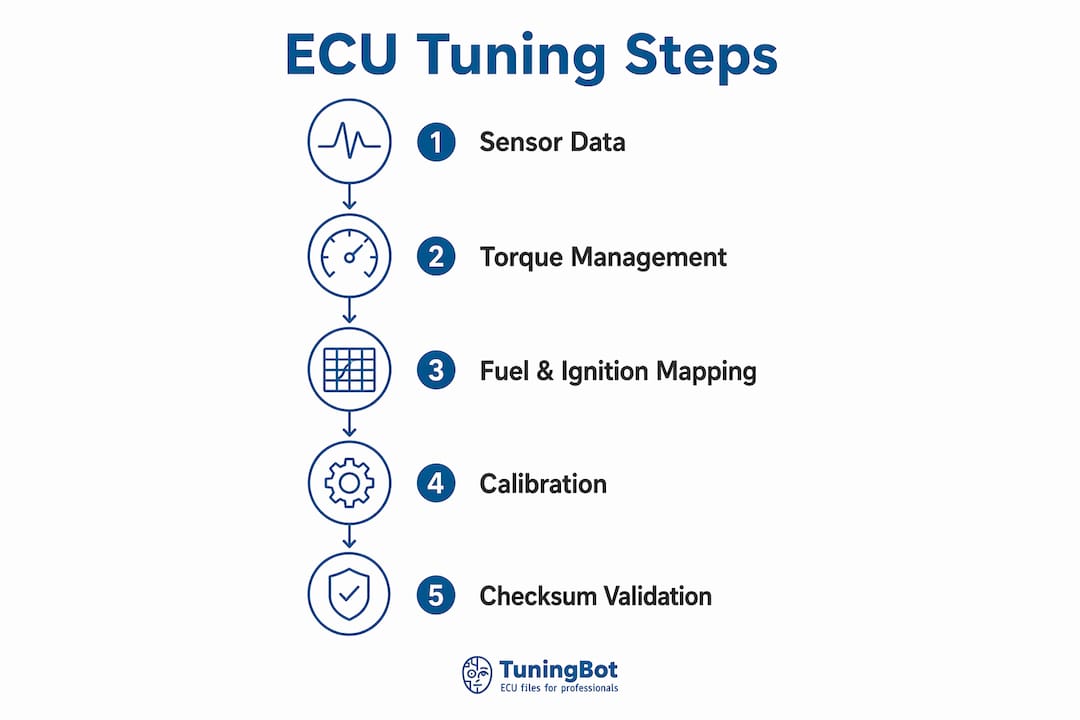
Many modern Bosch ECUs use modular, layered software architectures and may implement AUTOSAR components, but the exact software structure varies by generation, OEM project and ECU family.
Key architectural features include:
- ERCOS real-time operating system: the standard OS for Bosch automotive products, reused bit-for-bit across the EMS product line
- Layered software structure: hardware abstraction separates sensor and actuator interfaces from core calibration logic
- Physical transparency: functions are built around measurable physical quantities, making calibration data portable across hardware variants
- AUTOSAR compliance: standardized interfaces enable cross-manufacturer software integration and reduce development time
Calibration data is commonly stored in dedicated address ranges, but the separation from executable code is implementation-specific. Some ECUs use multiple Flash regions, compressed segments or protected containers.
Bosch ECU hardware, microcontrollers, and security for tuning professionals
Many MED17 and EDC17 variants use Infineon TriCore microcontrollers, although the exact processor, memory layout and security features vary by hardware revision.
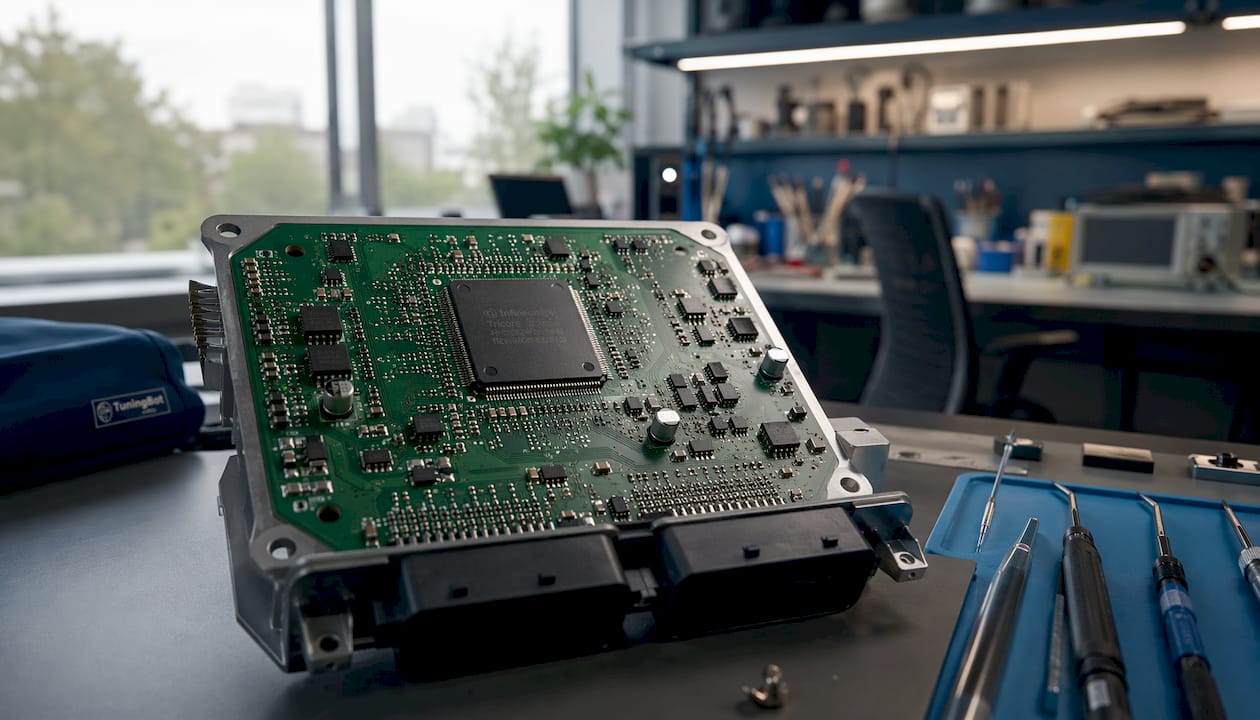
Bosch ECU model numbers follow a systematic naming convention. In MED17, “M” denotes Motronic, “E” indicates electronic throttle control, “D” signals direct injection, and “17” identifies the Tricore-based generation. In diesel units, “EDC” stands for Electronic Diesel Control, with subsequent letters specifying injection type.
Security considerations for tuning professionals:
- RSA-based firmware signing: newer Bosch ECUs use cryptographic signing that causes checksum errors or startup failure if firmware is modified without proper signing or bootloader patching
- Checksum validation: every calibration write must pass checksum verification before the ECU accepts the file
- Boot Mode access: Tricore-based units require physical PCB-level pin connections during a reset to access flash memory via debug interfaces, bypassing the operating system entirely
- Hardware identification first: understanding the exact hardware variant determines processor type, flash size, and pinout before any firmware work begins
Pro-Tipp: Always identify the full ECU part number before selecting a tuning tool or file. The sub-variant suffix on a MED17 or EDC17 determines which boot protocol and signing method applies.
For a deeper look at the microchip architecture inside these units, the hardware differences between Tricore generations have direct implications for tool compatibility.
How integrated ECUs are changing vehicle-wide management
The automotive industry is moving toward integrated ECUs that combine multiple control functions into fewer, more powerful units. Rather than a dedicated ECU per system, integrated controllers manage powertrain, chassis, and ADAS functions from a single hardware platform.
Trends shaping this shift include:
- Reduced component count: fewer discrete ECUs lower weight, wiring complexity, and failure points
- ADAS integration: advanced driver assistance functions require real-time coordination between powertrain, braking, and steering that distributed ECU architectures handle poorly
- Connected vehicle functions: over-the-air updates and vehicle-to-infrastructure communication demand centralized processing
- Tuning and diagnostic implications: as integration increases, isolating calibration data from safety-critical code becomes more complex, raising the technical bar for professional tuners
Common Bosch ECU models and their typical applications
Bosch produces distinct ECU families for gasoline and diesel applications, each identified by a systematic prefix.
Gasoline ECUs (Motronic series):
- ME7: port fuel injection with electronic throttle; widely used in late 1990s and early 2000s VAG, BMW, and Porsche applications
- MED17: direct injection gasoline; the dominant platform across modern VAG, BMW, Ford, and Hyundai-Kia vehicles
- MG1: gasoline with transmission integration; common in BMW applications requiring combined engine and gearbox management
- MEV17: gasoline with Valvetronic variable valve lift; specific to BMW N-series engines
Diesel ECUs (EDC series):
- EDC15: early common rail and pump-nozzle diesel; found in VAG TDI and PSA HDi engines from the late 1990s
- EDC16: second-generation common rail; covers VAG, BMW, Mercedes-Benz, and Fiat diesel applications from the mid-2000s
- EDC17: Tricore-based; the current standard for Euro 5 and Euro 6 diesel engines across most European manufacturers
Diesel fuel system health directly affects ECU calibration outcomes. The Bosch CP4 high-pressure pump is a common failure point on EDC17-equipped vehicles, and pump condition should be confirmed before any remap.
Bosch ECU diagnostics and troubleshooting methods
Bosch ECUs store fault codes as DTCs (Diagnostic Trouble Codes) accessible via the OBD-II port using any ISO 15765-4 compliant scan tool. Beyond generic OBD codes, Bosch ECUs carry manufacturer-specific DTCs that reveal component-level faults invisible to generic readers.
Effective diagnostic workflow for Bosch ECUs:
- Read all stored and pending DTCs before clearing, to capture intermittent faults
- Check live data streams for lambda sensor response, fuel trim values, and boost pressure against expected ranges
- Verify adaptation values such as idle fuel trim and throttle body adaptation, which drift after component replacement
- Confirm power and ground integrity at the ECU connector before condemning the unit itself
- Use freeze frame data to identify the operating conditions present when a fault was logged
Die ECU-Programmierhandbuch from TuningBot covers the full diagnostic and programming sequence for professionals working with Bosch hardware.
What you can and cannot modify when tuning a Bosch ECU
Bosch ECU calibration data sits in a defined flash memory region, separate from operating system code. This separation makes targeted remapping possible without touching core firmware, provided the tuning tool reads and writes the correct memory addresses.
Modifiable parameters in a standard Bosch remap:
- Fuel injection quantity and timing maps
- Ignition advance tables
- Boost pressure targets and wastegate duty cycle
- Torque limiter and torque model scaling
- Rev limiter and speed limiter thresholds
- Lambda target maps and enrichment strategies
- DPF regeneration intervals and EGR rate tables
Parameters that cannot be freely modified without specialized access:
- RSA-signed firmware regions require bootloader patching or signing tools to accept changes
- Immobilizer and security seed-key logic is locked at hardware level on most MED17 and EDC17 units
- ADAS-related calibration on integrated ECUs is protected by additional cryptographic layers
Checksum correction is mandatory after any calibration write. A file with an invalid checksum will either be rejected at startup or cause the ECU to enter a reduced-function mode. TuningBot’s guide on checksum-Korrektur details the process for Bosch file structures specifically.
How Bosch ECU technology compares to other manufacturers
Bosch is one of the dominant global engine-management suppliers. Its broad deployment and extensive tool support make Bosch platforms a major reference point for professional calibration.
Continental, Vitesco-related, Delphi, Marelli and Denso platforms use their own sophisticated control architectures. Differences should be evaluated by exact ECU family rather than broad brand assumptions.
The key practical difference for tuning professionals is documentation depth. Bosch’s long market presence and OEM-scale deployment mean that map structures, checksum algorithms, and boot protocols for MED17 and EDC17 are well understood across the professional tuning community. That depth of knowledge translates directly into more reliable calibration outcomes and faster file turnaround.
Professionelle Bosch ECU-Abstimmungsunterstützung von TuningBot
TuningBot supports workshops working with Bosch ME, MED, EDC, MG1 and MD1 applications where coverage is available. Every job should include the exact ECU identification, original read and relevant diagnostic information.
Vor der Bestellung können Werkstätten prüfen ECU-Service-Abdeckung, überprüfen Sie öffentliche Preisliste und durchsuchen die verfügbaren ECU-Dienste.
Die Datei „original“ kann dann über Datei tunen without prepaid credits. TuningBot supports Alientech KESS3, AutoTuner, Magic Motorsport, CMD, Dimsport and PCMFlash.
Wichtige Erkenntnisse
Bosch ECUs use a torque-based management strategy with AUTOSAR-compliant, modular software running on Infineon Tricore hardware, making them the most widely documented and tunable engine management platform in the professional market.
| Punkt | Einzelheiten |
|---|---|
| Torque as the central criterion | All driver and system requests convert to torque demands before the ECU calculates fueling and ignition. |
| AUTOSAR-compliant architecture | Modular, layered software means similar map structures appear across gasoline, diesel, and hybrid Bosch platforms. |
| Infineon Tricore hardware | MED17 and EDC17 families run on 32-bit Tricore microcontrollers, the standard across VAG, BMW, and Mercedes-Benz. |
| RSA firmware signing | Newer Bosch ECUs require cryptographic signing or bootloader patching before modified firmware is accepted at startup. |
| Checksum-Korrektur ist zwingend erforderlich | Any calibration write to a Bosch ECU must pass checksum validation or the unit will reject the file or enter reduced-function mode. |
FAQ
Was macht ein Bosch-Steuergerät?
Ein Bosch Steuergerät verarbeitet Sensor-Eingänge zur Regelung von Kraftstoffeinspritzung, Zündzeitpunkt, Luftmanagement und Abgassystemen, wobei das Drehmoment als zentrales Kriterium für alle Motor-Entscheidungen verwendet wird.
Welche Fahrzeuge verwenden Bosch-Steuergeräte?
Bosch Steuergeräte werden in Fahrzeugen von Volkswagen Group, BMW, Mercedes-Benz, Ford, Hyundai-Kia, Fiat und vielen anderen Herstellern verbaut und decken sowohl Benzin- als auch Dieselantriebe ab.
Was ist der Unterschied zwischen MED17 und EDC17?
MED17 verwaltet Benzin-Direkteinspritzmotoren, während EDC17 Common-Rail-Diesel-Anwendungen steuert. Beide laufen auf Infineon Tricore Mikrocontrollern und teilen sich.
Kann ein Bosch Steuergerät ohne Hardwarezugriff getuned werden?
Eine Standardkalibrierung nach remapping über OBD- oder Prüfstandstools ist bei den meisten Bosch-Steuergeräten möglich, doch für RSA-signierte Firmware-Bereiche ist ein Zugriff auf Bootloader-Ebene oder ein signierter Patch erforderlich, um Änderungen zu akzeptieren.
Wie liest man Fehlercodes von einem Bosch Steuergerät aus?
Connect an OBD-II compliant scan tool to the vehicle’s diagnostic port and read both generic and manufacturer-specific DTCs. Live data streams and freeze frame records provide additional diagnostic context.