

 EnglishEN
 ItalianoIT
 DeutschDE
 EspañolES
 FrançaisFR
 РусскийRU
A otimização do mapa do turbo tuning é o processo de calibração dos mapas da ECU que controlam a pressão do boost, o fornecimento de combustível e o tempo de ignição, a fim de adequá-los à dinâmica real do fluxo de ar e às metas de desempenho de um motor turboalimentado. O termo padrão do setor para esse trabalho é “calibração da ECU”, e abrange todas as tabelas às quais a ECU se refere ao gerenciar um sistema de indução forçada. Sem a calibração adequada, um turbo atualizado causa condições pobres e baixo desempenho, pois as configurações padrão da ECU de fábrica não conseguem levar em conta a nova dinâmica do fluxo de ar. Este guia aborda os componentes essenciais dos mapas, as ferramentas necessárias, um fluxo de trabalho passo a passo do tuning e técnicas avançadas de automação utilizadas por profissionais dos tuners em 2026.
Quais são os componentes essenciais da otimização do mapa do turbo tuning?
Três tipos de tabelas constituem a base de qualquer calibração de ECU turbo: a tabela de pressão boost, a tabela de ciclo de trabalho da válvula de escape e a tabela de injeção de combustível. Cada tabela utiliza as RPM e a carga do motor como eixos principais. A ECU lê esses eixos simultaneamente e seleciona o valor de saída correto para cada condição de operação.
Tabelas de pressão de turbo e mapas de ciclo de trabalho da wastegate regulam de forma crítica o funcionamento do boost, a resposta do sistema e a segurança do motor. A tabela de pressão do boost define a pressão-alvo no coletor em cada ponto de rotação e carga. O mapa do ciclo de trabalho da válvula de escape indica à ECU com que intensidade acionar o atuador da válvula de escape para atingir essa meta. Uma tabela limitadora do boost funciona como um teto de segurança, interrompendo o boost caso a meta seja excedida.
Mapas de turbo e mapas de combustível devem ser coordenados para manter uma faixa de potência uniforme. Quando a pressão do boost aumenta, a massa de ar que entra em cada cilindro aumenta. O mapa de combustível deve ajustar o fornecimento de combustível para corresponder exatamente a essa massa de ar. Um desequilíbrio resulta em uma mistura pobre, o que acarreta risco de detonação, ou em uma mistura rica, o que desperdiça combustível e reduz a potência.
Os mapas de sincronização da ignição completam o quadro. Pressões mais altas nos cilindros, decorrentes do aumento do boost, comprimem a mistura ar-combustível de forma mais agressiva, o que aumenta o risco de batida. O mapa de ignição deve retardar o tempo de ignição em alta carga e alto boost para manter a combustão segura. Os preparadores que atualizam um turbo sem ajustar o mapa de ignição frequentemente enfrentam batida logo no primeiro teste no dinamômetro.
| Tipo de mapa | Entradas principais | Efeito primário |
|---|---|---|
| Tabela de pressão de turbo | RPM, carga do motor | Define a pressão do coletor alvo |
| Ciclo de trabalho da válvula de escape | RPM, carga do motor | Controla o atuador para atingir o alvo boost |
| Mapa de entrega de combustível | RPM, carga, sensor MAP | Ajusta a largura do pulso do injetor para o fluxo de ar |
| Mapa de avanço de ignição | RPM, carga, sensor de detonação | Previne detonação sob alta pressão no cilindro |
| Limitador de pressão | Pressão de boost | Reduz o boost acima de um limite máximo seguro |
Quais ferramentas e pré-requisitos você precisa para um ajuste eficaz do mapa da ECU?
Um trabalho eficaz com mapas de turbo exige que o software, o hardware e os dados de diagnóstico funcionem em conjunto. No que diz respeito ao software, é necessária uma plataforma de edição de ECUs capaz de ler e gravar a variante específica da ECU do veículo. O TuningBot oferece suporte à edição de arquivos para ECUs das marcas Bosch, Continental, Delphi, Marelli, Denso, Siemens, Keihin e ZF, abrangendo a grande maioria das plataformas com turbocompressor encontradas em oficinas profissionais.
Os requisitos de hardware são inegociáveis. Um dinamômetro de chassi oferece condições de carga controladas e repetíveis, permitindo que você faça alterações no mapa e avalie o resultado sem as variáveis da estrada. Um sensor de O₂ de banda larga fornece dados em tempo real da relação ar-combustível, que é a principal verificação de segurança durante qualquer ajuste de alimentação de combustível. Um sistema de detecção de batida, seja integrado ao fluxo de dados da ECU ou um dispositivo de áudio independente, avisa imediatamente se o tempo de ignição estiver muito agressivo.
O conhecimento prévio é tão importante quanto o equipamento. É preciso saber interpretar um mapa do compressor para entender em que condições o turbocompressor opera com eficiência em diferentes valores de boost e metas de vazão. Também é necessário interpretar com precisão os registros de AFR e os dados do sensor de detonação. A interpretação incorreta de um único ponto de dados pode levar a uma condição de mistura pobre destrutiva ou a uma perda desnecessária de potência devido a um atraso excessivo na ignição.
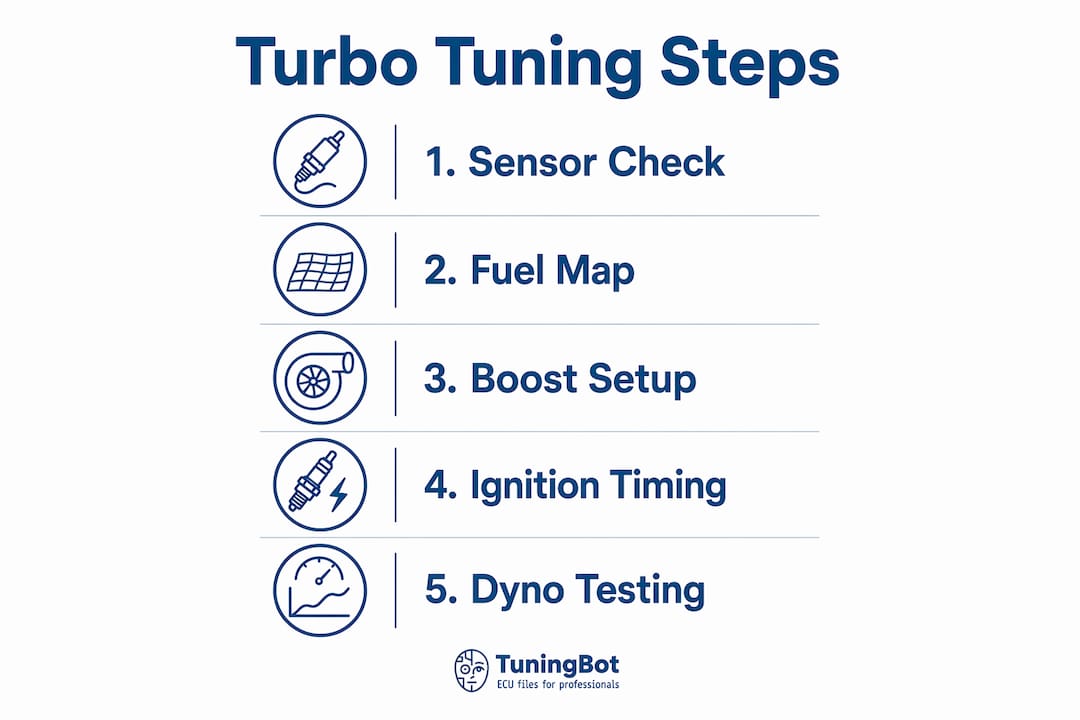
Dica de Mestre: Antes de qualquer sessão do tuning, verifique o estado de funcionamento de todos os sensores que a ECU utiliza para o controle do boost: o sensor MAP, o sensor de temperatura do ar de admissão e o sensor de posição do acelerador. Um sensor MAP com defeito corromperá todas as leituras das tabelas do boost e produzirá resultados que não podem ser reproduzidos.
| Categoria de ferramenta | Função | Necessário para mapas turbo |
|---|---|---|
| Software de edição de ECU | Ler, editar e escrever arquivos ECU | Sim |
| Dinamômetro de chassi | Teste de carga controlada | Sim |
| Sensor O2 Banda Larga | Monitoramento da AFR em tempo real | Sim |
| Sistema de detecção de detonação | Identificação de detonação | Sim |
| Interface de registro de dados | Registrar parâmetros da ECU durante as execuções | Sim |
Como otimizar mapas de turbo passo a passo para melhor desempenho
Um fluxo de trabalho estruturado previne danos e produz resultados repetíveis. Os fluxos de trabalho profissionais do tuning começam de forma conservadora com o ciclo de trabalho da válvula de escape e o tempo de ignição antes de refinar progressivamente os mapas à medida que a carga aumenta. Pular etapas ou passar diretamente para o modo de alta carga tuning sem uma linha de base verificada é a causa mais comum de danos ao motor durante a calibração do turbo.
Siga esta sequência para qualquer calibração de mapa de turbo:
- Criar um mapa base. Read the stock ECU file and log a full pull on the dyno before making any changes. This gives you a reference for AFR, boost, and timing at every load point.
- Verify supporting hardware. Fuel pump and injector upgrades require corresponding ECU scaling before you touch boost targets. Confirm injector size, fuel pressure, and pump flow rate are logged and match the ECU’s injector scaling values.
- Set conservative boost targets. Reduce the wastegate duty cycle map values by 10–15% from your intended final target. This gives the engine room to spool safely while you verify fueling.
- Adjust the fuel map first. At low load and partial throttle, confirm AFR stays within the target window. Rich is safer than lean at this stage. Correct any cells that show lean spikes before increasing boost.
- Increase boost in stages. Raise wastegate duty cycle incrementally, logging each run. Watch for boost spikes above the target, which indicate the wastegate control loop needs PID adjustment.
- Refine ignition timing. With boost and fueling stable, add timing in small increments at each load point. Stop immediately if the knock sensor activates. The goal is maximum brake torque timing without knock.
- Validate across the full RPM range. Run the engine from idle through redline at full throttle. Confirm AFR, boost, and timing match targets at every point on the map.
Dica de Mestre: Log coolant temperature and intake air temperature on every dyno run. Heat soak between runs changes the knock threshold significantly. A timing value that is safe on a cold engine can cause knock on a heat-soaked one.
The coordination between boost and fuel maps during this process is where most tuners spend the most time. A boost ramp that arrives faster than the fuel map can compensate produces a momentary lean condition at the point of peak boost onset. Slowing the wastegate duty cycle ramp rate in the mid-RPM range often resolves this without requiring large fuel map changes.
Quais técnicas avançadas melhoram a otimização do boost e a resposta do turbo?
Predictive boost control algorithms represent the most significant advancement in turbo ECU calibration over the past decade. Instead of reacting to a boost error after it occurs, a predictive algorithm reads throttle rate, gear position, and ambient pressure to pre-position the wastegate before the boost event begins. Predictive boost control combined with dynamic timing retard during spool-up reduces turbo lag and improves throttle response by 10–15%. That improvement is measurable on a dyno and immediately noticeable in driver feel.
Multi-dimensional mapping integrates throttle rate, gear selection, ambient pressure, and temperature to produce a more accurate boost and fueling response across all conditions. A 4D map adds a third axis beyond RPM and load, typically ambient air temperature or barometric pressure. This matters most for vehicles that operate across a wide range of altitudes or climates.
Automated calibration frameworks take this further. An SAE-validated automated framework explored approximately one million calibration candidates in roughly 36 hours using standard laptop parallel computation. That speed means a near-optimal preliminary map can be generated before a tuner ever touches the dyno. The tuner’s role shifts from manual cell-by-cell adjustment to verification and refinement of an already-optimized starting point.
Neural network digital twin simulations extend this further by creating a virtual engine model that predicts how map changes will affect output before any physical testing. You can also review AWD-specific tuning considerations when boost optimization interacts with torque distribution systems, which adds another layer of calibration complexity.
Key advantages and risks of advanced methods:
- Vantagem: Predictive algorithms reduce turbo lag without sacrificing peak boost targets.
- Vantagem: Automated frameworks cut preliminary calibration time from days to hours.
- Vantagem: Digital twin simulations reduce the number of destructive test cycles.
- Risk: Aggressive automated maps can exceed component limits if hardware constraints are not coded into the framework.
- Risk: Multi-dimensional maps require more sensor inputs, and a faulty sensor corrupts more of the map simultaneously.
Dica de Mestre: When using automated calibration outputs, always impose hard limits on boost pressure and ignition advance before the first physical dyno run. The algorithm optimizes for performance targets, not component survival. Your hardware limits must be the boundary conditions.
Principais Conclusões
Turbo tuning map optimization requires coordinated calibration of boost pressure, fuel delivery, and ignition timing maps, supported by proper hardware and a structured, data-driven workflow.
| Ponto | Detalhes |
|---|---|
| Map coordination is non-negotiable | Boost, fuel, and ignition maps must be calibrated together to avoid lean conditions and knock. |
| Hardware verification comes first | Confirm injector scaling, sensor health, and fuel system capacity before adjusting any boost targets. |
| Conservative progression prevents damage | Start below final boost targets and increase in stages while logging AFR and knock data on every run. |
| Predictive algorithms cut lag | Dynamic boost control strategies improve throttle response by 10–15% compared to static maps. |
| Automation accelerates, not replaces, expertise | Automated frameworks generate near-optimal starting maps, but a tuner must verify and impose hardware limits. |
O que aprendemos com anos de trabalho de calibração de turbos
The most common mistake we see in turbo ECU calibration is treating the fuel map as an afterthought. Tuners focus on boost targets and ignition timing, then wonder why the engine runs rough at partial throttle. The fuel map governs drivability at every load point below full throttle, and a poorly calibrated fuel map produces flat spots, hesitation, and elevated exhaust temperatures that shorten component life.
The second persistent myth is that a bolt-on turbo upgrade delivers power on its own. Ignoring calibration after hardware upgrades leads directly to knock, lean conditions, and poor drivability. The factory ECU has no knowledge of the new turbo’s flow characteristics. It will default to conservative fueling and timing that leaves power on the table while still running the engine outside safe parameters for the new hardware.
We advocate for treating turbo calibration as a system, not a series of isolated adjustments. Boost, fuel, and ignition interact at every operating point. Changing one without reviewing the others produces unpredictable results. Iterative data logging across the full RPM and load range is the only reliable method. Advanced automation tools accelerate the process, but they do not replace the judgment required to interpret knock data, read a compressor map, or recognize when a sensor reading is corrupted.
The tuners who produce the most consistent results are the ones who log everything, change one variable at a time, and treat every dyno run as a data collection exercise rather than a power hunt.
— Equipe Técnica do TuningBot
O fluxo de trabalho profissional de calibração de ECUs turbo do TuningBot
TuningBot gives workshops a direct way to turn a turbo ECU read into a calibrated, checksum-safe file without registration barriers, prepaid credits, or unclear pricing. For turbocharged petrol and diesel platforms, the file must coordinate boost targets, wastegate duty cycle, fuel delivery, ignition timing, torque monitoring, and safety limiters as one system. That is exactly where engineer-reviewed file support matters.
Workshops can upload the original ECU file through Remapeie seu arquivo, check service availability on Cobertura do serviço de ECU, review supported operations on Serviços ECU, and verify costs in the public Lista oficial de preços de remap de ECU. This matters because turbo map work is not the place for vague quotes, hidden credit systems, or generic files.
TuningBot supports Bosch, Continental, Delphi, Marelli, Denso, Siemens, Keihin, ZF, and other major ECU families, with compatibility for professional tools including Alientech KESS3, AutoTuner, Magic Motorsport, CMD, Dimsport, and PCMFlash. Services include Stage 1, Stage 2, Stage 3, big turbo remaps, torque limiter calibration, boost control optimization, checksum correction, DTC handling, DSG/TCU tuning, and related ECU services.
For workshops building or refining turbo calibration workflows, the 2026 ECU remapping techniques guide covers current methods for boost map editing, checksum handling, and file verification across supported platforms. TuningBot also provides Correção do arquivo ECU checksum as a standalone service, which is a required step after any map modification to prevent ECU rejection of the modified file.
PERGUNTAS FREQUENTES
O que é a otimização do mapa do turbo tuning?
Turbo tuning map optimization is the ECU calibration process of adjusting boost pressure, fuel delivery, and ignition timing tables to match a turbocharged engine’s actual airflow and performance requirements. It is the standard term for what tuners perform after any turbocharger upgrade or modification.
Por que um upgrade de turbo requer recalibração da ECU?
A stock ECU calibration is built around the factory turbo’s flow characteristics. An upgraded turbo moves more air, and without recalibration, the ECU runs the engine lean and fails to reach the new turbo’s power potential.
Qual é a ordem correta para ajustar os mapas da ECU do turbo?
Comece verificando o mapa de combustível em baixa carga; em seguida, defina metas conservadoras para boost e, depois, ajuste o tempo de ignição em pequenos incrementos. Sempre registre os dados de AFR e de batida em cada teste antes de aumentar a carga ou o valor de boost.
Como o controle preditivo boost reduz o turbo lag?
O controle preditivo do boost monitora a taxa de aceleração e a posição da marcha para pré-posicionar a válvula de escape antes do início do evento do boost. Essa abordagem, combinada com o atraso dinâmico na sincronização durante a aceleração, melhora a resposta do acelerador em 10–15% em comparação com estratégias de mapa estático.
As ferramentas de calibração automatizadas podem substituir um profissional tuner?
As estruturas automatizadas podem gerar mapas preliminares quase ótimos ao processar rapidamente um grande número de candidatos à calibração, conforme validado pela pesquisa da SAE. No entanto, um profissional tuner ainda precisa verificar os limites do hardware, interpretar os dados dos sensores e validar os resultados em um dinamômetro antes que o mapa seja utilizado em um veículo.