

 EnglishEN
 DeutschDE
 EspañolES
 PortuguêsPT
 FrançaisFR
 РусскийRU
EEPROM nella ECU: memoria, cloni e virginizing | TuningBot Si tratta di una memoria non volatile utilizzata per conservare insiemi di dati di piccole dimensioni ma importanti in caso di interruzione dell’alimentazione. A seconda dell’unità di controllo, tali insiemi di dati possono includere informazioni relative all’immobilizzatore, alla codifica, al numero di telaio (VIN), ai valori appresi, ai contatori di manutenzione o alla cronologia diagnostica. I moderni ECU possono utilizzare un’EEPROM esterna dedicata, una memoria non volatile interna o un’EEPROM emulata memorizzata nella memoria Flash. Comprendere quale sia l’EEPROM presente in una ECU — e quale architettura sia presente — è essenziale prima di clonare, riparare o riprogrammare un’unità di controllo.
Che cos’è l’EEPROM nei sistemi ECU?
Il contenuto esatto varia a seconda del modello ECU. Molte unità memorizzano i dati dell'immobilizzatore, la codifica, le informazioni relative al VIN e i valori appresi nella EEPROM o in una EEPROM emulata, mentre altri elementi possono risiedere nella memoria Flash interna, in circuiti dedicati ecurity modules o in unità di controllo separate.
Questa distinzione ha rilevanza pratica. Un tecnico che sostituisce una centralina usata in un veicolo donatore non si occupa solo del firmware. L'area EEPROM contiene l'associazione security del veicolo, le regolazioni adattive del carburante e la cronologia dei guasti. Se quell'area viene letta in modo errato o è danneggiata, la centralina si rifiuterà di comunicare con l'immobilizzatore, rendendo il veicolo inutilizzabile.
Funzioni chiave della EEPROM nelle ECU automobilistiche:
- Memorizzazione delle chiavi transponder dell'immobilizzatore e dei codici PIN
- Mantenere il numero di identificazione del veicolo (VIN) per l'associazione ECU-veicolo
- Mantenere offset di calibrazione appresi come adattamenti del minimo e correzioni del trim del carburante
- Mantenere i codici di errore diagnostici (DTC) persistenti attraverso cicli di alimentazione
- Salvataggio dei dati relativi al chilometraggio e dei contatori degli intervalli di manutenzione
- Registrazione dati di adattamento della trasmissione nelle applicazioni TCU
EEPROM nella ECU: memoria, cloni e virginizing | TuningBot
La resistenza della memoria Flash e EEPROM varia notevolmente in base alla tecnologia e al produttore. I dati tipici dei datasheet possono variare da migliaia a centinaia di migliaia di cicli, mentre le strategie EEPROM o EEPROM emulate possono ottenere una resistenza effettiva superiore grazie alla gestione della scrittura e al livellamento dell'usura.
I valori aggiornati frequentemente vengono gestiti tenendo conto dei limiti di durata, ma la strategia di scrittura effettiva varia. Molti dispositivi ECU utilizzano aggiornamenti bufferizzati, scritture basate sugli eventi o il livellamento dell'usura, anziché scrivere ogni adattamento in modo continuo.
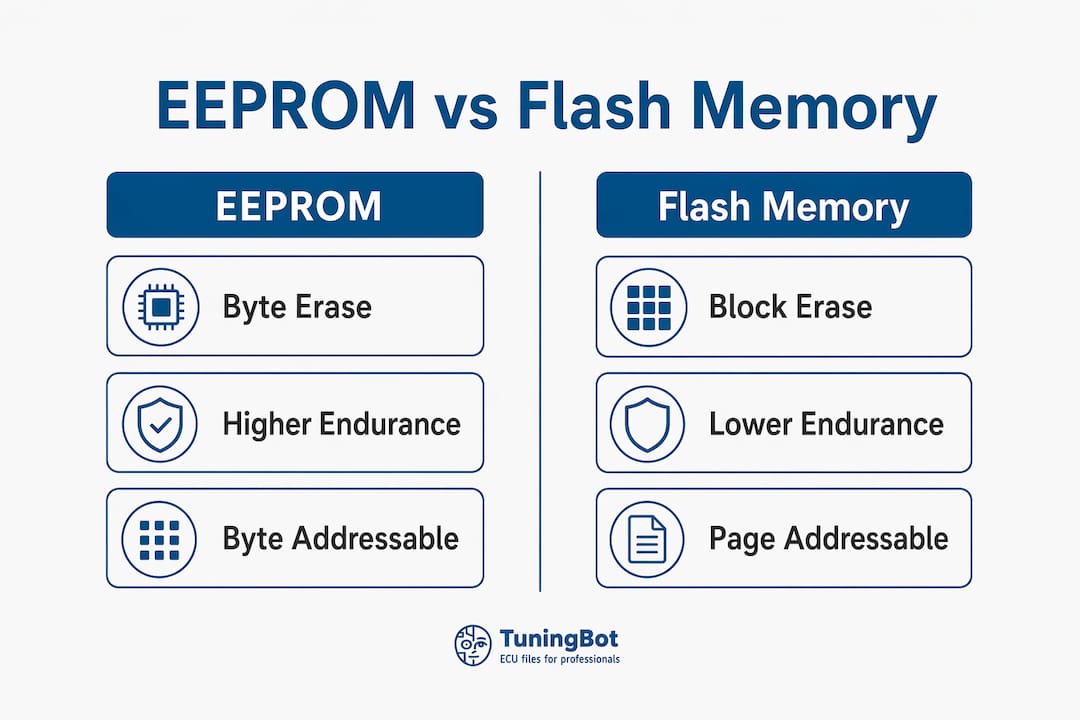
EEPROM vs. memoria Flash nelle applicazioni ECU:
| Proprietà | EEPROM | Memoria flash |
|---|---|---|
| Cancella unità | Byte o pagina, dipendente dal dispositivo | Settore o blocco |
| Resistenza alla scrittura | Tipicamente superiore; dipende dal datasheet | Tipicamente inferiore; dipende dal datasheet |
| Uso principale | Configurazione, security, adattamenti | Firmware, mappe di calibrazione |
| Codice execution | Normalmente archiviazione dei dati, non esecuzione diretta execution | Supportato |
| Frequenza di aggiornamento | Frequenti ma controllati | Aggiornamenti di firmware/calibrazione rari |
La separazione di questi due tipi di memoria nella progettazione delle centraline è intenzionale. L’EEPROM gestisce le variabili soggette ad aggiornamenti frequenti senza interferire con il codice principale memorizzato nella memoria Flash, mentre la funzionalità di modification a livello di byte garantisce che le operazioni di scrittura siano mirate ed efficienti.
Come si identificano i chip EEPROM su una scheda di circuito ECU?
Dispositivi come il 95320 sono EEPROM seriali comunemente utilizzate nell'elettronica automobilistica, ma la sola marcatura del contenitore non è sufficiente a dimostrare la funzione del chip in uno specifico ECU. Prima di eseguire operazioni di lettura o scrittura, è necessario verificare il circuito, la scheda tecnica e la documentazione relativa alla ECU.

Queste EEPROM seriali esterne vengono normalmente utilizzate come memoria dati piuttosto che per l'esecuzione diretta del codice, sebbene i microcontrollori moderni possano anche contenere aree interne non volatili con funzionalità diverse.
Lista di controllo per l'identificazione dei chip EEPROM sulle schede ECU:
- Cerca piccoli package SOIC a 8 pin separati dal microcontroller principale e dai chip Flash più grandi
- Corrispondenza dei codici articolo con le famiglie di datasheet 93Cxx, 95xxx e 24Cxx
- Traccia le linee del bus SPI o I2C dall'MCU per confermare l'interfaccia di comunicazione del chip
- Utilizza una lente d'ingrandimento o un microscopio digitale per leggere le marcature del componente incise al laser, appena visibili
- Consultare la documentazione pinout specifica dell'ECU per confermare la funzione del chip prima di effettuare misurazioni.
Consiglio Pro: Prima di eseguire il test di una EEPROM in-circuit, verificare se la MCU sta pilotando attivamente il bus SPI o I2C. Una contesa sul bus tra il programmatore e la MCU può compromettere le operazioni di lettura. Disattivando l'oscillatore della MCU o fisicamente rimozione del chip EEPROM La lettura da banco elimina completamente tale rischio.
Riprogrammazione, ripristino e clonazione dei dati EEPROM
Tre operazioni distinte coprono la maggior parte degli interventi sulle EEPROM nell'ambito della manutenzione professionale delle centraline: la riprogrammazione, il reset (ripristino alle impostazioni di fabbrica) e la clonazione. Ciascuna di esse ha uno scopo specifico, e confonderle è uno dei modi più rapidi per rendere inutilizzabile una centralina.
Riprogrammazione aggiorna specifici campi di dati all'interno dell'EEPROM, come la scrittura di nuovi offset di calibrazione dopo una modifica hardware o l'aggiornamento del conteggio delle chiavi dopo la sostituzione di un transponder. Si tratta di un'operazione di scrittura mirata che lascia intatti i dati non correlati.
La procedura di "virginizzazione" modifica i dati di security e di configurazione necessari per consentire a un'unità di controllo usata di avviare una procedura di riapprendimento o di accoppiamento. Non comporta necessariamente la cancellazione dell'intera EEPROM, e i byte esatti variano a seconda della famiglia ECU e della versione del software.
La clonazione trasferisce le aree di memoria necessarie per riprodurre l’identità e lo stato di security dell’unità original. Un clone completo può richiedere l’uso di EEPROM, memoria Flash interna, memoria Flash esterna, dati della MCU o aree OTP/security protette, a seconda del modello ECU.
Comuni operazioni di programmazione EEPROM e relativi scopi:
- Riprogrammazione: aggiornamenti mirati dei campi dati per la calibrazione o la gestione delle chiavi
- Virginizzazione: ripristino completo delle impostazioni di fabbrica per il riutilizzo della ECU su un altro veicolo
- Clonazione: trasferimento completo della memoria dal donatore al sostituto ECU
- Backup: lettura preventiva di tutte le regioni EEPROM per consentire il ripristino in caso di fallimento della scrittura
- Verifica: conferma post-scrittura checksum per convalidare l'integrità dei dati
Gli strumenti utilizzati per queste operazioni comprendono una gamma di programmatori hardware. I dispositivi che supportano l'accesso diretto SPI/I2C, come quelli compatibili con File ECU checksum il flusso di lavoro di verifica è uno standard nelle officine professionali. L'accesso tramite OBD è talvolta possibile per la riprogrammazione, ma la "verginità" (virginizzazione) e la clonazione richiedono quasi sempre l'accesso diretto ai chip.
Durata, affidabilità dell'EEPROM e l'ascesa dell'EEPROM emulata
I componenti EEPROM di grado automobilistico sono progettati per resistere a condizioni che danneggerebbero rapidamente le memorie di grado consumer. Le moderne EEPROM per il settore automobilistico mantengono l’integrità dei dati in ampi intervalli di temperatura, in presenza di vibrazioni continue e di rumore elettrico proveniente dai sistemi di accensione e dagli alternatori. La resistenza alla scrittura/cancellazione dei componenti specifici per il settore automobilistico raggiunge un numero di cicli molto elevato, che copre ampiamente la frequenza di aggiornamento dei dati adattivi per tutta la durata di vita utile del veicolo.
È opportuno tenere presente il confronto con la durata delle celle Flash. Le celle Flash hanno un limite inferiore di cicli di scrittura/cancellazione e il degrade diminuisce in modo misurabile quando vengono utilizzate per scritture ad alta frequenza. Questo divario in termini di durata è proprio il motivo per cui storicamente gli ingegneri hanno utilizzato EEPROM dedicate per i dati adattivi, anziché memorizzare tutto nella memoria Flash.
Nota di resistenza: I componenti EEPROM per il settore automobilistico supportano un numero molto elevato di cicli di scrittura/cancellazione, rispetto al limite massimo di cicli notevolmente inferiore tipico dei blocchi di memoria Flash, una differenza che influenza direttamente le scelte relative all'architettura della memoria ECU.
Molti modelli moderni e ECU utilizzano ormai una memoria Flash interna configurata come EEPROM emulata, spesso denominata dFlash. Questo approccio riduce i costi della distinta base eliminando il chip EEPROM esterno. Il compromesso è la complessità: EEPROM emulata richiede un firmware di livellamento dell’usura che distribuisca le operazioni di scrittura su più pagine Flash per evitare l’esaurimento prematuro delle celle. Quando tale firmware presenta dei bug o l’area Flash viene letta in modo errato durante la clonazione, il risultato è un danneggiamento dei dati adattivi o un errore nell’accoppiamento dell’immobilizzatore. I tecnici che lavorano con dispositivi ECU che utilizzano dFlash devono tenere conto di questa architettura durante il backup o il ripristino delle regioni di memoria. Uno strumento che legge solo l’EEPROM esterna tralascerà completamente la regione emulata, producendo una copia incompleta.
Punti chiave
L'EEPROM presente in una ECU è una memoria non volatile indirizzabile per byte che memorizza le chiavi security, i dati VIN e le calibrazioni adattive separatamente dal firmware basato su Flash, con valori di resistenza che superano di gran lunga quelli della memoria Flash per applicazioni che richiedono scritture ad alta frequenza.
| Punto | Dettagli |
|---|---|
| La EEPROM memorizza i dati critici del veicolo | Le chiavi dell'immobilizzatore, il VIN, i DTC e le tarature adattive persistono nei cicli di accensione nella memoria EEPROM. |
| La scrittura a livello di byte lo distingue dalla memoria Flash | La EEPROM supporta comunemente scritture a grana fine; la Flash richiede solitamente operazioni di cancellazione a settore o a blocco. |
| La resistenza supera nettamente Flash | L'EEPROM offre generalmente una maggiore durata rispetto alla Flash, ma i limiti esatti derivano dal datasheet del dispositivo. |
| La EEPROM emulata aggiunge complessità | L'emulazione basata su dFlash riduce i costi dell'hardware ma richiede un firmware di wear-leveling e la lettura completa delle regioni durante la clonazione. |
| L'identificazione dei chip richiede attenzione | Molte EEPROM esterne utilizzano piccoli package e interfacce seriali come SPI, I²C o Microwire; l'identificazione deve essere confermata dal circuito e dal foglio dati. |
FAQ
Cos'è l'EEPROM in una centralina elettronica?
L'EEPROM è una memoria non volatile utilizzata per memorizzare dati di configurazione, codifica, security o dati appresi che devono essere conservati anche in caso di interruzione dell'alimentazione. Il contenuto esatto e la posizione fisica variano a seconda dell'architettura ECU.
Come si identifica un chip EEPROM su una scheda ECU?
Individuare i contenitori che potrebbero ospitare memorie seriali e verificare la corrispondenza delle marcature con la scheda tecnica e la documentazione relativa alla ECU. Non basarsi esclusivamente sulle dimensioni del contenitore o sulla famiglia del codice articolo, poiché dispositivi simili possono svolgere funzioni diverse.
È possibile riprogrammare l'EEPROM in una ECU?
Sì, purché si conoscano la regione di memoria corretta, lo strumento e la procedura. A seconda del modello ECU, l'accesso può avvenire tramite OBD, Bench, Boot, servizio MCU Bench mode o programmazione diretta del chip.
Che effetto ha il reset dell'EEPROM in una ECU?
La procedura di "virginizzazione" modifica i dati relativi alla configurazione e all'security necessari per il riapprendimento o l'accoppiamento. Ciò non comporta sempre la cancellazione dell'intera EEPROM, e un reset eseguito in modo errato può rendere inutilizzabile l'ECU.
EEPROM del TuningBot, clonazione e supporto dei file ECU
TuningBot supporta le officine professionali che lavorano con file ECU e TCU su piattaforme Bosch, Continental, Delphi, Marelli, Denso, Siemens e ZF, compresi il clone di centraline e TCU VAG e l'IMMO Off. I lavori sull'EEPROM vanno inviati con l'identificazione esatta della centralina e i dati di memoria completi letti con lo strumento usato.
Prima di ordinare, le officine possono verificare Copertura servizi ECU e TCU, rivedi il Listino Prezzi Pubblico e naviga tra i disponibili Servizi di modifica.
Il file può quindi essere inviato tramite Rimappa il tuo file senza acquistare crediti prepagati. TuningBot è compatibile con strumenti professionali quali Alientech KESS3, AutoTuner, Magic Motorsport, CMD, Dimsport e PCMFlash.
Per la relativa guida tecnica, vedere Che cos'è il microchip all'interno di una ECU?, Come viene scritto un file ECU e il Guida alla correzione checksum.