

 ItalianoIT
 DeutschDE
 EspañolES
 PortuguêsPT
 FrançaisFR
 РусскийRU
EEPROM in ECU systems is non-volatile memory used to retain small but important datasets when power is removed. Depending on the control unit, these datasets may include immobilizer information, coding, VIN data, learned values, service counters or diagnostic history. Modern ECUs may use a dedicated external EEPROM, internal non-volatile memory or emulated EEPROM stored inside Flash. Understanding what EEPROM is in an ECU—and which architecture is present—is essential before cloning, repairing or reprogramming a control unit.
What is EEPROM in ECU systems?
The exact contents vary by ECU. Many units store immobilizer data, coding, VIN information and learned values in EEPROM or emulated EEPROM, while other items may reside in internal Flash, dedicated security modules or separate control units.
The distinction matters practically. A technician swapping a used ECU into a donor vehicle isn’t just dealing with firmware. The EEPROM region carries the vehicle’s security binding, adaptive fuel trims, and fault history. Misread or corrupt that region, and the ECU will refuse to communicate with the immobilizer, leaving the vehicle inoperable.
Key EEPROM functions in automotive ECUs:
- Storing immobilizer transponder keys and PIN codes
- Retaining the Vehicle Identification Number (VIN) for ECU-to-vehicle binding
- Holding learned calibration offsets such as idle adaptations and fuel trim corrections
- Preserving persistent Diagnostic Trouble Codes (DTCs) across power cycles
- Saving mileage data and service interval counters
- Recording transmission adaptive shift data in TCU applications
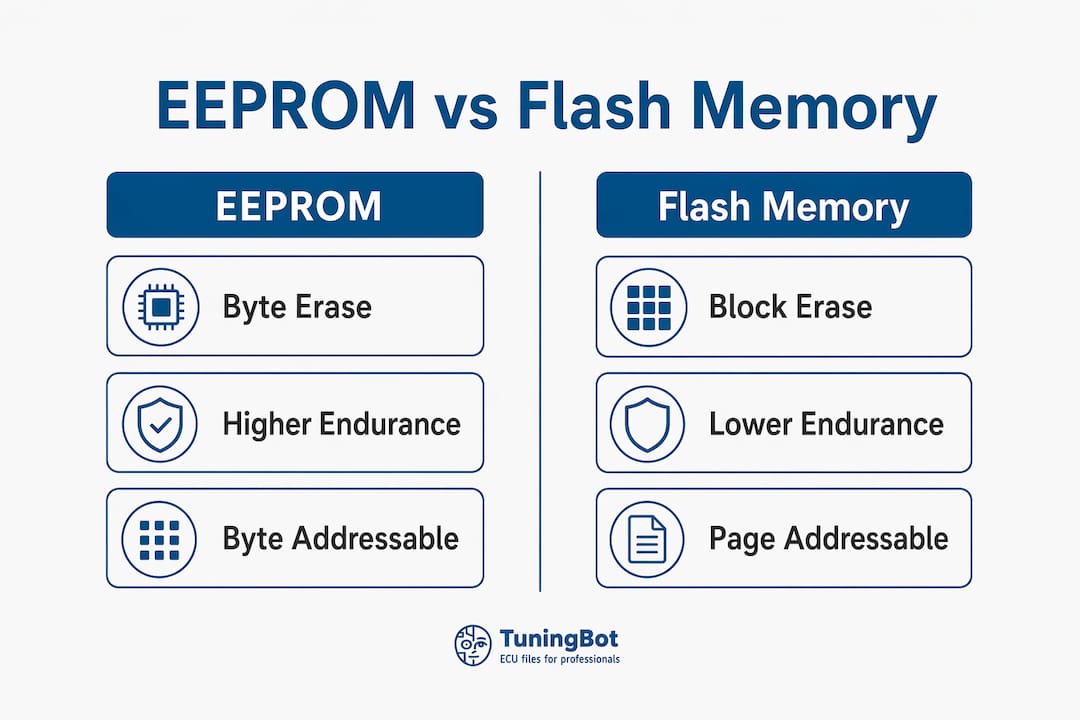
EEPROM in ECU vs. Flash memory: what changes?
Flash and EEPROM endurance vary widely by technology and manufacturer. Typical datasheet figures may range from thousands to hundreds of thousands of cycles, while EEPROM or emulated EEPROM strategies can achieve higher effective endurance through write management and wear leveling.
Frequently updated values are managed with endurance limits in mind, but the actual write strategy varies. Many ECUs use buffered updates, event-based writes or wear-leveling rather than writing every adaptation continuously.
EEPROM vs. Flash memory in ECU applications:
| Property | EEPROM | Flash Memory |
|---|---|---|
| Erase unit | Byte or page, device-dependent | Sector or block |
| Write endurance | Typically higher; datasheet-dependent | Typically lower; datasheet-dependent |
| Primary use | Configuration, security, adaptations | Firmware, calibration maps |
| Code execution | Normally data storage, not direct execution | Supported |
| Update frequency | Frequent but controlled | Infrequent firmware/calibration updates |
The separation of these two memory types in ECU design is deliberate. EEPROM handles frequently updated variables without disrupting the core code stored in Flash, and the byte-level modification capability keeps write operations targeted and efficient.
How do you identify EEPROM chips on an ECU circuit board?
Devices such as the 95320 are common serial EEPROMs in automotive electronics, but the package marking alone does not prove the chip’s function in a specific ECU. The circuit, datasheet and ECU documentation must be checked before reading or writing.

These external serial EEPROMs are normally used as data storage rather than for direct code execution, although modern microcontrollers may also contain internal non-volatile regions with different capabilities.
Identification checklist for EEPROM chips on ECU boards:
- Look for small 8-pin SOIC packages separate from the main MCU and larger Flash ICs
- Cross-reference part numbers against the 93Cxx, 95xxx, and 24Cxx datasheet families
- Trace SPI or I2C bus lines from the MCU to confirm the chip’s communication interface
- Use a magnifying loupe or digital microscope to read faint laser-etched part markings
- Consult ECU-specific pinout documentation to confirm chip function before probing
Pro Tip: Before probing an in-circuit EEPROM, check whether the MCU is actively driving the SPI or I2C bus. Bus contention between your programmer and the MCU can corrupt reads. Disabling the MCU oscillator or physically removing the EEPROM chip for bench reading eliminates that risk entirely.
Reprogramming, resetting, and cloning EEPROM data
Three distinct operations cover most EEPROM work in professional ECU servicing: reprogramming, resetting (virginizing), and cloning. Each has a specific purpose, and confusing them is one of the fastest ways to brick an ECU.
Reprogramming updates specific data fields within the EEPROM, such as writing new calibration offsets after a hardware modification or updating a key count after a transponder replacement. This is a targeted write operation that leaves unrelated data intact.
Virginizing modifies the security and configuration data required to let a used control unit enter a relearn or pairing procedure. It does not necessarily erase the entire EEPROM, and the exact bytes differ by ECU family and software version.
Cloning transfers the memory regions required to reproduce the original unit’s identity and security state. A complete clone may require EEPROM, internal Flash, external Flash, MCU data or protected OTP/security areas, depending on the ECU.
Common EEPROM programming operations and their purposes:
- Reprogramming: targeted data field updates for calibration or key management
- Virginizing: full factory reset for ECU reuse in a different vehicle
- Cloning: full memory transfer from donor to replacement ECU
- Backup: pre-work read of all EEPROM regions to enable recovery if a write fails
- Verification: post-write checksum confirmation to validate data integrity
Tools used for these operations span a range of hardware programmers. Devices supporting direct SPI/I2C access, such as those compatible with the ECU file checksum verification workflow, are standard in professional shops. OBD-based access is sometimes possible for reprogramming, but virginizing and cloning almost always require direct chip access.
EEPROM durability, reliability, and the rise of emulated EEPROM
Automotive-grade EEPROM parts are built to survive conditions that would degrade consumer-grade memory quickly. Modern automotive EEPROM maintains data integrity across wide temperature ranges, continuous vibration, and electrical noise from ignition systems and alternators. Write/erase endurance for automotive-specified parts reaches very high cycle counts, which comfortably covers the update frequency of adaptive data over a vehicle’s service life.
The comparison with Flash endurance is worth keeping in mind. Flash cells have a lower write/erase cycle limit and degrade measurably when used for high-frequency writes. That gap in endurance is precisely why engineers historically used dedicated EEPROM for adaptive data rather than storing everything in Flash.
Endurance note: Automotive EEPROM parts support very high write/erase cycle counts, compared to the considerably lower cycle ceiling typical of Flash memory blocks, a difference that directly drives ECU memory architecture decisions.
Many modern ECUs now use internal Flash memory configured as emulated EEPROM, often called dFlash. This approach reduces bill-of-materials cost by eliminating the external EEPROM chip. The trade-off is complexity: emulated EEPROM requires wear-leveling firmware that distributes writes across multiple Flash pages to prevent premature cell exhaustion. When that firmware has bugs or the Flash region is read incorrectly during cloning, the result is corrupted adaptive data or a failed immobilizer pairing. Technicians working with ECUs that use dFlash must account for this architecture when backing up or restoring memory regions. A tool that reads only the external EEPROM will miss the emulated region entirely, producing an incomplete clone.
Key Takeaways
EEPROM in an ECU is non-volatile, byte-addressable memory that stores security keys, VIN data, and adaptive calibrations separately from Flash-based firmware, with endurance ratings far exceeding Flash for high-frequency write applications.
| Point | Details |
|---|---|
| EEPROM stores critical vehicle data | Immobilizer keys, VIN, DTCs, and adaptive calibrations persist across power cycles in EEPROM. |
| Byte-level writes separate it from Flash | EEPROM commonly supports fine-grained writes; Flash usually requires sector or block erase operations. |
| Endurance exceeds Flash significantly | EEPROM generally offers higher endurance than Flash, but exact limits come from the device datasheet. |
| Emulated EEPROM adds complexity | dFlash-based emulation saves hardware cost but requires wear-leveling firmware and complete region reads during cloning. |
| Chip identification requires care | Many external EEPROMs use small packages and serial interfaces such as SPI, I²C or Microwire; identification must be confirmed from the circuit and datasheet. |
FAQ
What is EEPROM in an ECU?
EEPROM is non-volatile memory used to store configuration, coding, security or learned data that must survive power loss. The exact contents and physical location vary by ECU architecture.
How do you identify an EEPROM chip on an ECU board?
Look for likely serial-memory packages and cross-reference the marking with the datasheet and ECU documentation. Do not rely only on package size or part-number family, because similar devices can serve different functions.
Can you reprogram EEPROM in an ECU?
Yes, when the correct memory region, tool and procedure are known. Depending on the ECU, access may be through OBD, Bench, Boot, MCU service mode or direct chip programming.
What does resetting EEPROM do in an ECU?
Virginizing changes the security and configuration data needed for relearning or pairing. It does not always mean erasing the entire EEPROM, and an incorrect reset can make the ECU unusable.
TuningBot’s EEPROM, cloning and ECU file support
TuningBot supports professional workshops working with ECU and TCU files across Bosch, Continental, Delphi, Marelli, Denso, Siemens and ZF platforms, including VAG ECU and TCU cloning and IMMO Off. EEPROM-related jobs must be submitted with the exact ECU identification and complete memory data available from the chosen tool.
Before ordering, workshops can check ECU and TCU Service Coverage, review the public Price List and browse the available ECU services.
The file can then be submitted through Tune Your File without purchasing prepaid credits. TuningBot works with professional tools including Alientech KESS3, AutoTuner, Magic Motorsport, CMD, Dimsport and PCMFlash.
For related technical guidance, see What Is the Microchip Inside an ECU?, How an ECU File Is Written and the checksum correction guide.