

 EnglishEN
 ItalianoIT
 DeutschDE
 EspañolES
 PortuguêsPT
 РусскийRU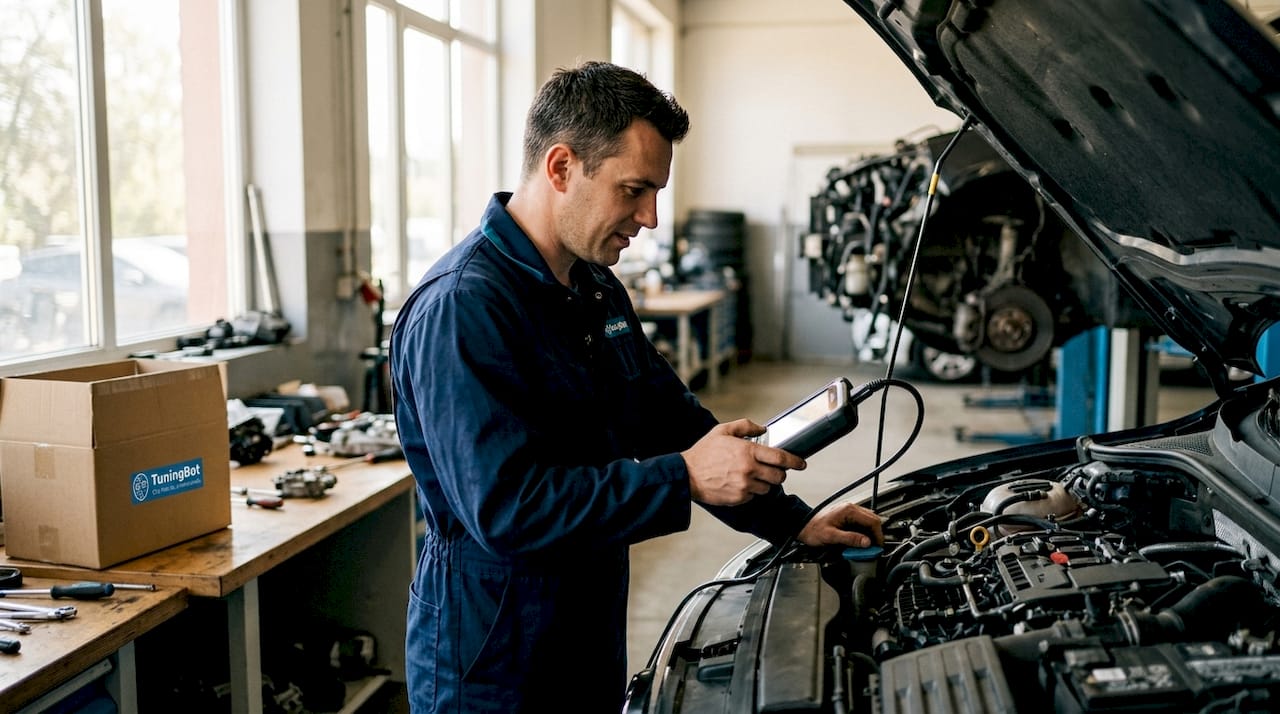
Rôle de l'ECU dans la gestion du moteur : capteurs, diagnostics et Sécurité
L'unité de commande du moteur (ECU) est définie comme l'ordinateur embarqué dédié qui régule l'injection de carburant, le calage de l'allumage, le régime de ralenti, le calage variable des soupapes et le contrôle des émissions dans les moteurs à combustion interne modernes. Des unités telles que le MED17 de Bosch et le Simos 18 de Continental représentent la norme actuelle en matière de conception d’ECU pour les systèmes de gestion moteur des équipementiers (OEM) ; elles traitent simultanément des dizaines de données provenant de capteurs afin d’assurer un contrôle précis de chaque phase de combustion. Le rôle de l’ECU dans la gestion du moteur va bien au-delà d’une simple mise en marche ou arrêt. Il assure un contrôle continu en boucle fermée, exécute des routines d’autodiagnostic, applique des protocoles de sécurité et concilie des objectifs contradictoires, notamment la puissance délivrée, la consommation de carburant et la conformité aux normes d’émissions. Comprendre le fonctionnement de ce système est essentiel pour tout professionnel travaillant dans le domaine du calibrage des calculateurs, de la remapping ou du diagnostic des défauts.
Table des matières
- Comment l'ECU contrôle-t-il les fonctions principales du moteur telles que l'injection de carburant et l'allumage ?
- Quelles fonctions de diagnostic et de contrôle des émissions l'ECU effectue-t-il ?
- Comment les entrées des capteurs influencent-elles les performances du calculateur (ECU) et la manœuvrabilité du moteur ?
- Quelle est l'architecture logicielle des calculateurs model et security model intégrés aux calculateurs modernes ?
- L'essentiel
- Pourquoi la plupart des diagnostics d'ECU échouent avant même de commencer
- Fichiers ECU tuning professionnels et solutions remapping
- FAQ
- Recommandé
Comment l'ECU contrôle-t-il les fonctions principales du moteur telles que l'injection de carburant et l'allumage ?
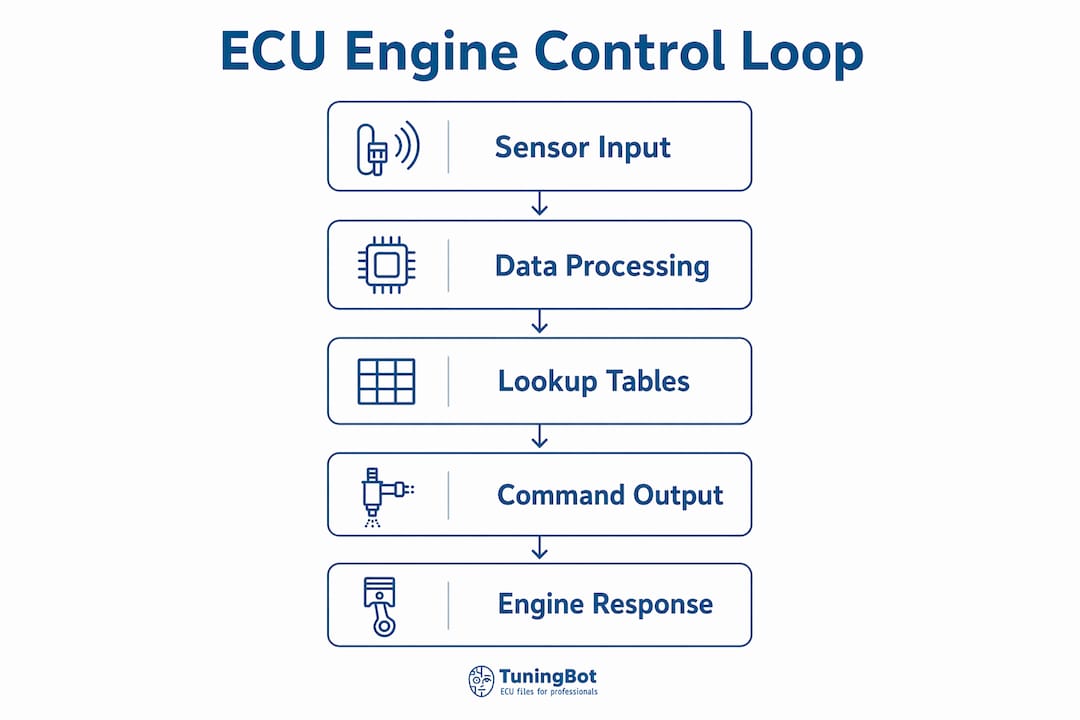
Le calculateur contrôle les fonctions du moteur grâce à une boucle continue de lecture, de traitement et de commande, dans laquelle les données des capteurs entrent, sont comparées à tables de correspondance étalonnées, et les commandes des actionneurs sortent en quelques millisecondes. Cette boucle s'exécute des centaines de fois par seconde lors du fonctionnement normal du moteur. La qualité de chaque sortie dépend directement de la précision de chaque entrée alimentant ce cycle.
Principaux capteurs influençant les décisions relatives au carburant et à l'allumage
Le calculateur (ECU) puise dans un ensemble défini de capteurs pour calculer les paramètres d'alimentation en carburant et d'allumage :
- Capteur de position de vilebrequin (CKP) : Fournit la vitesse du moteur en tr/min et la position du piston, l'axe principal pour tous les calculs de calage.
- Capteur de position d'arbre à cames (AAC) : Confirme la phase du calage des soupapes par rapport à la position du vilebrequin, ce qui est essentiel pour le séquençage de l'injection.
- Capteur de débit d'air massique (MAF) : Mesure directement la masse d'air entrant, alimentant l'axe de charge principal dans les cartes de carburant.
- Capteur de pression absolue de collecteur (MAP) : Utilisé dans les systèmes de vitesse-densité comme alternative ou complément au MAF pour le calcul de la charge.
- Capteur d'oxygène à large bande (O2/lambda) : Fournit un retour d'information sur le rapport air-carburant en temps réel pour la correction de l'injection en boucle fermée. AEM Bosch LSU 4.9 Il s'agit d'un capteur de remplacement largement utilisé dans les environnements professionnels tuning.
- Capteur de température du liquide de refroidissement (ECT) : Ajuste l'enrichissement en carburant et l'avance à l'allumage pendant les phases de démarrage à froid et de réchauffement.
- Capteur de position du papillon (TPS) : Indique la demande du conducteur et le taux de variation, déclenchant les routines d'enrichissement de l'accélération.
Une fois ces données collectées, l'ECU fait référence tables de correspondance 2D et 3D interpolées en fonction du régime et de la charge afin de déterminer la largeur d'impulsion de carburant de base et l'avance à l'allumage. La qualité de l’état des capteurs détermine la stabilité de la régulation, en particulier aux limites de la carte où les erreurs d’interpolation s’accumulent. Un signal MAF degraded, par exemple, déplace le point de fonctionnement hors de la zone calibrée de la carte et oblige l’ECU à recourir à des stratégies de repli en boucle ouverte qui sacrifient à la fois le rendement et la puissance.
La correction en boucle fermée applique une correction de mélange à court terme (STFT) et une correction de mélange à long terme (LTFT) par-dessus les valeurs de la cartographie de base, en utilisant le signal de retour du capteur lambda pour converger vers le rapport air-carburant cible. Le calage de l'allumage suit un processus de correction similaire : le signal du capteur de cliquetis retarde le calage lorsqu'une détonation est détectée, puis le réavance progressivement dès que le problème disparaît.
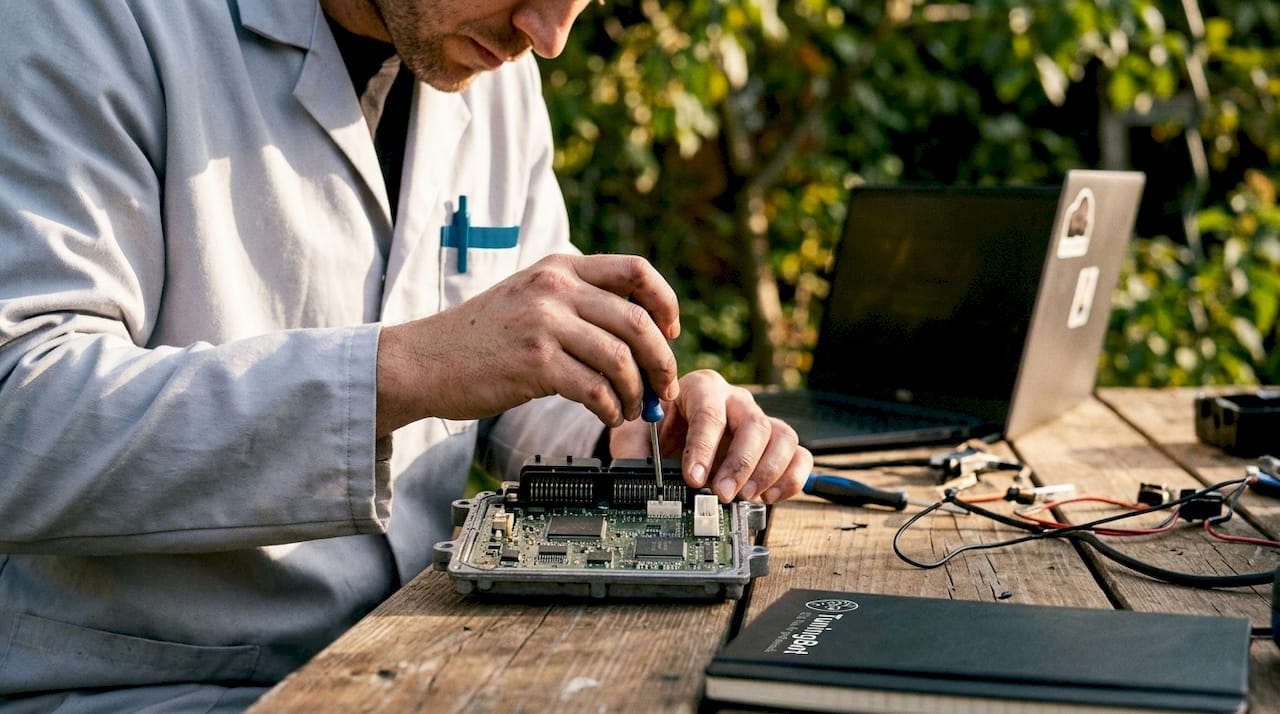
Astuce de pro : Lors du diagnostic d'anomalies d'alimentation en carburant, vérifiez séparément les valeurs LTFT au ralenti et à charge partielle. Une valeur LTFT supérieure à ±10% au ralenti indique généralement une fuite de dépression ou un dysfonctionnement du système de régulation de l'air de ralenti, tandis qu'un écart de la valeur LTFT à charge partielle suggère une erreur d'étalonnage du débitmètre d'air massique (MAF) ou un déséquilibre du débit des injecteurs.
Quelles fonctions de diagnostic et de contrôle des émissions l'ECU effectue-t-il ?
L'ECU effectue un autodiagnostic continu via les moniteurs de disponibilité OBD-II, qui sont autotests exécutés pendant la conduite pour confirmer que les systèmes liés aux émissions fonctionnent selon les spécifications. Ces moniteurs ont des critères d'activation spécifiques et ne se terminent pas simplement en démarrant le moteur. Cette distinction est la cause de plus d'échecs aux contrôles des émissions que la plupart des techniciens ne le prévoient.
L'ECU execu exécute les fonctions de diagnostic et de contrôle des émissions suivantes, dans l'ordre, au cours d'un cycle de conduite standard :
- Moniteur de catalyseur : Évalue l'efficacité du catalyseur en comparant les vitesses de commutation des sondes à oxygène amont et aval. Nécessite un moteur complètement chaud à une charge de croisière stable.
- Moniteur des émissions de vapeurs de carburant (EVAP) : Teste le système de récupération des vapeurs de carburant à la recherche de fuites en mettant sous pression ou en appliquant un vide sur le circuit du réservoir de carburant. Nécessite des conditions spécifiques de température ambiante et de niveau de carburant.
- Moniteur de capteur d'oxygène : Vérifie le temps de réponse du capteur et la fréquence de commutation. Un capteur lent qui franchit les seuils de tension peut tout de même échouer à ce test de surveillance.
- Moniteur EGR : Confirme que le Vanne EGR s'ouvre et s'écoule correctement en vérifiant la réponse de la pression du collecteur lors d'événements EGR commandés.
- Moniteur de ratés d'allumage : Fonctionne en continu, en utilisant les données d'accélération du vilebrequin pour détecter les événements de combustion qui ne parviennent pas à produire l'impulsion de rotation attendue.
Chaque moniteur conserve un indicateur d’état “ réussi/échoué ”. Lorsqu’un code de diagnostic (DTC) est effacé ou que la batterie est débranchée, tous les indicateurs des moniteurs reviennent à l’état “ non prêt ”. L’effacement des codes d’erreur ne réinitialise pas immédiatement l’état de préparation aux tests d’émissions. Un cycle de conduite complet, tel que spécifié par le constructeur, doit être effectué avant que les moniteurs ne reviennent à l’état « prêt » ; c’est pourquoi un véhicule peut sembler ne présenter aucun défaut tout en échouant à un contrôle des émissions.
L'ECU effectue également des contrôles d'authentification de l'antidémarrage au démarrage, en vérifiant que la clé à transpondeur correspond au code security enregistré avant d'activer l'injection de carburant. Sur des plateformes telles que Bosch MED17, ce contrôle est intégré dans la couche d'algorithmes de contrôle principale plutôt que d'être géré par une fonction distincte.
Astuce de pro : Après avoir effacé les codes d'erreur ou remplacé la batterie, utilisez un outil de diagnostic pour surveiller l'état de préparation en temps réel pendant le cycle de conduite. Ne soumettez pas le véhicule au contrôle des émissions tant que tous les moniteurs concernés n'affichent pas “ terminé ”. Les moniteurs EVAP et catalyseur sont généralement les derniers à s'activer et nécessitent les conditions d'activation les plus spécifiques.
Comment les entrées des capteurs influencent-elles les performances du calculateur (ECU) et la manœuvrabilité du moteur ?
L'intégrité des capteurs est le facteur le plus déterminant pour la qualité du contrôle de l'ECU. L'ECU ne peut pas compenser les données d'entrée dont il ne peut pas vérifier l'exactitude, et Les pannes de capteurs causent des problèmes de maniabilité notamment un ralenti irrégulier, des hésitations, l'activation du mode de secours mode et des problèmes de démarrage. Chaque symptôme correspond à un ensemble prévisible de pannes de capteurs mode.
| Capteur | Fonction principale du calculateur | Symptôme de panne |
|---|---|---|
| Capteur de position de vilebrequin | régime et référence de calage | Ne démarre pas ou cale ; pas d'impulsion d'injection |
| Débitmètre d'air massique | Calcul de charge pour le ravitaillement en carburant | Pompage riche/pauvre, mauvaise réponse à l'accélérateur |
| Température du liquide de refroidissement (LDR) | Enrichissement à froid, commande du ventilateur | Démarrage à froid difficile, surchauffe, mauvais ralenti |
| Position du papillon (TPS) | Signal de demande, enrichissement à l'accélération | Hésitation, ralenti irrégulier, perte de puissance mode |
| Capteur de cliquetis | Retard à l'allumage sous détonation | Puissance réduite, avance à l'allumage excessivement retirée |
| O₂ à large bande | Correction lambda en boucle fermée | Saturation des corrections de carburant, échec des émissions |
Le limp mode « Limp mode » est la réponse de protection de l’ECU face à un défaut de capteur qu’il ne peut résoudre par une simple correction. Le limp mode de secours remplace l’entrée manquante par une valeur par défaut fixe et limite la puissance du moteur afin d’éviter tout dommage mécanique. Un véhicule passant en limp mode de secours sur un moteur diesel équipé d’un calculateur Bosch EDC17, par exemple, plafonnera généralement la pression boost et limitera le régime moteur tout en générant un code d’erreur identifiant le circuit d’entrée défaillant.
La procédure de diagnostic prioritaire consiste toujours à vérifier les capteurs et le câblage avant tout remplacement de l'ECU. De nombreux problèmes de conduite trouvent leur origine dans des imprécisions des capteurs ou des défauts de câblage plutôt que dans une défaillance réelle de l'ECU. Remplacer un calculateur sans avoir vérifié la tension d'alimentation des capteurs, le retour de signal et l'intégrité de la masse integr fait perdre du temps et de l'argent. Un circuit de référence de 5 V partagé entre plusieurs capteurs est un point de défaillance courant qui génère plusieurs codes d'erreur simultanés et simule de manière convaincante une défaillance du calculateur.
Quelle est l'architecture logicielle des calculateurs model et security model intégrés aux calculateurs modernes ?
Les micrologiciels modernes des calculateurs utilisent une architecture logicielle en couches qui sépare les algorithmes de contrôle des fonctions du chargeur d'amorçage et des piles de communication de diagnostic. Cette séparation n'est pas le fruit du hasard. Elle définit la manière dont les mises à jour d'étalonnage sont appliquées, comment la sécurité est assurée, et où des modifications peuvent être apportées sans altérer les zones de code protégées.
Les couches logicielles clés dans des plateformes telles que Bosch MED17 et Continental Simos 18 sont structurées comme suit :
- Couche application : Contient les algorithmes principaux de commande du moteur (algorithms), notamment ceux relatifs à l'alimentation en carburant, à l'allumage, à la gestion du couple et aux émissions. C'est là que se trouvent les cartographies d'étalonnage des équipementiers et que sont appliquées les modifications de tuning.
- Couche de démarrage : Gère les opérations de mise à jour du micrologiciel, vérifie l'intégrité des données entrantes et contrôle les zones de mémoire pouvant être écrites lors d'une mise à jour. Le Continental Simos 18 utilise un chargeur d'amorçage multicouche comportant des vérifications d'intégrité qui doivent être validées avant que toute opération sur la mémoire flash ne puisse être lancée.
- Couche de diagnostic : Gère les protocoles de communication UDS et KWP2000, le stockage et la récupération des DTC, ainsi que le rapport des moniteurs de préparation OBD-II. Cette couche fonctionne indépendamment de la couche application afin de maintenir l'accès au diagnostic même en présence de défauts au niveau de l'application.
- Couche Sécurité : Permet la vérification des signatures RSA, des numéros de vérification d'étalonnage (CVN) et la liaison des composants. Le Simos 18 security model utilise des signatures numériques et des contrôles d'intégrité qui empêchent les mises à jour non autorisées du micrologiciel au niveau matériel.
Les cartes d'étalonnage sont stockées sous forme de données structurées au sein de la couche applicative ; les algorithmes de contrôle y font référence lors de l'exécution. Les sommes de contrôle protègent l'intégrité des données des cartes. Lorsqu'un tuner modifie des cartes de carburant ou d'allumage, la checksum doit être recalculée pour correspondre aux nouvelles données, sinon l'ECU rejettera le fichier modifié ou passera en état de défaut. Comprendre Structure du micrologiciel du calculateur et la gestion checksum est une condition préalable à toute intervention professionnelle sur remapping. Les algorithmes de clé de départ Sécurité ajoutent une couche supplémentaire, exigeant que l'outil tuner réussisse un test d'authentification avant que l'ECU n'accorde l'accès en écriture aux zones de mémoire protégées.
L'essentiel
Le rôle de l'ECU dans la gestion du moteur consiste à traiter en continu les données fournies par les capteurs à l'aide de cartographies et d'algorithmes étalonnés, afin de contrôler l'injection de carburant, le calage de l'allumage, et les systèmes d’émissions, tout en appliquant les protocoles de diagnostic et de sécurité qui régissent la manière dont le logiciel peut être mis à jour ou certifié.
| Point | Détails |
|---|---|
| Boucle de contrôle continue | Le calculateur lit les capteurs, consulte des tables de correspondance et commande des actionneurs des centaines de fois par seconde. |
| Réinitialisation du moniteur de préparation | L'effacement des codes défauts (DTC) réinitialise tous les indicateurs de contrôle OBD-II ; un cycle de conduite complet est nécessaire avant le test des émissions. |
| Défauts de capteurs avant le remplacement du calculateur | La plupart des problèmes liés au comportement routier sont dus à des défaillances de capteurs ou de câblage, et non à une défaillance de l'ECU module. |
| Architecture de microprogramme en couches | Les couches « application », « bootloader » et « diagnostic » sont distinctes ; le tuning ne modifie que la couche « application ». |
| Contrôle de somme et application de la norme security | Pour que la mise à jour soit effectuée avec succès, les fichiers d'étalonnage modifiés nécessitent un nouveau calcul correct de la valeur checksum ainsi qu'une authentification par clé de départ. |
Pourquoi la plupart des diagnostics d'ECU échouent avant même de commencer
D'après mon expérience avec les fichiers ECU sur les plateformes Bosch MED17, EDC17, Continental Simos 18 et Delphi DCM, le schéma qui revient le plus souvent est celui d'un diagnostic erroné résultant d'une approche axée sur les symptômes. Un technicien détecte un code d'erreur P0101 (MAF), remplace le capteur, et le défaut réapparaît en moins d'une semaine. Le capteur n'était en réalité pas la cause première du problème. Le circuit d'admission d'air présentait un tuyau fendu en amont du MAF, et le capteur de remplacement mesurait le même débit d'air faussé que le capteur d'origine.
Le ECU est un instrument de précision. Il transmet les informations que ses capteurs lui fournissent. Lorsque le rapport semble erroné, le réflexe est de blâmer celui qui l'a établi. Mais le ECU fait presque toujours exactement ce pour quoi il a été conçu, à partir des données dont il dispose. Le véritable travail de diagnostic consiste à vérifier l'exactitude des données avant de tirer des conclusions sur le comportement du module.
Je constate également une confusion persistante concernant l'état de préparation des émissions après l'effacement des codes. Les ateliers effacent un défaut, confirment qu'il ne revient pas et envoient le véhicule au contrôle technique. Le véhicule est refusé parce que trois moniteurs indiquent toujours “ non prêt ”. Le cycle de préparation OBD-II n'est pas facultatif et ne peut être ignoré. Intégrer cette étape dans chaque processus post-réparation élimine complètement une catégorie de retours en atelier.
Du côté du tuning, la complexité croissante de la ECU security sur des plateformes telles que Simos 18 fait que les erreurs checksum et les échecs d’authentification constituent désormais les causes les plus courantes de non-démarrage d’un remap. La compréhension de la structure du micrologiciel n'est pas une connaissance facultative pour un professionnel du tuner. C'est la base indispensable.
— Équipe technique de TuningBot
Fichiers ECU tuning professionnels et solutions remapping
La compréhension de l'architecture du ECU constitue la base. C'est en mettant ces connaissances en pratique par le biais d'un étalonnage de précision que l'on parvient à améliorer les performances.
TuningBot propose des services professionnels Fichiers ECU remapping pour les ateliers et les tuners travaillant sur les plateformes Bosch, Continental, Delphi, Marelli, Denso et Siemens. Les services couvrent les montées en puissance du Stage 1 au Stage 3, le DPF Off, l'EGR Off, la suppression des DTC, l'IMMO Off, le tuning DSG/TCU et la correction du checksum. Les fichiers sont livrés avec un vrai support d'ingénieur, sans crédits prépayés. Utilisez le TuningBot Couverture des services ECU page pour vérifier si une famille ECU spécifique et le service demandé sont pris en charge avant d'envoyer un fichier. Téléchargez votre fichier et obtenez un résultat calibré adapté à votre matériel spécifique.
FAQ
Quel est le rôle principal du ECU dans la gestion du moteur ?
Le ECU est l'unité centrale de gestion du moteur qui analyse les données fournies par les capteurs et contrôle l'injection de carburant, le calage de l'allumage, le régime de ralenti, le calage variable des soupapes et les systèmes de contrôle des émissions à l'aide de cartographies et d'algorithmes calibrés. Il contrôle de multiples sous-systèmes simultanément pour équilibrer la puissance, l'rendement et la conformité aux émissions.
Pourquoi les moniteurs de préparation OBD-II affichent-ils “ non prêts ” après l'effacement des codes ?
La suppression des codes d'erreur réinitialise tous les indicateurs de fin de contrôle à l'état “ inachevé ”. Le ECU doit effectuer chaque autotest de contrôle de disponibilité dans des conditions de conduite spécifiques avant que les indicateurs ne repassent à « prêt » ; c'est pourquoi les essais d'émissions ne doivent pas être effectués immédiatement après la suppression d'un code.
Un capteur défectueux peut-il provoquer des symptômes ressemblant à une défaillance du ECU ?
Oui. Les défaillances des capteurs et les problèmes de câblage entraînent des symptômes tels qu'un ralenti irrégulier, un fonctionnement en mode dégradé, des à-coups et un refus de démarrage, qui sont souvent attribués à tort à une défaillance du module ECU. La procédure de diagnostic correcte consiste à vérifier la tension d'alimentation et l'intégrité du signal du capteur avant de remplacer le ECU module.
Qu'est-ce qu'une carte d'étalonnage dans un ECU ?
Une carte d'étalonnage est une table de consultation en 2D ou 3D stockée dans la couche applicative du ECU, indexée par des paramètres tels que le régime (RPM) et la charge du moteur, qui définit les valeurs cibles pour l'injection de carburant, l'avance à l'allumage, la pression du boost et d'autres variables contrôlées. Le ECU effectue une interpolation entre les cellules de la carte en temps réel afin de calculer les commandes des actionneurs.
Quel est l'impact de la mutation ECU security sur la protéine remapping ?
Les modèles ECU modernes, tels que le Continental Simos 18, utilisent la vérification de signature RSA, le CVN checksum et la liaison des composants pour empêcher les mises à jour non autorisées du micrologiciel. Une utilisation professionnelle remapping nécessite une configuration correcte Nouveau calcul checksum et l'authentification par clé de graine pour enregistrer avec succès les données d'étalonnage modifiées.