

 EnglishEN
 ItalianoIT
 DeutschDE
 EspañolES
 PortuguêsPT
 РусскийRU
Rev matching tuning guide workflows should begin by identifying what the vehicle already exposes to the ECU or TCU: throttle-by-wire capability, clutch/gear or shift-state signals, engine speed, transmission speed and any OEM rev-match logic. There is no universal requirement for clutch position, output-speed sensors, a dedicated blip table or one target-RPM formula across every platform. A professional approach separates OEM-integrated rev matching, manual-transmission blip control, automatic/dual-clutch shift coordination and aftermarket standalone modules, then validates the actual signals and control path before changing calibration.
Before ordering a remap or a module, run through this feasibility check:
- Confirm whether the vehicle already has OEM rev-match or torque-coordination logic.
- Identify throttle type and the clutch/gear/shift-state signals actually available to the ECU or TCU.
- Record engine speed, transmission speed and relevant driver/shift inputs before calibration.
- Check clutch, flywheel, gearbox and driveline condition before attributing harshness to software.
- Confirm the ECU/TCU is supported by the chosen flashing or calibration workflow.
- Preserve the source file and define a supported recovery path before writing.
TL;DR:
- Rev matching depends on the control signals and functions available on the exact ECU/TCU platform; DBW is common but not the only architectural question.
- Manual, dual-clutch and automatic transmissions use different torque/shift coordination strategies.
- Blip magnitude, timing and damping should be derived from measured response rather than a fixed overshoot target.
- OEM-integrated logic, ECU/TCU calibration and standalone modules are different solutions with different capabilities.
- Baseline logging and exact platform identification are more important than generic rev-match formulas.
Rev Matching Tuning Guide: How ECU and TCU Coordination Works
OEM rev-match systems can use engine speed, clutch/shift state, gear information and transmission-speed data to coordinate target engine speed, but the exact inputs and control algorithm are manufacturer-specific.
Honda’s Rev Match Control System is a useful OEM example because it shows how clutch/shift information and engine torque control can be coordinated. It should not be treated as the architecture used by every ECU.
- Throttle/torque request may raise engine speed during a downshift where the platform supports it.
- Fuel and ignition can shape torque response on spark-ignition engines where the ECU uses those controls for the event.
- TCU/shift-state logic may coordinate torque reduction or speed matching on automated transmissions.
- The exact control path should be confirmed from OEM or calibration documentation for the specific platform.
OEM systems use their own target tolerances, filters and intervention limits. Do not assume a universal 50–100 RPM overshoot allowance or one stability-control interaction model.
Rev Matching Tuning Guide: Which Parameters Actually Matter
The parameters that influence rev-match behavior vary by platform. Some ECUs expose dedicated blip logic; others coordinate torque request, throttle, fueling, ignition or TCU shift state through different strategies.
- Driver/throttle request: Where supported, this shapes how quickly the ECU requests engine torque or throttle during a blip.
- Torque/fuel/ignition control: These may influence how engine speed rises or falls, depending on ECU architecture.
- Clutch/gear/shift-state conditioning: Signal filtering and event detection determine when the blip is allowed to trigger.
- ECU/TCU coordination: Automated transmissions can require torque and speed coordination across both controllers.
- Blip duration/damping or equivalent control: Only adjust where the platform exposes a documented strategy.
These functions do not exist in the same form in every ECU. Confirm the actual software strategy before editing.
Rev Matching Tuning Guide: Platform Feasibility Checklist
Before changing calibration or adding hardware, verify whether the vehicle already has the signals and control authority required for the intended rev-match behavior.
- Throttle/torque authority: Confirm the ECU can command engine torque quickly enough for the intended function.
- Signal access: Verify the clutch, gear/neutral, shift-state or transmission-speed signals actually used by that vehicle.
- Driveline condition: Clutch, flywheel, gearbox and mounts should be healthy before calibration.
- ECU/TCU support: Confirm the relevant control unit and file workflow are flashable/calibratable with the chosen tools.
Astuce de pro : Log clutch position, gear signal, and RPM through a full drive cycle before you touch a single map. That baseline tells you whether the car’s signals are clean enough to trust, and it saves hours of guesswork once calibration starts.
Rev Matching Tuning Guide: ECU/TCU Calibration vs Standalone Modules
There isn’t one correct path here. The right choice depends on how much electronic control the car already has and how integrated you need the result to feel.
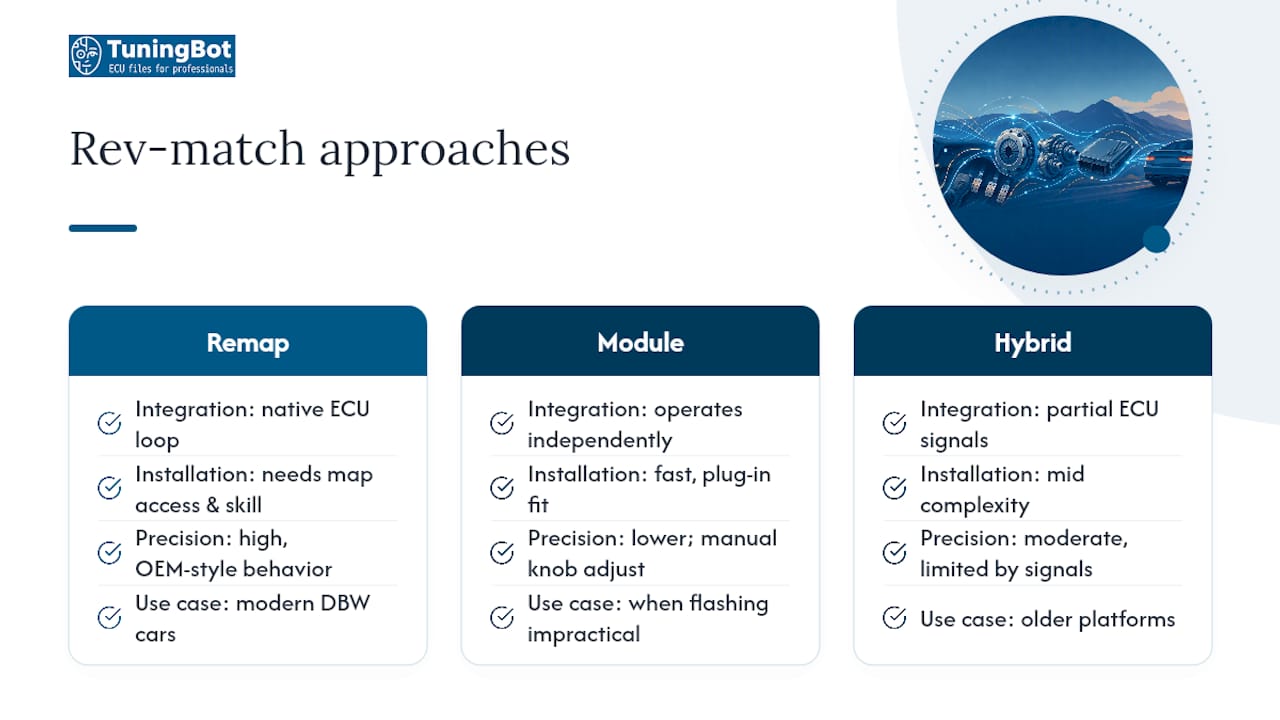
An integrated ECU/TCU calibration can be appropriate when the platform exposes the necessary signals and logic. It is not universally superior to a standalone module; the best approach depends on the vehicle architecture and intended use.
Standalone blip modules are separate control systems that can be useful when the factory ECU does not expose suitable rev-match logic. Their behavior and precision depend on product design, signal access and installation quality.
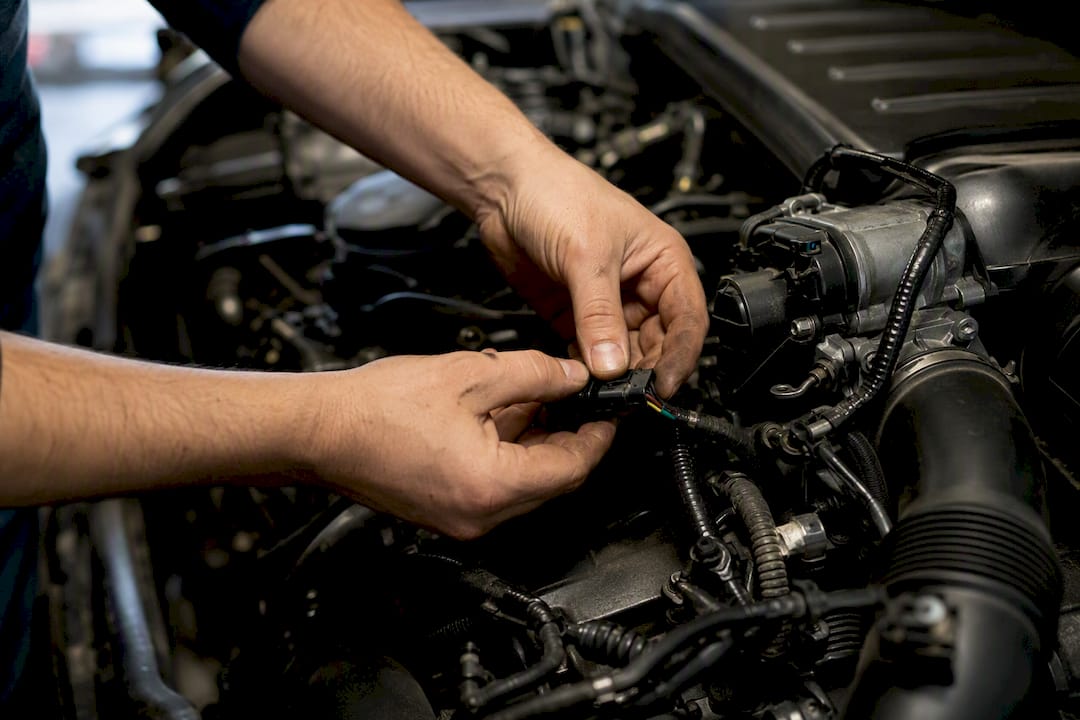
Hybrid or mixed-control approaches can be appropriate where the vehicle has partial electronic control but the factory ECU/TCU cannot provide the desired function alone.
Hardware upgrades are worth considering only when the baseline hardware is the actual bottleneck: a worn clutch, a mismatched flywheel, or missing sensors. Chasing a hardware fix before confirming the ECU calibration is right usually wastes money.
Rev Matching Tuning Guide: Professional Calibration Workflow
A rev matching tuning guide should treat calibration as iterative and data-driven. Use the signals available on the actual platform to measure target speed, overshoot/undershoot and shift smoothness.
- Identify the control architecture and any existing OEM rev-match logic.
- Capture baseline logs for the available clutch/shift, gear, engine-speed and transmission-speed signals.
- Confirm the target-speed calculation or event logic used by the exact platform.
- Adjust only the supported blip/torque/shift parameters and preserve the source file.
- Validate progressively across representative gears and speeds under safe conditions.
- Use the tool-supported recovery or stock-return path; do not assume every file contains a separate default map.
| Validation stage | Que vérifier |
|---|---|
| Signal baseline | Clutch/shift, gear and speed signals are stable and interpreted correctly. |
| Trigger logic | The event occurs only on the intended shift/downshift condition. |
| Speed matching | Engine speed approaches the target without excessive overshoot or undershoot. |
| Driveline behavior | No unexpected torque intervention, clutch shock or gearbox fault occurs. |
| Recovery/reference | The previous validated calibration or supported stock-return workflow remains available. |
Rev Matching Tuning Guide: Common Failure Modes
Poor rev-match behavior can show up as overshoot, undershoot, delayed blips, false triggering, harsh clutch engagement or torque intervention. No single failure mode dominates every platform.
Well-matched engine and transmission speed can reduce clutch slip during some downshifts, but the wear effect depends on driver behavior, clutch design and the accuracy of the control strategy. Do not promise a universal clutch-life benefit.
A few maintenance notes worth keeping in mind:
- Flywheel, clutch or gearbox changes can alter the required blip behavior and should trigger re-validation.
- Power/torque changes can alter the shift event or engine deceleration rate, so previous rev-match calibration may no longer be ideal.
- Signal filtering or CAN interpretation errors can cause false or late triggering.
- Mechanical transmission modifications should be treated separately from ECU/TCU calibration.
Why Rev Matching Depends on the Platform, Not the Trend
In a rev matching tuning guide, the correct solution depends on vehicle architecture, not on whether a remap or module sounds more sophisticated.
File-based ECU/TCU calibration is a good fit only when the platform exposes the required rev-match or torque-coordination strategies. Standalone modules remain a valid option when those strategies are unavailable or inaccessible.
— Équipe technique de TuningBot
How TuningBot Fits Into Rev-Matching Calibration Workflows
TuningBot can provide calibration files for supported ECU/TCU workflows where the requested rev-match or shift-related function exists in the exact software version.
Couverture des services ECU lets workshops check supported functions, while the Liste de prix publique et Services de l'ECU pages keep commercial intent on the service side.
For technical context, use How Remap Affects Torque Curve, Erreurs courantes en réglage ECU et le Checksum Correction Guide.
Submit a supported source file through Reprogrammer le fichier only after confirming the ECU/TCU and requested function are covered.
This article stays informational and technical so commercial ECU/TCU tuning keywords remain concentrated on TuningBot’s service and order pages.
Rev Matching Tuning Guide: Key Takeaways
A reliable rev matching tuning guide should confirm platform feasibility, signal quality, control authority and driveline behavior before any calibration change.
| Point | Détails |
|---|---|
| Platform architecture decides feasibility | Do not assume every DBW vehicle exposes the signals or calibration logic required. |
| Signals must be verified | Clutch/shift state, gear and speed data should be checked on the actual vehicle. |
| Integrated calibration is not always best | ECU/TCU calibration and standalone modules solve different platform constraints. |
| Overshoot is not the only risk | Late triggering, undershoot, false events and torque intervention can also create poor drivability. |
| Clutch-life benefits are not guaranteed | Wear depends on driver use, clutch design and the accuracy of speed matching. |
| Validate before release | Use matched logs and representative shift events rather than subjective feel alone. |
Sources and Further Reading
- Honda — Rev Match Control System — authoritative OEM rev-match reference retained unchanged.
- Bronco6G — manual transmission tuning discussion — external community reference retained unchanged.
- The Mustang Source — custom tune/rev matching discussion — external community reference retained unchanged.
- CarTech Books — manual transmission performance upgrades — external mechanical-driveline reference retained unchanged.
- Supercars Parts — external parts supplier retained unchanged; not a calibration source.
- TuningBot — How Remap Affects Torque Curve — verified internal torque-response reference.
- TuningBot — Common ECU Tuning Mistakes — verified internal workshop-process reference.
- TuningBot — ECU File Checksum Correction — verified internal integrity reference.
FAQ
What Is the Best Technique for Rev-Matching Tuning?
There is no universal best technique. Use the method supported by the vehicle’s control architecture: OEM ECU/TCU logic where accessible, or a standalone solution when the factory system cannot provide the function.
Can You Tune Rev Matching on an Automatic?
Some automatic and dual-clutch platforms coordinate engine speed and shift torque through ECU/TCU logic, but availability and tunability are transmission- and software-specific.
Does Rev Matching Hurt the Clutch?
Accurate speed matching can reduce clutch slip during some shifts, while poor timing or aggressive torque intervention can add driveline shock. The net wear effect is vehicle- and driver-specific.
Is Rev Matching Actually Necessary?
No. It is a drivability/shift-quality strategy rather than a requirement for normal engine operation, and some drivers or platforms do not need it.