

 ItalianoIT
 DeutschDE
 EspañolES
 PortuguêsPT
 FrançaisFR
 РусскийRU
Online remap file delivery is the structured exchange of ECU and TCU files between a workshop and a calibration service through a dedicated digital workflow. The process normally includes ECU reading, file upload, order data, engineer review, delivery of the calibrated file, flashing and post-write validation. A professional platform reduces versioning mistakes and administrative friction, but the workshop remains responsible for correct ECU identification, vehicle diagnostics, stable flashing conditions and final validation.
How the online remap file delivery process works step by step
The remap delivery workflow follows a defined sequence: the workshop reads the original ECU file, uploads it, the tuner modifies and returns it, and the workshop downloads and flashes the completed file. Each stage has a clear handoff point, which eliminates the ambiguity common in informal methods. Knowing each step helps technicians catch errors before they reach the vehicle.
Step 1: Read and extract the original ECU file
The technician connects a hardware interface, such as Alientech KESS3, AutoTuner, Magic Motorsport, CMD, Dimsport, or PCMFlash, to the vehicle’s OBD port or ECU bench connector. The tool reads the binary data stored in the ECU and saves it as a file, typically in formats like .bin, .ori, or .hex. This original file is the baseline for all tuning work.
Step 2: Upload the original file to the portal

Accepted formats vary by portal and tuning tool. Common ECU binaries include .bin, .ori, .hex and tool-specific encrypted formats, while ZIP files may be used for packaging. PDF and TXT files are normally supporting documents rather than flashable ECU data.
Step 3: The tuner modifies and returns the file
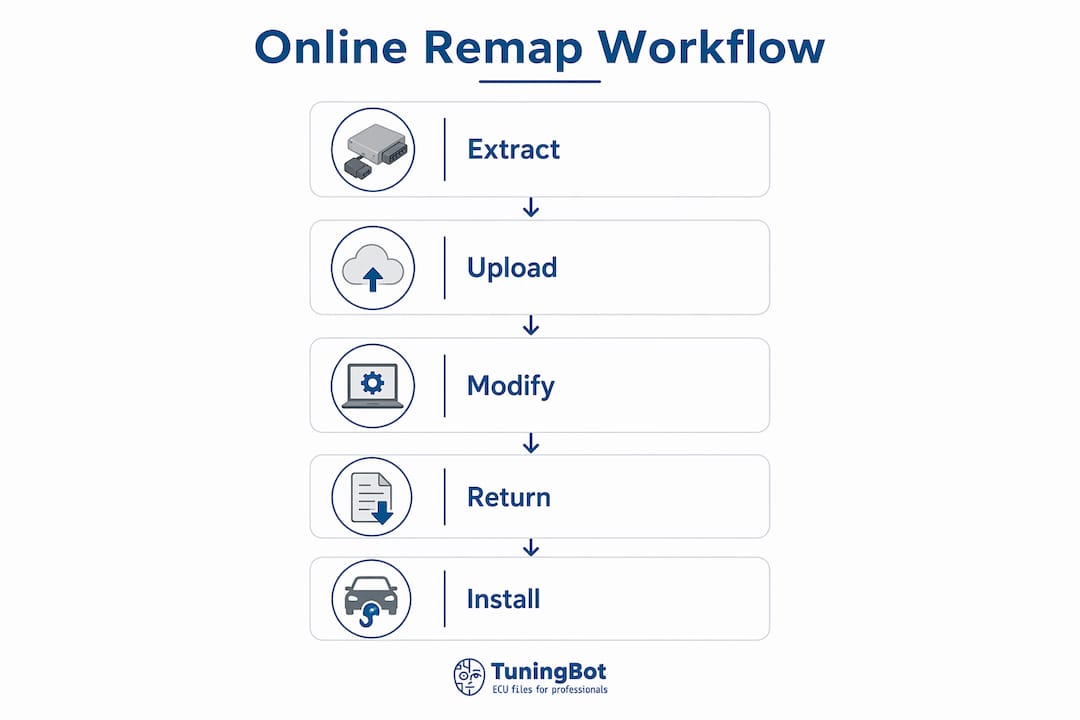
The assigned engineer receives the file, applies the requested calibration changes (Stage 1, DPF Off, EGR Off, DSG tuning, or other services), and uploads the completed tuned file back to the portal. The file status updates move through defined states: Pending, Processing, Completed, On Hold, or Rejected. This gives the workshop full visibility without needing to contact the tuner directly.
Step 4: Download and flash the tuned file
Once the status shows Completed, the workshop receives an email or SMS notification. The technician downloads the tuned file and writes it back to the ECU using the same hardware interface. The vehicle is then tested to confirm correct operation.
- Always verify the file checksum before flashing to avoid ECU rejection.
- Keep the original file stored separately as a backup before writing the tuned version.
- Confirm the vehicle make, model, ECU type, and requested service match the file before download.
Pro Tip: Before uploading, record the vehicle’s current fault codes with a diagnostic tool. This gives you a clean baseline and protects you if a pre-existing issue surfaces after the tune.
What technical safeguards protect files during delivery?
A wrong checksum can cause the ECU to reject the file, trigger faults or leave the unit unable to start, depending on the ECU architecture and write method.
Checksum correction is a complex but essential process occurring behind the scenes to ensure the vehicle’s ECU accepts the remapped file and operates correctly. Missing this step results in engine start failure or outright ECU rejection of the file. Professional delivery platforms handle this automatically, removing the risk from the workshop’s hands.
Beyond checksum handling, professional portals apply multiple layers of security to protect sensitive tuning data:
- Encrypted transfers: All file uploads and downloads use end-to-end HTTPS encryption, preventing interception during transit.
- Login protections: Portal security measures include Google reCAPTCHA, login attempt limiting, and encrypted credential storage to block brute force attacks.
- Automatic file validation: The portal checks every uploaded file for structural integrity before it enters the tuner’s queue, catching corrupted or mismatched files early.
- Audit trails and version control: Every file submission, engineer note, and status change is logged with a timestamp. These immutable activity logs are critical for post-tune troubleshooting and liability protection.
Workshops that maintain complete audit trails can resolve post-service disputes quickly and demonstrate compliance with insurance requirements. A log showing the exact file version flashed, the engineer who handled it, and the timestamp of each action is far more defensible than a WhatsApp message thread.
How do online delivery methods compare to legacy file sharing?
The remap file transfer method a workshop uses directly affects its error rate, turnaround time, and professional credibility. Legacy communication channels like WhatsApp and email are still used by some providers, but they carry significant operational risks that structured portals eliminate.
| Feature | Legacy methods (email, WhatsApp) | Structured dealer portals |
|---|---|---|
| Audit trail | Limited or manual | Structured timestamped history |
| Checksum correction | Manual or absent | Platform-dependent |
| File format validation | Limited or manual | Automatic on upload |
| Status tracking | Manual follow-up required | Real-time status updates |
| Security | Varies by provider and workflow | HTTPS/TLS and account controls |
| Scalability | Low, manual handling | High, supports large daily volumes |
| Notification system | Limited or manual | Email and SMS alerts |
The practical difference shows up most clearly at volume. A workshop processing five or more files per day on email quickly loses track of file versions, misses status updates, and risks flashing an outdated file. A structured portal handles all of that automatically.
Pro Tip: If you are still using email or messaging apps to exchange tuning files, export your last 30 days of file exchanges and count how many times you had to ask “is this the latest version?” That number tells you exactly how much risk you are carrying.
Understanding performance chip tuning concepts alongside remap file delivery helps technicians explain the full scope of ECU calibration to clients, which builds trust and reduces post-service confusion.
What are the practical benefits of online remap delivery for workshops?
Online remap file delivery enables workshops to scale operations efficiently, processing large volumes of tuning files with low overhead costs. No physical stock, no shipping, and no in-person handoffs are required. The entire workflow runs through the portal, which means a two-person workshop can handle the same daily file volume as a much larger operation.
The operational benefits extend across every part of the tuning business:
- Reduced errors: Automatic validation and checksum correction remove the two most common causes of post-flash failures before the file ever reaches the vehicle.
- Faster turnaround: Real-time status notifications mean the technician knows the moment a file is ready, without waiting on a reply message. This cuts idle time between reading the ECU and completing the job.
- Professional client communication: Status updates and job records give workshops a clear paper trail to share with clients when explaining what was done and why.
- Post-service support: When a client returns with a complaint, the workshop can pull the exact file version, the engineer notes, and the timestamp of every action. This documentation protects the workshop and speeds up diagnosis.
- High-volume processing: Dealer networks using structured portals expand their daily file capacity without adding staff, because the platform manages routing, notifications, and file storage automatically.
The online tuning file service workflow also standardizes how technicians handle files across different ECU brands, including Bosch, Continental, Delphi, Marelli, Denso, Siemens, Keihin, and ZF. Consistency across ECU families reduces the learning curve when a technician encounters a less familiar unit.
Key Takeaways
Online remap file delivery requires a structured portal with checksum correction available, encrypted transfers, and full audit trails to protect both the vehicle and the workshop.
| Point | Details |
|---|---|
| Checksum correction is non-negotiable | Missing checksum correction causes ECU rejection and engine no-start after flashing. |
| Structured portals outperform legacy methods | Email and WhatsApp lack audit trails, validation, and status tracking that portals provide. |
| Audit trails protect workshops legally | Timestamped logs of every file version and engineer action support dispute resolution and insurance compliance. |
| File format compatibility matters | Portals supporting .bin, .ori, .hex, .mmf, and .zip handle the full range of ECU types in active use. |
| Volume scales without added overhead | Digital delivery removes physical logistics, letting small workshops process high daily file volumes. |
What we have learned from years of digital remap delivery
The shift to structured delivery portals is not optional for workshops that want to operate professionally. We have seen workshops lose client vehicles to no-start failures caused by a single missed checksum correction on an informally shared file. The fix required bench recovery, which cost more in time and reputation than any efficiency gain from using a free messaging app.
The most underused feature in most portals is the audit trail. Workshops that treat the job log as a liability record, not just a workflow tool, resolve post-service disputes in minutes instead of days. When a client insists the tune caused a fault that was already present, a timestamped log with the original file, the tuned file, and the engineer notes ends the conversation immediately.
We also see workshops underestimate the value of professional ECU remapping techniques when combined with a reliable delivery platform. The platform handles the logistics. The technician’s job is to read the vehicle correctly, specify the service accurately, and verify the result. Those three steps, done consistently, are what build a workshop’s reputation.
The next evolution in online remap file delivery is tighter integration between the portal and the hardware interface, so file reads, uploads, and downloads happen within a single connected workflow. Workshops that adopt structured platforms now will adapt to that integration far more easily than those still working through disconnected channels.
— TuningBot Technical Team
TuningBot’s professional remap file delivery workflow
TuningBot is built for workshops that need a direct, traceable ECU and TCU file workflow without prepaid credit packages or unnecessary onboarding. The workshop reads the original file, submits the job data, receives the calibrated file and remains in control of flashing and post-write validation.
Before ordering, workshops can verify ECU and TCU Service Coverage, review the public Price List and browse the available ECU services.
Files can then be submitted through Tune Your File. TuningBot supports Alientech KESS3, AutoTuner, Magic Motorsport, CMD, Dimsport and PCMFlash, with engineer support for jobs that need technical clarification.
For the wider process, see the online tuning file workflow guide, the checksum correction guide and the engineer-supported remap service guide.
FAQ
What is online remap file delivery?
Online remap file delivery is the process of electronically transferring ECU tuning files between a workshop and a tuning service through a secure digital portal. The workflow covers file upload, calibration, and download with status tracking and automatic validation at each stage.
Why does checksum correction matter in remap file delivery?
Checksum correction updates the integrity values expected by the ECU after calibration changes. A wrong checksum can cause rejection, faults or a no-start condition, depending on the ECU and write method.
How are remap files kept secure during transfer?
Professional portals should use HTTPS/TLS encryption in transit, authenticated access, secure credential storage and sensible account protections. Workshops must also protect downloaded files and local backups.
What file formats does online remap delivery support?
Supported formats depend on the tool and portal. Common ECU files include .bin, .ori, .hex and encrypted tool-specific formats. ZIP may be used for packaging, while PDF and TXT are usually supporting documents.
How does an audit trail benefit a workshop?
A structured audit trail records file versions, notes and status changes, helping with troubleshooting and customer disputes. Its evidential value depends on the completeness and integrity of the platform logs.