

 ItalianoIT
 DeutschDE
 EspañolES
 PortuguêsPT
 FrançaisFR
 РусскийRU
Outsourcing ECU remap files is the most direct way for automotive workshops to expand their tuning capacity without building expensive in-house calibration infrastructure. The core reason why workshops outsource remap files comes down to three factors: access to specialist expertise, elimination of capital overhead, and the ability to handle more vehicles without adding headcount. Workshops using platforms like TuningBot or dedicated file portals can deliver Stage 1, Stage 2, DPF Off, and DSG tuning to customers without employing a full-time calibration engineer for every ECU family. The result is a leaner operation with higher margins and faster turnaround times.
Why workshops outsource remap files: the operational case
The decision to outsource ECU calibration work is rarely made on a single factor. It builds from a combination of workflow friction, staffing limits, and the sheer complexity of modern ECU families from Bosch, Delphi, Marelli, and Continental.

Workflow chaos from informal communication tools
The most common trigger for outsourcing is a breakdown in file request management. Managing requests via WhatsApp and email in multi-tuner operations leads directly to lost files, duplicate work, and missed deadlines. That breakdown damages customer relationships and cuts into revenue.
The specific problems workshops report include:
- Overlapping assignments: Two tuners pick up the same request with no visibility into who owns it.
- Unclaimed requests: Files submitted late in the day get buried in chat threads and never actioned.
- Missing vehicle details: Tuners start work without complete ECU read files, mileage, or modification history, forcing multiple back-and-forth exchanges.
- No audit trail: When a file goes wrong, there is no record of what was sent, when, or by whom.
These are not people problems. They are systems problems. Chat apps become unsustainable beyond roughly 8–10 active dealers, at which point errors compound and revenue leaks become measurable.
Pro Tip: If your team spends more than 30 minutes per day chasing file status updates, you have already crossed the threshold where a structured portal or outsourced file service pays for itself.
ECU specialization gaps
No single tuner masters every ECU platform. A workshop strong on Bosch EDC17 diesel files may struggle with Siemens SID or Keihin gasoline ECUs. Outsourcing fills those gaps without requiring the workshop to invest in additional training, dyno time, or software licenses for ECU families that represent only a fraction of their monthly volume.
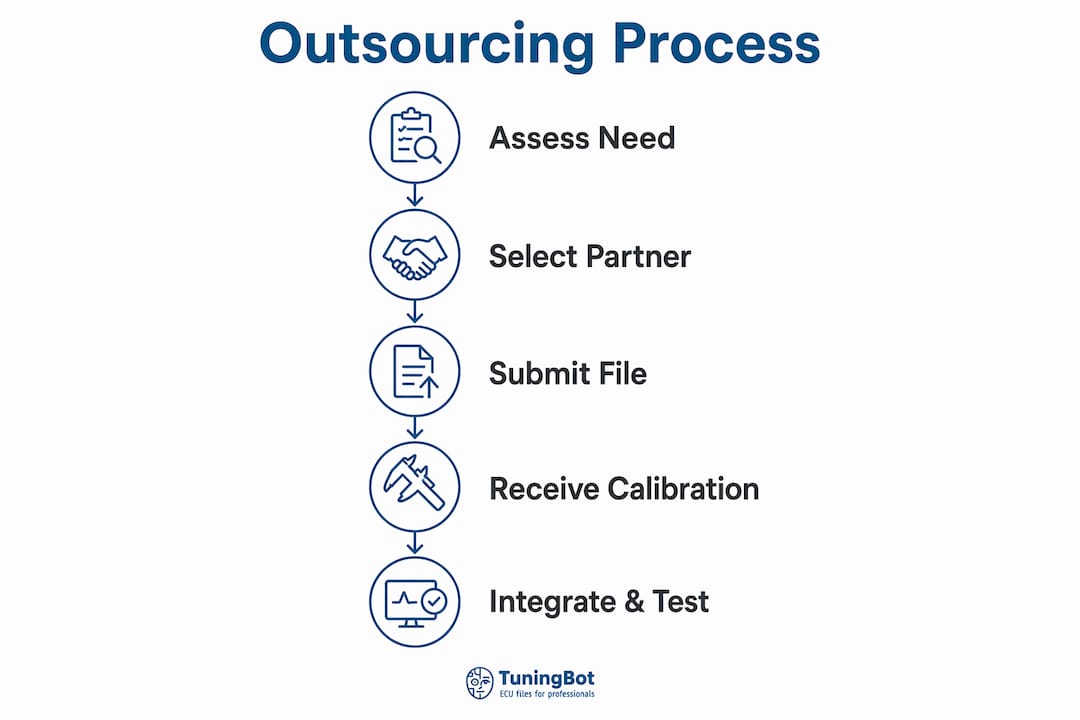
Many master tuners outsource ECUs outside their specialty to manage workload and maintain quality. This is not a sign of weakness. It is a deliberate capacity decision that protects the workshop’s reputation on every vehicle it touches.
How does outsourcing remap files reduce costs and improve efficiency?
The financial case for outsourcing ECU calibration is straightforward. Building in-house capability for a broad range of ECU platforms requires substantial upfront investment.
- Capital avoidance: Building in-house calibration capabilities typically requires $55,000 or more in specialized equipment, software licenses, and technician training. Outsourcing converts that fixed cost into a variable, per-file expense.
- Admin time recovery: A dedicated file portal saves over 2–3 hours daily by automating request validation, status notifications, and file delivery. That time goes back to billable work.
- Faster turnaround: External specialists work on specific ECU families all day. Their turnaround on a Bosch MED17 or Continental SID305 file is faster than a generalist tuner splitting attention across the workshop floor.
- Error reduction: Separating administrative work from calibration reduces bottlenecks and mistakes. In-house multitasking is the primary source of file errors in busy workshops.
- Revenue capture without infrastructure: Outsourcing allows workshops to capture revenue from premium ECU remapping services without tying up capital in costly infrastructure or needing high volume to justify ROI.
“Treating file management as a systems problem rather than a people problem is the critical shift that allows tuning workshops to scale their remap file services without proportionally increasing staff or overhead.” — Multi-site tuning operations
The financial math is clear. A workshop paying per file for outsourced calibration on ECU types outside its core competency will almost always spend less than hiring, training, and equipping a specialist for those platforms in-house.
What criteria should workshops use when selecting remap file partners?
Choosing the wrong outsourcing partner creates more problems than it solves. A file returned with incorrect checksum data, missing torque management adjustments, or unverified DTC removal can damage an engine and destroy a customer relationship. Use these criteria to evaluate any external remap file provider:
- ECU and TCU coverage: Confirm the provider supports the specific ECU families you submit most often. Bosch, Continental, Delphi, Marelli, Denso, Siemens, and ZF each require distinct calibration expertise. A provider claiming universal coverage without named engineer specializations is a red flag.
- Secure file exchange: Dedicated portals provide user-level access controls and full activity logs. This protects sensitive ECU binary data and creates an auditable record of every file transaction.
- Status transparency: Dealers prefer portals that provide request history, real-time status tracking, and on-demand file downloads. The same standard applies when you are the customer. A provider that communicates only via WhatsApp or email is not built for professional volume.
- Pricing clarity: Understand whether the provider uses per-file pricing, credit bundles, or subscription models. Per-file pricing with no prepaid credits required is the most flexible structure for workshops with variable monthly volume.
- Reputation and verification: Request references from workshops in similar markets. Check whether the provider supports your primary tuning tools, such as Alientech KESS3, AutoTuner, Magic Motorsport, CMD, or Dimsport.
Pro Tip: Before committing to any outsourcing partner, submit a test file on a vehicle ECU you know well. Compare the returned calibration against your own reference map. This reveals the provider’s actual calibration depth, not just their marketing claims.
| Evaluation criterion | What to look for |
|---|---|
| ECU coverage | Named support for Bosch, Delphi, Marelli, Continental, Siemens, Denso |
| File security | Portal with access controls and full activity logs |
| Communication | Status tracking, not chat-based updates |
| Pricing model | Per-file or credit-based with no forced prepayment |
| Tool compatibility | Alientech KESS3, AutoTuner, Magic Motorsport, CMD, Dimsport |
How outsourcing remap files supports workshop scaling
Outsourcing ECU calibration is not just a short-term fix for capacity problems. It is a structural decision that determines how far a workshop can grow without its operations becoming unmanageable.
Systemizing file requests for dealer volume
Scaling beyond 8–10 active dealers requires moving away from informal communication tools to professional file portals that standardize requests, track progress, manage payments, and improve the dealer experience. This is the same logic that applies when outsourcing. The file portal becomes the operational backbone, and the external calibration partner becomes an extension of the workshop’s technical team.
Workshops that implement this structure early report two measurable outcomes. First, they can onboard new dealers without adding administrative staff. Second, their in-house tuners spend more time on high-value calibration work and less time managing logistics.
Separating expertise from administration
The most productive workshops treat ECU calibration and file administration as two distinct functions. Calibration requires deep technical knowledge of specific ECU platforms, fuel maps, torque management tables, and emission-related parameters. Administration requires process discipline, communication, and tracking. Mixing the two degrades both.
Outsourcing the calibration function on ECU families outside the workshop’s core strength allows in-house tuners to focus on what they do best. The workshop’s tuning business model shifts from reactive to systematic, with defined intake processes, clear turnaround commitments, and predictable output quality.
Long-term blended calibration strategy
The most effective workshops in 2026 do not choose between fully in-house and fully outsourced calibration. They build a blended model. Common diesel platforms like Bosch EDC17 stay in-house where the team has deep expertise. Specialist requests covering Keihin motorcycle ECUs, ZF transmission control units, or rare Marelli variants go to external specialists via a file portal. This approach maximizes both quality and margin across the full service catalog.
The online tuning file service workflow that supports this model requires clear intake criteria, defined escalation paths, and a reliable external partner who can turn files around within agreed timeframes.
Key takeaways
Workshops outsource remap files to access specialist ECU expertise, eliminate capital overhead, and build scalable operations that informal communication tools cannot support.
| Point | Details |
|---|---|
| Capital cost avoidance | Outsourcing eliminates $55,000+ in upfront equipment, software, and training costs. |
| Admin time recovery | File portals save 2–3 hours daily by automating request validation and delivery. |
| ECU specialization | External partners cover Bosch, Delphi, Marelli, Siemens, and other platforms in-house teams lack. |
| Scalability threshold | Workshops beyond 8–10 dealers require portal-based systems to maintain quality and throughput. |
| Blended model advantage | Combining in-house expertise with outsourced specialists maximizes margin and service range. |
The case for outsourcing before you think you need it
Most workshops I have observed wait too long to outsource. They manage the first 20 file requests per week manually, absorb the chaos, and assume the situation is temporary. By the time they implement a structured solution, they have already lost customers to faster competitors and burned out their best tuners with administrative overhead.
The workshops that scale cleanly make the systems decision early. They recognize that a tuner spending 90 minutes per day chasing file status updates is a calibration resource being wasted on logistics. They also recognize that turning away a dealer request because the workshop lacks expertise in a specific ECU family is a revenue loss that compounds over time.
My recommendation is to treat outsourcing as a permanent capability, not a stopgap. Identify the ECU families where your in-house team is genuinely strong. Build your intake process around those. For everything else, establish a relationship with a reliable external partner before you need them urgently. Urgency is when mistakes happen and when workshops accept partners they have not properly vetted.
The common mistakes I see are skipping the test file evaluation, choosing partners based on price alone, and failing to set clear turnaround expectations in writing. A partner who is 20% cheaper but delivers files 48 hours late will cost you more in customer attrition than you save on calibration fees.
— TuningBot Technical Team
Professional remap file services from TuningBot
TuningBot provides professional ECU and TCU remapping files for workshops that need reliable outsourcing without the friction of registration requirements or prepaid credit commitments.
Workshops upload ECU files directly through the TuningBot tuning file workflow and receive professionally calibrated files with real engineer support. Coverage includes Bosch, Continental, Delphi, Marelli, Denso, Siemens, Keihin and ZF platforms. Before submitting a file, verify support through the ECU Service Coverage. Services span Stage 1 through Stage 3, DPF Off, EGR Off, AdBlue/SCR Off, DTC removal, IMMO Off, DSG/TCU tuning and more. For workshops building a blended calibration model, the ECU remapping professional guide covers technical standards and workflow structures that support scalable operations.
FAQ
Why do workshops outsource remap files instead of building in-house?
Building in-house ECU calibration capability typically requires $55,000 or more in equipment, software, and training. Outsourcing converts that fixed cost into a variable per-file expense while providing access to specialists across all major ECU platforms.
What ECU types are most commonly outsourced?
Workshops most often outsource ECU families outside their core expertise, including Keihin gasoline ECUs, ZF transmission control units, and rare Marelli variants. Bosch EDC17 diesel files are frequently handled in-house where teams have established depth.
How does a file portal improve the outsourcing process?
A dedicated file portal automates request validation, status tracking, and file delivery, saving 2–3 hours of admin time daily. It also provides user-level access controls and full activity logs, replacing the security and auditability gaps left by WhatsApp and email.
At what point should a workshop switch from email to a file portal?
Workshops managing requests from more than 8–10 active dealers should move to a structured file portal. Beyond that threshold, chat-based tools create overlapping assignments, unclaimed requests, and measurable revenue loss.
What is the biggest risk when selecting a remap file outsourcing partner?
The biggest risk is accepting a partner without verifying their calibration depth on your specific ECU families. Always submit a test file on a vehicle you know well and compare the returned calibration against your own reference map before committing to a working relationship.