

 EnglishEN
 ItalianoIT
 DeutschDE
 EspañolES
 PortuguêsPT
 РусскийRU
ZF 8HP TCU tuning guide workflows should begin with the exact 8HP variant, TCU software, vehicle configuration, transmission condition and engine-torque model. The ZF 8HP family spans multiple mechanical capacities and OEM implementations, so there is no universal software-only torque ceiling, shift-time target, pressure increase or launch-control recipe. A professional calibration changes only the shift, torque, clutch/pressure or converter strategies that are actually exposed and relevant to the target vehicle, then validates the result from measured transmission behavior.
TL;DR:
- ZF 8HP variants do not share one universal software-only torque limit; clutch, hydraulic, thermal and driveline limits are vehicle-specific.
- Shift schedules, torque limits, clutch/line pressure, converter lockup and launch/rev-match logic vary by TCU software.
- Do not use 100–200 ms shift targets or 550–650 lb-ft as generic calibration rules.
- Adaptation resets/relearns are tool-, TCU- and service-specific; they are not mandatory after every flash.
- OBD, Bench and other access methods should follow the exact flashing-tool protocol; file backup and recovery capability are protocol-specific.
ZF 8HP TCU Tuning Guide: What the Calibration Can Change
The ZF 8HP TCU coordinates several interacting shift, torque, clutch, converter and protection strategies. Their implementation differs by OEM and software revision.
Shift quality depends on torque handoff, clutch fill/pressure, converter state, schedule and adaptation—not one shift-time value.
A tuner working on an 8HP file is typically editing:
- Shift schedules and mode-specific upshift/downshift behavior where exposed.
- Engine/TCU torque limits and torque-intervention strategy.
- Clutch fill, pressure or torque-to-pressure strategies where the calibration provides access.
- Torque-converter lockup/release strategy on converter-equipped variants.
- Shift timing and torque handoff between ECU and TCU.
- Launch, downshift and rev-matching behavior only where the exact OEM software supports those functions.
- Thermal and component-protection strategies that must remain coherent with the hardware.
Poor calibration can present as flare, harshness, hunting, delayed engagement, converter issues or faults, but each symptom requires diagnosis rather than one assumed cause.
ZF 8HP TCU Tuning Guide: Torque Capacity and Software Limits
The 8HP family includes several variants with different clutch packs, gearsets, converters and OEM applications. Variant name alone does not define safe tuned torque capacity.
Use the exact transmission variant, vehicle mass, clutch condition, cooling, torque shape and duty cycle to determine usable headroom rather than a generic torque bracket.
- Identify the exact 8HP variant and OEM application.
- Check current clutch slip/adaptation/fault history and fluid condition.
- Compare actual engine torque shape with the transmission’s modeled/requested torque.
- Monitor clutch/line pressure tracking and transmission temperature where data is available.
- Treat persistent slip, thermal rise or pressure saturation as a hardware limit rather than a reason to keep raising software limits.
Software headroom does not equal mechanical endurance. A TCU flash raises the torque limit the electronics will allow through. It does nothing to strengthen the hubs, drums, or friction material actually clamping that torque, which is why every variant eventually hits a wall software cannot move.
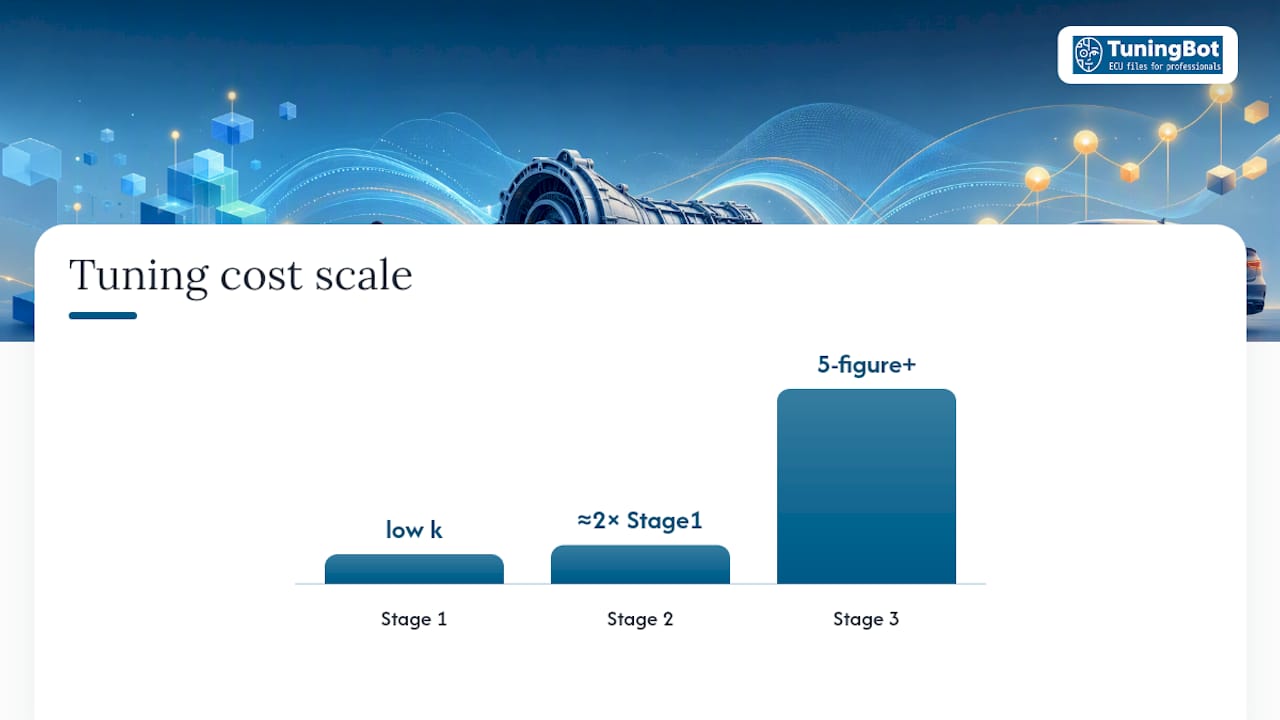
Cost cannot be inferred reliably from the transmission family alone. File/service pricing, access method, calibration scope and hardware requirements vary by vehicle and provider.
ZF 8HP TCU Tuning Guide: When Hardware Becomes the Limit
When clutch, hydraulic, thermal or mechanical capacity is exceeded, calibration cannot restore margin. Persistent slip, pressure shortfall or temperature rise should trigger a hardware diagnosis.
Hardware reinforcement may be appropriate on high-load builds once measured clutch, hydraulic, thermal or mechanical capacity becomes the limiting factor. The required components depend on the exact 8HP variant and use case.
- Clutch/friction upgrades when measured slip or torque capacity exceeds the healthy stock pack’s capability.
- Valve-body/hydraulic work where commanded pressure cannot be achieved reliably.
- Converter upgrades where converter slip/thermal load is the limiting factor.
- Internal hubs/drums/gearset reinforcement only where the specific variant and target use justify it.
- Cooling improvements where sustained temperature, not peak torque, is the real constraint.
Hardware changes can require recalibration of clutch fill, pressure, converter or shift strategies, but the exact changes depend on the parts installed and TCU software.
Astuce de pro : Quote hardware and calibration as one package, not two separate line items. A shop that sells billet hubs without a matched TCU recalibration is selling half a fix.
Avoid universal Stage 1/2/3 price or hardware definitions for ZF 8HP builds; these labels are informal and provider-specific.
ZF 8HP TCU Tuning Guide: Professional Workshop Workflow
A ZF 8HP TCU tuning guide should use a workflow that starts with exact TCU identification, mechanical/diagnostic baseline, supported programming access and matched post-write validation.
- Identify the exact TCU hardware/software, transmission variant, vehicle and engine calibration.
- Scan DTCs and check fluid condition, existing slip/shift complaints and mechanical/hydraulic health.
- Obtain the source file through the access method supported by the flashing tool for that exact TCU.
- Preserve the source file and record the tool/protocol/software version used.
- Change only the shift, torque, clutch/pressure or converter strategies justified by the objective and logs.
- Perform adaptation/basic settings only when required by the exact TCU, tool or service procedure.
- Validate progressively using relevant shift, torque, pressure/slip and temperature data under safe conditions.
- Road-test normal drivability after controlled validation.
Astuce de pro : Keep a stock-file backup and a documented flash-back procedure ready before every session. If adaptation values go sideways mid-test, you need a fast path to a known-good baseline, not a scramble.
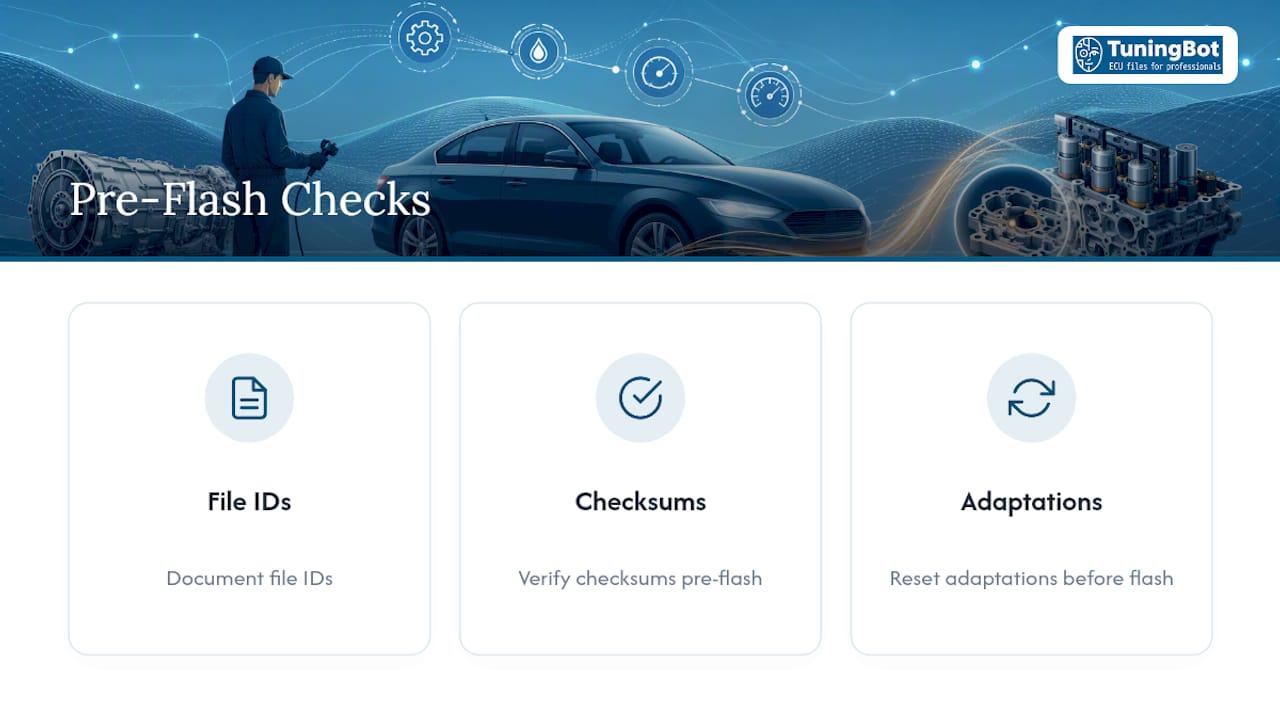
The pre-flash checklist matters as much as the calibration itself. Skipping steps 1 through 3 is where most preventable comebacks originate.
ZF 8HP TCU Tuning Guide: Durability and Fluid Service
Higher torque or altered clutch/pressure strategies can change transmission loading, but maintenance intervals should be based on ZF/OEM guidance, fluid condition, temperature and actual duty cycle rather than automatically shortened.
- Use the correct ZF/OEM-approved fluid specification for the exact transmission.
- Base fluid/filter service intervals on OEM/ZF guidance, fluid condition, temperature and duty cycle—not a generic tuning interval.
- Monitor for clutch slip, delayed engagement, unusual shift quality and sustained temperature increase.
- Keep the original/source file, TCU ID and released calibration revision documented for future service.
- If torque/use exceeds hardware capability, recommend mechanical work rather than further software pressure or torque-limit increases.
Transmission servicing should follow the correct ZF/OEM fluid specification and the actual service/duty requirements of the vehicle.
ZF 8HP TCU Tuning Guide: Fuel Economy and Compliance
Transmission calibration can influence engine operating points and therefore fuel consumption, but direction and magnitude depend on shift strategy, converter lockup, vehicle use and engine calibration.
A transmission-only calibration does not normally disable engine aftertreatment, but it can change engine operating points. Any engine-side emissions modification should be assessed separately under applicable law.
Road vehicles remain subject to applicable emissions, safety and warranty requirements. A TCU-only calibration should not be used to justify unrelated engine-side emissions modifications.
ZF 8HP TCU Tuning Guide: Common Workshop Mistakes
Common problems include tuning around existing transmission faults, using the wrong file/TCU ID, changing pressure or shift timing without measured evidence, and skipping post-write validation.
Shops that record TCU IDs, source files, tool/protocol and validation results make recovery and troubleshooting substantially easier.
Long-term durability cannot be inferred from one dyno or road session; the goal is to keep clutch slip, hydraulic tracking and temperatures within acceptable limits for the actual duty cycle.
— Équipe technique de TuningBot
How TuningBot Supports ZF 8HP Calibration Workflows
TuningBot can provide calibration files for supported ZF TCU workflows once the exact transmission, source-file type and requested service are confirmed.
For related technical context, use the verified Workflow du service de fichiers ECU en ligne, ECU File Writing Guide et Checksum Correction Guide.
Before ordering, check Couverture des services ECU, le Liste de prix publique et Services de l'ECU.
Submit a supported source file through Reprogrammer le fichier after confirming the ZF TCU and requested calibration objective.
This article stays technical and informational so commercial ZF/TCU tuning keywords remain concentrated on TuningBot’s service and order pages.
Sources and Further Reading
- TempaDrive Forum — ZF 8HP tuning discussion — external community reference retained unchanged.
- Applied Torque Solutions — 8HP7x billet hub — external hardware reference retained unchanged.
- Bench Built Transmissions — ZF 8HP rebuilds — external hardware/service reference retained unchanged.
- PFR — Transmission servicing — external maintenance reference retained unchanged.
- TuningBot — Online Tuning File Service Workflow — verified internal workflow reference.
- TuningBot — ECU File Writing Guide — verified internal programming reference.
- TuningBot — ECU File Checksum Correction — verified internal integrity reference.
FAQ
What Does a ZF 8HP TCU Tune Change?
Depending on the exact software, a ZF 8HP calibration can change shift schedules, torque limits, clutch/pressure strategy, torque handoff, converter lockup and launch/downshift behavior.
Is a TCU Flash Enough or Do I Need Hardware Too?
There is no universal torque threshold. Hardware is needed when the exact transmission shows clutch, hydraulic, converter, thermal or internal mechanical limits that software cannot safely overcome.
How Much Does ZF 8HP TCU Tuning Cost?
There is no universal price. Cost depends on TCU variant, access method, calibration scope, provider and whether mechanical work is required.
Can a ZF 8HP Be Tuned Remotely?
Some ZF 8HP workflows support OBD, Bench or file-based remote calibration. Exact availability depends on the TCU, vehicle and flashing-tool protocol.
Does Tuning the ZF 8HP Void the Factory Warranty?
A modified TCU calibration can affect warranty coverage, but the exact outcome depends on manufacturer policy, jurisdiction and the specific claim.