

 EnglishEN
 ItalianoIT
 DeutschDE
 EspañolES
 PortuguêsPT
 РусскийRU
Hardcut limiter calibration guide workflows should treat the limiter as an ECU-specific engine-speed control strategy, not as a universal “popcorn” feature. Depending on the ECU and engine, limiting can involve fuel cut, ignition cut, throttle/load intervention, torque control or a combination of strategies. The correct thresholds, re-enable logic and protections must be identified from the actual ECU software and vehicle hardware; fixed hysteresis bands, universal cut-mode preferences and guaranteed sound effects should not be carried from one platform to another.
- What it does: limits engine speed using the control strategy available in the exact ECU.
- What it does not do: it does not create peak power by itself.
- Why platform identification matters: fuel, spark, throttle and torque interventions differ by ECU/engine.
- Why validation matters: repeated limiter contact can increase thermal and driveline stress depending on the strategy and vehicle.
- Road use: noise, emissions, warranty and roadworthiness rules must be evaluated separately from the calibration itself.
Hardcut Limiter Calibration Guide: Key Takeaways
A professional hardcut limiter calibration guide should focus on ECU-specific rev-control logic, mechanical and thermal limits, platform-specific validation and legal use rather than one fixed fuel/ignition-cut recipe.
| Point | Détails |
|---|---|
| Limiter strategy is ECU-specific | Fuel, spark, throttle/load and torque-control methods vary by engine and ECU. |
| There is no universal hysteresis range | Cut and re-enable behavior should be calibrated from the actual platform and use case. |
| Sound is not the engineering target | The audible effect is a by-product of the limiter strategy, not proof of a good calibration. |
| Repeated limiter contact adds stress | Thermal, exhaust and driveline effects depend on hardware and cut strategy. |
| Stage labels do not define suitability | Base calibration, fuel, turbo, transmission and vehicle condition matter more than the Stage name. |
| Validate the actual vehicle | Use DTCs and relevant logs rather than generic RPM or temperature thresholds. |
Hardcut Limiter Calibration Guide: How the Control Strategy Works
The basic idea is to reduce engine torque at a defined speed and re-enable it below the limiter threshold, but the actual mechanism is ECU-specific.
Spark-ignition engines may use ignition, fuel, throttle or torque intervention; diesel engines generally rely on fueling/load control rather than spark. No one cut strategy is automatically safest across every application.
- The ECU reaches the configured engine-speed control region.
- Torque is reduced using the strategy available on that platform: fuel, ignition, throttle/load, torque request or a combination.
- The ECU re-enables torque according to its re-entry logic, hysteresis or regulator strategy.
- Protection functions for temperature, knock, fuel pressure, turbo/airflow and drivetrain should remain coherent with the limiter behavior.
Astuce de pro : A narrow control range (under 100 rpm) produces the sharpest, most dramatic popcorn sound, but it also means the engine hits the limiter far more often per second. If you’re chasing the effect for a show build rather than lap times, widen the band before you narrow it.
What Damage Can a Hardcut Limiter Actually Cause?
Limiter abuse can create rapid torque reversals, thermal loading and exhaust/driveline stress. The exact failure mechanism depends on the engine, turbo, fueling strategy, cut method and how often the limiter is contacted.
The damage modes tuners actually see include:
- Driveline shock or oscillation from abrupt torque changes.
- Exhaust/turbo thermal stress where the cut strategy sends unburned mixture or high heat downstream.
- Combustion or fuel-system stress where re-entry is poorly matched to load and fuel delivery.
- Accelerated wear when the limiter is used repeatedly rather than occasionally.
Frequent limiter contact should be treated as a stress indicator. Inspection and maintenance decisions should come from actual component condition, temperatures, oil analysis or manufacturer guidance rather than a fixed event count.
Re-enable behavior, combustion timing and torque recovery after a cut can affect drivability and component stress, so the transition should be calibrated and logged on the actual platform.
Hardcut Limiter Calibration Guide: ECU Workflow
A hardcut limiter is integrated into the ECU’s engine-speed and torque-control strategy. The relevant maps and logic vary by ECU software.
- Identify the exact ECU, software version and engine/drivetrain configuration.
- Preserve the original, virtual or server-supplied source file used by the supported tool workflow.
- Locate the engine-speed control and related torque/load strategy using verified definitions.
- Change only the limiter parameters justified by the intended use and hardware limits.
- Apply the checksum/signature/integrity procedure required by the ECU and write tool.
- Write with the supported protocol, then validate progressively from low load to the limiter region under controlled conditions.
External/piggyback devices may alter signals or behavior without directly modifying the ECU’s internal limiter strategy. Their capability and precision depend on the product and vehicle, so they should not be characterized universally as inferior or superior.
Hardcut Limiter Calibration Guide: Parameter and Validation Checklist
A hardcut limiter calibration guide should start from the vehicle’s engine-speed limit, valvetrain/turbo/driveline capability and ECU strategy—not from a target sound.
- Set the engine-speed ceiling from the actual engine/valvetrain/turbo/drivetrain limits.
- Choose the cut/intervention method only from strategies supported by that ECU.
- Calibrate re-enable/hysteresis behavior from measured torque oscillation and drivability—not a universal 200–400 rpm band.
- Retain temperature, knock, fuel-pressure, boost/load and transmission protection functions.
- Log relevant channels during controlled validation and stop if abnormal temperature, pressure, knock or driveline behavior appears.
Astuce de pro : Don’t calibrate a hardcut limiter and call it done after one dyno pull. Run it through a full heat cycle on the road before you trust it on track, because turbo lag and thermal expansion behave differently after twenty minutes of real driving than they do in a five-minute dyno session.
Where a Hardcut Limiter Makes Technical Sense
A hard limiter can be useful where an application genuinely needs an abrupt engine-speed ceiling, but suitability depends on motorsport rules, drivetrain behavior, engine design and legal use.
- Potential fit: competition or test applications that specifically require an abrupt RPM ceiling.
- Questionable fit: daily road use where repeated limiter contact, noise or emissions behavior creates no functional benefit.
- Always check motorsport, roadworthiness, noise, emissions and warranty implications for the actual vehicle and jurisdiction.
How a Hardcut Limiter Is Added to an Existing Calibration
Whether hardcut logic can be added to an existing calibration without wider changes depends on the ECU software and current tune. Some platforms expose dedicated limiter functions; others require different torque/load strategies.
- Confirm the ECU/software supports a controllable limiter strategy.
- Review the existing calibration and installed engine/drivetrain hardware.
- Define the intervention and validation plan rather than starting from a sound target.
- Keep the previous release/source file available for supported recovery or comparison.
- Validate the revised file under controlled conditions.
Cost cannot be estimated reliably from the feature name alone. ECU complexity, required file work, access method and validation time determine the real job cost.
How TuningBot Fits Into Hardcut Limiter Calibration
TuningBot can provide calibration files for supported ECU/TCU workflows where hardcut or related limiter functionality is available for the exact software version.
Before ordering, check Couverture des services ECU, examiner Liste de prix publique and browse Services de l'ECU.
For related technical context, use the verified Checksum Correction Guide, Guide de réglage de la carte de carburant et Torque Curve Guide.
Submit a supported source file through Reprogrammer le fichier only after confirming the ECU and requested limiter function are covered.
This article remains informational and technical; transactional hardcut/pop-and-bang queries should continue to resolve to TuningBot service/order pages.
Hardcut Versus Soft Limiters and Fuel Trim Adjustments
Soft and hard limiting are different ways of enforcing engine-speed control. Soft strategies generally reduce torque progressively, while hard strategies intervene more abruptly.
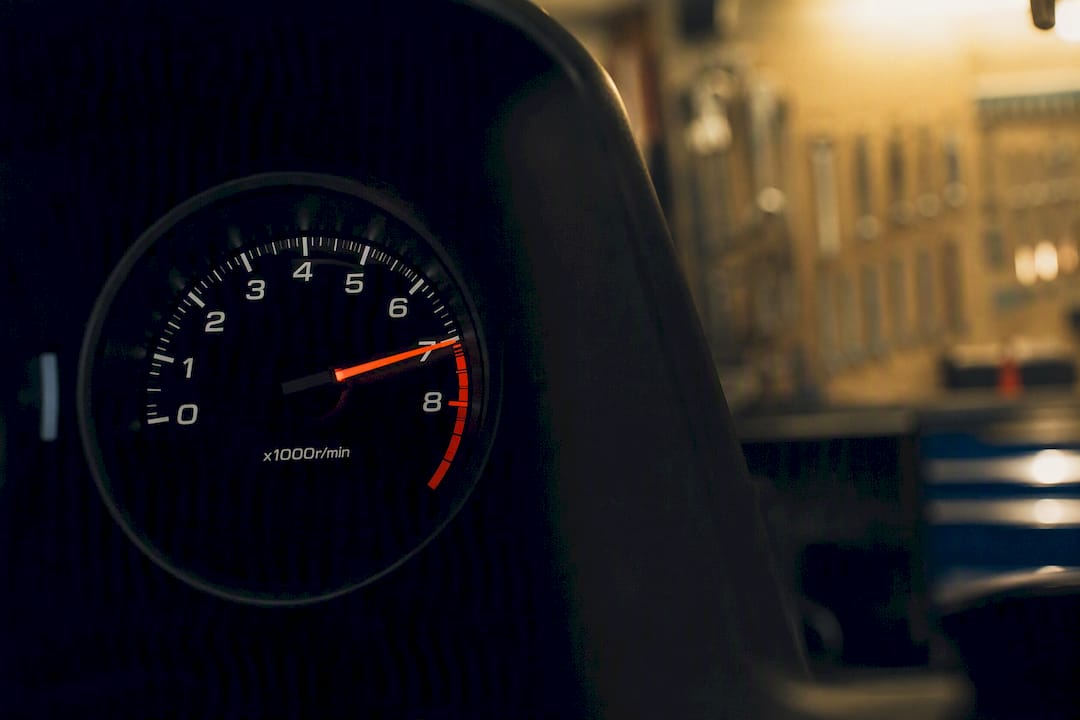
In a hardcut limiter calibration guide, a hard limiter is characterized by a more abrupt torque reduction near the ceiling. Fuel-trim corrections are separate closed-loop fueling adaptations and should not be described as a rev-limiter strategy.
Abrupt limiting can feel and sound more aggressive than progressive limiting, but the mechanical effect depends on how the ECU produces the intervention. Neither approach increases peak power by itself.
Diagnosing Common Hardcut Limiter Problems
Problems after a limiter calibration can come from file/integrity issues, unsuitable thresholds, incorrect cut/re-enable logic, underlying vehicle faults or a mismatch between the calibration and hardware.
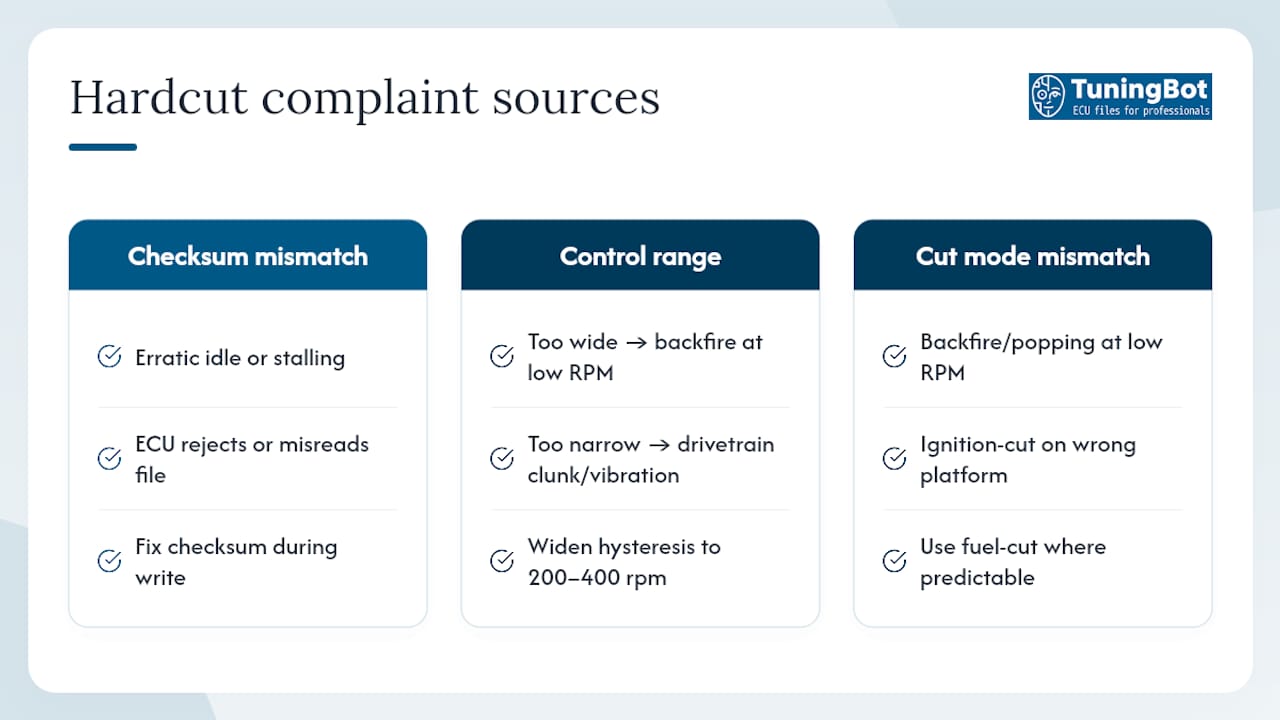
Erratic idle, stalling, unexpected popping or abnormal intervention should be diagnosed from DTCs, logs and the actual edited logic. Do not assume a checksum fault or a specific hysteresis mistake from the symptom alone.
Unexpectedly rising EGT, exhaust temperature, turbo speed/boost or oil temperature during repeated limiter contact is a reason to stop testing and diagnose the cause.
Drivetrain clunk or vibration during limiter contact can indicate excessive torque oscillation or pre-existing driveline wear. Do not apply a universal RPM-band correction; change the control strategy only after identifying the source.
Does a Hardcut Limiter Change How the Car Drives?
Below the intervention region, drivability should be unchanged if no other maps were modified. Near the limiter, vehicle behavior depends on the ECU strategy and drivetrain.
At the threshold, abrupt torque changes may be audible or felt through the driveline. The exact behavior varies substantially by engine, transmission and limiter implementation.
The limiter feature itself does not define fuel economy. Any consumption change is dominated by driving behavior and any other calibration changes.
A hardcut limiter does not create additional peak power; it changes engine-speed control behavior at the ceiling.
Our Take on the Popcorn Effect Versus Engine Longevity
For calibration quality, sound should remain secondary to stable torque control, component limits and reproducible vehicle behavior.
Street-use suitability depends on legal noise/emissions requirements, drivetrain behavior and how often the vehicle is operated near the limiter.
If an audible limiter effect is desired, validate it only after confirming the engine, exhaust, turbo and drivetrain can tolerate the chosen control strategy.
— Équipe technique de TuningBot
Using This Hardcut Limiter Calibration Guide in a Workshop
Use the guide to identify the control strategy, vehicle limits and validation plan before changing limiter behavior.
If calibration is outsourced, first verify the exact ECU in Couverture des services ECU, then submit the supported source file through Reprogrammer le fichier.
The workshop remains responsible for programming conditions, legal use and vehicle-side validation.
Sources and Further Reading
- HP Academy — Soft vs Hard Rev Limiters — external educational reference retained unchanged.
- MaxxECU — Rev Limit Settings — external ECU documentation retained unchanged.
- TuningBot — ECU File Checksum Correction — verified internal file-integrity reference.
- TuningBot — Fuel Map Tuning Guide — verified internal calibration reference.
- TuningBot — Torque Curve Guide — verified internal torque-behavior reference.
FAQ
What Is a Hardcut Limiter?
A hardcut limiter is an abrupt engine-speed control strategy. The ECU may reduce torque through fuel, ignition, throttle/load or another mechanism depending on the platform.
Are Hardcut Limiters Bad for Cars?
Repeated abrupt limiter contact can increase thermal or driveline stress, but the risk depends on the engine, transmission, intervention strategy, RPM ceiling and how the vehicle is used.
How Much Does It Cost to Get a Hard Cut Limiter?
There is no reliable universal price. Cost depends on ECU support, source-file workflow, complexity of the limiter logic and validation time.
How Do You Get a Hard Cut Limiter Installed?
The ECU software must first be checked for a supported limiter strategy. The file is then modified and written using the ECU/tool-specific workflow, followed by vehicle-side validation.