

 EnglishEN
 ItalianoIT
 DeutschDE
 EspañolES
 PortuguêsPT
 РусскийRU
EPA tuning rules do not prohibit every aftermarket ECU calibration, but the Clean Air Act prohibits tampering with required emissions controls and the manufacture, sale, offering for sale or installation of defeat devices. For a professional workshop, the key question is not whether a tune is marketed as “performance” or “off-road”; it is whether the exact modification preserves the certified emissions-control functions or has a documented legal compliance basis.
What is permitted vs. what triggers enforcement:
- Road-use performance calibration: must preserve required emissions controls and diagnostic functions unless a valid compliance pathway applies.
- Defeat-device risk: arises when hardware or software bypasses, defeats or renders required emissions controls inoperative.
- Documentation: can support a compliance position but does not convert an otherwise prohibited modification into a legal one.
- State law: can add separate inspection, registration and tampering requirements beyond federal law.
Immediate actions for your shop:
- Audit every calibration and product description that affects DPF, EGR, SCR/DEF, catalysts, OBD monitors or other emissions-related elements.
- Remove marketing that promotes bypassing, defeating or rendering required emissions controls inoperative.
- Preserve source files, job records and the exact hardware/software configuration used for compliant work.
- Do not rely on customer waivers, ‘race use’ labels or stock-file restoration as substitutes for legal compliance.
- Check current EPA guidance, applicable CARB Executive Orders and state requirements for the exact application.
EPA Tuning Rules: Key Takeaways
EPA tuning rules focus on whether a modification tampers with required emissions controls or constitutes a defeat device. The EPA Tampering Policy can inform enforcement discretion when a documented reasonable basis exists, but it is not a statutory safe harbor.
| Point | Détails |
|---|---|
| Section 203(a)(3) is central | Federal law prohibits tampering and aftermarket defeat devices. |
| Reasonable basis is not immunity | The EPA Tampering Policy is enforcement guidance, not a blanket legal exemption. |
| OBD changes require special caution | The Tampering Policy’s reasonable-basis framework does not cover conduct affecting OBD systems. |
| CARB EO scope is specific | Use only an EO that actually covers the application identified in the order. |
| Penalty amounts change | Use EPA’s current Title II enforcement pages and 40 CFR §19.4 rather than old penalty figures. |
| Blog content should support service pages | This article targets legal/compliance intent and should link to TuningBot service pages rather than compete with them. |
EPA Tuning Rules Under the Clean Air Act
Clean Air Act Section 203(a)(3) contains the core federal prohibitions relevant to aftermarket emissions tampering. Section 203(a)(3)(A) addresses removal or rendering inoperative of required emissions-control devices or elements of design, while Section 203(a)(3)(B) addresses manufacture, sale, offering for sale or installation of defeat devices.
Liability can extend beyond the vehicle owner to manufacturers, sellers, distributors and installers. The exact legal theory depends on the conduct and evidence; workshops should not assume that a customer request transfers responsibility away from the business.
Covered modifications include:
- DPF (diesel particulate filter) removal or bypass calibrations
- EGR (exhaust gas recirculation) delete tunes
- SCR/AdBlue/urea injection disable
- Software calibrations that prevent catalyst warm-up monitoring
- OBD changes that disable, falsify or render required monitoring inaccurate.
- Marketing that promotes defeating emissions controls or evading an inspection.
Penalty framework:
Civil-penalty maximums are adjusted over time. EPA’s current vehicle-and-engine enforcement page lists potential penalties up to $45,268 per noncompliant vehicle or engine and $4,527 per tampering event or sale of a defeat device, while 40 CFR §19.4 controls inflation-adjusted amounts. Always verify the current figure before publishing or quoting a penalty.
Statistic callout: EPA’s National Enforcement and Compliance Initiative (NECI) on aftermarket defeat devices generated 172 civil enforcement cases totaling approximately $55.5 million in civil penalties and 17 criminal cases from FY2020 through FY2023.
Le Federal Register notice formalizing the Tampering Policy also signals that EPA views the 1986 catalyst performance criteria as an area for ongoing regulatory attention, meaning the compliance landscape for catalytic converter-related calibrations may tighten further.
How does the EPA Tampering Policy’s “reasonable basis” test work?
The EPA Tampering Policy describes circumstances in which EPA may exercise enforcement discretion when a person has a documented reasonable basis for believing that an alteration will not adversely affect emissions. The policy is guidance, not a statutory safe harbor, and the burden remains on the party relying on that position.
The six reasonable bases (A through F)
- Basis A — Identical configuration: The modified part or calibration is identical in all emission-related respects to the OEM-certified configuration. Practically, this means a direct replacement that changes nothing affecting emissions.
- Basis B — Replacement after-treatment: The modification replaces a worn or damaged emission control component with one of equivalent or better performance. Documentation of the original component’s condition and the replacement’s specifications is required.
- Basis C — Emissions testing: The tuner has conducted emissions testing demonstrating the modification does not increase emissions above the vehicle’s certified standards. This is the most broadly applicable basis for performance calibrations and requires a documented test protocol.
- Basis D — EPA certification: The part or calibration has received EPA certification or approval under a relevant program.
- Basis E — CARB Executive Order: The modification is covered by a valid CARB EO for the exact vehicle and engine combination being modified.
- Basis F — Warranty/useful life: The modification is within the vehicle’s useful life and warranty terms, and the manufacturer has documented that emissions performance is maintained.
The OBD bright line
The EPA Tampering Policy states that its reasonable-basis framework does not apply to conduct affecting OBD systems. That does not mean every OBD-related change automatically produces criminal liability; criminal exposure depends on the specific conduct and applicable Clean Air Act provisions.

How marketing affects the “knows or should know” standard
Marketing can become evidence of a seller’s or installer’s knowledge and intended use. Statements promoting removal, bypass or defeat of emissions controls can materially increase enforcement risk.
Astuce de pro : Review every product description, social media post, and customer-facing document for language that references removing, disabling, or bypassing emissions equipment. A single archived post can establish the “knows or should know” element EPA needs to proceed.
What do recent EPA and DOJ enforcement cases reveal about shop risk?
Recent enforcement under EPA tuning rules shows continued action against aftermarket products and software alleged to defeat required emissions controls. Outcomes vary by case and can include civil penalties, injunctions, product changes, compliance programs and, in criminal matters, fines or probation.
Notable cases and settlements
COBB Tuning Products, LLC: The COBB settlement required the company to stop manufacturing and selling specific calibration products EPA considered defeat devices, implement a compliance program, and pay civil penalties. The case illustrates that even established, well-known tuning brands face enforcement when specific products cross the defeat-device line.
Derive Systems: Le DOJ/EPA settlement with Derive Systems required code surrender, retrofit of previously sold devices, and cessation of sales. DOJ’s direct involvement signals that EPA does not handle major cases alone; the Department of Justice is an active enforcement partner.
Idaho diesel parts companies: The Idaho case resulted in criminal guilty pleas and an agreement to pay $1 million, tied specifically to OBD tampering. This is the clearest available example of the criminal exposure that follows when diagnostic monitoring is rendered inoperative.
Performance Diesel, Inc. and Punch It Performance and Tuning: Both cases followed the same pattern: EPA identified businesses selling defeat device products or calibrations, pursued civil enforcement, and required cessation of sales and compliance programs as part of resolution.
Enforcement patterns
- Investigations can involve marketing, product purchases, customer records and supply-chain evidence.
- Certain knowing monitoring-device violations can create criminal exposure under the Clean Air Act.
- Some settlements have required product changes, destruction, code restrictions or limits on related intellectual property.
- Retrofit obligations can extend liability to previously sold products
- DOJ may participate in significant civil judicial and criminal matters.
| Case | Pourquoi c'est important | Outcome highlighted by EPA/DOJ |
|---|---|---|
| COBB Tuning Products | Aftermarket tuning products alleged to be defeat devices | Product restrictions, compliance obligations and $2.914M civil penalty |
| Derive Systems | Custom tuning software and handheld products | Compliance changes, retrofit obligations and civil penalty |
| Idaho / other criminal matters | Knowing emissions-control and monitoring-device conduct | Criminal enforcement can occur depending on the charged conduct |
How EPA Tuning Rules Interact With CARB and State Law
California operates an Executive Order program for qualifying aftermarket parts and calibrations. A CARB EO can provide an important documented compliance pathway when the exact product and application fall within the EO’s stated scope.
CARB Executive Orders are application-specific. A workshop should verify the EO number, covered vehicles/engines and installation conditions exactly as stated in the order rather than extrapolating coverage to a similar vehicle.
State requirements vary. Some states adopt California vehicle-emissions standards, while others use different inspection, registration or anti-tampering rules. Federal compliance does not eliminate separate state obligations.
When to check CARB and what to record:
- Confirm whether the specific part or calibration has a current, valid CARB EO before installation
- Record the EO number, the covered vehicle/engine application, and the date of verification
- Document the install procedure step by step, including any configuration settings required to maintain EO compliance
- Retain copies of the EO text alongside the vehicle’s service record
- Check whether the customer’s state follows CARB standards or has independent tampering rules that may apply
EPA’s regional guidance also notes that states add separate tampering and registration risks beyond federal exposure, and that there is no EPA whitelist of compliant aftermarket devices.
What compliance steps should every professional tuning shop take now?
Under EPA tuning rules, a professional shop should separate legal/compliance review from calibration engineering. Technical reversibility, customer consent and a stock backup are useful operational controls, but they do not determine whether a modification is lawful.
- Audit your current product and service offerings. Identify every calibration, tune package, or hardware modification that references DPF, EGR, SCR, AdBlue, or OBD monitor changes. Classify each as either defensible (supported by emissions testing or a valid CARB EO) or requiring immediate review.
- Remove all delete-related advertising. Pull any product listing, social media post, website copy, or customer communication that uses language like “delete,” “emissions removal,” “inspection pass,” or “DPF off for road use.” Archive the removed content with timestamps for your records.
- Use customer documentation to define the job scope, but do not treat a waiver or intended-use statement as a substitute for legal compliance.
- Preserve source files and job records for traceability; technical reversibility does not make a prohibited modification lawful.
- Maintain the compliance documentation appropriate to the product or calibration, such as applicable EO, certification, testing and installation records.
- Consult legal counsel for borderline applications. Engine swaps, nonstandard after-treatment configurations, and calibrations for vehicles with modified exhaust systems all require case-specific legal analysis. A general compliance checklist is not a substitute for counsel when the application is unusual.
- Review current EPA enforcement guidance, penalty updates, CARB materials and relevant state rules periodically.
Astuce de pro : For track-only or off-road-only calibrations, document the customer’s use case explicitly and review TuningBot’s Guidage de calibration sur piste et hors route before deploying any tune that removes emissions controls, even for competition applications. “Race use only” claims are not a blanket defense under federal law.
How do you build a defensible “reasonable basis” through testing and documentation?
Documented emissions testing can support a reasonable-basis analysis, but the appropriate test method depends on the vehicle, certification category and modification. A workshop should not present a simplified internal test as equivalent to formal EPA or CARB certification testing.
Step-by-step testing protocol
- Define the scope. Specify the exact vehicle/engine/transmission combination, the calibration version, and the emission standards the vehicle was originally certified to. Scope limits are critical: a test on one configuration does not cover variants.
- Select a representative test vehicle. Choose a production vehicle with documented service history, no prior emissions-related modifications, and mileage within the vehicle’s useful life as defined by EPA. Chain-of-custody documentation for the test vehicle begins here.
- Use a qualified test plan appropriate to the vehicle and compliance claim; formal certification-style testing may require specialized facilities and procedures.
- Where emissions testing is used as part of a compliance analysis, document the test configuration, calibration revision and controlled comparison procedure.
- Document enough repeatable data to support the specific compliance claim; there is no universal three-run rule for every application.
- Consider durability and useful-life requirements where relevant to the certification or compliance pathway being relied upon.
- Compile the records required by the applicable compliance pathway and retain the exact calibration/version identification.
For professional ECU remapping workflows that integrate with this kind of structured documentation, TuningBot’s ECU remapping techniques guide covers the calibration engineering side of the process.
Document package checklist for a defensible tune
| Document | Minimum Content |
|---|---|
| Emissions test report | Before/after tailpipe readings, OBD status, test cycle, conditions, instrumentation records |
| Calibration version record | ECU ID, software version, install date, technician name |
| CARB EO reference (if applicable) | EO number, covered vehicle/engine, verification date |
| Installation instructions | Step-by-step procedure, configuration settings, restore procedure |
| Marketing limits statement | Explicit scope of tested application; prohibited use cases |
| Customer acknowledgment | Signed statement of intended use and compliance responsibility |
Astuce de pro : Chain-of-custody for the test vehicle is the element most often missing from otherwise solid test packages. Document the vehicle’s history from acquisition through testing completion. An undocumented test vehicle gives EPA grounds to question whether the results reflect a production-representative calibration.
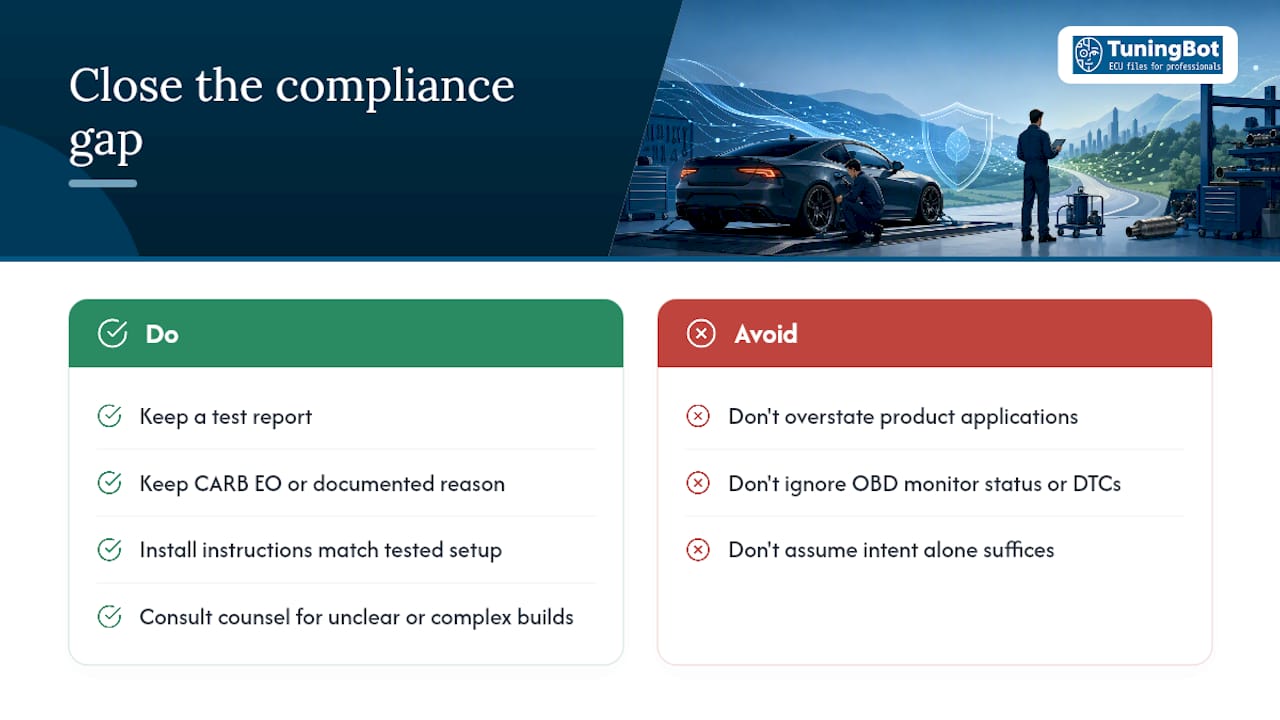
The compliance gap most shops are not closing
The TuningBot Technical Team works with calibration engineers and workshop operators across a wide range of ECU and TCU platforms, from Bosch and Continental to Delphi and Marelli. What we observe consistently is that shops understand the prohibition on deletes but underestimate the documentation burden for calibrations they consider clearly legal.
A compliance position should be supported by the documentation appropriate to the modification—such as a valid CARB EO, applicable certification, or a documented reasonable-basis analysis—rather than by marketing language or intent alone.
OBD-related changes deserve particular caution because the EPA Tampering Policy’s reasonable-basis framework excludes conduct affecting OBD systems. Readiness and diagnostic behavior should be checked after calibration, but a temporary ‘not ready’ state immediately after legitimate service is not by itself proof of illegal tampering.
This is not legal advice. For complex builds, engine swaps, or any application where the compliance path is genuinely unclear, consult qualified legal counsel with Clean Air Act experience.
How TuningBot Supports a Compliance-Conscious Workshop Workflow
TuningBot can support the calibration-file side of a professional workshop workflow, while legal compliance remains a separate responsibility of the workshop and vehicle owner.
Before ordering, check Couverture des services ECU, examiner Liste de prix publique et parcourir les offres disponibles Services de l'ECU.
For road-use compliance context, see the verified Euro 5 Engine Tuning guide. For non-road-use considerations, see Track / Off-Road Only Calibrations.
The source file can be submitted through Reprogrammer le fichier after the workshop has confirmed the requested service is appropriate for the application.
This article intentionally targets EPA compliance and legal-risk intent rather than commercial ECU-service keywords, so it supports—rather than competes with—TuningBot service pages.
Primary Sources and Further Reading
- EPA enforcement alert — original external EPA source retained unchanged.
- Federal Register — EPA Tampering Policy notice — external federal source retained unchanged.
- DOJ / EPA — Derive Systems settlement — external DOJ source retained unchanged.
- EPA — COBB Tuning settlement — external EPA enforcement source retained unchanged.
- EPA — Idaho diesel criminal matter — external EPA source retained unchanged.
- EPA regional tampering guidance — external EPA regional reference retained unchanged.
- TuningBot Euro 5 Engine Tuning — internal road-compliance-oriented tuning guide.
- TuningBot Track / Off-Road Calibration Guidance — internal non-road-use context.
- TuningBot Common Stage 3 Pitfalls — internal performance-tuning workflow reference.
FAQ
Is ECU tuning legal in the US?
ECU tuning is not categorically illegal in the United States. The legal issue is whether a specific modification tampers with required emissions controls, constitutes a defeat device, or otherwise violates federal or state requirements.
Does the EPA Tampering Policy protect professional tuners?
The EPA Tampering Policy is enforcement guidance, not a statutory safe harbor. A documented reasonable basis can matter to EPA’s enforcement discretion, but it does not guarantee immunity.
What are the penalties for selling illegal defeat devices?
Penalty maximums are adjusted over time. EPA’s current vehicle-and-engine enforcement page lists potential penalties up to $45,268 per noncompliant vehicle or engine and $4,527 per tampering event or sale of a defeat device; verify the current amount before relying on a figure.
Is diesel tuning legal under current EPA rules?
Diesel tuning is subject to the same Clean Air Act framework as gasoline tuning. A road-use calibration must not unlawfully bypass or render required DPF, EGR, SCR/DEF, catalyst or OBD functions inoperative.
How does a CARB Executive Order help with EPA compliance?
A CARB Executive Order can be an important documented compliance basis when the exact product and application fall within the EO’s stated scope. Verify the order and installation conditions rather than extrapolating coverage.