
 EnglishEN
 ItalianoIT
 DeutschDE
 EspañolES
 PortuguêsPT
 РусскийRU
L'ECU BMW remapping est l'un des sujets les plus débattus dans le domaine de la performance tuning, et ce à juste titre. Avec des dizaines d'options de calibrage couvrant plusieurs familles de moteurs, tuning et stage, ainsi que divers cas d'utilisation, choisir parmi les différentes cartographies de l'ECU BMW remapping ne se résume pas à la simple lecture d'un chiffre de puissance. Les véritables critères de décision concernent la compatibilité matérielle, l’architecture de l’ECU, la stratégie de gestion du couple, ainsi que le fait de savoir si une cartographie est conçue pour la longévité ou pour une puissance maximale. Cet article analyse des exemples concrets, les compare côte à côte et vous fournit les critères nécessaires pour faire un choix éclairé.
Table des matières
- L'essentiel
- 1. Critères de sélection d'une cartographie pour l'ECU BMW remapping
- 2. Exemples de cartographies pour l'ECU BMW remapping
- 3. Comparaison des cartographies de l'ECU BMW remapping avec celles du stage et de leurs fonctionnalités
- 4. Bonnes pratiques pour l'application des cartographies remapping des calculateurs BMW
- 5. Tendances émergentes concernant l'ECU remapping de BMW
- Mon point de vue sur la raison pour laquelle les exemples documentés changent la donne dans le manuel BMW tuning
- Découvrez les solutions TuningBot pour l'ECU BMW remap
- FAQ
L'essentiel
| Point | Détails |
|---|---|
| Réglage des stage : définition du champ d'application | Les cartes de stade 1, 2 et 3 diffèrent considérablement en termes de exigences matérielles, de puissance cible et de complexité de calibration de l'ECU. |
| Les cartes personnalisées surpassent les réglages génériques | Les calibrages personnalisés réalisés sur banc d'essai ou à partir de données d'enregistrement offrent des résultats plus fiables que les fichiers prêts à l'emploi pour les véhicules modifiés. |
| Les cartes commutables augmentent la convivialité | Les profils de cartographie sélectionnables par le conducteur permettent aux tuners de concilier confort de conduite au quotidien et performances modes dans un seul fichier ECU. |
| Les BMW d'après 2013 prennent en charge le flashage OBD | La plupart des BMW modernes permettent la programmation à distance de l'ECU via le port OBD, ce qui réduit le recours à la programmation sur banc d'essai. |
| La stratégie de carte de base empêche le dépassement de boost | Les réglages prudents du cycle de fonctionnement de la soupape de décharge dans les cartographies initiales protègent les moteurs boosted pendant la validation et l'enregistrement des données. |
1. Critères de sélection d'une cartographie pour l'ECU BMW remapping
Avant d'examiner des exemples concrets de cartographies pour l'ECU BMW remapping, il est utile de comprendre ce qui distingue une cartographie bien adaptée d'une cartographie problématique. Une cartographie inadaptée sur un moteur de série, ou une cartographie adaptée sur un matériel incompatible, entraîne au mieux des performances médiocres et, au pire, des dommages mécaniques.
Réglage de la compatibilité avec le stage constitue la première Stage. Le Stage 1 permet de gagner entre 50 et 100 HP sans modifications matérielles, tandis que le Stage 2 associe un réglage de l'ECU à des pièces à montage direct, telles que des intercoolers améliorés ou des downpipes, pour un gain de puissance compris entre 100 et 150 HP. Le niveau 3 implique des améliorations matérielles substantielles, notamment des turbos et des systèmes d’injection plus puissants, avec une puissance potentielle dépassant les 600 HP. Chaque stage nécessite un calibrage de l’ECU correspondant, et le mélange de stages entraîne des conflits au niveau de la délivrance du couple et des erreurs d’injection.
La compatibilité spécifique au modèle est tout aussi importante que le choix du stage. BMW utilise des calculateurs Bosch MG1, Bosch ME17, Siemens MSD85 et d’autres modèles sur différentes années de production et différents codes moteur du model. Un calibrage conçu pour un moteur N55 monté sur un châssis F30 ne sera pas parfaitement transposable à un moteur N55 monté sur un châssis E90 sans ajustement des valeurs de modèles de couple et de la mise à l'échelle des capteurs.
Voici les critères essentiels à prendre en compte avant de choisir un modèle BMW remap :
- Identification du matériel de l'ECU : Confirmez le numéro exact de la pièce ECU et la version du logiciel avant de demander un fichier de calibrage. Un Incompatibilité de l'ID de l'ECU provoque des erreurs flash ou un comportement indéfini.
- Personnalisé ou prêt à l'emploi : Les cartes personnalisées maximisent le rendement pour un matériel et des conditions spécifiques ; les réglages génériques offrent une amélioration sûre et générale des configurations d'origine.
- Emplacements de carte sélectionnables : Les calculateurs BMW modernes prennent en charge plusieurs profils de réglage au sein d'une même mémoire flash, ce qui permet de choisir entre les modes « économie » et « performance » modes à l'aide de la pédale d'accélérateur ou de l'ordinateur de bord.
- Méthode de flashage : Les BMW postérieures à 2013 prennent en charge le port OBD tuning via des outils tels que Accordeur automatique ou Alientech KESS3, tandis que les calculateurs verrouillés ou plus anciens nécessitent un accès au banc d'essai ou via boot mode.
- Comparaison entre "piggyback" et reprogrammation complète : Les dispositifs de type « piggyback », tels que le JB4, interceptent les signaux des capteurs sans modifier directement le calibrage de l'ECU, ce qui les rend inadaptés aux configurations de niveau 3 nécessitant un contrôle total de l'allumage et de l'injection.
Astuce de pro : Vérifiez toujours la version logicielle de l'ECU, et pas seulement le numéro de série du matériel. Deux unités Bosch MG1 physiquement identiques, mais dotées de versions logicielles différentes, nécessitent des cartographies de base et des corrections checksum différentes.
2. Exemples de cartographies pour l'ECU BMW remapping
C'est là que les détails comptent. Les exemples suivants de cartographies BMW tuning représentent les types de réglages les plus couramment utilisés dans les ateliers BMW et par les tuners professionnels.
Carte de scène 1 : essence turbocompressée BMW N55
La cartographie N55 Stage 1 est la cartographie BMW remap la plus répandue sur le marché professionnel. Sur une F10 535i ou une F30 335i de série, une cartographie N55 Stage 1 correctement programmée ajuste les valeurs cibles de pression du boost, les tables de calage de l'allumage, les limites de demande de couple et les corrections d'injection afin d'exploiter le potentiel latent du moteur sans aucune modification matérielle.
Les performances typiques vont de 340 HP et 440 Nm avec un réglage d'origine à environ 390 HP et 530 Nm après le recalibrage. La reprogrammation de l'ECU s'effectue via OBD à l'aide d'outils tels que l'Alientech KESS3 ou l'Autotuner, et le processus prend moins de deux heures. Aucun démontage de matériel n'est nécessaire.
Carte Stage 1 : BMW 320d diesel (châssis G20)
Une BMW 320d G20 de 2020 illustre l'efficacité de la modification diesel de niveau 1 remapping. Après l'installation du kit remap via le port OBD, la puissance est passée de 190 HP et 400 Nm à 238 HP et 462 Nm, soit un gain de 53 HP et 77 Nm. L'ensemble du processus a été réalisé en environ deux heures, sans qu'il soit nécessaire de démonter le calculateur.
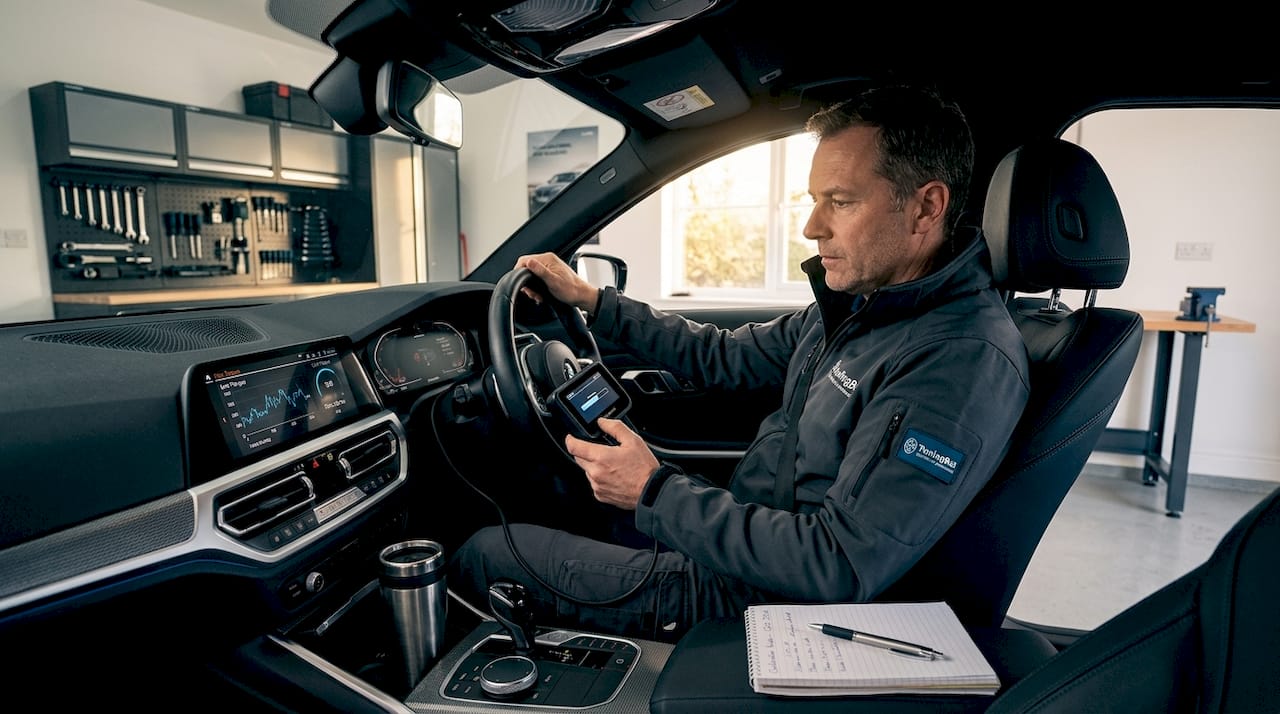
Les fichiers remaps pour les moteurs BMW B47 et N47 ciblent principalement le calage de l'injection, la pression dans la rampe d'injection, les paramètres boost et la stratégie EGR. Les tables de gestion du couple sont ajustées afin de refléter les nouvelles exigences en matière d'alimentation en carburant sans dépasser les limites de sécurité de la boîte de vitesses.
Carte du Stage 2 : installation du matériel prêt à l'emploi integration
Les calibrages de niveau 2 pour les moteurs essence BMW sont conçus autour d’ensembles de composants spécifiques. Une configuration courante associe un downpipe, un tuyau de suralimentation à haut débit et un refroidisseur intermédiaire amélioré à une cible boost recalibrée et à une cartographie d’allumage adaptée. Le calibrage de l'ECU tient compte de la réduction de la contre-pression d'échappement générée par le downpipe, ce qui permet d'augmenter les cycles de fonctionnement de la soupape de décharge et de prolonger la durée d'action du boost.
Sans une cartographie ECU de Stage 2 adaptée au matériel, le système de gestion moteur applique des limitations de couple d'usine qui annulent une grande partie du potentiel offert par les améliorations physiques.
Cartographie développée sur banc d'essai personnalisé : moteurs série M
Pour les configurations M2, M3 ou M4 modifiées équipées d’injecteurs, d’arbres à cames ou de composants turbo améliorés, un calibrage personnalisé développé au banc d’essai constitue la meilleure approche. Ces cartographies sont élaborées à l'issue de séries de tests au banc d'essai, avec des ajustements en temps réel des seuils de réponse au cliquetis, des cibles lambda et de la mise à l'échelle du modèle de couple. Les cartographies personnalisées, qu'elles soient issues de tests au banc d'essai ou basées sur des données d'enregistrement, offrent des performances bien plus fiables que les fichiers génériques lorsque le matériel s'écarte de la configuration d'origine.
Cartes commutable : profils performance et économique
Les cartographies commutables sur les BMW modernes permettent au conducteur de choisir entre un profil « performance » et un profil « économie » ou « conduite quotidienne » sans avoir à reprogrammer le calculateur. La commutation s'effectue généralement via une séquence définie de mouvements de la pédale d'accélérateur ou via le menu du calculateur de bord. Ce type de calibrage nécessite que le tuner enregistre deux jeux de calibrage complets au sein d'un seul fichier de calculateur, avec des tables d'injection de base communes et des tables distinctes de couple, de boost et d'allumage pour chaque mode.
Cartographie spécialisée : calibration axée sur les émissions avec gestion du FAP et de l'EGR
Certains opérateurs BMW dans le cadre d'une utilisation en flotte ou commerciale nécessitent des calibrations qui gèrent les composants d'émission sans déclencher de codes d'erreur DTC. Ces cartographies ajustent les cycles de régénération EGR et DPF tout en maintenant la conformité avec les exigences opérationnelles. Cela diffère des cartographies de suppression et est pertinent pour les applications où le matériel reste physiquement installé, mais où la planification de la régénération doit être recalibrée pour des cycles de service en dehors de l'enveloppe de conception d'usine.
Astuce de pro : Les cartographies commutables compliquent considérablement le fichier d'étalonnage. Demandez à votre fournisseur tuning de vous fournir une documentation attestant que les deux profils de cartographie ont été validés indépendamment l'un de l'autre, et pas seulement les performances mode.
3. Comparaison des cartographies de l'ECU BMW remapping avec celles du stage et de leurs fonctionnalités
Le tableau ci-dessous présente une comparaison directe des exemples de cartes décrits ci-dessus, en tenant compte des critères clés pertinents pour la prise de décisions professionnelles concernant le tuning.
| Type de carte | Réglage du stage | Gain HP typique | Matériel requis | Profils interchangeables | Méthode de flashage |
|---|---|---|---|---|---|
| Essence N55 Stage 1 | Première Stage | +50 à +70 PV | Aucun | En option | OBD |
| B47 320d diesel Stage 1 | Première Stage | +50 à +55 HP | Aucun | En option | OBD |
| Essence modifiée Stage 2 | Stage 2 | +90 à +130 PV | Tubes de descente, échangeur air-air | Oui | OBD / banc |
| M series carte dyno personnalisée | Stage 2 à 3 | +150 à +250 CV | Spécifique au moteur | Oui | Banc / coffre |
| Économie/Sport commutable | Stage 1 à 2 | Varie selon la carte de base | Varie | Oui | OBD |
| Carte de gestion des émissions | Première Stage | Minimal | Aucun | Non | OBD |
Les cartographies « Stage 1 » N55 et B47 constituent la solution la moins risquée et la plus rapide à mettre en œuvre. Elles conviennent aux véhicules utilisés au quotidien dont le propriétaire souhaite obtenir une amélioration mesurable des performances sans investissement matériel ni risque de perte de garantie au-delà de la mise à jour de l'ECU (modification). Les configurations « Stage 2 » nécessitent un investissement matériel initial, mais offrent des gains proportionnellement plus importants, tandis que la complexité du calibrage augmente en conséquence.
Les cartographies personnalisées de la série M ne sont pas adaptées aux véhicules de série ou légèrement modifiés. Le temps consacré au réglage, le coût des essais au banc et les sessions itératives de réglage ne se justifient que lorsque le matériel du véhicule nécessite véritablement une stratégie de couple et d'injection sur mesure.
4. Bonnes pratiques pour l'application des cartographies remapping des calculateurs BMW
Le choix de l'exemple de carte approprié ne constitue qu'une partie du processus. C'est la manière dont vous appliquez, validez et surveillez cet étalonnage qui détermine si les avantages du BMW remapping peuvent être exploités en toute sécurité.
- Utilisez des outils tuning certifiés : Les outils sans abonnement, tels qu’Autotuner, sont plébiscités par les ateliers professionnels spécialisés dans les BMW models, car ils prennent en charge les diagnostics OBD, les tests au banc et les boot modes, avec des mises à jour à vie et sans frais de recurring.
- Appliquer la stratégie de carte de base conservatrice : Lors de la validation d'une nouvelle cartographie moteur boosted, réduisez les cycles de fonctionnement de la soupape de décharge de 10 à 15% par rapport à la valeur cible. En commençant avec un WGDC d'environ 55%, vous éviterez les événements « overboost » lors des premières sessions d'enregistrement des données.
- Connectez avant de valider : Après chaque mise à jour, effectuez au moins trois sessions d'enregistrement de données sur différentes plages de charge et de régime avant de considérer la cartographie comme définitive. Comparez le nombre de cliquetis, les valeurs lambda et la pression boost aux tableaux de référence de la cartographie.
- Comprendre le risque de détection des concessionnaires : Les concessionnaires BMW peuvent détecter un logiciel de calculateur modifié en analysant les codes checksum et les indicateurs de version logicielle lors d'une lecture d'entretien. Si le maintien de la garantie est important, discutez-en avec le client avant de procéder à la mise à jour du logiciel.
- tuning incrémental pour une plus grande longévité : Ne passez pas directement du Stage 1 au Stage 3 sans effectuer les Stages de validation intermédiaires. Chaque stage doit être validé par des données avant l'application de la révision suivante de la carte.
Astuce de pro : L'enregistrement de données sur les calculateurs BMW via OBD est plus fiable avec des outils qui prennent en charge l'identification de paramètres étendus au-delà des PIDs OBD-II standard. Les outils de diagnostic génériques ne parviennent pas à capter les canaux critiques spécifiques au moteur tels que la correction de la température de l'air de suralimentation et le rapport de réalisation de la demande de couple.
5. Tendances émergentes concernant l'ECU remapping de BMW
La toute dernière technologie de moteur M de BMW pose de réels défis à la communauté tuning. Le Système d'allumage à préchambre BMW M Ignite utilisé dans les moteurs S58 et les moteurs M de nouvelle génération nécessite un logiciel de calibration pour gérer la double allumage par cylindre, un système emprunté à la technologie de combustion à préchambre de Formule 1. La rédaction de cartographies d'allumage précises pour ces moteurs nécessite une compréhension beaucoup plus approfondie du calage de la combustion que les unités turbocompressées précédentes.
Les systèmes de contrôle des émissions d'usine sur les nouvelles plateformes BMW ajoutent également des niveaux de calibrage qui interagissent avec la gestion du couple de manière non évidente. Les stratégies de dosage de l'AdBlue, les seuils de régénération du GPF et la température prédictive des gaz d'échappement (models) influencent tous la manière dont l'ECU réagit aux paramètres de suralimentation modifiés et aux tables d'injection. Les préparateurs qui ignorent ces interactions produisent des cartographies qui passent les tests initiaux mais déclenchent des codes d'erreur adaptatifs (DTC) en cas de charge prolongée.
“ Les systèmes d’allumage complexes des nouveaux moteurs BMW M exigent une évolution considérable du logiciel remap. Ces architectures promettent un meilleur contrôle de la combustion pour les experts tuners qui maîtrisent la logique sous-jacente, mais elles rehaussent considérablement le niveau minimum requis pour un réglage compétent. ”
L'enregistrement de données à distance et l'adaptation de cartes assistée par l'IA commencent à influencer les flux de travail professionnels. Les plateformes d'enregistrement basées sur le cloud permettent aux ingénieurs de calibration de recevoir des données du monde réel provenant de véhicules clients et de pousser des cartes corrigées à distance, réduisant ainsi le besoin de sessions sur banc d'essai en personne pour un affinement itératif. Cette tendance est particulièrement pertinente pour le processus d'optimisation des cartes ECU de BMW sur les véhicules dotés d'architectures d'émissions complexes où les valeurs d'adaptation d'usine évoluent avec le temps.
Mon point de vue sur la raison pour laquelle les exemples documentés changent la donne dans le manuel BMW tuning
J'ai examiné des centaines de fichiers de calibrage BMW pour différentes familles de moteurs, et l'erreur la plus courante que je constate est que tuners sélectionne une cartographie en se basant sur la réputation de la marque plutôt que sur des données de validation documentées. Le fait qu’un nom connu figure sur un fichier de calibrage ne remplace pas un essai enregistré montrant la pression réelle du capteur boost, les événements de cliquetis et la courbe du capteur lambda correspondant aux valeurs cibles de la cartographie.
Lorsque les ateliers me demandent ce qui différencie un calibrage professionnel d'un calibrage risqué, ma réponse est toujours la documentation. Le fichier est-il accompagné de journaux de validation ? La source publie-t-elle des feuilles de banc d'essai avant et après pour le code moteur spécifique ? Sinon, la cartographie est essentiellement une hypothèse plutôt qu'un calibrage validé.
Les exemples présentés dans cet article illustrent chacun une philosophie d’étalonnage distincte. Le remap diesel de niveau 1 est simple, bien compris et reproductible. La cartographie sur banc d’essai personnalisée de la série M est complexe, spécifique à chaque véhicule et ne convient que dans un contexte approprié. Savoir quel exemple s’applique à un véhicule et à un objectif donnés permet d’éviter la majorité des échecs de tuning que j’ai observés. Le tuning par Stages avec profils commutables offre également aux tuners et à leurs propriétaires une solution de repli pratique. Si une cartographie est trop exigeante dans des conditions d’utilisation quotidiennes, le profil économique absorbe cette variation sans nécessiter de reflash.
Ma recommandation la plus forte : ne jamais considérer un BMW remap comme un événement isolé. Il faut l'envisager comme une campagne d'étalonnage comportant des étapes de validation. Les exemples qui donnent les meilleurs résultats à long terme ne sont pas toujours les plus ambitieux.
— Équipe technique de TuningBot
Découvrez les solutions TuningBot pour l'ECU BMW remap
Pour les ateliers et les professionnels tuners à la recherche de fichiers de calibrage spécifiques à BMW, accompagnés d'un véritable soutien technique, TuningBot propose une base de données régulièrement mise à jour de solutions ECU remap couvrant les niveaux Stage 1, Stage 2 et Stage 3, la désactivation du FAP (DPF) et du système EGR, ainsi que des configurations de cartographies commutables pour toutes les principales familles de moteurs BMW.
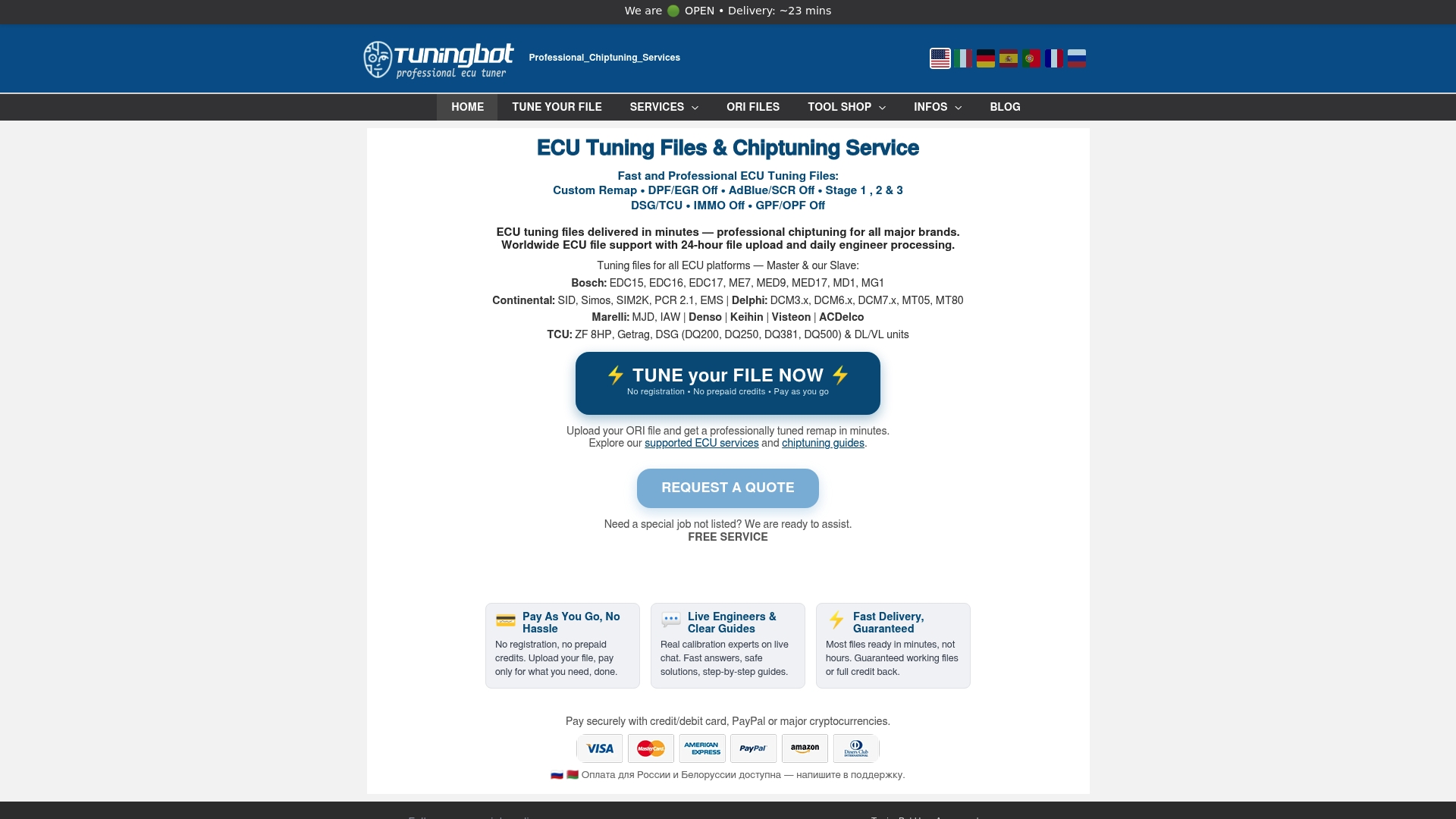
Le Mise à jour des solutions ECU, mai 2026 ajouté 837 fichiers nouveaux et révisés, y compris un support étendu pour les codes moteur B48, B58 et S58. TuningBot prend en charge les principaux outils de flashage professionnels, notamment Alientech KESS3, Accordeur automatique, et Magic Motorsport Flex, sans aucun crédit prépayé requis. Téléchargez votre fichier ECU directement et recevez un fichier calibré par des professionnels grâce au flux de travail revu par les ingénieurs de la plateforme. Visitez Le catalogue complet de solutions de TuningBot, vérifier Couverture des services ECU, ou soumettez votre fichier via Reprogrammer le fichier pour trouver la bonne carte pour la construction de votre BMW.
FAQ
Quels sont les exemples les plus courants de cartographies pour l'ECU BMW remapping ?
Les exemples les plus courants de cartographies pour l'ECU BMW remapping sont les calibrages « Stage 1 » pour moteurs essence et diesel, les cartographies « Stage 2 » à installation simple, les fichiers personnalisés de la série M développés au banc d'essai, ainsi que les cartographies permettant de basculer entre un profil économique et un profil performant. Chacune d'entre elles cible une combinaison différente de matériel, d'objectifs de puissance et d'exigences en matière de comportement routier.
Quel gain de puissance peut apporter un kit Stage 1 pour la BMW remap ?
Un module remap de niveau 1 permet généralement de gagner entre 50 et 100 HP sur les moteurs essence turbocompressés. Sur les modèles diesel tels que la 320d équipée du moteur B47, des gains de 53 HP et 77 Nm ont été constatés après une seule session de flashage via le port OBD.
Quelle est la différence entre une cartographie personnalisée et une cartographie BMW remap standard ?
Les cartographies prêtes à l'emploi offrent une amélioration sûre et globale par rapport aux véhicules de série, tandis que les cartographies personnalisées, élaborées à partir de données de banc d'essai ou de données d'enregistrement, sont calibrées en fonction d'un matériel et de conditions spécifiques. Les fichiers personnalisés permettent une gestion plus précise du couple et un contrôle plus fin de l'injection, ce qui en fait le choix idéal pour les moteurs modifiés.
Les calculateurs BMW peuvent-ils être flashés via OBD sans retirer le calculateur ?
La plupart des BMW fabriquées après 2013 prennent en charge la programmation via le port OBD à l'aide d'outils professionnels tels que l'Autotuner ou le KESS3. Les calculateurs plus anciens ou verrouillés nécessitent un accès physique au banc d'essai ou une programmation via le boot mode.
Qu'est-ce qu'un remap commutable et en quoi est-ce important ?
Un module remap commutable permet de stocker plusieurs profils d'étalonnage dans la mémoire flash d'un seul calculateur, ce qui permet au conducteur de choisir entre les modes « performances » et « économie » modes sans avoir à se rendre dans un garage. Cela améliore le confort de conduite au quotidien tout en conservant les performances optimisées mode pour la conduite sur circuit ou sportive.