

 EnglishEN
 ItalianoIT
 EspañolES
 PortuguêsPT
 FrançaisFR
 РусскийRU
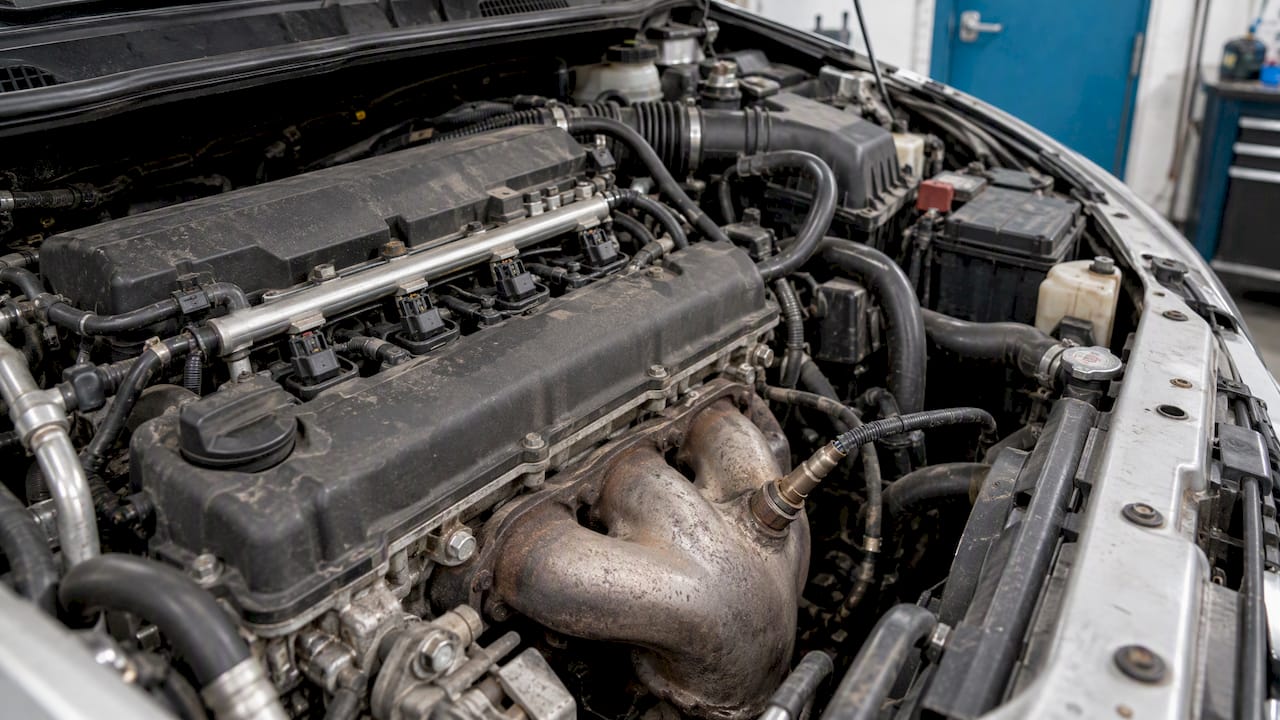
Closed loop vs open loop describes whether a particular control function uses feedback to correct its output. For ECU fueling, closed loop uses exhaust oxygen-sensor feedback to adjust fuel delivery toward a target; open loop does not use that feedback for the active fuel correction. Neither term, by itself, tells you the engine load, the target lambda or whether the mixture is safe.
Closed loop vs open loop: the actual difference
Both modes require a base fuel calculation. Depending on the controller, that calculation can use measured airflow, a speed-density model, injector characterization, torque requests and other inputs. Open-loop fueling is not universally “the VE table,” and it does not mean that the ECU stops reading all sensors.
In closed loop, the controller compares feedback with the applicable target and applies a correction within its available authority. In open loop, live oxygen feedback is not closing that fuel-control loop, but temperature compensation, transient fueling, learned corrections where supported and other control functions may still operate.
| Question | Kraftstoffregelung im geschlossenen Kreislauf | Open-loop fuel control |
|---|---|---|
| Is live oxygen feedback correcting fueling? | Yes, while the control function is active and conditions are valid. | No, for the fuel-control function being described. |
| Does the base calculation matter? | Yes. Feedback corrects errors only within its limits. | Yes. Base calculations and applicable corrections determine delivery. |
| Must the target be stoichiometric? | No. Suitable wideband systems can control richer or leaner targets. | No. The commanded target depends on the strategy. |
| Does the mode establish engine safety? | No. Sensor validity and control limits still matter. | No. Correct calibration and validation still matter. |
The same engine can simultaneously use different control modes for fueling, idle, boost and other functions. A fuel-system status flag does not describe every loop in the ECU. Our boost control guide discusses another application of feedback.
Narrowband and wideband feedback are different
A conventional switching narrowband oxygen sensor is useful for identifying rich or lean operation close to stoichiometry. It is not a precise instrument for measuring a substantially rich full-load mixture. Older explanations built around this sensor type should not be applied unchanged to every modern engine.
A suitable wideband sensor and controller provide usable lambda information across a broader, specified range. That allows a compatible ECU to regulate fuel around a rich target at high load when its strategy permits. Having a wideband fitted does not prove that the ECU uses it for closed-loop control: it may be used only for logging or protection.
Lambda compares the actual air-fuel ratio with the stoichiometric ratio of the fuel. Lambda 1 is stoichiometric, but it does not imply one universal numerical AFR for all fuels. Fuel composition and display configuration matter when comparing logs. See lambda target tuning und die flex-fuel calibration guide.
Why the ECU enters or leaves closed loop
Entry conditions may include sensor readiness, time since starting, engine temperature, load, speed, transient conditions and diagnostic status. These are controller-specific criteria, not universal thresholds. Warm-up enrichment does not inherently require open loop: a supported system can use feedback with a target that includes the required enrichment.
Haltech’s Elite O2-control documentation provides a concrete example: it distinguishes wideband lambda targets from narrowband voltage targets and describes configurable operating conditions and correction limits. Its optional throttle and manifold-pressure limits should not be mistaken for a rule that all ECUs must leave closed loop at wide-open throttle.
- Starting: feedback may be unavailable or intentionally inactive during cranking and sensor warm-up.
- Steady operation: feedback can correct mixture errors when the enabling conditions are met.
- Acceleration and high load: control may remain active, pause or change behavior according to the strategy.
- Overrun fuel cut: a very lean exhaust reading is not a request to add fuel while injection is intentionally disabled.
- Sensor faults: the ECU may suspend feedback or use a fallback strategy; consult the application-specific behavior.
Read the actual mode and reason-for-inhibition channels where available. Do not infer fuel-control mode from pedal position or coolant temperature alone.
Interpret short-term and long-term corrections
Short-term fuel trim generally describes an immediate correction. Long-term trim describes learned compensation, but storage, cell selection, enabling conditions and persistence differ between systems. Some tools display percentages, others multipliers or manufacturer-specific values; check definitions and sign conventions before interpreting a log.
Learned corrections may remain applicable in some open-loop conditions, but this is not universal. Nor does a zero short-term trim prove that the mixture is correct: feedback could be inactive, limited, unsupported by that channel or not yet responding.
Large or persistent correction is evidence to investigate, not proof that the base map must be edited. Possible causes include an intake or exhaust leak, inaccurate airflow measurement, injector data, fuel pressure, fuel composition, sensor problems or a calibration error. Misfire can leave oxygen in the exhaust and produce a lean indication even when simply adding fuel is inappropriate.
Feedback also has transport and response delays. The sensor sees exhaust from combustion that happened earlier, so rapid transients require careful alignment of commanded and measured values. Raising control gains or widening correction limits without understanding the delay can worsen oscillation or conceal the underlying fault.
Use logs to distinguish target changes from base-map errors
Changing the base fuel calculation while leaving the target unchanged can lead closed-loop correction to counteract the edit. That does not mean all changes in closed-loop regions are ignored. Changing a supported target, correcting injector data and fixing airflow estimation are different actions with different effects.
Die fuel map tuning guide explains the broader calculation. For a useful before-and-after comparison, record:
- Controller identification, software version, fuel and relevant hardware.
- RPM, load, throttle, temperatures and active fuel-control mode.
- Commanded lambda, measured lambda, sensor status and both bank readings where applicable.
- Short-term and long-term corrections, their limits and any active learning state.
- Fuel pressure and injector operation where available, plus diagnostic information and relevant protection events.
Check sensor scaling and exhaust integrity before drawing conclusions. Preserve the diagnostic baseline; reset adaptations only when the applicable calibration or repair procedure calls for it. Validate the transitions and operating conditions affected by the change, not just one warm idle log.
Diesel control needs its own interpretation. Lambda information can support air-path and emissions strategies, but a diesel is not generally managed like a stoichiometric spark-ignition engine. Torque, air availability, injection and aftertreatment requirements interact differently. The EDC17 guide provides related context.
Häufig gestellte Fragen
What is the difference between closed-loop and open-loop fueling?
Closed-loop fueling uses live oxygen-sensor feedback to correct fuel delivery toward a target. Open-loop fueling does not use that feedback for the active fuel correction, although other inputs and corrections can still apply.
Can closed loop operate at wide-open throttle?
Yes, when the ECU strategy, sensor and operating conditions support it. A suitable wideband system can control a rich target. High load does not universally require open loop.
Does closed loop always target lambda 1?
No. Conventional narrowband control is useful near stoichiometry, while suitable wideband control can follow other targets within its supported range.
Do long-term fuel trims always apply in open loop?
No. Their application depends on the controller and operating mode. Check the relevant documentation and logged correction channels instead of assuming universal carryover.
Do large fuel trims mean the base map is wrong?
Not necessarily. Sensor errors, leaks, fuel delivery, injector data and other faults can also cause persistent corrections. Establish the cause before changing calibration tables.
Weiterführende Informationen
These resources discuss different generations of fuel control. Apply their examples to the stated sensor type and controller rather than treating older narrowband behavior as universal.