

 EnglishEN
 ItalianoIT
 EspañolES
 PortuguêsPT
 FrançaisFR
 РусскийRU
Flex fuel tuning guide workflows should begin with fuel-system capacity, exact ECU strategy and a verified ethanol-content signal where variable-blend operation is intended. Not every implementation uses two complete map groups, linear interpolation, the same sensor scaling or the same fail-safe behavior. The professional approach is to confirm sensor integration, material and fuel-system compatibility, baseline gasoline calibration, cold-start behavior and the ECU’s actual blend-control logic before increasing load.
TL;DR:
- A flex-fuel system needs a reliable ethanol-content signal only when the ECU strategy uses real-time blend compensation; fixed E85 calibrations are a different workflow.
- Sensor wiring and installation must follow the exact sensor and vehicle documentation; there is no universal return-line or grounding rule.
- Fueling, ignition, cold-start, torque and boost changes must follow the actual ECU strategy and fuel-system limits.
- Higher ethanol content usually increases fuel demand, but injector and pump headroom must be verified from logs rather than generic duty-cycle thresholds.
- Validate multiple blend points where practical; do not assume a perfect linear transition between gasoline and high-ethanol calibrations.
Flex Fuel Tuning Guide: What the ECU Actually Changes
Gasoline and ethanol blends have different stoichiometric requirements. Calibrate and log in lambda where possible rather than relying on one gasoline-equivalent AFR number.
Where the ECU supports flex-fuel logic, ethanol content can influence fuel-mass calculation, ignition, cold-start, torque and boost-related strategies. The exact tables and blend functions are platform-specific.
Realistic expectations matter here. Gains depend heavily on the platform, but the mechanism behind them includes:
- Increased injector on time to match ethanol’s lower energy density
- Additional ignition advance where knock margin allows it
- Higher boost targets on forced-induction setups with adequate fueling headroom
- A driveability tradeoff during cold starts, since ethanol vaporizes poorly below freezing without added enrichment
Flex Fuel Tuning Guide: Ethanol Sensor Integration
Sensor accuracy matters because every blend-dependent strategy relies on the ethanol signal. Confirm the exact sensor datasheet, scaling and diagnostic behavior before calibration.
Follow the sensor manufacturer and vehicle-specific installation instructions rather than a universal mounting, shielding or grounding recipe.
- Use a sensor compatible with the fuel blend, ECU input or CAN interface.
- Mount it only in the location and orientation approved for that sensor and fuel system.
- Use the sensor manufacturer’s wiring, grounding, shielding and power requirements.
- Verify raw frequency/voltage/CAN data and calculated ethanol content before calibration.
- Test for dropouts, electrical noise and implausible readings under real vehicle conditions.
- Use a known reference fuel or laboratory standard only when that level of calibration verification is actually required.
Pro-Tipp: Log raw sensor frequency alongside calculated ethanol percentage during your first drive. If the frequency jumps erratically at idle near the alternator or ignition coils, you have an EMI problem, not a sensor problem, and rerouting the signal wire will fix it faster than replacing the part.
Flex Fuel Tuning Guide: Petrol-to-Ethanol Calibration Workflow
A flex fuel tuning guide should move from a verified low-ethanol baseline toward the intended high-ethanol range while validating interpolation and protection behavior between them.
- Validate the vehicle and low-ethanol baseline first.
- Confirm sensor scaling and the ECU’s ethanol-content input strategy.
- Calibrate fuel-mass/injector behavior for the intended ethanol range.
- Calibrate cold-start, warm-up, ignition, torque and boost strategies only where the ECU and hardware require them.
- Configure sensor-failure or implausibility handling using the ECU/tool’s supported fail-safe logic.
- Validate several representative blend points rather than only the two endpoints.
Some platforms are calibrated around low- and high-ethanol reference points and checked at intermediate blends, but the exact breakpoints and interpolation model depend on the ECU.
Choose logging channels from the actual ECU and fuel system; there is no universal minimum list.
- Calculated ethanol content and raw sensor signal where available.
- Commanded and measured lambda plus fuel corrections where meaningful.
- Low- and high-pressure fuel-system behavior under load.
- Injector control time/duty or available headroom using the metric appropriate to the ECU.
- Knock/ignition response and relevant temperatures.
- Cold-start and warm-up behavior at representative ambient conditions.
Validate cold-start, transient and higher-load behavior at representative ethanol contents and ambient conditions appropriate to the vehicle.
Flex Fuel Tuning Guide: Fuel-System Limits
Higher ethanol content generally increases required fuel mass for equivalent lambda, which can expose low-pressure pump, high-pressure pump, injector and control-time limits.
Watch for these bottlenecks when pushing a flex fuel calibration toward higher power:
- Low-pressure supply: confirm pressure/flow remains adequate at the intended ethanol content and load.
- High-pressure fuel system: verify actual versus requested pressure on direct-injection applications.
- Injector capacity: use the ECU’s actual control-time/duty/headroom metric rather than one universal percentage.
- Fuel-contact materials: verify pump, hose, seals and sensor compatibility with the intended blend.
- Cold-start capability: higher ethanol content may require additional strategy or hardware depending on climate and engine design.
Keep an eye on fuel rail pressure actual versus target, HPFP duty percentage, and PI IDC in every log. If any of these track toward their ceiling under boost, the fix is hardware (bigger pump, larger injectors), not more timing or a richer target. A larger fuel system is often the deciding factor in whether an E85 conversion delivers its expected power gain or falls short at high RPM.
Flex Fuel Tuning Guide: Fuel Scaling and Blend Strategy
In a flex fuel tuning guide, flex-fuel strategies can blend stoichiometric/fuel-mass, ignition, boost, cold-start and torque-related functions differently. Do not assume two universal blending philosophies or one linear model.
Fuel-mass compensation should be based on the ECU’s injector model, actual ethanol content, fuel pressure and lambda target. A simple stoichiometric-ratio multiplier can be a rough reference, not a universal injector-scalar rule.
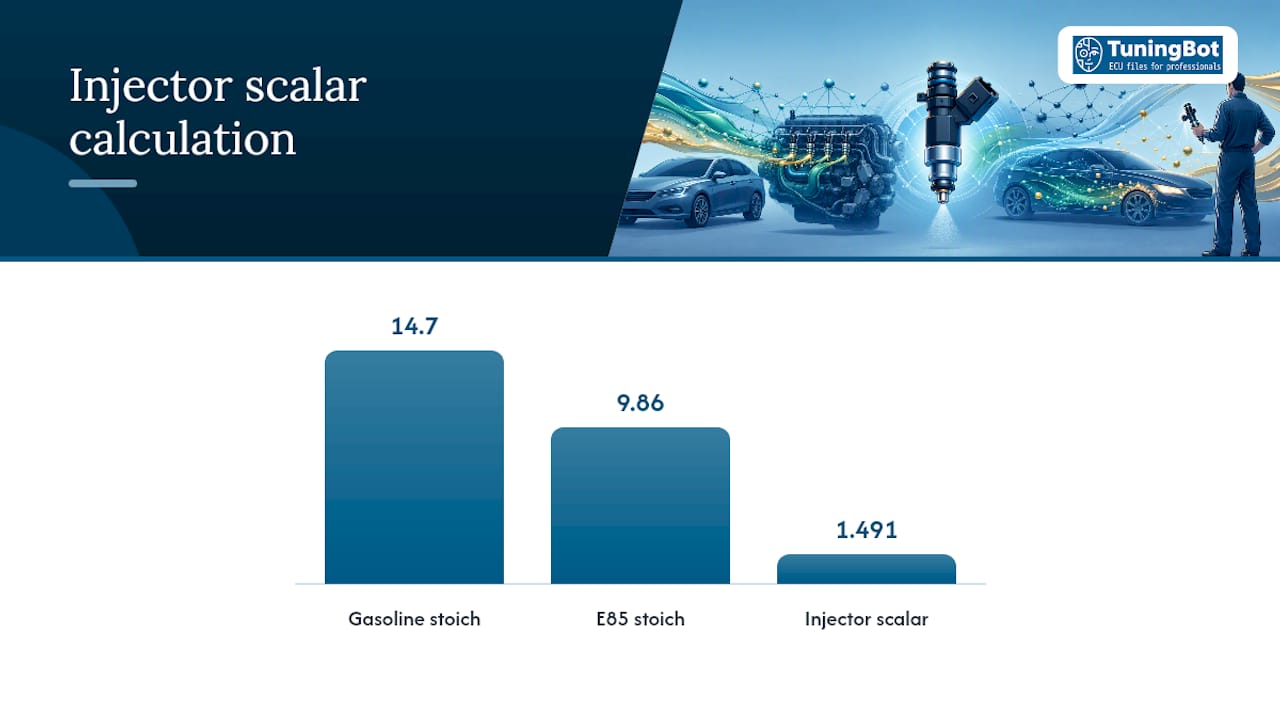
Ignition and boost response to ethanol content is generally nonlinear and should be calibrated from measured knock margin, air charge, fuel pressure and temperature rather than a fixed breakpoint rule.
Practical rules that keep this process safe:
- Use lambda and the ECU’s actual injector/fuel-mass model rather than a fixed 1.491 multiplier.
- Keep a validated baseline revision so blend-related changes remain traceable.
- Calibrate ignition and boost only from measured knock/fuel/thermal headroom at each representative blend.
- Do not assume timing or boost should increase monotonically with ethanol percentage.
- Validate sensor-failure behavior and blend interpolation before customer release.
Flex Fuel Tuning Guide: Common Failure Modes
Flex-fuel problems can originate from sensor/wiring faults, incorrect scaling, fuel-system limits, interpolation errors, cold-start calibration, mechanical issues or an incorrect base tune.
- Erratic ethanol signal: diagnose sensor power, ground, wiring, CAN/frequency signal and scaling.
- Wrong sensor placement: compare the installation with the sensor/fuel-system manufacturer’s requirements.
- Fuel pressure shortfall: treat it as a hardware or control-capacity issue, not a timing problem.
- Base-calibration error: confirm low-ethanol operation before blaming blend interpolation.
- Cold-start or warm-up issue: validate the temperature-dependent ethanol strategy rather than overcorrecting the main fuel map.
- Sensor failure handling: confirm the ECU enters a safe, documented state instead of assuming a universal default ethanol value.
Pro-Tipp: When a customer reports intermittent rough idle only in certain weather, check the sensor ground connection before anything else. Cold, damp conditions expose marginal grounds that read fine on a warm, dry bench.
How TuningBot Fits Into Flex-Fuel Calibration Workflows
TuningBot can support E85 and flex-fuel calibration requests where the exact ECU, source-file type and service are covered.
Before ordering, check ECU-Service-Abdeckung, überprüfen Sie öffentliche Preisliste and browse ECU-Dienste.
For related technical context, use the verified E85 Conversion Remap Guide und Kraftstoffkarten-Abstimmungsanleitung.
Submit a supported source file through Datei tunen after confirming the ECU, hardware and intended ethanol range.
This article stays informational and technical so commercial E85/flex-fuel service keywords remain concentrated on TuningBot’s service and order pages.
Using This Flex Fuel Tuning Guide in a Workshop
Use this guide to verify sensor integration, fuel-system capacity, blend logic, cold-start behavior and validation before changing the calibration.
If calibration is outsourced, verify the exact ECU in ECU-Service-Abdeckung and submit the supported source file through Datei tunen.
The workshop remains responsible for fuel-system hardware, sensor installation, programming, legal use and final validation.
Sources and Further Reading
- NIST SRM 2895 certificate — external ethanol reference standard retained unchanged.
- FuelTech — Setting Up Flex Fuel — external ECU/flex-fuel setup reference retained unchanged.
- TuningBot — E85 Conversion Remap Guide — verified internal ethanol-calibration reference.
- TuningBot — Fuel Map Tuning Guide — verified internal fueling reference.
- TuningBot — ECU Service Coverage — verified internal coverage reference.
FAQ
How do you tune for flex fuel?
Start with a healthy low-ethanol baseline, verify the ethanol-content signal, then calibrate the fuel-mass, ignition, cold-start, torque and boost strategies that the exact ECU actually blends across ethanol content.
How much horsepower can an E85 tune add?
There is no universal gain. Output depends on engine, turbo, compression, fuel system, knock margin, calibration and the actual ethanol content.
How does a flex fuel tune work?
A supported ECU uses ethanol-content information to modify the strategies linked to fuel composition. The exact blend tables, interpolation and fail-safe logic vary by ECU.
Can I put 87 octane gasoline in a flex fuel car tuned for E85?
Only if the calibration has been explicitly validated for that gasoline octane and ethanol range. Flex-fuel capability does not automatically make every low-octane fuel safe for every performance calibration.