

 ItalianoIT
 DeutschDE
 EspañolES
 PortuguêsPT
 FrançaisFR
 РусскийRU
Understanding precisely how a remap file is calibrated separates professional-grade tuning from guesswork. Many workshops treat ECU remapping as a simple parameter adjustment, but calibration is a distinct, technical discipline: it involves verifying binary modifications byte-by-byte, confirming compatibility with the target ECU, and validating every change before and after flashing. This guide walks automotive tuners and calibration professionals through the full remap file calibration process, from reading the stock file to post-flash verification, covering modern toolchains, common pitfalls, and the expert strategies that produce reliable, repeatable results. For supported services and ECU families, the TuningBot ECU Service Coverage page is the best internal reference before submitting a file.
Table of Contents
- Key Takeaways
- How remap file calibration works at a technical level
- The remap file calibration process: step by step
- Traditional tuning approaches vs. modern calibration toolchains
- Calibration challenges, pitfalls, and expert strategies
- My perspective on where calibration discipline is heading
- Calibrate smarter with TuningBot
- FAQ
Key Takeaways
| Point | Details |
|---|---|
| Calibration differs from tuning | Calibration verifies the exactness of binary modifications; tuning adjusts parameters toward a performance target. |
| Binary diffing is foundational | Modern workflows compare stock and modified binaries to generate portable, verifiable patch recipes before flashing. |
| Validation precedes every flash | Confirming ECU family and software version compatibility before applying a remap prevents irreversible damage. |
| Post-flash verification is mandatory | Checking calibration integrity after flashing confirms the file was applied correctly and completely. |
| Pitfalls are process failures | Most calibration errors trace back to skipped validation steps, not the tuning parameters themselves. |
How remap file calibration works at a technical level
In industry terminology, the process of adjusting and verifying an ECU binary is called ECU calibration. The phrase “how a remap file is calibrated” describes the same workflow from the practitioner’s perspective. Recognizing that distinction matters because calibration carries a stricter definition than tuning. Calibration targets accuracy while tuning adjusts parameters, and conflating the two leads to incomplete workflows.
An ECU binary contains hundreds of interdependent data tables governing fuel delivery, ignition advance, torque limits, boost targets, idle control, and emission-related thresholds. Calibrating a remap file means confirming that every modified byte produces the intended effect in the target ECU without introducing conflicts across those tables. This is not a subjective process. It requires reading the original stock binary, applying defined modifications, and then verifying the output against expected values.
The parameters most commonly touched during calibration include:
- Fuel maps: Injector pulse width and lambda targets across the load/RPM matrix
- Ignition timing: Advance tables per cylinder, with knock retard thresholds
- Torque management: Requested versus actual torque limits, including gearbox torque reduction signals
- Boost control: Wastegate duty cycle maps and boost pressure targets by load
- Emission controls: EGR rate tables, DPF regeneration thresholds, and AdBlue dosing maps
- Rev limiters and speed governors: Soft cut and hard cut RPM values, Vmax limits
Modern toolchains formalize this by treating calibration as a verifiable, scriptable operation. OpenRemap reads two binary files, finds all modified bytes, and saves the differences as a portable recipe that is validated before patching and verified after applying. That approach makes the calibration auditable and repeatable across multiple ECU units of the same family.
The remap file calibration process: step by step
The remap file calibration process follows a defined sequence. Deviating from that sequence is where most errors originate.
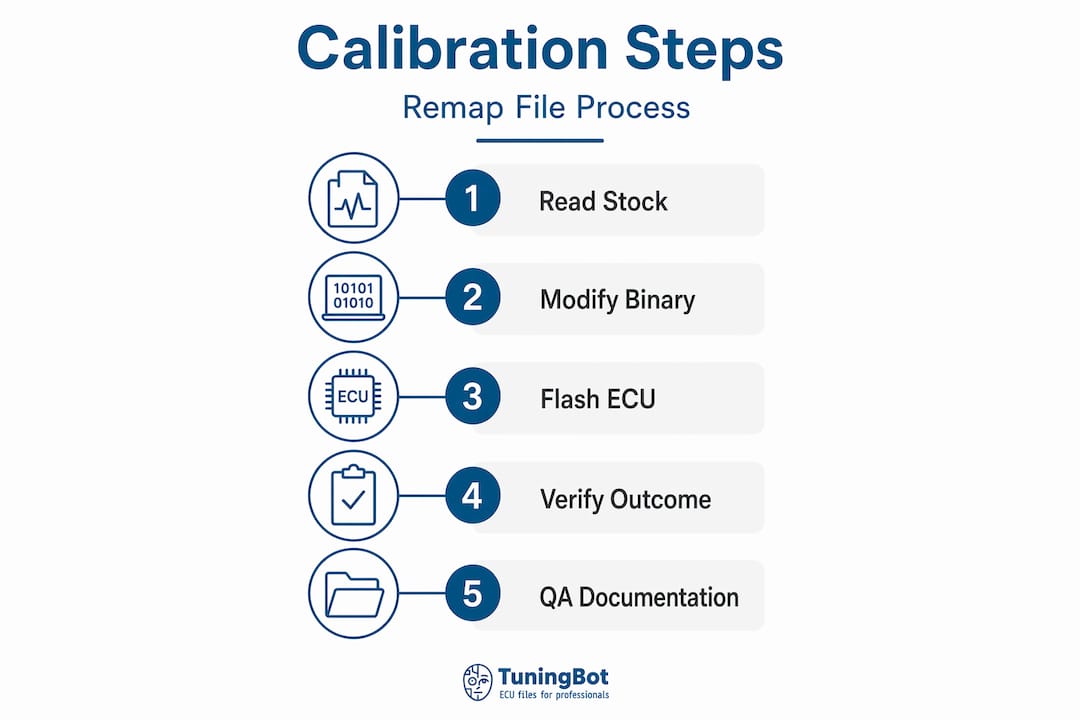
Extract and archive the stock ECU file. Use a hardware interface tool compatible with the target ECU: Alientech KESS3, AutoTuner, Magic Motorsport Flex, CMD Flash, or PCMFlash. Read the full binary, verify the read by performing a second read and comparing checksums, then archive the original. This file is the baseline for every subsequent diff and the recovery point if anything goes wrong.
Identify the ECU family, software version, and hardware variant. Every ECU family has quirks. A Bosch MED17.1.6 and a Bosch MED17.4.2 share architecture but differ in map offsets and protection mechanisms. Knowing how a professional tuner reads ECU data and identifies those variants is the difference between a clean calibration and a bricked unit.
Define tuning objectives and modify parameters. Working from the stock binary in a map editor, modify fuel, ignition, torque, and boost tables according to the tuning target. Whether that target is Stage 1 optimization on standard hardware or a Stage 2 build with upgraded hardware, remapping focuses on parameter optimization rather than arbitrary power increases. Document every change with specific before and after values.
Generate the calibration recipe by binary diffing. Compare the modified binary against the stock baseline. The diff output is the calibration recipe: a structured record of which bytes changed and what they changed to. This recipe is the deployable unit, not the raw modified binary.
Validate the recipe against the target ECU. Before flashing, confirm that the ECU on the vehicle matches the software version and hardware variant the recipe was built for. A mismatch at this stage is recoverable. A mismatch discovered after flashing may not be. ECU ID verification and controlled stock-file handling preserve data integrity and allow rollback.
Apply the calibrated remap and perform post-flash verification. Flash the file using the same hardware interface used for the original read. After writing, read the ECU back and diff the result against the intended calibrated binary. Any discrepancy indicates a write error that must be resolved before the vehicle leaves the workshop.
Pro Tip: Always perform the post-flash read-back on a cold ECU. Some units cache values in RAM during a live session that do not reflect what was actually written to non-volatile memory. A cold read gives you the true stored state.
The full workshop remap procedure emphasizes clarity and speed combined with quality assurance. Those two properties are not in conflict when the calibration workflow is properly structured.

Traditional tuning approaches vs. modern calibration toolchains
Understanding the trade-offs between legacy and modern methods helps you choose the right approach for each job.
| Method | Approach | Key benefits | Primary risks |
|---|---|---|---|
| Manual binary editing | Direct hex or map editor modification of the binary | Full control, no toolchain dependency | No audit trail, high error surface, difficult to replicate |
| Copy-paste from known maps | Transplanting validated map values from a reference file | Speed, community-validated data | Incompatible offsets across ECU revisions, silent failures |
| Scriptable recipe patching | Binary diffing to generate portable, validated patch recipes | Auditable, repeatable, verifiable pre and post-flash | Requires accurate stock file identification upfront |
| Dyno-validated custom calibration | Full closed-loop calibration with dynamometer feedback | Highest accuracy, performance verified under load | Time-intensive, requires dyno access and skilled operator |
The shift toward scriptable, verifiable tuning recipes enhances accuracy and safety in ECU remap calibration workflows in a way that manual methods cannot replicate at scale. When a workshop processes dozens of files per week, the ability to generate a recipe once, validate it programmatically, and apply it with confidence across matching ECU units dramatically reduces rework.
Legacy manual editing is not obsolete. For highly customized builds where the stock binary is the starting point but the end result diverges significantly from any reference file, direct editing remains necessary. The discipline is in knowing when each method applies and never skipping the verification layer regardless of approach.
Pro Tip: When working with a new ECU family for the first time, run your binary diff against two independently sourced stock files of the same version. If they do not match byte-for-byte in the unmodified regions, one of them has been previously modified. Using a corrupted baseline will produce a flawed recipe.
Professional calibration is ultimately a balance of technical precision and road-testing to confirm performance without reliability loss. Dyno-tested files calibrated by expert engineers set the quality standard that any calibration workflow should aim to meet, while the TuningBot ECU Services page gives workshops a clearer internal reference for professional calibration categories.
Calibration challenges, pitfalls, and expert strategies
The most expensive mistakes in remap calibration are not caused by wrong parameter values. They are caused by skipped process steps. The following are the most consequential errors professionals encounter and how to avoid them:
Flashing the wrong ECU variant. ECU hardware and software versions must match the calibration recipe exactly. A recipe built for a Marelli MJD9DF will produce unpredictable results on a MJD9F1 even though both units share physical similarities. Cross-referencing the ECU ID before every job is non-negotiable.
Omitting checksum correction. Many ECU families validate internal checksums on startup. A modified binary with an uncorrected checksum will trigger a failsafe or refuse to boot entirely. Checksum correction must be part of every calibration workflow, not an afterthought.
Overwriting torque limits without adjusting safety thresholds. Increasing requested torque values without updating the corresponding actual torque limits and torque reduction signals to the TCU creates a conflict that manifests as jerky power delivery, transmission faults, or limp mode. Calibrating a remap file correctly means treating the ECU and TCU parameters as a system, not isolated tables.
Skipping the post-flash read-back. A write operation that returns no error code is not confirmation that the data was stored correctly. Hardware interface failures, voltage drops during flashing, and memory sector errors can all produce a corrupt stored calibration without generating an error at the interface level.
Copying proven maps without verifying injector scaling. A fuel map that produces correct lambda values with 310cc injectors will run dangerously rich with 550cc injectors at the same pulse width values. Reviewing common ECU tuning mistakes reveals that injector scaling mismatches are among the most frequently overlooked errors in remap calibration.
Expert-level calibration practice also involves building a structured library of known-good stock files organized by ECU family, software version, and hardware revision. That library accelerates validation, provides reliable diff baselines, and makes calibration recipes portable across the workshop’s full vehicle coverage.
My perspective on where calibration discipline is heading
I have watched calibration practices evolve significantly over the past decade, and the pattern is consistent: shops that treat calibration as a checklist process consistently outperform shops that rely on experienced intuition alone. Intuition matters, but it does not scale and it does not produce an audit trail.
What concerns me most in current practice is how many professionals still skip binary verification after flashing. The assumption is that if the interface reports success and the car starts, the calibration is correct. That assumption is wrong often enough to be genuinely dangerous. A partial write that affects only certain memory sectors can produce a vehicle that runs normally under light load and fails catastrophically under full load.
The advancement I find most significant is the move toward portable recipe formats rather than raw binary distribution. When you distribute a binary, you lose visibility into what changed and why. When you distribute a verified recipe, every recipient can audit the changes, confirm compatibility, and reproduce the result independently. That level of transparency is where the industry needs to go.
My advice to any professional tuner looking to tighten their calibration workflow: invest in the validation layer before you invest in faster flashing hardware. Speed without verification is not efficiency. It is deferred risk.
— TuningBot Technical Team
Calibrate smarter with TuningBot
TuningBot operates specifically for the needs of professional workshops and ECU tuners who require precision calibration without operational overhead. Every remap file delivered through TuningBot’s platform is built on structured calibration workflows: stock file extraction, parameter modification with defined objectives, binary verification, and engineer review before delivery. The platform supports Bosch, Continental, Delphi, Marelli, Denso, Siemens, and ZF ECU families, with direct compatibility for Alientech KESS3, AutoTuner, Magic Motorsport Flex, CMD Flash, Dimsport, and PCMFlash.
Whether you need Stage 1 through Stage 3 calibration, DPF Off, EGR Off, AdBlue / SCR Off, DSG/TCU tuning, or advanced options like Pop and Bang and Vmax removal, TuningBot delivers verified calibrated remap files with no registration and no prepaid credits required. Check compatibility through ECU Service Coverage, then submit the original file through Tune Your File. Explore the 2026 platform upgrades to see the latest supported integrations and toolchain improvements that make remap calibration faster and more reliable for your workshop.
FAQ
What is the difference between ECU tuning and calibration?
Tuning adjusts ECU parameters toward a performance target, while calibration verifies that binary modifications are accurate and produce the intended result in the specific ECU being flashed. Both steps are required for a professional remap.
How do you verify a remap file after flashing?
After flashing, read the ECU binary back using the same hardware interface and compare it byte-by-byte against the intended calibrated file. Any discrepancy indicates a write error that must be corrected before the vehicle is returned to service.
What causes remap calibration to fail?
The most common causes are ECU variant mismatches, missing checksum corrections, skipped post-flash verification, and parameter conflicts between ECU and TCU torque tables. Skipping validation steps rather than incorrect parameter values accounts for the majority of calibration failures.
What is a calibration recipe in ECU remapping?
A calibration recipe is a structured file that records only the bytes that differ between a stock and modified binary. It allows the same calibration to be validated, audited, and applied reliably to any matching ECU unit without distributing the full modified binary.
How does ECU family identification affect calibration?
Each ECU family has unique map offsets, memory layouts, checksum algorithms, and protection mechanisms. A calibration recipe built for one software version will not apply correctly to a different version of the same ECU family, which is why stock file identification and ECU ID verification precede every calibration job.