

 ItalianoIT
 DeutschDE
 EspañolES
 PortuguêsPT
 FrançaisFR
 РусскийRU
ECU remapping directly changes how your engine consumes fuel by recalibrating injection timing, turbo boost pressure, and torque delivery curves inside the engine control unit. How remap affects fuel consumption depends on two factors above all others: the type of remap applied and how the driver uses the extra torque afterward. Diesel engines typically see 5–15% fuel savings after a well-executed remap, while petrol engines average 3–8%. Those numbers are not guaranteed. They reflect what happens when the right remap meets the right driving habits.
How does remapping affect fuel consumption technically?
The stock ECU calibration from manufacturers like Bosch, Delphi, or Continental is deliberately conservative. Manufacturers restrict mid-range torque to protect drivetrains, satisfy global emissions standards, and account for variable fuel quality across markets. That means a significant portion of the engine’s efficiency potential is software-locked, not hardware-limited. A remap unlocks that potential by rewriting the calibration tables the ECU uses to govern engine behavior.
The technical changes that reduce fuel consumption work through several mechanisms:
- Torque delivery in the mid-range: A remap shifts peak torque to lower RPM bands. The engine pulls confidently at 1,500–2,000 RPM instead of requiring 2,800–3,200 RPM to produce the same road force. Lower RPM operation burns less fuel per kilometer traveled.
- Injection timing and quantity: Eco remaps optimize injection timing to fire fuel at the precise point in the combustion cycle where energy extraction is highest. Less fuel is wasted as heat or unburned exhaust.
- Turbo boost management: Adjusting boost pressure curves reduces pumping losses. The engine does more work per intake stroke without forcing the turbocharger to work harder than necessary.
- Throttle response calibration: Smoother throttle mapping reduces the tendency to over-fuel during partial-load conditions, which is where most real-world driving occurs.
Pro Tip: A remap file calibrated for a Bosch EDC17 or Delphi DCM3.5 diesel ECU will address all four of these parameters simultaneously. A generic Stage 1 power file may only target boost and injection quantity, leaving torque curve optimization incomplete.
Understanding how a remap file is calibrated at the binary level helps clarify why file quality matters as much as the remap concept itself.

How does driving style impact fuel economy after a remap?
A remap creates the conditions for better fuel economy. The driver decides whether those conditions are used. Fuel economy improves when drivers use lighter throttle and shift to higher gears earlier, taking advantage of the increased mid-range torque instead of revving the engine to its previous power band. Drivers who continue their pre-remap habits, pressing harder to access what now feels like normal power, will see no improvement or worse consumption.
The adaptation process follows a predictable pattern for most drivers:
- First two weeks: Drivers often use more throttle than needed because the engine responds faster than expected. Fuel consumption may temporarily increase.
- Weeks three through six: Most drivers naturally adjust throttle input downward. The engine pulls from lower RPM, gear changes happen earlier, and fuel use begins to drop.
- After two months: Drivers who have adapted fully report consistent MPG gains. Those who have not adapted report mixed results.
A remapped diesel engine shows more confident pulling at lighter throttle positions, which directly reduces fuel burn when climbing hills or accelerating on motorways. Pre-remap, many drivers apply heavier throttle than the situation requires because the engine’s torque response is flat at low RPM. Post-remap, that same road situation requires noticeably less pedal input.
Pro Tip: After a remap, practice shifting up one gear earlier than you normally would. On a turbocharged diesel, this single habit change can account for the majority of your fuel savings.
For older vehicles where fuel efficiency is already a concern, combining a remap with basic fuel efficiency improvements in engine maintenance compounds the gains significantly.
What fuel economy improvements can you expect by engine type?
Realistic expectations vary by engine type, vehicle usage, and driving conditions. The table below summarizes typical ranges based on documented outcomes across diesel and petrol applications.
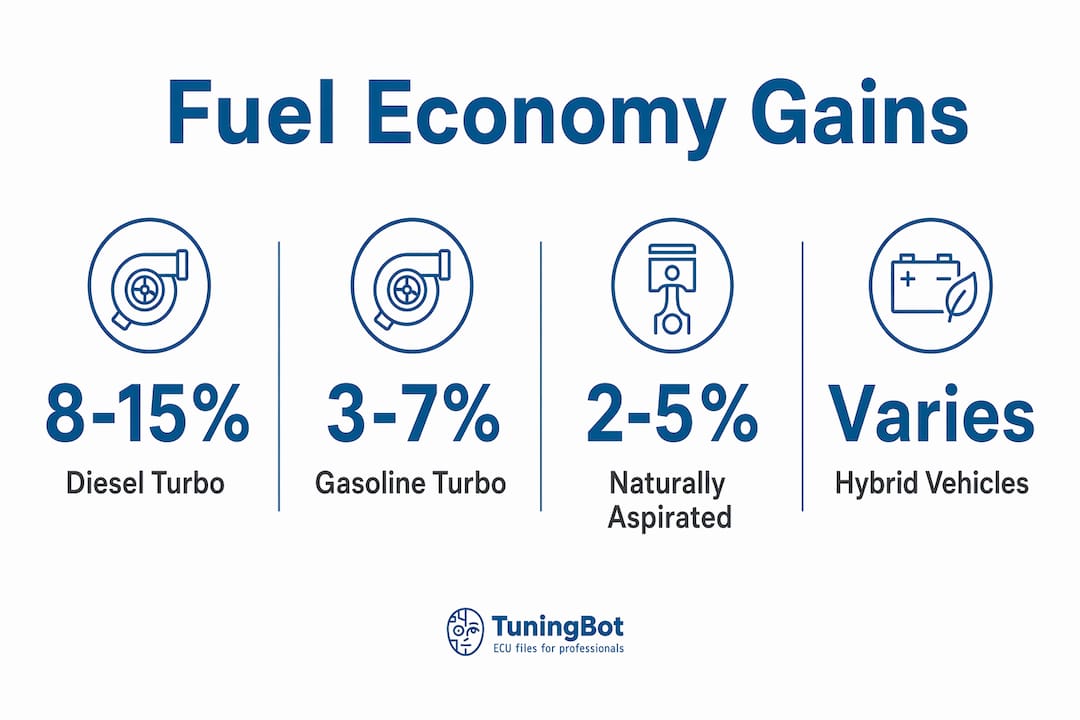
| Engine type | Typical fuel saving | Best conditions |
|---|---|---|
| Turbocharged diesel | 8–15% | Motorway, fleet, steady cruising |
| Turbocharged petrol | 3–8% | Mixed road, partial throttle |
| Naturally aspirated petrol | 0–5% | Limited; gains are minimal |
| Fleet/commercial diesel | 15–20% | High-mileage, consistent routes |
Fuel economy improvements are more pronounced in turbocharged engines compared to naturally aspirated petrol engines. Naturally aspirated engines have no boost pressure to recalibrate, which removes one of the primary efficiency levers. Turbocharged diesel engines benefit from all four calibration mechanisms simultaneously, which is why their gains are the largest.
“Cold starts, short trips, and heavy stop-start traffic reduce the effectiveness of remaps on fuel savings because the engine cannot reach or maintain optimal temperature and load zones.” — ECU Remapping Blog
Cold starts and short trips prevent the engine from reaching the operating temperature where the recalibrated maps are most active. A driver covering 5-mile urban commutes will see far less benefit than a driver covering 200-mile motorway runs. Fleet operators and high-mileage private drivers consistently report the strongest returns. For those drivers, annual fuel savings can exceed £500, meaning a remap costing £200–£500 pays for itself within 12 months when the vehicle is in good mechanical condition.
Performance remap vs economy remap: which affects fuel use more?
The remap type determines the primary outcome. Performance remaps increase power output but may raise fuel consumption if the driver frequently uses the extra power. Economy remaps prioritize torque optimization and fuel savings under normal driving conditions. Blended remaps attempt to deliver both outcomes by targeting different load zones for different calibration goals.
Performance remap characteristics:
- Raises peak power and torque figures significantly
- Advances injection timing aggressively for maximum combustion pressure
- Increases boost pressure to the upper safe limit
- Fuel consumption rises when the driver exploits the power band regularly
Economy remap characteristics:
- Targets mid-range torque for lower RPM efficiency
- Optimizes injection timing and turbo boost for cleaner combustion
- Reduces pumping losses at partial throttle
- Fuel consumption drops when the driver adapts driving style accordingly
| Remap type | Power gain | Fuel consumption | Best suited for |
|---|---|---|---|
| Performance | High | Increases with use | Track, towing, spirited driving |
| Economy | Low to moderate | Decreases with adaptation | Fleet, commuting, motorway |
| Blended | Moderate | Neutral to slight decrease | General mixed-use driving |
The choice between remap types should reflect actual driving patterns. A fleet manager running diesel vans on fixed motorway routes gains more from an economy remap than from a Stage 1 performance file. A driver who tows heavy loads benefits from a blended remap that adds torque without sacrificing fuel efficiency at cruising speeds. Selecting the wrong remap type for the vehicle’s usage profile is the most common reason drivers report no fuel savings after remapping.
Key takeaways
ECU remapping improves fuel consumption only when the remap type matches the vehicle’s usage profile and the driver adapts their throttle behavior to use mid-range torque efficiently.
| Point | Details |
|---|---|
| Diesel gains the most | Turbocharged diesel engines see 8–15% fuel savings under motorway and fleet conditions. |
| Driver adaptation is required | Lighter throttle and earlier gear shifts are necessary to realize any fuel economy benefit. |
| Engine type determines ceiling | Naturally aspirated petrol engines gain 0–5%; turbocharged petrol gains 3–8%. |
| Remap type must match usage | Economy remaps reduce fuel use; performance remaps increase it when power is used aggressively. |
| Vehicle condition matters | Poor mechanical condition undermines fuel economy gains regardless of remap quality. |
What I’ve learned about remapping and fuel economy after years in the calibration space
The most persistent misconception I encounter is that a remap alone saves fuel. It does not. A remap changes what is possible. The driver and the vehicle’s mechanical condition determine what actually happens.
Workshops that deliver the best fuel economy results for their clients do three things consistently. They assess the vehicle’s condition before touching the ECU. They match the remap type to the client’s actual driving pattern, not the client’s aspirations. And they spend time explaining throttle adaptation after the remap is complete. That last step is the one most workshops skip, and it is the reason so many drivers report mixed results.
The other misconception worth addressing is that performance and economy are mutually exclusive. A well-calibrated blended remap on a turbocharged diesel can add 40–60 Nm of mid-range torque while simultaneously reducing fuel consumption at motorway cruise. That outcome is achievable because the efficiency gains come from the low-to-mid load zone, not the peak power zone. The professional ECU remapping techniques that produce this result require precise calibration of multiple ECU maps in coordination, not a single parameter change.
Realistic expectations matter. A driver covering 8,000 miles per year on urban roads will not recover remap costs through fuel savings. A fleet operator covering 80,000 miles per year on motorways almost certainly will. Know your usage profile before you commit to a remap type.
How TuningBot helps workshops deliver real fuel efficiency gains
Professional fuel economy results depend on calibration quality, not just the concept of remapping. TuningBot provides workshops and professional tuners with custom ECU remap files engineered for specific ECU hardware, including Bosch, Delphi, Marelli, and Continental units across diesel and petrol applications.
Every file is calibrated by engineers who account for the vehicle’s usage profile, turbo configuration, and injection system. Workshops upload ECU files directly through the TuningBot platform with no prepaid credits required, and receive files built to deliver measurable fuel economy improvements under real driving conditions. TuningBot supports all major tuning tools including Alientech KESS3, AutoTuner, and Magic Motorsport. Explore the latest ECU Service Coverage to see what is available for your vehicle lineup. Submit your file through the TuningBot file upload platform when the ECU and requested service are supported.
FAQ
Does a remap always improve fuel economy?
No. A remap creates the conditions for better fuel economy, but the driver must adapt their throttle behavior to realize savings. Aggressive driving after a remap can increase fuel consumption rather than reduce it.
Which engine type benefits most from a fuel economy remap?
Turbocharged diesel engines benefit the most, with typical savings of 8–15% under motorway conditions. Naturally aspirated petrol engines see minimal gains of 0–5%.
How long does it take to see fuel savings after a remap?
Most drivers begin to see consistent MPG improvements after 4–8 weeks, once they have adapted their driving style to use the increased mid-range torque at lower throttle inputs.
Does vehicle condition affect remap fuel savings?
Yes. Poor vehicle condition undermines potential fuel economy gains regardless of remap quality. Worn injectors, clogged filters, and low compression all reduce the effectiveness of any ECU calibration change.
What is the difference between a performance remap and an economy remap?
A performance remap targets peak power and may raise fuel consumption under hard use. An economy remap targets mid-range torque and injection efficiency to reduce fuel use during normal driving conditions.