
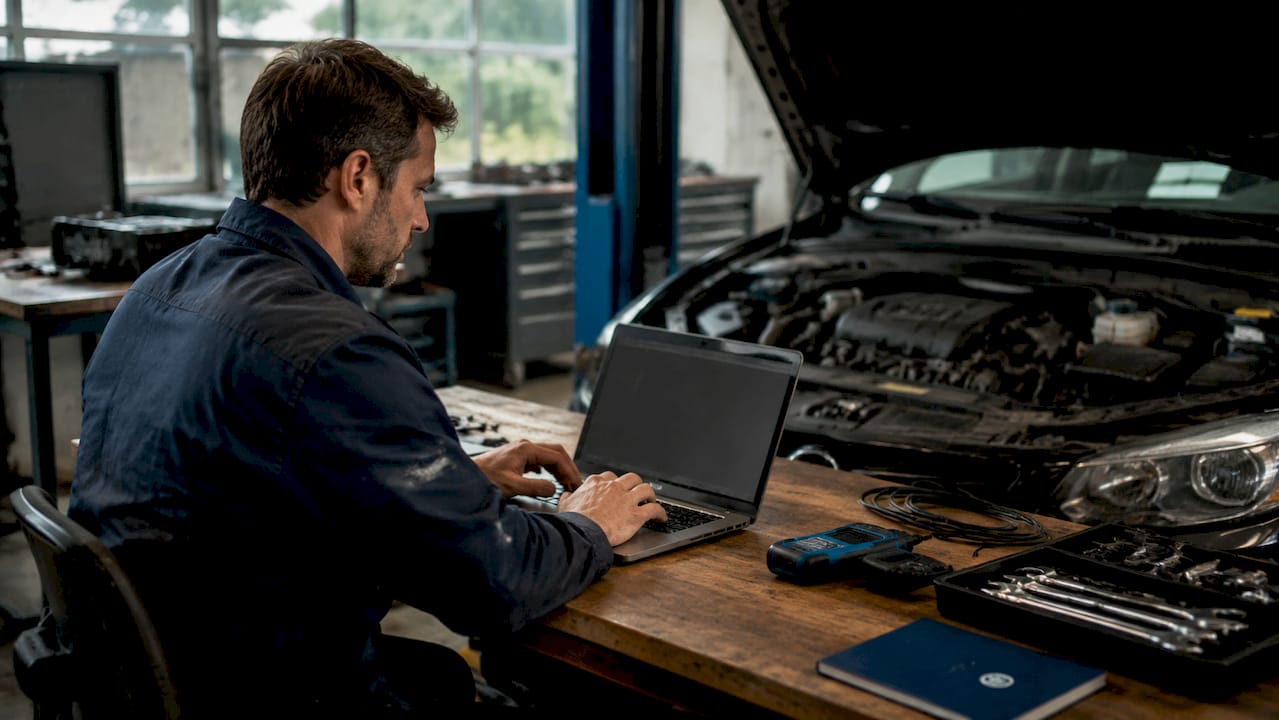
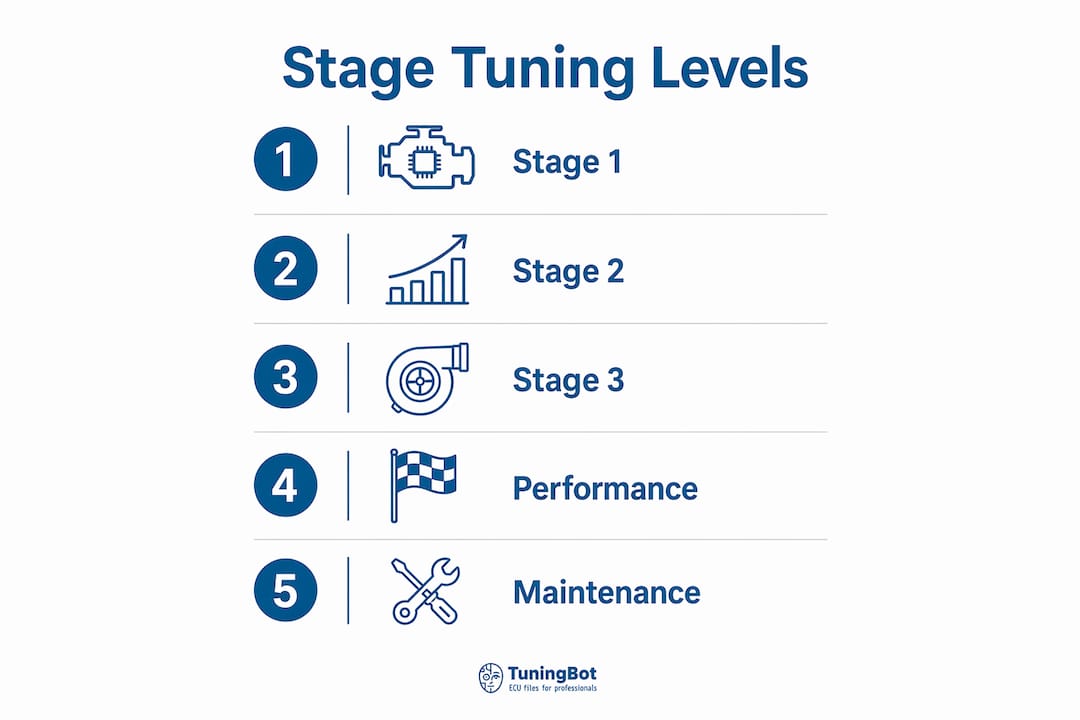
Stage tuning levels are defined as progressive performance modification tiers that combine ECU software calibration with increasingly significant hardware upgrades to raise engine output. Understanding how stage tuning levels differ is the foundation of every responsible tuning decision, whether you are remapping a daily driver or building a dedicated track car. Stage 1 requires no hardware changes, Stage 2 demands specific bolt-on components, and Stage 3 involves major mechanical modifications. Each tier carries distinct power targets, cost implications, and maintenance requirements that every professional tuner must account for before writing a single calibration file.
Table of contents
- How stage tuning levels differ: the core framework
- What is Stage 1 tuning and when is it appropriate?
- How does Stage 2 tuning differ in terms of hardware and software?
- What defines Stage 3 tuning and its implications for performance and maintenance?
- Why there is no universal standard for tuning stages
- How to choose the right stage tuning level for your vehicle and goals
- Key takeaways
- Why I think the stage label is the least useful thing on a build sheet
- Take your stage tuning further with TuningBot
- FAQ
How stage tuning levels differ: the core framework
Stage tuning is the industry’s colloquial shorthand for categorizing the depth of modification applied to a vehicle’s powertrain. The term is not standardized by any governing body, but the three-stage model is widely used by workshops, ECU calibrators, and platforms like TuningBot to communicate the general scope of a build.
The critical distinction between stages is not just power output. It is the relationship between software calibration and physical hardware. A Stage 1 remap written for a stock Volkswagen Golf GTI will not produce safe or optimal results on a car fitted with a high-flow intake and a decat downpipe. The ECU’s fueling, boost, and ignition maps are calibrated against specific airflow and backpressure assumptions. Change the hardware, and you must change the file.
Pro Tip: Before quoting a customer a stage level, document the exact hardware fitted to the vehicle. Stage labels mean nothing without a confirmed parts list.
What is Stage 1 tuning and when is it appropriate?
Stage 1 tuning is a software-only ECU optimization that requires no hardware modifications beyond the stock configuration. The calibrator accesses the ECU using tools such as Alientech KESS3, AutoTuner, or Magic Motorsport, reads the original file, and modifies parameters including boost pressure, ignition timing, fuel delivery, and torque limiters.
Power gains on turbocharged engines typically fall in the 15–25% range, while naturally aspirated engines yield more modest improvements of 5–15%. Those figures reflect the headroom built into OEM calibrations, which are deliberately conservative to accommodate fuel quality variation, emissions compliance, and warranty liability.
Stage 1 is the correct choice for:
- Daily-driven vehicles that must remain reliable and emissions-compliant
- Vehicles under manufacturer warranty where hardware changes would void coverage
- Customers seeking improved throttle response and linear power delivery without mechanical risk
- Workshops new to a specific ECU platform who want a controlled baseline
The maintenance impact of Stage 1 is minimal. Oil change intervals may tighten slightly on turbocharged applications, but no additional cooling, fueling, or structural upgrades are required. The reversal cost is effectively zero since the original file can be restored at any time.
Pro Tip: Always verify fuel octane requirements before finalizing a Stage 1 file. A map optimized for 98 RON on a pump that delivers 91 RON will detonate under load.
How does Stage 2 tuning differ in terms of hardware and software?
Stage 2 tuning requires a combination of bolt-on hardware upgrades and a custom ECU calibration written specifically for that hardware configuration. The hardware changes are not optional additions. They are prerequisites for the software to function correctly and safely.
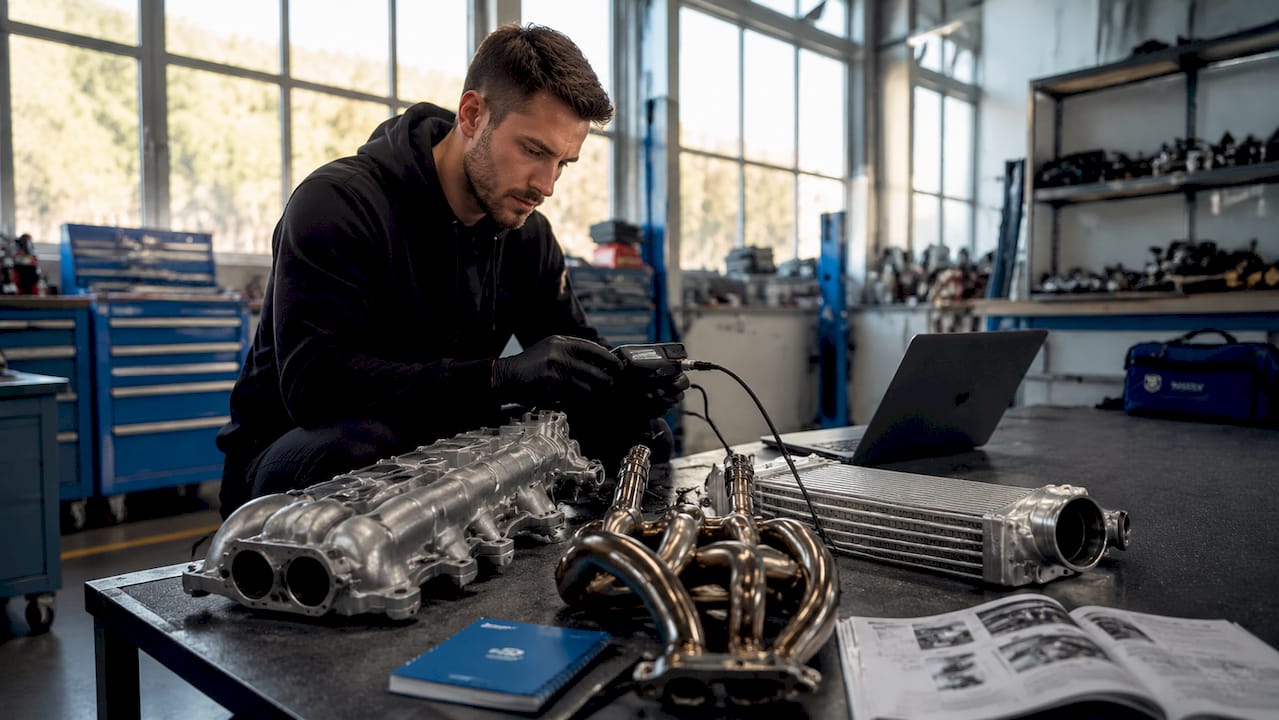
Stage 2 hardware typically includes:
- High-flow air intake or induction kit
- Performance exhaust system or decat downpipe to reduce backpressure
- Upgraded intercooler to manage increased charge temperatures
- Boost pipes and silicone couplers rated for higher pressures
These components alter the engine’s airflow characteristics and thermal behavior. A larger intercooler drops charge air temperature, which allows the calibrator to run more aggressive ignition timing without risking knock. A free-flowing exhaust reduces backpressure, which changes the turbine speed curve and affects boost response. The ECU file must account for all of these changes simultaneously.
Power gains at Stage 2 typically reach 20–40% over stock output. That increase is only achievable because the hardware modifications allow the software to operate in a range that stock components cannot support.
The critical error many workshops make is running a Stage 1 calibration on a vehicle fitted with Stage 2 hardware. Mismatched software does not compensate for the altered airflow and thermal dynamics, which leads to inefficiency at best and calibration-induced damage at worst. Every hardware change requires a corresponding file revision.
| Parameter | Stage 1 | Stage 2 |
|---|---|---|
| Hardware required | Stock | Intake, exhaust, intercooler |
| ECU calibration | Modified OEM file | Custom file for specific hardware |
| Typical power gain | 15–25% (turbo) | 20–40% |
| Maintenance increase | Minimal | Moderate |
| Reversibility | Full | Partial (hardware remains) |
Pro Tip: On turbocharged direct-injection engines, Stage 2 often requires fuel system attention as well. High-pressure fuel pump limitations become apparent under sustained high-load operation.
What defines Stage 3 tuning and its implications for performance and maintenance?
Stage 3 tuning is defined by major mechanical modifications that go beyond bolt-on components. On turbocharged engines, this means replacing the factory turbocharger with a larger unit. On naturally aspirated engines, it means adding forced induction entirely. Either path demands a complete supporting build to function reliably.
Stage 3 power gains exceed 40–60% over stock output, and in many builds they go significantly higher. Those numbers come at a cost. Stage 3 projects routinely exceed $3,500–$11,000 in total expenditure when all supporting modifications are included.
A complete Stage 3 build typically requires:
- Upgraded turbocharger or supercharger system
- Forged or strengthened internal engine components (pistons, connecting rods, head studs)
- High-flow fuel injectors and upgraded fuel pump
- Uprated clutch or torque converter for automatic transmissions
- Enhanced cooling system including oil cooler and upgraded radiator
- Transmission and driveline upgrades to handle increased torque
| Stage 3 component | Purpose |
|---|---|
| Larger turbocharger | Increases airflow capacity and peak boost potential |
| Forged internals | Withstand higher cylinder pressures and thermal loads |
| High-flow injectors | Deliver sufficient fuel volume at elevated power levels |
| Upgraded clutch | Transmit increased torque without slipping |
| Enhanced cooling | Manage heat generated by sustained high-output operation |
Thermal stress and mechanical load increase substantially at Stage 3. Oil changes must occur more frequently, spark plugs require inspection at shorter intervals, and cooling system condition becomes a critical reliability factor. Workshops that deliver Stage 3 calibrations without communicating these maintenance requirements to the customer are setting up a warranty dispute.
Pro Tip: Dyno validation is non-negotiable at Stage 3. A dyno-based calibration confirms power targets and identifies dangerous anomalies in fueling or knock activity before the vehicle leaves the workshop.
Why there is no universal standard for tuning stages
Stage designations are marketing shorthand, not technical specifications. No industry body defines what Stage 2 means in terms of specific hardware or power output. A Stage 2 tune from one workshop may involve only an intake and a remap. From another, it may include a full exhaust, intercooler, and fuel system upgrade. Both are technically accurate descriptions of Stage 2 within their respective frameworks.
This variability creates real problems for professional tuners. A customer who arrives with a “Stage 2 tune” from another shop may be running a calibration that was never validated against the actual hardware fitted. The stage label tells you nothing about the file quality, the hardware specification, or the calibration methodology.
Engine architecture compounds the inconsistency further. A Stage 2 calibration on a turbocharged direct-injection engine like a BMW N55 demands intercooler and fuel system attention. The same stage label on a naturally aspirated engine may only involve intake and exhaust enhancements, with no fueling changes required. The stage is the same. The build is completely different.
“Professional tuners recommend focusing on specific mechanical modifications and calibration details rather than stage labels. The hardware list and the calibration file are the specification. The stage number is just a communication shortcut.”
To avoid confusion when evaluating a vehicle or quoting a customer, ask these questions:
- What specific hardware is currently fitted to the vehicle?
- What ECU platform and calibration tool were used for the existing tune?
- Has the vehicle been dyno-verified at its current state of tune?
- What are the customer’s performance goals and primary use case?
The answers to those questions determine the correct calibration path. The stage label is a starting point for the conversation, not the conclusion.
How to choose the right stage tuning level for your vehicle and goals
Selecting the correct tuning stage requires matching the vehicle’s hardware condition, the customer’s usage profile, and the available budget to a calibration approach that delivers reliable results.
Follow this decision framework:
- Assess the vehicle’s current condition. A high-mileage engine with worn seals and marginal compression is not a candidate for Stage 2 or Stage 3. Address mechanical issues before any calibration work.
- Define the primary use case. Daily-driven vehicles with emissions requirements belong at Stage 1. Performance street cars with supporting hardware belong at Stage 2. Track and competition builds belong at Stage 3.
- Confirm the hardware specification. Do not write a Stage 2 file until the intake, exhaust, and intercooler are physically installed and verified. Calibrating for hardware that is “planned but not yet fitted” produces an unsafe file.
- Calculate the full cost of ownership. Stage 3 is not just the cost of the turbocharger and the calibration file. Factor in supporting components, increased maintenance frequency, and potential transmission upgrades.
- Communicate maintenance requirements clearly. Higher stage tunes demand more frequent oil changes, spark plug inspections, and cooling system checks. Document these requirements for the customer in writing.
For workshops using tools like Alientech KESS3 or AutoTuner, TuningBot’s safe Stage 1 workflow provides a structured process for baseline calibration that scales cleanly into Stage 2 territory when the hardware is ready.
Pro Tip: Never let a customer’s power target drive the stage selection. Let the vehicle’s hardware and condition drive the target, then set realistic expectations about the achievable output.
Key takeaways
Stage tuning levels differ by the scope of hardware modification and the depth of ECU calibration required, making hardware verification the single most important step before any file is written.
| Point | Details |
|---|---|
| Stage 1 is software only | No hardware changes required; gains of 15–25% on turbo engines with minimal maintenance impact. |
| Stage 2 requires matched hardware | Intake, exhaust, and intercooler upgrades must be fitted before a Stage 2 file is written. |
| Stage 3 demands full supporting builds | Turbo replacement and internal engine upgrades are required to sustain 40–60%+ power gains safely. |
| Stage labels are not standardized | Hardware lists and calibration specs define a tune; the stage number is a communication shortcut only. |
| Maintenance scales with stage level | Oil change frequency, spark plug intervals, and cooling system demands all increase from Stage 1 through Stage 3. |
Why I think the stage label is the least useful thing on a build sheet
After working through hundreds of ECU calibration files across Bosch, Delphi, and Marelli platforms, I have come to one firm conclusion: the stage number is the last thing I look at and the first thing customers ask about. That gap is where most tuning problems originate.
I have seen Stage 2 files running on vehicles with stock intercoolers because the customer assumed the label covered the hardware. I have seen Stage 1 files on cars with decat downpipes and high-flow intakes, producing knock events the original calibrator never anticipated. In both cases, the stage label created a false sense of specification.
What actually matters is the hardware list, the ECU platform, the calibration tool used to write the file, and whether the result was validated on a dyno. Taylor’d Tuning’s approach to dyno-based validation reflects the same principle: the dyno is the only honest measurement of what a calibration actually delivers.
My recommendation to every workshop is to retire the stage label as an internal specification tool. Use it for customer communication because it is a useful shorthand. But internally, work from a confirmed hardware list and a calibration brief that specifies target boost, fueling strategy, and torque management approach. That is the document that produces reliable results. The stage number is just the title on the cover.
— TuningBot Technical Team
Take your stage tuning further with TuningBot
TuningBot provides professional ECU remapping files for Stage 1, Stage 2 and Stage 3 builds across all major ECU platforms including Bosch, Continental, Delphi, Marelli and Denso. Every file is calibrated by real engineers and delivered through a direct upload workflow that requires no registration or prepaid credits.
FAQ
What is the difference between Stage 1 and Stage 2 tuning?
Whether you are setting up a clean Stage 1 baseline or managing a complex Stage 3 build with a large-frame turbocharger, use Tune Your File to upload the original ECU file and receive a calibrated result. Before ordering, verify ECU and service compatibility in the ECU Service Coverage matrix, then document the vehicle hardware so the calibration matches the actual stage level.
How much power does each tuning stage add?
Stage 1 delivers 15–25% power gains on turbocharged engines and 5–15% on naturally aspirated engines. Stage 2 reaches 20–40% gains, and Stage 3 exceeds 40–60% over stock output depending on the turbocharger specification and supporting hardware.
Is Stage 3 tuning suitable for a daily-driven vehicle?
Stage 3 is designed for track and competition applications. The increased maintenance demands, higher mechanical stress, and potential emissions non-compliance make it impractical for most daily-driven vehicles.
Why do stage definitions vary between tuners and workshops?
There is no universal industry standard for tuning stage definitions. Stage labels are colloquial shorthand, and what one workshop calls Stage 2 may differ significantly from another’s specification. Always request a confirmed hardware list and calibration brief rather than relying on the stage number alone.
Does Stage 2 tuning void a vehicle warranty?
Stage 2 tuning involves both ECU modification and physical hardware changes, both of which typically void the manufacturer’s powertrain warranty. Stage 1 tuning, being software only, is more reversible, but any ECU modification carries warranty risk depending on the manufacturer’s policy.