

 ItalianoIT
 DeutschDE
 EspañolES
 PortuguêsPT
 FrançaisFR
 РусскийRU
Stage tuning is an informal commercial convention, not a regulated engineering standard. Stage 1, Stage 2 and Stage 3 can describe very different hardware, fuel and calibration requirements depending on the vehicle and tuner. The correct decision should be based on the exact ECU, installed parts, fuel, intended use, drivetrain limits and validation—not on the label alone.
At a glance:
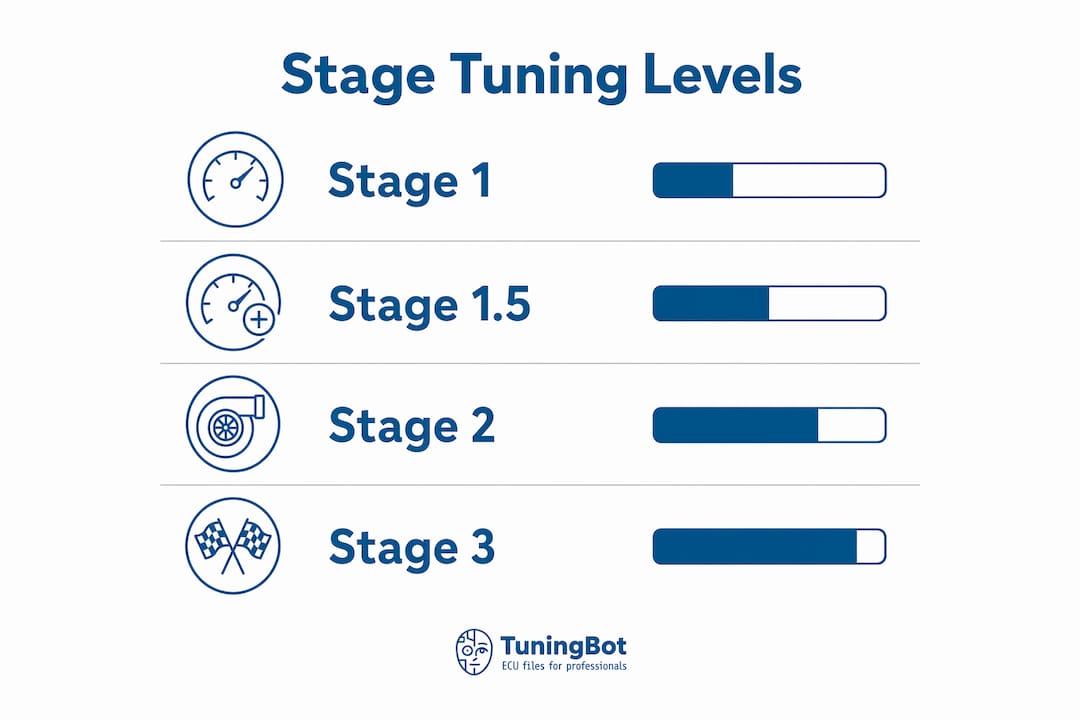
- Stage 1: usually a software calibration on standard hardware, but definitions vary.
- Stage 1+ / 1.5: a non-standard label for limited supporting changes or a different fuel strategy.
- Stage 2: usually a calibration developed around specified supporting hardware.
- Stage 3: an informal label for more extensive turbo, fuel, engine or drivetrain changes.
What does stage tuning actually mean for your car?
Stage labels are packaging conventions. They are useful only when the tuner also states the exact hardware, fuel and calibration assumptions.
Stage labels simplify customer communication, but they should never replace a written technical specification.
The table below shows the typical scope at each level. Exact inclusions vary by platform and shop.
| Label | Common meaning | What must be specified |
|---|---|---|
| Stage 1 | Software calibration on standard hardware | Fuel, torque target, ECU version and validation method |
| Stage 1+ / 1.5 | Shop-specific intermediate package | Exact hardware or fuel change |
| Stage 2 | Calibration dependent on supporting hardware | Complete parts list and legal status |
| Stage 3+ | More extensive engine, turbo, fuel or drivetrain changes | Full technical specification and maintenance plan |
Pro Tip: Before committing to any stage package, ask the shop for a written parts list. Stage names vary significantly between tuners, and the only reliable comparison is what the package actually includes.
Stage 1: what you actually get, and what it costs
Stage 1 commonly refers to a calibration on standard hardware. Exact changes and safe limits vary by ECU, engine, fuel and vehicle condition.

A full ECU remap and a plug-in tuning box are different products. A remap changes ECU calibration data; a tuning box alters selected signals. They should not be treated as technically equivalent.
Typical Stage 1 outcomes:
- Noticeable power gains on turbocharged petrol and diesel engines under professional calibration
- Some aftermarket sources report higher gains, but these figures vary widely by vehicle and lack consistent verification
- Naturally aspirated engines typically see smaller percentage gains because there is less headroom in the factory calibration
- Fuel requirement: use the exact grade specified for the calibration.
- Turnaround time varies by file access, diagnosis, development and validation.
Statistic: Turbocharged engines often show power gains from a Stage 1 remap, making it a cost-effective modification at this level.
Pros: No hardware cost, fully reversible in most cases, minimal impact on daily driveability, improved throttle response and torque delivery across the rev range.
Cons: Gains are capped by factory hardware limits; aggressive calibrations on worn or unmaintained engines can increase stress; most OEM warranties treat any ECU modification as grounds for denial on related claims. Stage 1 is sufficient for the majority of daily drivers who want noticeably better performance without committing to a build.
What is Stage 1.5 and when does it make sense?
Stage 1.5 or Stage 1+ is a shop-specific label with no universal technical definition.
Common Stage 1.5 additions include higher-flow fuel injectors to support E85 conversion, an upgraded mass airflow sensor, or a higher-capacity fuel pump. The calibration is then rewritten to account for the changed fueling parameters. This is not simply a Stage 1 map with a parts list attached; the tune must reflect the actual hardware installed, or the engine will run with incorrect fueling targets.
| Configuration | Typical Hardware Added | Common Use Case |
|---|---|---|
| Stage 1+ (E85) | High-flow injectors, flex-fuel sensor | E85 or ethanol blend conversion |
| Stage 1+ (fueling) | Upgraded fuel pump, larger injectors | High-demand fueling on stock turbo |
| Stage 1+ (intake) | High-flow intake, larger MAF | Marginal airflow improvement on specific platforms |
Cost sits between Stage 1 and Stage 2: the calibration fee is comparable to Stage 1, but the hardware additions add to the total. Shops offer this tier because some platforms hit a fueling ceiling before they need a downpipe or intercooler. An E85 conversion is the clearest example: the fuel system must support the new fuel’s stoichiometry, but the rest of the drivetrain can remain stock. Stage 1.5 handles that specific requirement without the full commitment of a Stage 2 build.
Stage 2: when hardware finally lets the platform breathe
Stage 2 usually means that the calibration depends on specified supporting hardware. A downpipe, intercooler or fuel-system upgrade is not mandatory on every platform.
Typical Stage 2 hardware checklist:
- Exhaust hardware where required by the platform and legal for the intended use.
- Charge-air cooling where logs show heat-soak or temperature limitation.
- Intake hardware where measured restriction or sensor scaling requires it.
- Fuel-system upgrades only where measured capacity is insufficient.
- Exhaust system upgrade (cat-back) on some platforms
Cooling and fueling should be upgraded only where logs or component data show that stock capacity is insufficient.
Statistic: Stage 2 gains on turbocharged setups can be significantly higher over stock output, though actual figures depend on platform, parts quality, and calibration precision.
Stage 2 cost and project time depend on platform, parts, labor, access method, dyno time and revisions. Universal price or duration ranges are misleading.
Stage 2 may suit road, track or mixed-use vehicles when the hardware and calibration are appropriate.
Stage 3 and beyond: full hardware builds and what they demand
Stage 3 is a non-standard label commonly used for more extensive hardware changes. It does not automatically imply forged internals, alternative fuel or track-only use.
Typical Stage 3 elements include a larger turbocharger or supercharger, an E85 or methanol injection system, forged pistons and connecting rods, an upgraded clutch and flywheel assembly, and reinforced drivetrain components. On some platforms, cylinder head work, upgraded camshafts, or a built transmission are also part of the package.
Some high-specification builds need vehicle-specific calibration; others can use a validated platform file when hardware and software match exactly.
Pro Tip: For any Stage 3 build, request a full datalog from the tuner after each dyno session. Those logs are your evidence that the calibration is safe and that the engine is operating within the thermal and mechanical limits of the installed hardware. See common Stage 3 pitfalls for a detailed breakdown of where high-power builds go wrong.
Cost, maintenance and component life depend on the actual hardware, target output and duty cycle.
High-output builds may be used on road or track depending on legal status, drivability, cooling, fuel availability and maintenance expectations.
Why do stage definitions differ between shops and platforms?
Stage labels are not standardized across the industry. A shop in one region may define Stage 2 as a downpipe and intercooler with a tune; another may include fueling hardware and an intake in the same package. Platform differences compound this: a Stage 2 on a Volkswagen 2.0T is not the same scope as a Stage 2 on a Subaru EJ engine or a Ford EcoBoost.
Three factors drive the variation: platform-specific hardware limits, shop strategy (some bundle parts, others sell calibration-only and let customers source parts), and whether the shop defines stages by hardware installed or by calibration scope. The most reliable approach is to read the shop’s actual parts list and ask for dyno or datalog proof rather than trusting the stage number alone.
Verification checklist before committing to a stage package:
- Request a written list of every part included in the stage package, with part numbers where available.
- Ask whether the calibration is written specifically for your vehicle’s hardware or is a base map applied to a class of vehicles.
- Confirm the fuel specification required (93 octane, E85, or other) and whether your local supply supports it.
- Ask for a before-and-after dyno sheet or datalog from a comparable vehicle on the same platform.
- Clarify whether the stage price includes installation labor, calibration time, and any required supporting hardware (gaskets, hardware, sensors).
- Ask how the shop handles warranty claims or recalibration if the tune requires adjustment after installation.
- Confirm whether the modification affects emissions compliance in your state and whether the shop provides documentation.
Risks, U.S. emissions compliance, and warranty implications
Tuning modifications carry legal and financial consequences that vary by state. In the United States, the Environmental Protection Agency (EPA) and the California Air Resources Board (CARB) set the primary emissions standards. CARB’s rules are the most restrictive and apply in California and states that have adopted California emissions standards. Any modification that alters or defeats emissions control systems, including catalytic converters, EGR systems, or OBD2 monitoring, can constitute a violation of federal or state law regardless of whether the vehicle passes a visual inspection.
Owners should check their state’s specific emissions testing requirements before any modification. A catless downpipe that is common in Stage 2 builds is not legal for road use in California or CARB-compliant states, and some states conduct OBD2 readiness checks that a recent ECU flash may fail.
Warranty outcomes depend on jurisdiction, policy language and whether the modification contributed to the failure. The Magnuson-Moss Warranty Act does not guarantee coverage for tuned components.
Insurance disclosure is a related consideration. Some insurers require disclosure of performance modifications; failure to disclose can affect claim outcomes. Checking with your insurer before installation is the straightforward step most owners skip.
This article provides general information about tuning modifications and their legal context. Confirm current EPA, CARB, and state-level rules with the relevant authority or a qualified professional for your specific vehicle and location.
How a professional tuner implements and validates a stage tune
A professional workflow should include identification, diagnostics, file control, supported writing and appropriate validation.
Standard professional workflow:
- Baseline datalog: The tuner records stock operating parameters, including boost pressure, air-fuel ratio, ignition timing, knock events, and intake air temperature, before any calibration change is made.
- Initial calibration load: A base map appropriate for the platform and stage is loaded using a professional tool such as Alientech KESS3, PCMFlash, Dimsport, Magic Motorsport, or AutoTuner. The ECU or TCU vendor (Bosch, Continental, Denso, Marelli, Siemens, or Delphi) determines which tool and protocol are required.
- Dyno or road safety validation: The vehicle is run under load to verify that the calibration is not producing unsafe air-fuel ratios, excessive knock, or thermal events. Dyno pulls provide repeatable, measurable data; road datalogs supplement this on platforms where dyno access is limited.
- Iterative mapping: The tuner adjusts boost targets, ignition advance, fueling tables, and torque limits in response to the data. This is rarely a single-pass process; most professional calibrations require multiple iterations.
- In-vehicle datalogs: After dyno validation, the vehicle is driven under real-world conditions to capture behavior the dyno cannot replicate (transient load, gear changes, ambient temperature variation).
- Final verification: A final dyno pull or datalog confirms the calibration is stable, and the tuner documents the before-and-after figures.
ECU/TCU compatibility is a practical constraint at every stage. A safe Stage 1 workflow begins with confirming the ECU hardware ID and software version before any file is written, because applying a calibration to the wrong ECU variant can cause immediate faults or long-term reliability issues.
Pro Tip: Ask your shop for the before-and-after dyno sheet and at least one full datalog from the final calibration session. A shop that cannot or will not provide these documents has not completed a professional validation process. For a detailed workshop setup reference, the Stage 1 tune workshop guide covers the procedural controls a professional shop should have in place.
How to choose the right stage for your driving goals
The right configuration depends on vehicle condition, intended use, fuel, legal requirements, budget and maintenance tolerance.
Decision criteria:
- Daily or track use: choose hardware and torque targets from the actual duty cycle.
- Budget: Stage 1 is the lowest-cost entry point. Stage 2 requires hardware investment on top of calibration. Stage 3 requires a full build budget and ongoing maintenance funding.
- Fuel availability: confirm the exact fuel or blend required by the calibration.
- Drivetrain durability: assess clutch, transmission and driveline capacity against requested torque.
- Resale considerations: ECU modifications are detectable by dealers and can affect resale value or trade-in offers. Reversible OBD2 modules reduce this risk at Stage 1.
Red flags that indicate a low-quality shop or product:
- No dyno sheet or datalog available for the platform
- Stage price that seems unusually low with no explanation of what is included
- No written parts list for the stage package
- Claims of gains that significantly exceed the platform’s documented headroom
- No discussion of fuel requirements or emissions compliance
- Unwillingness to provide documentation of the calibration performed
Quick decision rules:
- Daily driver, no track use → Stage 1
- Occasional track use, willing to add hardware → Stage 2
- Dedicated performance build, specific power target, committed maintenance → Stage 3
Key Takeaways
Stage tuning is useful only as shorthand. Hardware, calibration and validation must match at every level.
| Point | Details |
|---|---|
| Stage labels are not standards | Always ask for actual hardware, fuel and calibration scope. |
| Stage 1 is not always best | The correct choice depends on the vehicle and owner’s goals. |
| Stage 2 hardware varies | Downpipe, intercooler and fueling upgrades are not universal. |
| Stage 3 has no fixed definition | It does not automatically mean forged internals or E85. |
| Legal and warranty effects vary | Check emissions, insurance and warranty implications for the exact build. |
| Validation matters more than the label | A successful flash alone does not prove calibration quality. |
The case for verifying every stage claim before you commit
The main risk with Stage terminology is assuming that similarly named packages are technically equivalent.
Two packages with the same Stage name can differ in hardware, fuel assumptions, torque target and protection strategy.
Workshops should verify ECU identification, hardware, fuel and legal use before ordering or writing a file.
TuningBot file support across tuning stages
TuningBot can provide ECU and TCU files for supported Stage 1, Stage 2 and higher-output workflows. The workshop should provide the exact original file, control-unit identification, installed hardware, fuel and requested result.
Before ordering, workshops can check ECU and TCU Service Coverage, review the public Price List and browse the available ECU services.
Files can be submitted through Tune Your File without prepaid credits. Compatibility depends on the exact control unit, file format, protocol and Master/Slave configuration.
The workshop remains responsible for mechanical readiness, programming, validation, emissions compliance and customer documentation.
Useful sources
- Jalopnik stage-tuning standards article — external discussion of non-standardized Stage labels.
- E6 Carbon high-performance upgrade guide — external overview of high-performance hardware paths.
- EPA Emissions Standards Reference Guide — official U.S. emissions reference.
- TuningBot Stage Levels Guide — internal Stage overview.
FAQ
What is Stage 1, Stage 2, and Stage 3 tuning?
There is no universal definition. Stage 1 usually means software on standard hardware, Stage 2 usually assumes specified supporting hardware, and Stage 3 is an informal label for more extensive modifications.
What does a stage tune actually do to the engine?
It changes ECU calibration functions such as torque, boost, fuel, ignition and protection strategies. Exact changes depend on the ECU and build.
What stage tune is best for a daily driver?
There is no universal answer. Choose the least complex configuration that meets the owner’s goals while preserving legal compliance, drivability and reliability.
Is there a Stage 4 tuning level?
Some shops use Stage 4 or higher labels, but these have no standard definition and require a complete written specification.
Do stage tunes void the factory warranty?
They may affect warranty coverage, particularly where a modification contributes to a failure.