

 EnglishEN
 ItalianoIT
 DeutschDE
 EspañolES
 PortuguêsPT
 FrançaisFR
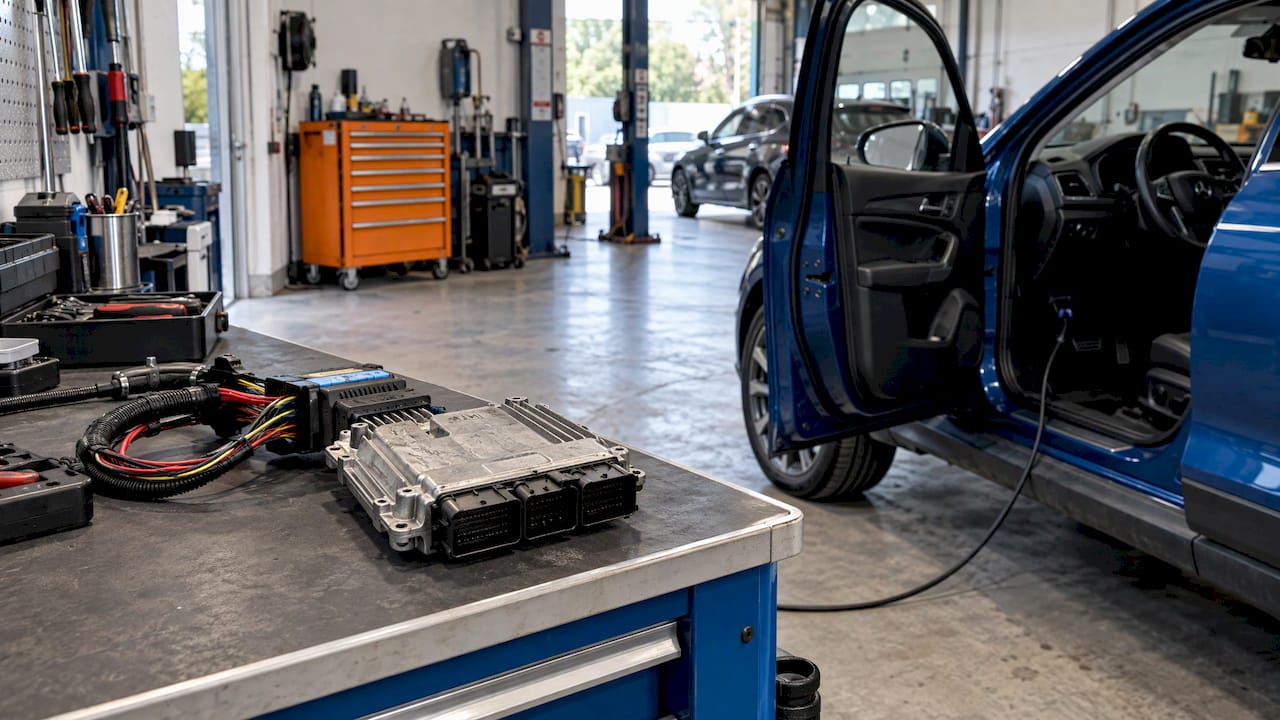
OBD tuning files are files obtained or prepared for a supported programming workflow through the vehicle’s diagnostic connector. Bench access connects to the controller more directly. The connection route does not, by itself, tell you which memory regions a file contains, whether it represents the installed calibration or whether it can recover a failed write.
OBD tuning files: distinguish access from file contents
Start with the controller hardware and software identifiers, tool, protocol and requested operation. Two files associated with the same engine can have different software versions, layouts or packaging. A matching filename, vehicle model or file size is not sufficient evidence of compatibility.
A direct read retrieves the data exposed by that operation. It may be a calibration area rather than every memory device in the controller. If the vehicle was previously modified, a current read may already contain modifications; calling it “original” does not establish factory provenance.
A virtual read supplies a reference file associated with the identified software instead of necessarily reading the installed calibration. AutoTuner explains this distinction for its workflows. A virtual read must not be used as proof that an earlier tune has been captured or that a newly written modification is present.
OBD, bench and boot are different access methods
| Метод | Connection context | What must be verified |
|---|---|---|
| OBD | Access through the vehicle diagnostic connector. | Supported identification, read or virtual-read operation, writing and any required prior unlock. |
| Скамейка | Direct connection using the controller connectors and the documented harness. | Pin assignment, supply requirements, supported memory coverage and whether removal is necessary. |
| Boot or processor-specific service access | A controller-specific low-level access procedure, often requiring opening the housing. | Exact board revision, access points, protection requirements and supported operations. |
BDM and boot are not interchangeable names for a single procedure. Processor architecture and tool support determine the interface. Do not infer a wiring arrangement from a visually similar ECU.
Some supported workflows require an initial operation outside OBD before later OBD writing becomes available. Others do not. Consult the current protocol instructions rather than assuming that a vehicle brand always requires one method. The bench tuning guide provides related context.

Define what the backup actually includes
A bench connection does not universally guarantee a complete, transferable backup of every flash, EEPROM, security or external memory region. Record the components supplied by the tool and the supported restore function. A file suitable for modifying maps may not be sufficient for controller replacement or recovery.
AutoTuner’s backup documentation describes its own bench and boot backup behavior and distinguishes it from OBD reading. That description should not be generalized to every tool or controller.
Preserve identification reports, available read files, tool logs and versions separately from modified outputs. Label a virtual reference, a current calibration read and a broader backup accurately. Check the recovery procedure before writing; possession of files does not guarantee access to a damaged or non-communicating controller.
Prepare the vehicle and connection for the selected protocol
Resolve relevant supply, communication and hardware faults first. Follow the tool’s specified power-support, connection, ignition and interruption precautions. There is no universal supply setting or connection sequence suitable for all vehicles and bench harnesses.
The linked KESS3 instructions and historical KESSv2 manual concern different products. Do not transfer an older tool’s procedure to a newer protocol without checking its current documentation.
Inspect the housing, connector condition and working environment. General advice about a clean engine bay is separate from an ECU programming procedure: avoid introducing moisture or cleaning chemicals into electrical connections, and follow vehicle-specific handling instructions.
Check the file against the intended write operation
Confirm whether the workflow uses an editable binary, a tool-specific container or an encrypted master/slave exchange. The file provider needs the actual identification and read type, not just the vehicle registration or an advertised stage.
- Match the output to the supported software and intended vehicle configuration.
- Identify who handles checksums and other required integrity operations for this protocol.
- Preserve the supported format, including any required headers or packaging.
- Record the requested changes and the baseline used for comparison.
- Use the documented write operation and retain its completion report.
There is no universal “OBD calibration” that becomes a bench file merely by changing its name. Conversion, merging or use of a different access route requires explicit support for that controller and tool. See the ECU reading guide for identification and read context.
Validate operation and applicable requirements
After a successful write, perform the required ignition, diagnostic and learning steps. Check relevant faults and compare actual operation with the intended calibration under suitable controlled conditions. A completion message establishes that the programming operation reported success; it does not establish mechanical health or correct calibration behavior.
Do not treat a reference file returned by virtual read as independent confirmation of modified bytes in the ECU. Where supported, use an appropriate readback or verification function and combine it with diagnostic and functional checks.
For road vehicles, changes must meet the requirements applicable to the vehicle and jurisdiction. The EPA’s tampering guidance explains the U.S. restrictions; an off-road label is not a blanket exemption. The linked Colorado и Minnesota resources provide state-specific information.
Часто задаваемые вопросы
Is a bench read always a complete backup?
No. Memory coverage and restore support depend on the controller, protocol and tool. Confirm which components the operation actually supplies.
Does a virtual read capture an existing remap?
Not necessarily. A virtual read can return a matching reference file rather than the current installed calibration. Record its provenance accurately.
Can an OBD file be written through bench access?
Only when the controller, file format and tool explicitly support that workflow. The access route alone does not establish interchangeability.
Подробнее
Additional explanations of the available access routes: