

 EnglishEN
 ItalianoIT
 DeutschDE
 EspañolES
 PortuguêsPT
 FrançaisFR
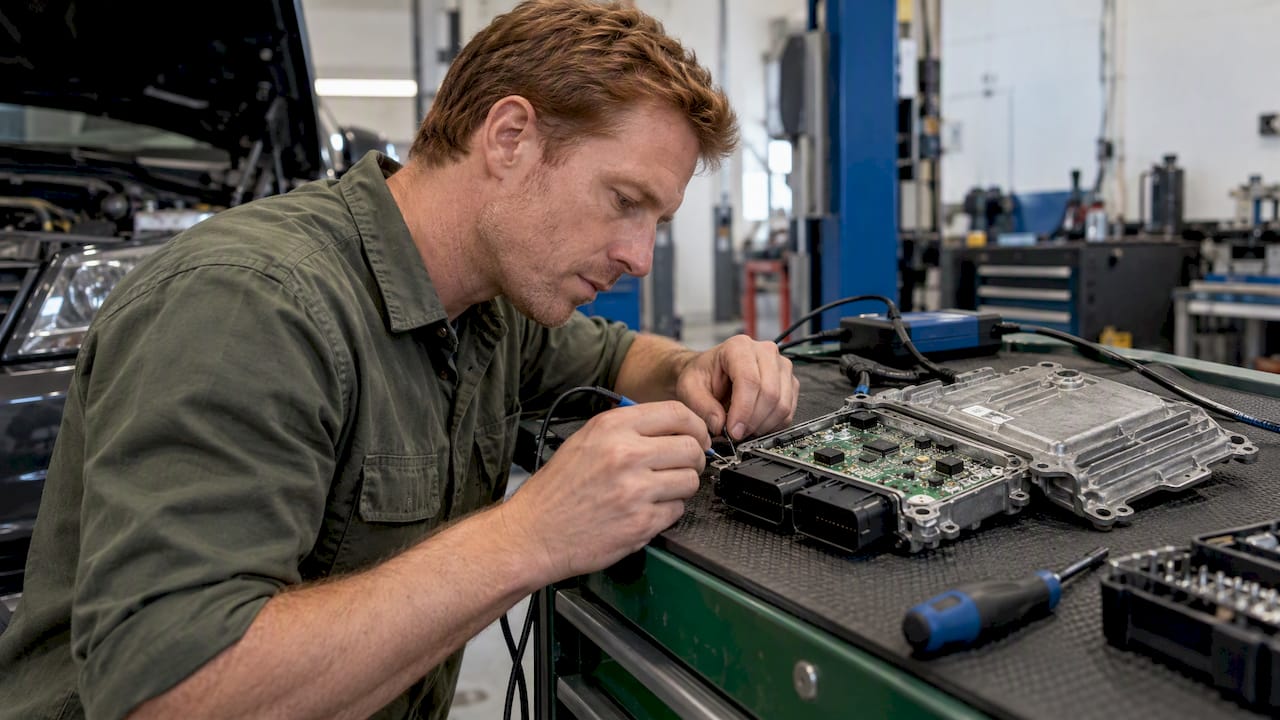
ME9 tuning starts with identifying the actual Bosch ECU hardware and software, then understanding how its calibration controls engine torque. The ME9 family includes different applications and access requirements. A shared family name does not establish file compatibility, a supported programming method or a safe calibration for the vehicle.
ME9 tuning: identify the controller and baseline
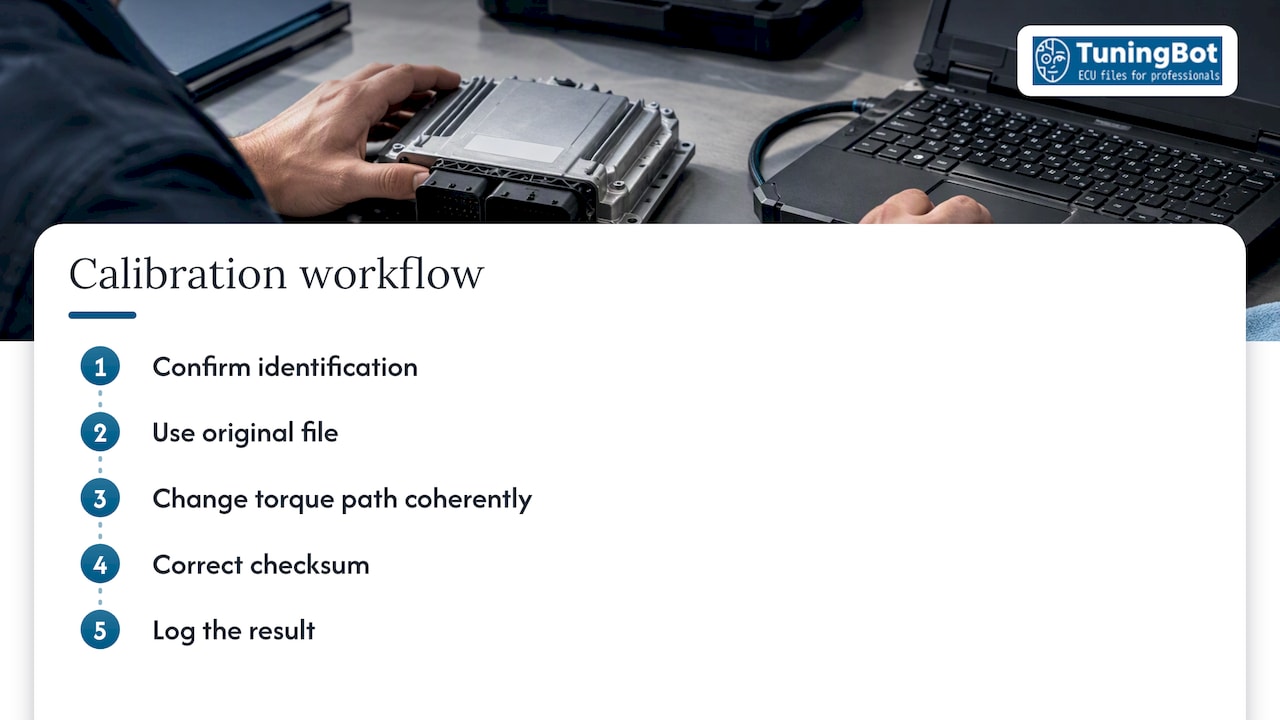
Record the ECU label, diagnostic identification, software and calibration identifiers, vehicle specification and transmission. Compare the label with the electronic identification because replacement modules or earlier programming may have changed the installed software. Preserve the tool’s original identification report rather than relying on a filename.
Also record fuel, engine hardware changes, symptoms and the known modification history. An existing read may already contain a tune; “original read” can mean the file read before this job, not necessarily an untouched factory calibration. Our ECU identification guide explains why these distinctions matter.
ME9 and MED9 labels should not be treated as interchangeable. Bosch’s gasoline direct-injection overview provides system background, but it is not a list of ME9 applications or a map definition for a specific binary.
Choose access from the exact tool protocol
OBD, bench, boot and BDM are not interchangeable names for the same operation. Support depends on the ECU, processor, tool, software version and selected protocol. Confirm what can actually be read, written and recovered before modifying the file.
Услуга EVC BDM100 documentation lists several ME9 variants with different processor and memory arrangements. It supports the need for variant-specific identification; it does not prove that every ME9 is accessible with the same probe or connection procedure.
Likewise, the DFOX product page describes a tool family, while Microtronik’s ME9 example describes a particular workflow. Use the current instructions for the selected controller rather than transferring a connection method from a differently identified unit.
Distinguish a calibration-only read, a tool-supplied virtual file and a backup containing additional memory regions. Save available originals, identification and protocol details. Follow the specified power and connection requirements; a stored file does not guarantee recovery from every programming failure.
Validate map definitions before changing values
A map pack or definition file must match the software being edited. Check addresses, dimensions, axis units, scaling and the function represented by each table. Similar-looking data in another ME9 file is not enough to establish the same purpose or conversion factors.
The retained ME9 map-finding course is training context, not evidence that a particular definition matches the ECU on the bench. Keep an untouched comparison file and a record of intended changes so that unexpected edits can be identified before writing.
Follow requests, models and interventions
Torque-oriented control coordinates driver demand with other requests and operating limits. The relevant actuators depend on the engine: throttle, ignition and fuel control are common, while boost control only applies where the hardware supports it. A naturally aspirated ME9 application does not acquire a boost strategy merely because another ME9 vehicle has one.
Separate the requested torque, permitted torque, modeled output and the diagnostic channels available to the workshop. “Actual torque” in a log is often an ECU estimate rather than a direct shaft measurement. Confirm the channel definition before comparing it with a dynamometer result.
A throttle closure or reduced boost can have several causes, including traction requests, temperature protection, sensor faults or normal torque coordination. It is not proof that a limiter simply needs raising. Review the active intervention and supporting measurements before changing the calibration.
Hardware changes can alter airflow, pressure losses and the relationship between actuator commands and delivered output. Less boost does not automatically mean equal power or improved efficiency. Compare conditions, fuel delivery and measured behavior rather than assuming a fixed explanation.
Validate the vehicle as well as the file
Resolve relevant baseline faults first. Choose mechanical and electrical checks from the symptoms and vehicle history instead of imposing one fixed test sequence on every engine. Preserve fault codes and freeze-frame information before clearing anything.
After programming, use the supported verification process and check starting, idle, transitions and the intended operating range under controlled conditions. Select test load and gear for the engine, transmission and test facility; a high-gear pull is not a universal first test. Investigate abnormal lambda, fuel pressure, knock response, temperatures or unexpected intervention before increasing load.
Используйте spark advance guide for ignition concepts. A short clean log or absence of fault codes does not prove durability, emissions compliance or full operating-range validation. The retained gas-engine performance bulletin offers manufacturer context, not ME9-specific limits.
Document checksum handling and the delivered scope
Confirm who handles the checksums for the exact file format and operation. Some tool workflows perform supported corrections; others require separate processing. Checksums, digital signatures and software compatibility are different checks. A successful checksum result does not validate the calibration itself. See the checksum guide.
Keep the baseline, final file, tool version, logs and test conditions together. A central record of vehicle measurements and diagnostic notes can help another technician understand what was tested and what remains unresolved.
The EPA policy and enforcement references below provide context; the linked eCFR page is specifically a 23 April 2020 snapshot, not a current warranty determination. Assess the actual modification under applicable requirements. Neither an “off-road” label nor functioning readiness monitors alone establishes compliance.
For a file request, confirm the exact supported scope and current service terms. This technical guide does not promise universal coverage, included checksum work, turnaround or recovery.
Часто задаваемые вопросы
Can every ME9 ECU be programmed through OBD?
No. Read, write and recovery support depend on the exact ECU, software, tool and protocol. Confirm those operations for the identified unit.
Is an original read always a complete factory backup?
No. It may contain only calibration data or already include previous modifications. Record the file type, memory coverage and known history.
Does lower boost after a hardware change prove improved efficiency?
No. Boost alone cannot establish airflow, power or efficiency. Compare operating conditions, commands and measured behavior.
Does a throttle closure mean a torque limiter needs raising?
No. Normal torque coordination, traction requests, protection functions and faults can all cause intervention. Identify the active cause first.
Does a valid checksum prove that an ME9 calibration is correct?
No. It checks data integrity within its scope. Compatibility, engine behavior and the required validation remain separate questions.
Sources and further reading
Related TuningBot reading
- ЭБУ Bosch: как работает, модели и тюнинг
- Правка таблицы DTC: определения, объём и проверка
- Надежность тюнинга ЭБУ - почему не существует гарантий
- Тюнинг в рамках норм выбросов: доказательства и правила США
- Снятие ограничителя скорости: Vmax и правила США
- Чип-тюнинг для профессионалов: Руководство по техникам
- Тюнинг Bosch MD1: 7 ключевых проверок калибровки ЭБУ
- Тюнинг ME7: определения, момент и проверка файла