

 EnglishEN
 ItalianoIT
 DeutschDE
 EspañolES
 PortuguêsPT
 FrançaisFR
Idle timing is the ignition advance an engine runs at idle, expressed in degrees before top dead center (BTDC). On an ECU-controlled engine it is not a single fixed number. It is a calibrated value that the idle speed controller also uses as a fast torque lever, so a change to it moves idle speed, stability and load response together. Treat it as part of the idle-control calibration, verify it against a timing light or a scan tool before editing, and change it only after the mechanical basics are confirmed.
This article is written for tuners and workshop technicians who read and modify ECU files. It covers what idle timing is, typical reference values from a documented OEM procedure, how the ECU uses spark to hold idle, how timing is verified, and what to check before you change anything.
TL;DR
- Idle timing is the spark angle at idle, normally a few degrees before TDC on the compression stroke, and it is only one part of how the ECU holds idle speed.
- On modern engines the ECU trims idle spark advance to correct idle speed error, so commanded timing at idle will move even on a healthy engine.
- Verify actual timing against commanded timing with a timing light or scan tool data before editing any idle spark table.
- Confirm mechanical idle, fans, A/C load and warm-up state first, because the ECU cannot compensate for a wrong mechanical baseline.
- Reference values differ by engine and calibration, so use the OEM procedure or the original file as the baseline, not a universal number.
Оглавление
- What idle timing actually describes
- A documented reference: what an OEM procedure specifies
- How the ECU uses spark to control idle
- Measuring actual timing against commanded timing
- Conditions to confirm before you change idle timing
- Reading the symptoms
- Calibration changes that affect idle timing
- Our perspective
- Where a calibrated file fits in the workflow
- A short idle timing checklist for the bay
- ЧАСТО ЗАДАВАЕМЫЕ ВОПРОСЫ
- Источники
What idle timing actually describes
At idle the piston speed is low, cylinder charge is small and the mixture burns quickly relative to crank rotation. The spark therefore fires only a few degrees before TDC on the compression stroke. Holley’s timing support documentation describes it this way and adds that centrifugal advance is needed as engine speed rises. The same page makes the point that matters for any calibration: timing should be checked both at idle and at higher rpm, because excess advance can cause pre-ignition, power loss or engine damage.
Two terms get mixed up in forums and in customer conversations, so it is worth separating them:
- Idle speed is engine rpm with no load, the target the idle controller works toward.
- Idle timing is the ignition angle at that operating point, the degrees of advance at which the spark fires.
They are linked, but they are not the same parameter. Advance changes torque, torque changes rpm, and that is the mechanism the ECU exploits.
Base, initial and commanded timing
On distributor engines, base or initial timing is a mechanical setting. On ECU-controlled engines there is usually no manually set timing at all: the ECU commands the angle from tables indexed by rpm, load, coolant temperature and other inputs. Some systems still have a base timing mode, entered through a service connector or a tool command, which locks advance at a fixed angle so the mechanical reference can be verified. When you talk to a customer about idle timing, establish early which of these cases applies to the vehicle.
A documented reference: what an OEM procedure specifies
Generic numbers circulate widely, and most of them describe older, carbureted or distributor-based engines. A manufacturer procedure is a better anchor for what a production calibration looks like. Toyota’s inspection procedure for the XV70 Camry, reproduced on this on-vehicle inspection page, gives standard ignition timing at idle of 12 to 24 degrees BTDC when read from the Techstream data list, and 8 to 12 degrees BTDC with the TC terminal activated. Standard idle speed is 650 to 750 rpm.
Three things in that specification are useful to a tuner:
- The range is wide. Twelve to twenty-four degrees for a healthy production engine shows that commanded idle timing is a window, not a point. The ECU moves within it depending on conditions.
- The fixed-angle mode is different. With the TC terminal activated the ECU holds a lower, fixed advance so the mechanical reference can be checked. The two readings are not interchangeable.
- The test conditions are defined. The procedure calls for fans off, electrical systems and A/C off, and the transaxle in neutral or park. Any reading you compare against a spec needs the same conditions.
This is one application. It does not transfer to another platform, and it should not be quoted to a customer as a general target.
How the ECU uses spark to control idle
Idle speed control on a drive-by-wire or stepper-motor system normally works through airflow: the throttle or idle valve opens or closes to bring rpm toward a target. Air is a slow actuator. Spark advance is fast, because a timing change alters torque on the very next combustion event. Many calibrations therefore add an ignition-based correction on top of the airflow control.
The principle is simple. When rpm falls below target, the ECU adds advance, torque rises and rpm recovers. When rpm rises above target, it removes advance. This only works if there is room to move in both directions, which means the base idle advance should not sit at the point of maximum torque. If idle spark is already at MBT (minimum advance for best torque), adding more gives no torque and the controller has no authority in that direction. A calibrator therefore sets base idle advance with deliberate headroom, so the ignition overlay can trim up and down.
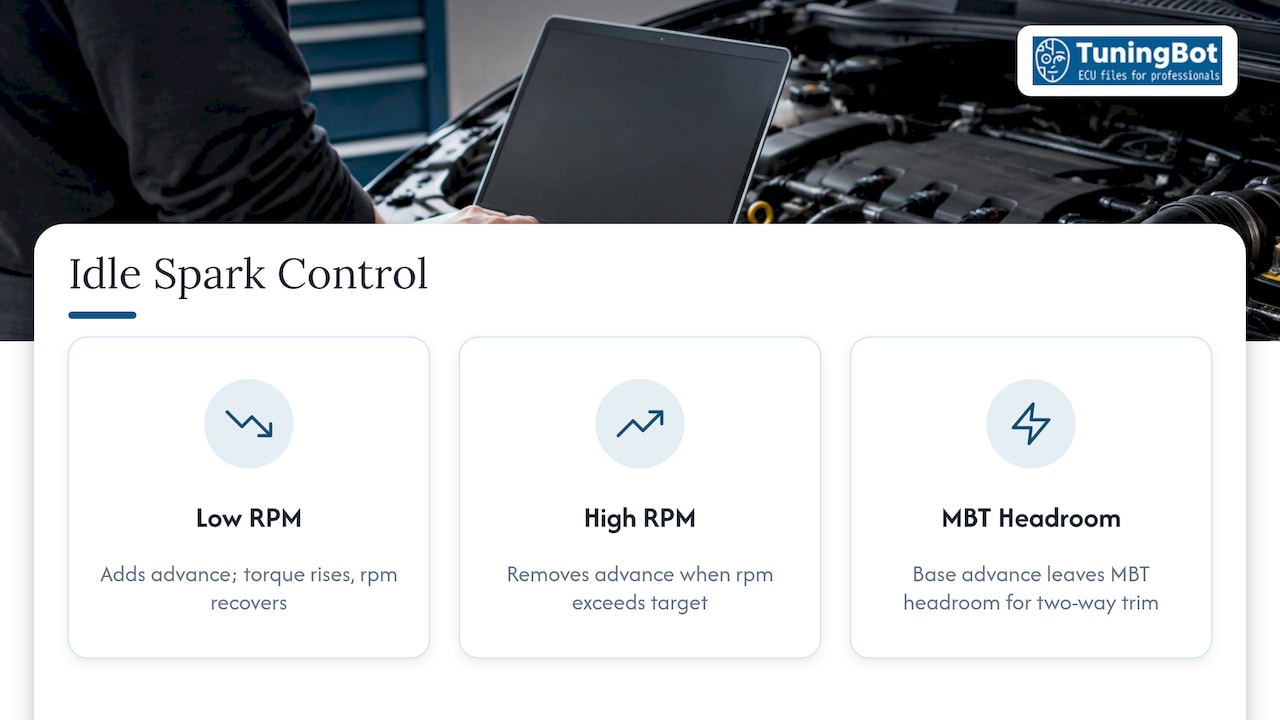
This explains behavior that surprises less experienced technicians. Holley’s manual for the Avenger ECU notes that idle timing (with the throttle position at zero) may fluctuate rapidly because the ECU uses ignition timing to stabilize idle, and that this is normal. A timing light that shows a moving mark at idle is often a healthy idle controller, not a fault.
What this means when you read a customer file
When you open an original file to assess idle behavior, look at the structure before the numbers:
- Is there a base idle advance map, and is it indexed by coolant temperature or by idle state?
- Is there a separate correction table or controller output that adds or subtracts advance as a function of rpm error?
- Do the limits on that correction leave authority in both directions?
- Does the idle spark region blend smoothly into the part-throttle map when the pedal is touched? A step at the transition is a classic source of a stumble on throttle tip-in.
The naming differs by ECU family and software version, so identify the file precisely first. Our note on ECU ID and calibration identification covers why the exact identifier matters before any map is treated as the one you think it is. For the wider relationship between spark tables, MBT and knock, see our guide to spark advance tuning, and for hunting and load response specifically, the page on idle control tuning.
Measuring actual timing against commanded timing
Commanded advance is what the ECU asks for. Actual advance is where the spark really fires relative to the crank. On a standalone or reflashed system they can differ if the crank trigger offset, trigger wheel reference or coil delay is wrong. A timing light and a lock-angle method resolve this.
The documented procedure from Emtron is a clear example of the method. Their ignition tables documentation describes enabling an ignition lock at a fixed angle, measuring actual timing with a timing light at idle, and adjusting the crank index offset until the light agrees with the locked angle. Timing is then verified as engine speed increases, and an ignition delay time is adjusted so that commanded and actual timing agree across the rpm range.
The workflow generalizes even where the parameter names differ:
- Lock the ignition at a known fixed angle so the ECU is not moving it.
- Read actual timing with a timing light at idle.
- Correct the trigger offset until actual matches locked.
- Raise rpm and confirm that the match holds, adjusting for coil or driver delay if it drifts.
- Release the lock and return the ECU to its normal control.
On a computer-controlled distributor the procedure is similar but ends mechanically. Holley’s Avenger documentation has the installer rev to about 2000 rpm, match the timing light to the handheld’s commanded timing, and then tighten the distributor. Syncing at a raised rpm rather than at idle avoids the idle-stabilization movement described above.
Most late-model production engines will not allow this kind of manual alignment, and there is nothing to adjust. In that case the diagnostic question changes: is the commanded value plausible for the operating state, and does the scan tool value respond correctly to rpm error and load?
Conditions to confirm before you change idle timing
Idle problems are often reported by customers as a timing issue when the cause sits elsewhere. Before editing any spark table, confirm the following.
Operating state
The Toyota procedure is a useful template for conditions: engine warmed up, cooling fans off, electrical loads and A/C off, transmission in neutral or park, and a check that timing advances immediately when engine speed is raised. A reading taken with the fans cycling or a high electrical load is not comparable to a spec, and it is not a baseline for your calibration. Record coolant temperature and which loads were active when you log.
Mechanical baseline
The ECU cannot be expected to correct a wrong mechanical idle. Vacuum leaks, a dirty or sticking throttle body, a mis-set mechanical stop, a worn idle valve or low compression all shift the airflow and torque the controller works with. The Louisiana Department of Environmental Quality’s fuel economy education page makes a related point for non-computer-assisted engines: compensating for one problem by changing static timing can cause severe long-term engine damage. The principle applies to calibration too. If you hide a mechanical fault with spark, you move the problem into the hardware.
Stored faults and adaptations
Check for stored faults before logging. An idle speed regulation code tells you the controller is at its limit. Our database entry for 00533, idle speed regulation is a starting point for that class of fault. Also clear or relearn throttle and idle adaptations after any mechanical correction, because a stale adaptation value will otherwise skew the numbers you read.
Hot restart and cranking behavior
Idle spark and cranking spark are separate calibrations, but a hot-start complaint is often reported together with an idle complaint. If the engine idles well but cranks poorly when hot, the cause is usually in fueling, rail pressure or cranking strategy rather than idle advance. See hot start fix diagnosis before you touch idle tables for that symptom.
Reading the symptoms
Excess advance at idle tends to produce a harsh, knock-prone or starter-fighting condition, while too little advance gives a sluggish, rough and hot-running engine that needs more throttle opening to hold rpm. These symptoms overlap with mixture, air leak and mechanical faults, so use them to guide where you look, not as a diagnosis on their own. The reliable method is to compare commanded timing, actual timing and the idle controller’s trim at several coolant temperatures and electrical loads.
A practical logging set for an idle complaint:
- Engine speed and idle target
- Commanded spark advance
- Idle ignition trim or controller output, if the ECU exposes it
- Throttle or idle valve position
- Coolant and intake air temperature
- Load inputs: A/C request, alternator load, power steering, gearbox state
- Lambda or fuel trims, to separate mixture from ignition
If the idle ignition trim sits at its limit, the controller is out of authority. That points you toward the base idle advance map, the airflow baseline or a mechanical cause, not toward widening the trim limits.
Calibration changes that affect idle timing
Idle spark is rarely edited alone. These are the situations where it comes into play.
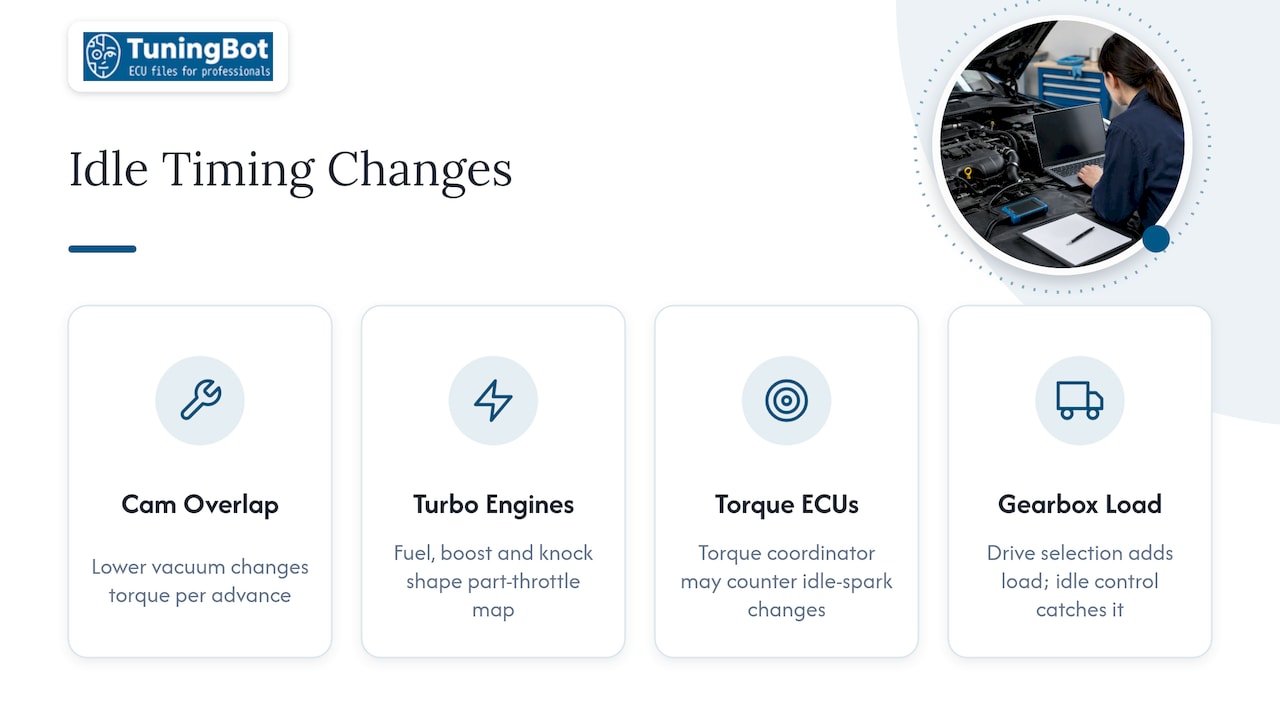
Larger cams and heavier overlap. Reduced manifold vacuum and a lumpier idle change how much torque a given advance produces, so the base idle advance and idle target usually need review. This is a hardware change and falls under the work described in our overview of Stage 2 tuning requirements.
Turbocharged petrol engines. Fuel quality, boost transitions and knock limits shape the part-throttle map, and the idle region has to blend into it cleanly. The principles are in the spark advance guide above.
Torque-based ECU structures. On engines where the ECU computes a torque request and converts it to spark and air, altering idle spark may be countered by the torque coordinator. Changes here need to be checked in logs, not assumed from the table.
Gearbox and load changes. Selecting drive on an automatic adds load, and the idle controller must catch it. If you modify transmission behavior, the same engine-side idle response matters. Our TCU remapping overview covers how engine and gearbox calibration interact.
Any change to idle spark can also alter emissions behavior. Calibration work that touches emissions-related functions is intended only for applications where it is permitted, such as off-road or motorsport use.
Our perspective
We see idle timing as a boundary between two calibrations: the base spark tables and the idle controller. Editing one without understanding the other is the most common way an otherwise sound file ends up with hunting or a stumble when the A/C compressor engages.
Our approach to a custom file starts from the original calibration structure. We look at how the idle ignition correction is built, how much authority it keeps in each direction and how it blends into the part-throttle map, and we calibrate against the specific ECU family and software version instead of a generic number. Availability of a modification depends on the ECU, the software version and the reading method, and we say so up front.
For workshops this matters in practice. Customers upload the original file read with their own tool, select the services they need, and receive a calibrated file ready to write. Our support portal gives your technicians a route to talk through an idle or load-response question on a specific file with our calibration engineers.
TuningBot Technical Team
Where a calibrated file fits in the workflow
A workshop that does its own mechanical checks and logging still needs a calibration it can rely on. That is the point at which an outsourced file is efficient. If you have confirmed the mechanical baseline, recorded the idle behavior and identified the ECU, the calibration itself can be handled by engineers who work with that platform every day. Our tuning service overview shows how the ordering process works.
For reference, the published per-file prices on our прайс-листе include Diesel Stage 1 at €49.99, Petrol Stage 1 at €69.99, ECO Tuning for fuel economy and drivability at €49.99, Checksum Correction at €29.99 and DTC Removal at €29.99, each per file. Standard orders do not require registration, optional prepaid credits are available, and most standard files are delivered in approximately 15 to 20 minutes during published operating hours, depending on complexity and workload.
A short idle timing checklist for the bay
- Identify the ECU and software version, and keep the original file.
- Warm the engine and set the test conditions: loads off, neutral or park.
- Scan for faults and clear or relearn idle adaptations after any mechanical repair.
- Log rpm, idle target, commanded spark, idle trim, throttle position and temperatures.
- If the platform allows, lock timing and compare actual against commanded with a timing light.
- Confirm that advance responds immediately when rpm is raised.
- Check trim authority in both directions and look for limit conditions.
- Change one parameter at a time and repeat the same log.
ЧАСТО ЗАДАВАЕМЫЕ ВОПРОСЫ
What is a normal idle timing on a modern ECU-controlled engine?
There is no single normal value. One documented production example, the Toyota XV70 Camry procedure, lists 12 to 24 degrees BTDC at idle from the data list and 8 to 12 degrees with the TC terminal activated. Use the manufacturer procedure or the original calibration for the specific engine.
Why does idle timing change by itself on a timing light?
The ECU trims spark advance to hold idle speed on target, so the angle moves with rpm error and load. Holley’s Avenger documentation describes this fluctuation as normal. To compare actual with commanded timing, lock the ignition angle first or sync at a raised rpm.
Can I fix a rough idle by changing idle timing?
Only after the mechanical baseline is confirmed. Vacuum leaks, throttle body deposits, a wrong mechanical idle setting or stored faults must be ruled out first, because spark changes can mask a hardware problem rather than cure it.
Is idle timing the same as idle speed?
No. Idle speed is engine rpm with no load, and idle timing is the spark angle at that operating point. The ECU uses timing as a fast correction to bring idle speed onto its target.
Does idle timing affect hot-start problems?
Usually not directly. Hot-start complaints more often involve fueling, rail pressure or cranking strategy, so check those before editing idle spark.
Источники
- Set Your Timing, Holley
- Avenger ECU and Handheld Setup and Tuning, Holley
- Ignition Main Tables, Emtron Resource Centre
- Toyota Camry (XV70) On-vehicle Inspection: Engine
- Vacuum, Timing and Fuel Economy, Louisiana DENR