

 EnglishEN
 ItalianoIT
 DeutschDE
 EspañolES
 PortuguêsPT
 FrançaisFR
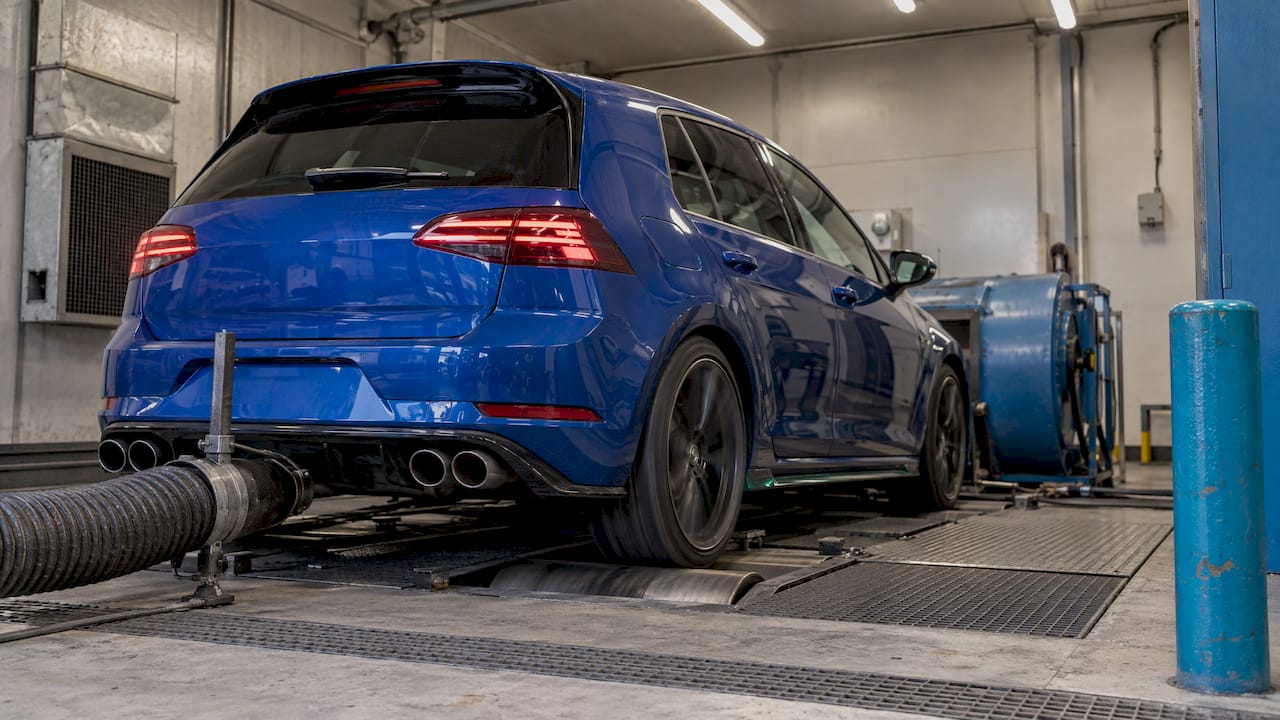
A Stage 2 tune requires supporting hardware already fitted to the vehicle, a calibration written for exactly that hardware, and a healthy engine to run it on. Typically that means a freer-flowing intake and exhaust, better charge cooling on turbocharged engines, and sometimes a fuel-system upgrade. The file is only half of the job. We build Stage 2 files as custom calibrations for workshops and tuners, and the quality of the result depends on how closely the file matches the parts on the car.
TL;DR
- Stage 2 is a calibration matched to hardware: typically intake, exhaust (often a downpipe or high-flow catalyst) and, on turbo engines, an uprated intercooler. Fuel-system parts depend on the platform.
- The hardware goes on first. A Stage 2 file written for parts the car does not have runs on false assumptions.
- A Stage 1 file is not a prerequisite. Stage 1 and Stage 2 are different calibrations for different hardware states.
- Stage 3 adds larger turbochargers or comparable airflow hardware, a stronger fuel system and drivetrain upgrades, so the file is closer to a full engine calibration.
- Emissions and road-use rules apply to hardware and software changes alike. Check them before the car leaves the workshop.
Оглавление
- What “Stage 2” actually means
- The hardware a Stage 2 tune usually requires
- Do you need a Stage 1 tune first?
- Condition checks before the file is written
- What a Stage 2 remap file needs to match
- Expected gains and how to measure them
- Diesel Stage 2 requirements
- Stage 3 remap requirements
- Emissions, inspection and road-use rules
- Перспектива
- Ordering a Stage 2 file
- ЧАСТО ЗАДАВАЕМЫЕ ВОПРОСЫ
- Источники
What “Stage 2” actually means
Stage numbers are a trade convention, not a standard. No regulator or manufacturer defines them, so a Stage 2 from one calibrator may ask for different parts than a Stage 2 from another. What the stages share is the logic: each step assumes more hardware than the one before, and the calibration is written to exploit it. Our own overview of Stage 1, Stage 2 and Stage 3 explained covers the ladder in general terms, and the Stage 2 hardware, ECU map and risks guide goes deeper on the second step.
In practical terms:
- Stage 1 is a software-only calibration on an otherwise stock car: boost, fueling, ignition timing, torque limiters and similar maps are adjusted within the margins the stock hardware tolerates.
- Stage 2 assumes bolt-on hardware that changes airflow, and the maps are rewritten around it.
- Stage 3 assumes major hardware changes, typically a larger turbocharger or equivalent, and calibration becomes close to engine-specific development.
Because the definitions vary, the safe approach in a workshop is to list the installed parts and let those parts, not the stage label, drive the calibration.
The hardware a Stage 2 tune usually requires
The exact list depends on the engine. These are the groups that come up most often.
Потребление
A high-flow air filter or a complete intake system lowers restriction and, on turbo engines, helps the compressor see cooler, denser air. On naturally aspirated engines the intake is one of the few parts that moves the airflow figure at all, so it is a common Stage 2 component there.
Exhaust and downpipe
On a turbocharged engine, the exhaust side limits how quickly exhaust gas leaves the turbine. A free-flowing downpipe, with a high-flow catalyst or a catalyst-equivalent where the road is the destination, lets the turbo spool earlier and hold boost more consistently. Some platforms ask for this part in their Stage 2 definition and others do not, which is why two cars with the same stage label can need different hardware.
The catalyst and any particulate or NOx aftertreatment are emissions equipment. Section on rules below covers what that means for road use.
Intercooler and charge piping
Heat is what limits repeated pulls. A stock intercooler that works well on one run can heat-soak on the third, and the engine management then pulls timing and boost to protect itself. A larger intercooler and the piping to match keep intake temperatures lower, which is what makes the extra power repeatable rather than a one-time figure on a cool day.
Топливная система
More airflow needs more fuel. Many Stage 2 builds stay within what the factory injectors, pump and rail can deliver, but on some direct-injection platforms the high-pressure pump or injectors are the first thing to run out of headroom. Whether a Stage 2 file needs a fuel upgrade is a property of the platform and the target figure, so check the calibration notes and the datalog, not the stage name.
Drivetrain and supporting parts
A higher torque figure loads the clutch, the gearbox and the mounts. Manual cars often need a stronger clutch before a Stage 2 file is practical. Automatic and dual-clutch gearboxes have their own torque limits, and the transmission control unit can be calibrated separately. We offer full gearbox tuning for exactly that reason: engine torque and shift behavior have to be calibrated together.
Do you need a Stage 1 tune first?
No. A Stage 2 file is a complete calibration, not an add-on to Stage 1. If the car already has the Stage 2 hardware, flash the Stage 2 file. If the car is stock, a Stage 2 file is written for parts that are not there, so the correct order is hardware first, then the calibration that matches it, then datalog verification.
There is one practical reason to start with Stage 1: the car may be used for a period on stock hardware before parts are fitted. In that case a Stage 1 file is appropriate for the stock state, and the file is replaced when the hardware goes in. Treat them as two different files, not an upgrade path where one builds on the other.

Condition checks before the file is written
The calibration assumes a healthy engine. Run these checks before reading the ECU:
- Boost and vacuum leaks. A leak under stock boost becomes a bigger one under higher boost. Smoke test the intake tract and verify the charge pipes and clamps.
- Ignition. Coils, plugs and the plug gap suit the higher cylinder pressure. Misfires that are tolerable stock become audible under load.
- Fuel delivery. Check fuel pressure and trims on a datalog. Long-term trims that already sit at the edge of their range are a warning.
- Cooling and oil. Coolant condition, thermostat operation and oil level and grade matter because the engine will see more heat.
- Clutch and drivetrain. Look for slip under load on a manual car and for adaptation problems on an automatic.
- Fault codes. Read and record stored codes. Faults that exist before the file is flashed are far easier to separate from calibration effects.
These are the points where a workshop’s own diagnostic work decides whether the remap performs. The calibration cannot compensate for a worn component.
What a Stage 2 remap file needs to match
A remap file is built from the original ECU read, so the file has to correspond to the specific hardware and software version in the car. The things that decide it:
- ECU family and software version. Bosch, Continental, Delphi, Marelli, Denso, Siemens and other units each use different map structures, and the same engine can carry different software across model years. Our guide to EDC17 calibration checks shows how much of this is platform-specific.
- Installed parts. Intake, downpipe, intercooler, injectors and turbo are the inputs the calibrator needs to know about.
- Fuel grade. Octane or ethanol content changes how much ignition advance and boost the engine tolerates.
- Checksum correction. After maps are edited, checksums must be corrected so the ECU accepts the file. Some tools do this automatically and some platforms need it handled separately. We list Корректировка checksum at 29.99 EUR per file.
- Read and write method. The file must be read and written with a tool and protocol that supports the ECU, whether by OBD, bench or boot mode.
Once the file is flashed, verification matters as much as the file. Log boost, air-fuel ratio or lambda, ignition correction and intake temperature on a loaded run, then adjust the calibration if the data shows margin is being lost. Our walkthrough on Как профессиональный прибор тюнера считывает данные с ЭБУ explains which parameters to watch.
Expected gains and how to measure them
Gains depend on the engine type. Turbocharged engines respond far more than naturally aspirated ones, and a car that started with a small factory downpipe or intercooler has more to gain from replacing them. Published comparisons show wide ranges, including modest gains on naturally aspirated builds and much larger ones on turbo cars, so any single figure for “a Stage 2” is an average of very different cars.
The more useful measure in a workshop is consistency: the same output on the third pull, on a warm day, with intake temperatures in range. If you also want to see how a calibration changes real-world consumption, use a MPG and L/100 km converter so before-and-after logs from different units can be compared on one scale.
Diesel Stage 2 requirements
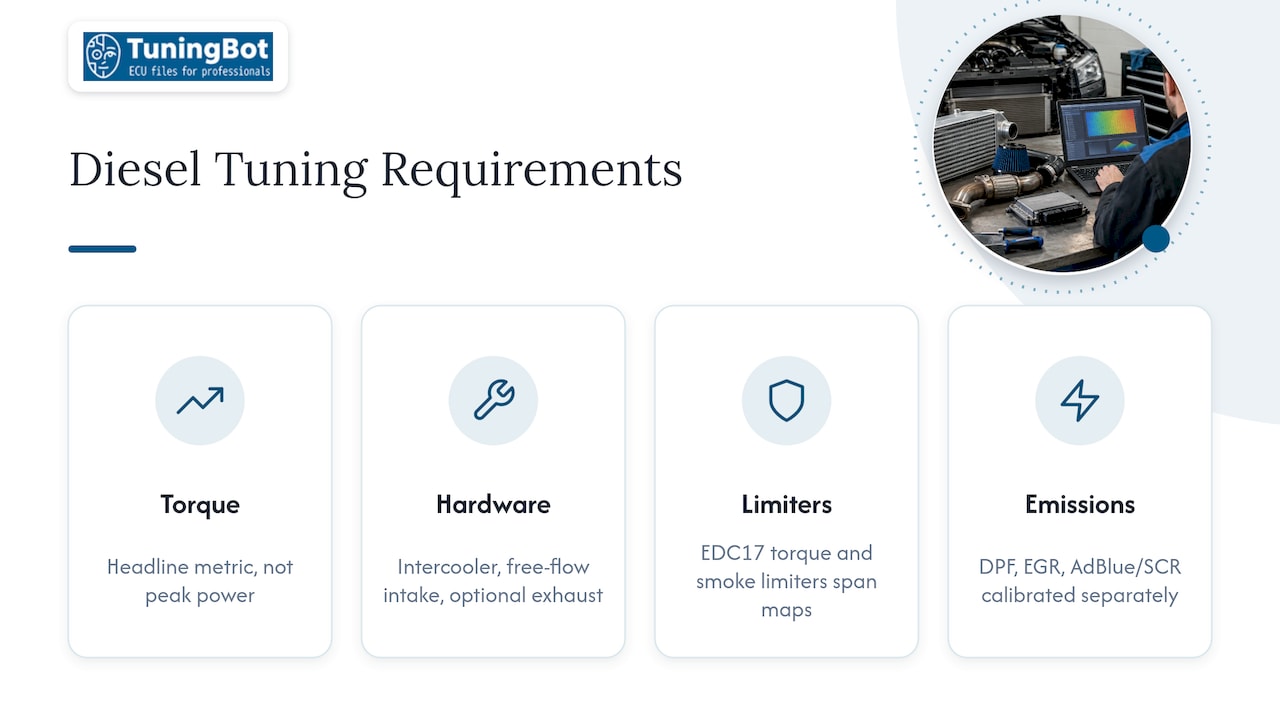
Diesel engines follow the same logic with different limits. Torque rather than peak power is the headline, and the hardware list often centers on the intercooler, a free-flowing intake and, where the application allows, the exhaust. Injector capability, turbocharger capacity and exhaust gas temperature set the ceiling. Diesel calibrations on EDC17-type units also have to respect torque limiters and smoke limiters that sit across several maps, which is why we treat each platform individually.
Because diesel vehicles carry particulate filters, EGR and SCR systems, the emissions rules below matter more on diesels than on petrol cars. We calibrate DPF, EGR and AdBlue/SCR functions as separate services, and each should be used only where the law and the vehicle’s use allow it.
Stage 3 remap requirements
Stage 3 starts where Stage 2 stops. The usual requirements:
- A larger or hybrid turbocharger, or a different forced-induction setup.
- A fuel system sized for the new airflow: higher-flow injectors, a stronger high-pressure pump and often a low-pressure pump upgrade.
- Upgraded internals or a verified engine condition when cylinder pressures exceed what the stock components were designed for.
- A reinforced clutch or gearbox, plus calibrated transmission control.
- Dyno time, because a Stage 3 file is rarely correct on the first flash.
Stage 3 files are therefore closer to development work than to a stock-based file, and mistakes are expensive. Our article on common Stage 3 tuning pitfalls lists the seven errors that cost workshops the most.
Emissions, inspection and road-use rules
The hardware that makes a Stage 2 or Stage 3 build effective, a downpipe without a catalyst, a removed particulate filter, a disabled EGR or SCR system, touches emissions equipment. In the United States, the EPA treats aftermarket hardware and software that bypass required emissions controls as defeat devices and has made stopping them an enforcement priority. Rules differ by state, and other countries run their own inspection and type-approval regimes.
In practice:
- Confirm what your state or country requires for emissions inspection before specifying hardware for a road vehicle.
- Keep catalytic and particulate components in place on vehicles that must pass inspection.
- Reserve emissions-related function-off files for vehicles and uses where they are lawful, such as competition or off-road vehicles, and tell the customer in writing.
- Check insurance and warranty terms with the vehicle’s owner, since modifications can affect both.
For questions about a specific vehicle’s legal status, the local inspection authority or a qualified legal adviser is the right contact.
Перспектива
A Stage 2 file is only as good as the information behind it. The most common cause of a disappointing Stage 2 is a mismatch: parts that the file assumes are not fitted, or a fitted part the calibrator never heard about.
That is why we treat Stage 2 as custom calibration rather than a catalog item. Our engineers work from the ECU read, and we support workshops through the process, with files typically returned in 15 to 20 minutes. If a file does not work, our credit-back guarantee covers it.
Workshops also ask us to keep costs predictable. We publish a price list, charge per file, and do not require registration or prepaid credits, so a single Stage 2 job can be ordered without any account commitment.
TuningBot Technical Team
Ordering a Stage 2 file
Workshops and tuners can upload the ECU file directly on our site, with no registration and no prepaid credits. Premium Stage 2 is listed at 129.99 EUR per file, Stage 1 at 49.99 EUR or 69.99 EUR per file depending on the option, and add-ons such as checksum correction at 29.99 EUR. Real engineer support is available if the hardware list or the platform needs discussion, and the credit-back guarantee applies if a file does not work.

See the full Прайс-лист на тюнинг ЭБУ or start from tuningbot.com to upload a file.
ЧАСТО ЗАДАВАЕМЫЕ ВОПРОСЫ
What is needed for a Stage 2 tune?
A car in good mechanical condition, the supporting hardware the calibration is written for (typically intake, exhaust and intercooler on turbo engines), and a file matched to the exact ECU and software version. Fuel-system and clutch upgrades depend on the platform and the target output.
Can I run a Stage 2 file on a stock car?
A Stage 2 file assumes parts the car does not have, so the engine would run on false assumptions. Fit the hardware first, then flash the matching calibration and verify with a datalog. For a stock car, a Stage 1 file is the matching calibration.
Can a diesel be Stage 2 remapped?
Yes, with the same principle: hardware and calibration must match. Intercooler, intake and injector or turbo capacity set the limits, and emissions equipment such as the particulate filter, EGR and SCR is regulated, so local rules apply to any change involving it.
What does a Stage 3 remap require beyond Stage 2?
Typically a larger turbocharger, a stronger fuel system, a reinforced clutch or gearbox, verified engine internals and dyno time. The file is built around those parts and usually refined over several datalogged runs.
Источники
- EPA: Stopping Aftermarket Defeat Devices for Vehicles and Engines
- Fuel Economy Converter: MPG, L/100 km and km/L