

 EnglishEN
 ItalianoIT
 DeutschDE
 EspañolES
 FrançaisFR
 РусскийRU
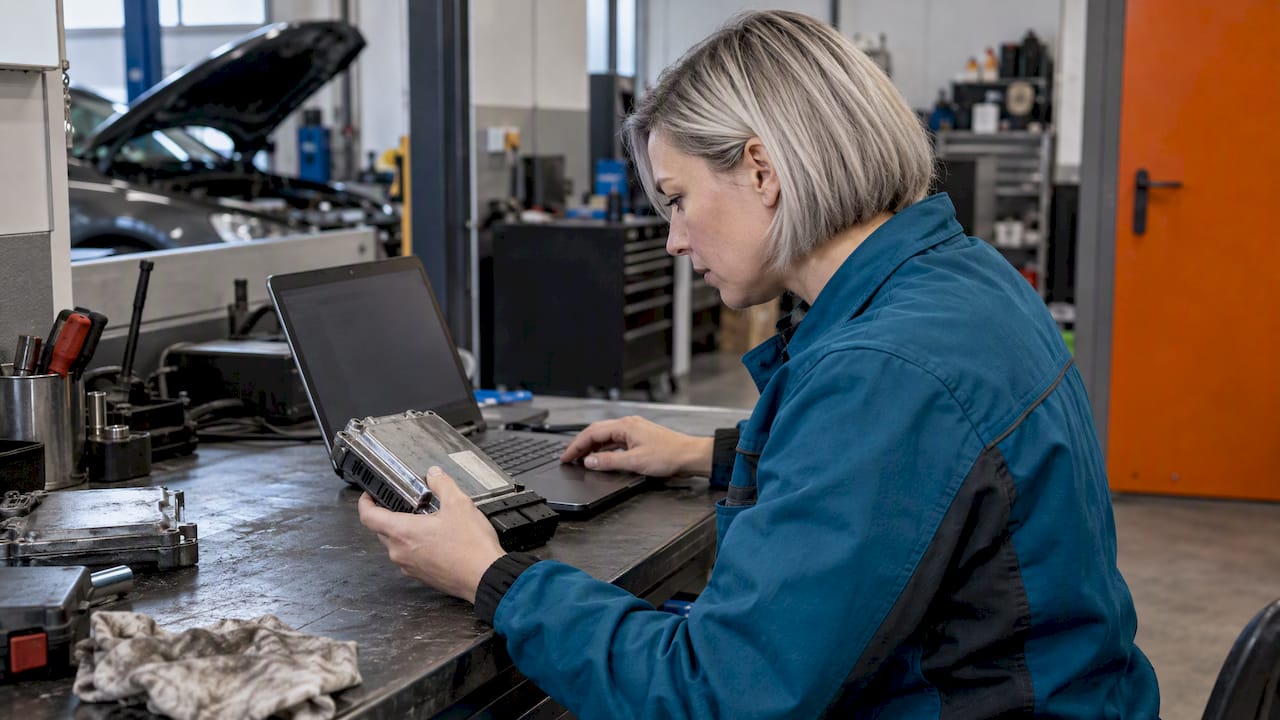
A DPF off file service describes software work intended to disable or alter diesel particulate-filter management. The label alone does not define the file’s contents, compatibility or legal use. To evaluate a request, a workshop needs to distinguish the vehicle’s actual fault, its installed hardware, the ECU data available and the functions affected by the proposed calibration.
DPF off file service: define the technical scope
A diesel particulate filter traps particles in the exhaust. Its management can involve soot estimates, pressure measurements, temperature information, regeneration decisions and diagnostic checks. Implementations differ across engines, ECU software versions and aftertreatment layouts; there is no universal set of maps or switches that describes every controller.
Bosch’s differential-pressure sensor documentation explains how pressure-drop information supports filter monitoring and demand-based regeneration. A displayed loading value still needs interpretation: a calculated soot estimate, an ash estimate and a pressure measurement are different quantities.
Regeneration oxidizes accumulated soot under suitable conditions. It is not a general method for removing non-combustible ash or repairing a damaged filter. Active heat management can use different arrangements, so late in-cylinder post-injection should not be described as the only regeneration mechanism.
Software work does not physically clean, repair or remove a filter. Disabling regeneration while a filter remains in service can leave it accumulating soot without its intended management. Suppressing a warning does not establish that exhaust restriction or a thermal problem has been resolved.
Diagnose the vehicle before discussing a file
Preserve the scan, freeze-frame information and customer complaint before clearing faults or writing software. Check the applicable service information for the engine and ECU. A DPF-related code can involve pressure hoses, sensors, wiring, temperature control, combustion problems or other causes as well as the filter itself.
- Identify the exact engine, ECU hardware, software and calibration version.
- Record which filter, catalysts, sensors and associated components are installed.
- Inspect pressure hoses, connectors and exhaust integrity using the manufacturer’s procedure.
- Compare pressure and temperature readings under documented conditions, using application-specific references.
- Record soot and ash estimates with their units and definitions, plus available regeneration history and inhibition reasons.
- Investigate underlying engine faults that can repeatedly load the filter or prevent successful regeneration.
There is no universal acceptable idle pressure, regeneration interval or soot-mass threshold. Do not initiate a forced regeneration solely because a generic guide suggests it; the vehicle procedure defines its prerequisites and limits. Depending on the diagnosis, the appropriate work may be sensor repair, an approved software update, cleaning, regeneration or replacement.
Clear access helps inspection. These engine-bay cleaning notes are maintenance context; follow vehicle-specific precautions around electronics and do not substitute cleaning for circuit tests.
Separate fault clearing, suppression and readiness
| Item | Significado | Important limit |
|---|---|---|
| Clearing diagnostic information | A supported diagnostic command removes certain stored records. | It does not repair the fault and can reset readiness information. |
| Changing fault reporting | Software changes affect whether or how a fault is reported. | The physical fault or another protection path may remain. |
| Readiness status | Indicates whether a supported monitor has completed its evaluation. | “Ready” is not synonymous with a successful test or legal compliance. |
| Permanent DTC | A separate emissions-related diagnostic record on supported vehicles. | It is not cleared like an ordinary stored code. |
Ross-Tech’s generic OBD-II overview distinguishes current, pending and permanent codes from readiness. The Texas DPS readiness explanation likewise separates monitor completion from fault status. Its inspection examples are jurisdiction-specific, not a worldwide acceptance rule.
O California BAR explanation of permanent DTCs states that ordinary scan-tool clearing or battery disconnection does not erase them. The applicable monitor must verify the repaired condition. Do not promise that a calibration write automatically clears every diagnostic record or makes all monitors ready.
Document the read and verify the deliverable
A file request needs more than a vehicle model and a service label. Record the tool, software version, selected protocol, access method and controller identification. State whether the supplied file is a direct calibration read, a virtual read or a wider memory backup. File size alone cannot prove that the file is complete or correct for the intended operation.
Nosso ECU identification guide explains the identifiers to preserve. Keep the received file and tool log unchanged, and document any previous modification you know about. A current read should not be called factory-original without evidence.
Confirm the expected output format and the scope of any integrity handling. A checksum does not establish that the calibration is appropriate, and signature or security requirements can be separate. Do not assume checksum correction, recovery assistance or further revisions are included unless the actual service terms specify them.
Use the tool’s instructions for supported writes and power requirements. A saved calibration is not necessarily a complete backup, and possession of a backup is not a universal recovery guarantee. The Dimsport read, write and recovery guide discusses these distinctions.
Keep DPF, EGR and SCR functions distinct
DPF, EGR and SCR functions can interact, but they are not interchangeable. The DPF addresses particles; EGR affects the combustion air path and formation of emissions; SCR uses a catalyst and reductant to reduce nitrogen oxides. Their monitoring may involve different controllers and sensor arrangements.
A problem in one system does not establish that changes to the others are necessary. Define the diagnosed issue and the affected function separately. Generic combinations of DPF, EGR and SCR services are not a substitute for that assessment, and a diagnostic-code edit alone does not define the resulting system behavior.
Assess compliance independently of dashboard status
O EPA enforcement alert on tampering and defeat devices addresses emissions hardware, monitoring and calibration changes. Its tampering guidance explains that an “off-road” or “competition” label does not create a blanket exemption for a certified vehicle. A customer acknowledgment does not itself authorize otherwise prohibited work.
For the UK, government DPF guidance explains that a missing factory-fitted filter causes MOT failure and that removal will almost invariably make the vehicle illegal for road use. Other jurisdictions and vehicle classes require their own applicable rules to be checked.
O DIAS research paper on emissions-system tampering documents why suppressed warnings cannot demonstrate functioning emissions controls. It is research evidence, not a substitute for current legislation. Inspection, emissions performance and a clear dashboard are separate questions.
Define what a completed job must demonstrate
For a repair or approved software intervention, retain before-and-after records, verify controller identification, check communication and faults, complete the required adaptation or learning procedures and evaluate the system under the specified conditions. Monitor completion and diagnostic results must be interpreted together. Starting the engine once is not a complete validation.
Separate file charges from diagnosis, tool access, physical repair and vehicle testing. Consult the current TuningBot price list for service information rather than treating an article’s example as a quote. Delivery timing, coverage and support must come from the actual order terms.
Perguntas frequentes
Does a DPF off file repair a blocked filter?
No. A software change does not remove soot or ash, repair a damaged filter or fix a sensor fault. Diagnose the physical system and select the appropriate repair.
Is clearing a DTC the same as disabling its reporting?
No. Clearing diagnostic records and changing the software that reports a fault are different operations. Neither, by itself, repairs the underlying condition.
Does a ready monitor prove that a vehicle is compliant?
No. Readiness concerns monitor completion. Fault results, the installed hardware, emissions performance and applicable compliance requirements must be assessed separately.
What information is needed to assess an ECU file request?
Record the vehicle, ECU hardware and software identifiers, tool and protocol, read type, diagnostic baseline and installed components. State the exact requested scope and known previous modifications.
Does an off-road label make emissions-system disabling legal?
Not automatically. The applicable rules depend on the jurisdiction and vehicle category. A label or customer acknowledgment does not itself create an exemption.