

 EnglishEN
 DeutschDE
 EspañolES
 PortuguêsPT
 FrançaisFR
 РусскийRU
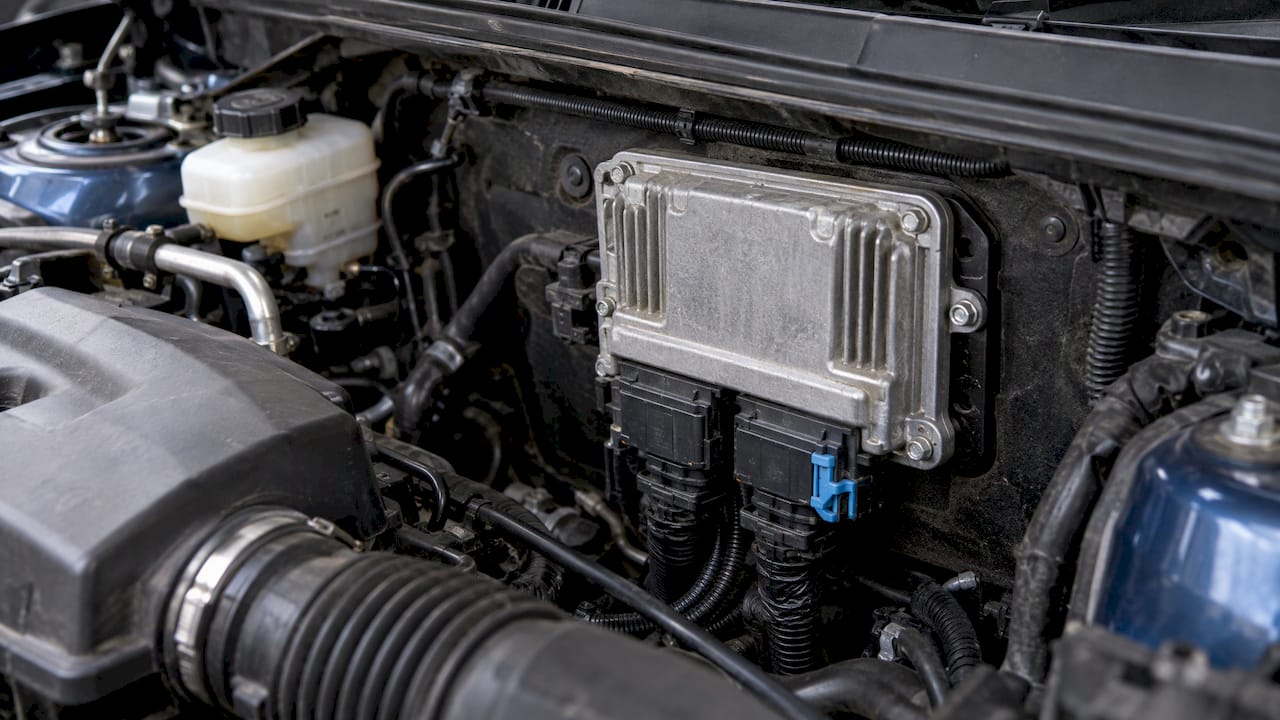
What is an engine control unit? It is the electronic controller that manages an internal-combustion engine using sensor information, software and commands to actuators. Often called an ECM, it coordinates functions such as fuel delivery, air management and, on spark-ignition engines, ignition. Its exact responsibilities depend on the vehicle’s architecture.
What is an engine control unit responsible for?
The engine controller evaluates operating conditions and requests, then calculates suitable outputs. It also monitors signals and functions for faults and can restrict operation when a relevant protection strategy requires it. It works with other vehicle modules rather than independently controlling every system in the car.
Bosch’s engine-controller overview describes fuel, air and combustion management, torque coordination and diagnostic functions. Modern implementations can incorporate models, adaptation and multiple processing cores. One processor speed or memory size should not be presented as a specification for all current ECUs.
A pedal movement is not always a direct command to open the throttle by the same amount. In a torque-based strategy, the controller considers the driver’s request alongside transmission, traction, thermal and other requirements. Earlier systems and different powertrains can organize these functions differently.
ECU, ECM, PCM and TCU terminology
| Term | Usual meaning | Important qualification |
|---|---|---|
| Engine ECU or ECM | Engine control unit or engine control module. | The manufacturer’s service naming should identify the actual module. |
| Electronic control unit | A general term for a vehicle controller. | It can refer to brakes, body functions or other systems, not only the engine. |
| PCM | Powertrain control module. | Often includes engine and transmission control, but terminology and integration vary. |
| TCU or TCM | Transmission controller. | May be separate, integrated into mechatronics or combined with other control functions. |
Use the wiring diagram and diagnostic identification to resolve an ambiguous name. A generic “ECU fault” description does not establish which controller or circuit is responsible.
Inputs, calculations and outputs
Typical inputs include crank and cam position, temperatures, pressure, airflow, pedal position and exhaust oxygen information. Some signals arrive directly through wiring; others arrive from another controller over a vehicle network. Not every engine has every sensor, and not every displayed diagnostic value comes from a physical sensor.
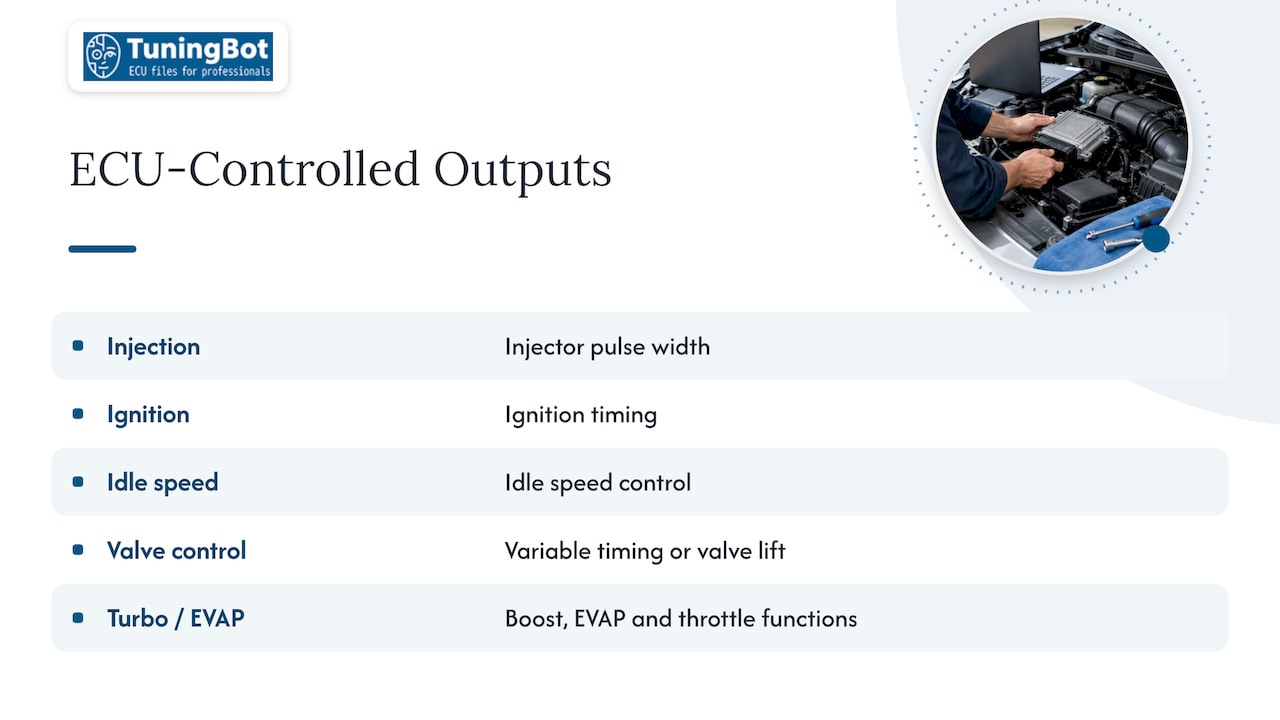
The software combines these inputs with calibration data and its control algorithms. Outputs can drive injectors, ignition coils, electronic throttle or other actuators, or request action from another module. Different tasks run at different rates; there is no single universal frequency at which the entire ECU operates.
Il Volvo ME7.01 system overview illustrates one implementation, including injection, ignition, camshaft, throttle, turbocharger and diagnostic functions. It also describes adaptation. These are application-specific examples, not a complete list for all engines.
Feedback helps a controller correct an observed error when the relevant loop is active. Adaptation can compensate within defined limits, but it cannot repair a damaged injector, leaking hose or poor electrical connection. Large learned corrections can be a diagnostic clue rather than evidence that the hardware is healthy.
Hardware, program code and calibration
Inside an engine controller are processing and memory resources, power-supply circuits, signal-conditioning circuits, output drivers and communication interfaces. Their layout varies with the controller generation and its functions. Memory may be internal to the processor, external, or distributed across several devices.
Program code implements the logic. Calibration data provides values and configuration used by that logic. Vehicle identity, learned information and security-related data may occupy other regions. EEPROM is not a universal location for every map or every immobilizer value; see the ECU memory guide.
Reading, editing and writing are distinct operations. Tool support and protection mechanisms determine what can be obtained or changed. A valid checksum is an integrity condition, not proof that a file matches the hardware or that the calibration will produce correct operation. The ECU writing guide explains the programming side.
Failure symptoms do not identify the cause by themselves
A no-start, intermittent stall, reduced-power condition or communication fault can involve the ECU, but similar symptoms can arise from its supply, grounds, wiring, sensors, actuators or other modules. A warning light means a diagnostic condition has been detected; it does not by itself condemn the controller.
- Preserve the fault codes, status and available freeze-frame data before clearing anything.
- Check the module’s supply and grounds using the vehicle-specific test procedure, including appropriate loaded checks.
- Inspect connectors and wiring for damage, moisture, corrosion or poor terminal contact.
- Evaluate network communication using the actual topology and service information.
- Assess software history and controller hardware only with the supporting evidence.
Do not apply a generic bus-resistance or voltage rule to every network. Likewise, a lost-communication code in another module can indicate that the expected message was absent without proving why it was absent. Check whether the engine ECU itself communicates and whether the condition is current or historical.
If symptoms begin after programming, verify the operation and file before assuming the engine merely needs time to relearn. Required learning procedures vary; abnormal running should not automatically be dismissed as normal adaptation.
Repair, replacement and programming are separate decisions
A vehicle designed around electronic engine management normally needs a functioning compatible controller to operate as intended. This is different from older mechanically controlled engines. A battery-electric vehicle has other powertrain controllers rather than an internal-combustion engine ECU.
A donor unit with matching connectors is not necessarily a usable replacement. Hardware, software, configuration and authorized security pairing must be checked. Not every used unit can be commissioned by the procedure intended for a new unit. Our used ECU programming guide covers these distinctions.
A repair quote should identify diagnosis, hardware work, software work, coding and final testing separately. Avoid treating a price from another country or a different controller as a meaningful estimate for an unidentified fault. Confirm the diagnosed failure and available repair route first.
Domande frequenti
Are ECU and ECM the same thing?
Engine ECU and ECM commonly refer to the engine controller. ECU can also mean electronic control unit more generally, so the manufacturer’s module naming matters.
Does a check-engine light mean the ECU has failed?
No. It indicates a detected diagnostic condition. Supply, wiring, sensor, actuator and mechanical faults must be considered before condemning the controller.
Can any matching used ECU be installed?
No. Connectors alone do not establish compatibility. Hardware, software, configuration and authorized security pairing must match the supported replacement procedure.
Approfondimenti
These resources provide additional system explanations and repair perspectives. Older architecture examples, model-specific fault descriptions and regional price discussions should be read within their stated scope.
- Engine Control Units (ECUs): a complete guide, RAC Drive
- Clemson Vehicular Electronics Laboratory: Engine Control
- Introduction to Engine Control Systems, Toyota technical training
- What is an Engine Control Unit and how does it work? AutoGuru
- Engine control unit, Wikipedia
- Ford Escape U0100: Lost Communication with ECM/PCM
- Faulty ECU Symptoms: How to Recognise ECU Failure
- Engine ECU Repair, Cloning & Reprogramming
- What Is a Car ECU and ECU Repairs, e-CAR Menlyn
- What a check engine light actually costs to fix