

 EnglishEN
 DeutschDE
 EspañolES
 PortuguêsPT
 FrançaisFR
 РусскийRU
Shift map tuning guide workflows should begin with exact transmission/TCU identification, baseline diagnostics and an understanding of which shift-schedule, pressure, torque-reduction, converter-clutch or adaptation strategies the platform actually exposes. There is no universal recipe of “raise pressure, shorten shift time, reduce torque and reset adaptives” that applies to every automatic or dual-clutch transmission. The professional approach is to identify the real shift-quality constraint, make only justified changes, use the supported programming workflow and validate clutch/gearbox behavior from measured data.
TL;DR:
- Shift-map architecture varies by TCU; pressure, shift time, torque reduction, TCC and hysteresis are not universal tuning levers on every transmission.
- There is no universal +5–10% pressure or torque-reduction starting point and no universal 0.3-second street shift target.
- Adaptive reset/relearn is tool-, TCU- and service-specific; do not reset adaptives automatically after every calibration change.
- Mechanical clutch capacity, hydraulic capability and temperature define limits that software cannot bypass.
- Logging and validation should use the signals and sample rate actually available and meaningful for the specific TCU.
Shift Map Tuning Guide: How TCU Shift Schedules Work
A shift map may use throttle, load, torque, speed, gear, temperature or drive-mode inputs to determine upshift/downshift behavior. Some TCUs use simple tables; others use multiple schedules, state machines and adaptive logic.
Upshift and downshift thresholds often use hysteresis to avoid hunting, but their structure and relationship are platform-specific. Do not assume every TCU uses one simple pair of lines.
Modern TCUs can use multiple drive-mode schedules, learned values and protection layers, but the exact interaction must be confirmed for the specific transmission software.
Three things to keep in mind before you open a table:
- The upshift line always sits above the downshift line for the same throttle position.
- Drive-mode selection changes which map the TCU is actually reading, so testing in the wrong mode wastes a log.
- Adaptive/learning values sit in a separate layer and can mask or fight your changes until they’re reset.
Shift Map Tuning Guide: What Controls Shift Feel
Shift feel can depend on pressure, torque coordination, shift timing, clutch fill, converter-clutch behavior, adaptation and hydraulic control. No fixed five-parameter model applies universally.
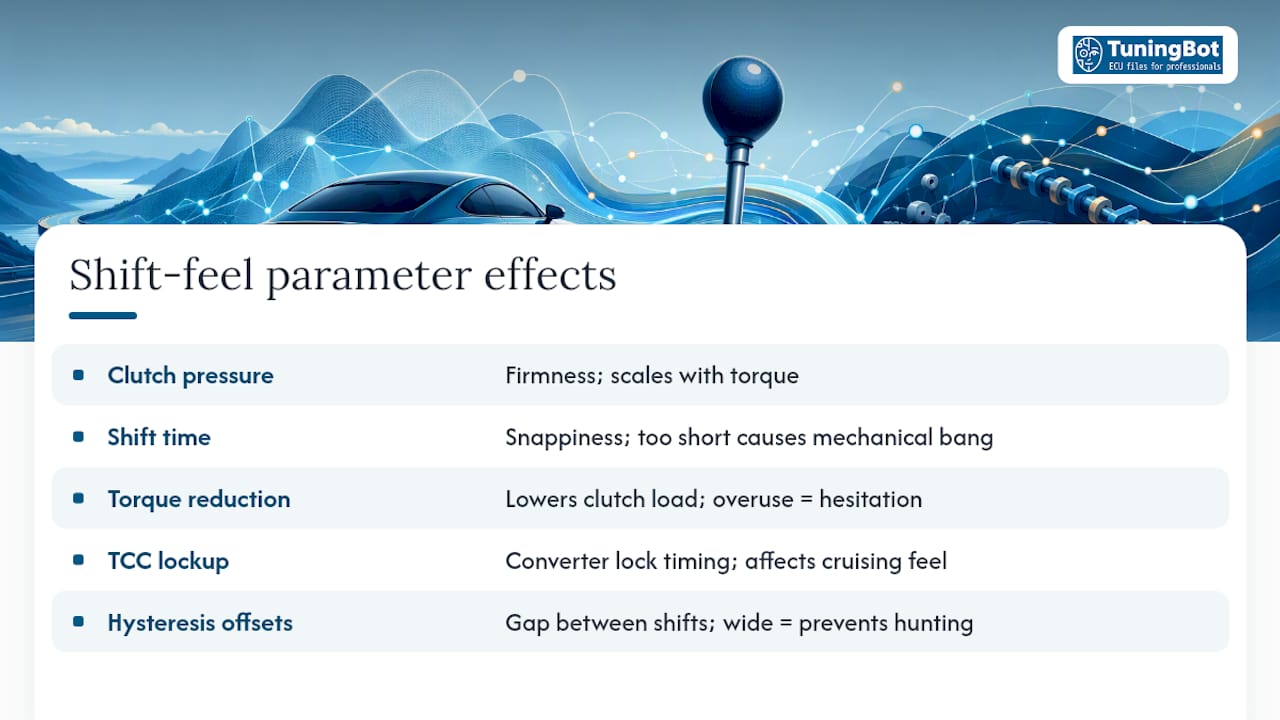
Clutch or line-pressure targets influence clutch capacity and shift feel where the TCU exposes them. Pressure should not be increased automatically just because engine torque is higher; use measured slip, torque model and hydraulic headroom.
Shift duration is one useful validation metric, but its command and control strategy vary by transmission and shift type. Shorter is not automatically better.
Engine-torque reduction during a shift can reduce clutch load on some powertrains, but the required amount and timing are TCU/ECU-specific.
Torque-converter-clutch lockup affects drivability and efficiency on converter automatics; it is not relevant to transmissions without a torque converter.
Hysteresis or equivalent schedule separation can reduce hunting, but the correct spacing depends on the TCU strategy and vehicle behavior.
Consiglio Pro: *When you increase shift pressure after a torque-adding remap, check the pressure-to-torque ratio, not just the raw pressure value.
Shift Map Tuning Guide: Professional Calibration Workflow
A shift map tuning guide should use a professional workflow that is diagnostic and iterative: establish the baseline, identify the actual constraint, change the relevant strategy, program, and validate.
- Identify the exact TCU hardware/software, transmission type and current engine calibration.
- Check DTCs, fluid/temperature condition, existing shift complaints and any mechanical or hydraulic symptoms.
- Preserve the source file supplied by the supported tool workflow.
- Capture a baseline log using the shift, torque, pressure/slip, speed and temperature channels actually available on that TCU.
- Identify the specific problem or objective: schedule, shift timing, clutch slip, converter lockup, hunting or torque intervention.
- Change only the relevant strategy where practical and keep each calibration revision traceable.
- Program using the supported protocol and follow any required basic-setting/adaptation procedure only when specified.
- Repeat matched validation and compare against the baseline before further changes.
The logging checklist worth keeping on a clipboard, literally or digitally, includes:
- Current/target gear and shift-state information.
- Engine and input/output shaft speed where available.
- Requested/reported engine torque and TCU torque intervention where available.
- Clutch or line pressure and clutch slip where the TCU exposes trustworthy values.
- Throttle/load input and drive mode.
- Transmission-fluid/clutch temperature and active DTCs.
Do not force one exact sequence across every TCU. Use a repeatable, traceable workflow and change only strategies supported by the exact transmission software.
Shift Map Tuning Guide: Clutch and Thermal Limits
Firmer shifts feel good until they cost you a transmission. The line between “sharp” and “damaging” shows up in your logs long before it shows up as a mechanical failure, if you know where to look.
Clutch slip is an important warning sign where it can be measured reliably, but harshness or flare can also come from torque coordination, fill timing, pressure control, adaptation or mechanical faults.
Hydraulic pressure and clutch capacity have hardware limits. Do not exceed documented control ranges or attempt to compensate for insufficient clutch capacity with pressure alone.
Transmission temperature is an important validation parameter. Use platform-specific operating limits and cooling behavior rather than one generic temperature threshold.
On some platforms, transmission fluid capacity and clutch friction material simply can’t absorb torque increases past a certain point, no matter how the pressure table is tuned. When logs consistently show slip at a given torque level despite pressure increases, a mechanical upgrade, not another software pass, is the correct next step.
Watch for these signals specifically:
- RPM flare during a shift that doesn’t correspond to a throttle lift
- Line pressure that plateaus below the commanded value under load
- Oil temperature that climbs faster on later runs than it did on your baseline
- Shift times that get longer, not shorter, as a session progresses (a sign of heat soak)
Shift Map Tuning Guide: Why Universal Starting Numbers Do Not Work
There is no universal safe percentage increase for pressure or torque reduction. Starting values must come from the exact TCU strategy, hardware condition and measured baseline.
There is no universal 0.3-second street shift target. Appropriate shift duration depends on transmission type, gear change, clutch/fill strategy, torque level and drivability objective.
If the engine has been remapped for more torque, the torque axis on the pressure table needs rescaling to match. Skipping this step leaves the clutch under-pressurized for the new torque band, which shows up as slip precisely at the RPM and load range where the extra power lives.
- Pressure change: only where logs and hardware limits show the current pressure strategy is insufficient.
- Torque reduction: calibrate from shift quality and clutch loading; do not apply a fixed percentage cut.
- Shift time: use the value appropriate to the transmission and shift event rather than a universal 0.3-second target.
- Adaptation/basic settings: perform only when required by the TCU, tool or specific service operation.
- Stop conditions: persistent slip, abnormal pressure tracking, rising temperature, DTCs or deteriorating repeatability.
Shift Map Tuning Guide: Diagnosing Harsh, Soft or Hunting Shifts
Post-tune shift complaints can come from calibration, learned values, sensors, hydraulics, clutch wear, engine-torque reporting or hardware faults. Diagnose the actual cause before editing another table.
Harsh shifts usually come from pressure overshoot, an overly aggressive torque cut that snaps back too hard at shift completion, or noisy sensor input feeding the TCU bad data. Check the pressure trace for a spike rather than a clean ramp, and confirm the torque reduction curve tapers smoothly instead of stepping.
Soft or slipping shifts point to insufficient pressure for the torque being handled. Increase pressure in small steps, confirm the clutch has the mechanical capacity to hold the new pressure and torque combination, and look specifically at the torque handoff moment in your logs where slip typically shows up first.
Gear hunting almost always means hysteresis is too narrow for real-world driving, though it’s worth ruling out VSS or RPM sensor noise before touching the map itself. Widen the gap between upshift and downshift lines and re-test on the same borderline-throttle section of road that triggered the hunting originally.
TCC lockup issues (surging, shudder, or delayed engagement) come from lockup and release cells that don’t match the vehicle’s real-world throttle response. Review lockup speed across a full throttle sweep, not just one operating point.
Consiglio Pro: If a symptom only shows up in one drive mode, check whether you’re editing the map that mode actually reads. Editing the wrong drive-mode table is one of the most common reasons a “fix” doesn’t fix anything.
- Harsh shifts: check torque handoff, fill/pressure control, learned values and mechanical/hydraulic condition.
- Soft or slipping shifts: verify clutch slip, pressure delivery, torque reporting and hardware capacity before increasing pressure.
- Hunting: inspect schedule logic, hysteresis, driver/load inputs and sensor quality.
- TCC issues: review lockup/release strategy only on torque-converter transmissions and rule out converter or fluid problems.
Shift Map Tuning Guide: Workshop Checklist
A workshop-grade shift-map workflow starts with exact TCU identification, supported programming access, a valid source file, baseline diagnostics and a clear validation plan.
For related technical context, use the verified DSG TCU Tuning Procedure, Torque Curve Guide e Errori comuni nella mappatura della centralina.
Before ordering a calibration file, check Copertura dei servizi ECU, la Listino Prezzi Pubblico e Servizi di modifica.
Submit a supported source file through Rimappa il tuo file after confirming the TCU and requested shift behavior are covered.
This article stays informational and technical so commercial TCU/DSG tuning keywords remain concentrated on TuningBot’s service and order pages.
Where Can You Learn More About Shift Map Engineering?
For deeper technical grounding, High Performance Academy’s transmission tuning resources cover logging and iterative calibration practice, the MDPI Energies paper on shift map development documents instrumented validation testing, and the patent on automatic transmission shift control explains how multi-map and learning-value logic actually works under the hood.
Shift Map Tuning Guide: Practical Workshop Priorities
Shift quality is the result of multiple interacting torque, hydraulic, clutch and schedule strategies. Pressure alone is not a universal firmness dial.
Where most self-taught tuning goes wrong isn’t the direction of the edit, it’s the absence of a baseline log. Changing pressure without a “before” comparison means you’re evaluating the result by feel, and feel is a poor instrument for detecting the early stages of clutch slip that show up clearly in a data trace weeks before they show up as a symptom you can feel from the driver’s seat.
The priority is traceability: preserve the baseline, identify the real constraint, validate every meaningful change and stop when logs indicate a hardware or thermal limit.
— TuningBot Team Tecnico
Using This Shift Map Tuning Guide in a Workshop
Use this guide to identify whether the shift issue is schedule, torque coordination, clutch/pressure control, converter lockup, adaptation or hardware before editing the TCU.
If calibration is outsourced, verify the exact TCU in Copertura dei servizi ECU and submit the supported source file through Rimappa il tuo file.
The workshop remains responsible for transmission condition, programming, test safety and final validation.
Sources and Further Reading
- High Performance Academy — transmission tuning resources — external educational reference retained unchanged.
- MDPI Energies — shift map development — external research reference retained unchanged.
- Automatic transmission shift-control patent — external patent reference retained unchanged.
- EFILive forum transmission tuning tutorial — external community reference retained unchanged.
- TuningBot — DSG TCU Tuning Procedure — verified internal transmission-workflow reference.
- TuningBot — How Remap Affects Torque Curve — verified internal torque reference.
- TuningBot — Common ECU Tuning Mistakes — verified internal workshop reference.
FAQ
What Does TCM Tuning Actually Do?
TCM tuning can change shift schedules, torque coordination, clutch/line-pressure strategies, shift timing and converter-clutch behavior where those functions are exposed in the exact transmission software.
Can You Tune a Transmission to Shift Faster?
Often yes, but the available shift-time controls and safe limits are transmission-specific. Faster is not automatically better if clutch, hydraulic or torque-coordination limits are exceeded.
How Much Does It Cost to Tune a Transmission?
There is no universal price. Cost depends on TCU support, source-file workflow, calibration complexity and validation requirements.
Can I Adjust the Shift Points on an Older Automatic Transmission Like a TH350?
Older hydraulically controlled transmissions use mechanical/hydraulic governor and valve-body logic rather than a programmable TCU, so shift-point changes are primarily hardware adjustments.
Do I Need to Reset Adaptives Every Time I Change the Shift Map?
No. Reset or relearn adaptives only when the TCU, flashing tool, OEM procedure or specific calibration/service change requires it.