

 ItalianoIT
 DeutschDE
 EspañolES
 PortuguêsPT
 FrançaisFR
 РусскийRU
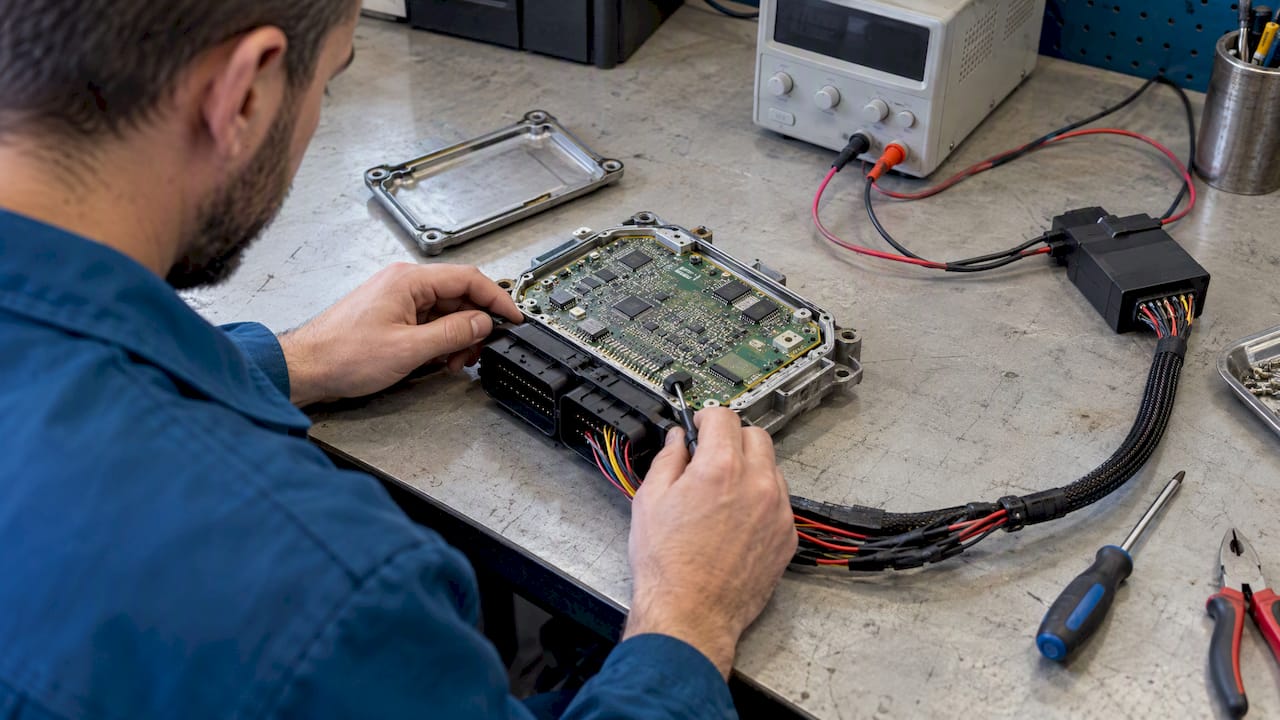
This IMMO off guide explains the identification, diagnostic and verification questions behind an immobilizer-related ECU request. “IMMO off” describes disabling some part of start authorization; it does not describe a universal file format, a guaranteed repair or the same change on every vehicle. An immobilizer fault should first be diagnosed as a vehicle-system problem.
IMMO off guide: define the actual repair need
Depending on the vehicle, start authorization can involve a transponder, reader, body or security module, instrument cluster, gateway and engine controller. The architecture and permitted repair procedures vary. A no-start condition does not establish that the ECU’s immobilizer logic is at fault.
Distinguish key recognition, communication, power-supply and module-identity faults from unrelated fuel, ignition or mechanical problems. Record symptoms and diagnostic results before choosing a remedy. Replacing a damaged component or performing supported key or module adaptation may restore the intended security function without disabling it.
Record the customer’s authorization, vehicle identity, reason for the work and the controller’s hardware and software identifiers. A shared vehicle model, engine code or ECU family name is not enough to establish compatibility.
Understand what the read actually contains
OBD, bench and boot describe access methods, not a universal list of memory areas. Coverage depends on the controller, protocol, tool version and operation selected. A calibration read, a virtual file supplied by a tool and a backup containing device-specific data are different artifacts.
Bench access commonly uses the ECU connector with the unit removed; boot access may require opening the unit and following a controller-specific procedure. Neither term alone guarantees access to all memory, security data or protected regions. Use the tool’s documented capabilities for the exact target.
AutoTuner describes its own backup behavior in its backup-file documentation. That product-specific description should not be generalized to every tool. Our AutoTuner read and write guide also distinguishes access methods and file types.
Archive original files without overwriting them, together with the tool, protocol, date and identifiers. Record which memory areas were obtained and any tool-reported limitations. A file called “full read” is not proof that every component of a vehicle’s authorization system can be restored from it.
Interpret immobilizer faults in context
The TuningBot entries for Lexus B2796 and Lexus B2799 illustrate communication and immobilizer-related fault descriptions. Apply the manufacturer’s diagnostic procedure to the exact model and reporting module; a code description is not a diagnosis or an instruction to disable security.
Check the relevant power supplies, communication status, key recognition and module history using supported diagnostic equipment. A replacement ECU may have incompatible hardware, software or identity data. Resolving one authorization issue will not fix an unrelated supply, network or engine fault.
Deleting a diagnostic code is also different from repairing its cause. The DTC table guide describes that distinction. Preserve useful fault information during diagnosis rather than using an empty fault list as the sole acceptance criterion.
Separate file integrity from vehicle validation
Checksum handling depends on the file, memory region and tool workflow. Some operations correct supported checksums automatically; other files need a separate supported process. Cryptographic signatures and access protections are separate considerations. A valid checksum does not prove that a modification is compatible or that the vehicle will start.
Use the checksum guide to clarify responsibilities before work begins. Recovery capability must be established for the actual controller and tool; keeping a copy of a file does not guarantee that it can be written after every failure.
Verification should follow the tool’s documented method. A byte-for-byte comparison is not always appropriate when read formats, volatile data, counters or tool processing differ. Conversely, a successful write message confirms only the tool’s reported operation. Relevant module diagnostics and vehicle behavior still need checking.
Evaluate replacement and adaptation options
Compare the proposed work with supported repair, replacement and adaptation routes. For a replacement controller, verify hardware identity, software applicability and any required security pairing before purchasing or installing the part. Matching the casing or connector does not establish compatibility.
For workshops sourcing components internationally, this overview of importing OEM electronic parts for premium cars discusses parts identification and import considerations. Confirm the actual part through the vehicle manufacturer’s information; a sourcing article cannot establish suitability for an individual vehicle.
The retained EDC17 and Multi-Prog references below describe specific examples. Their memory layouts, timing figures and procedures should not be reused as general instructions for other controllers. This article does not provide security-patch offsets, credentials or a universal bypass procedure.
Document security effects and the agreed outcome
Immobilizer changes affect theft deterrence. NHTSA’s theft-prevention guidance explains the role of immobilizing devices; it does not approve disabling them or establish that every vehicle has the same system.
Do not describe an immobilizer modification as automatically lawful because it is unrelated to exhaust aftertreatment. Applicable requirements and insurance conditions depend on the vehicle and jurisdiction. Emissions changes included in the same request need a separate assessment. The EPA references below provide background and case history, not authorization for a specific repair.
Record the agreed function, remaining limitations, diagnostic findings and checks performed. Confirm current availability and terms for the identified controller through the published coverage information and service details. A coverage announcement is not a guarantee for every software revision, and this guide does not promise turnaround, recovery or a successful outcome on an unidentified unit.
Frequently asked questions
What does IMMO off mean?
It describes disabling some part of a vehicle’s immobilizer-related start authorization. The affected function and consequences depend on the system and software.
Is a full bench or boot read always required?
No universal rule applies. Required data and available read coverage depend on the controller, tool, protocol and proposed operation.
Does an immobilizer DTC prove the ECU needs modification?
No. Key recognition, power supplies, wiring, communication and module compatibility must be considered using the relevant diagnostic procedure.
Does a correct checksum guarantee a working vehicle?
No. A checksum addresses data integrity within its scope. It does not establish software compatibility, successful authorization or mechanical condition.
Is disabling the immobilizer the only repair option?
No. Supported diagnosis, component repair, replacement and adaptation may restore the original security function. Assess those options for the actual vehicle.
Sources and further reading
Related TuningBot reading
- DTC Codes Database – 17,000+ Fault Codes
- ECU Tuning Reliability — Why 100% Guarantees Don’t Exist
- Emissions Compliant Tuning: Evidence and U.S. Checks
- TuningBot Solutions Upgrade: New Supported ECU Coverage
- Online Tuning File Service Workflow for Workshops
- Online Remap File Delivery: Secure Workshop Workflow