

 ItalianoIT
 DeutschDE
 EspañolES
 PortuguêsPT
 FrançaisFR
 РусскийRU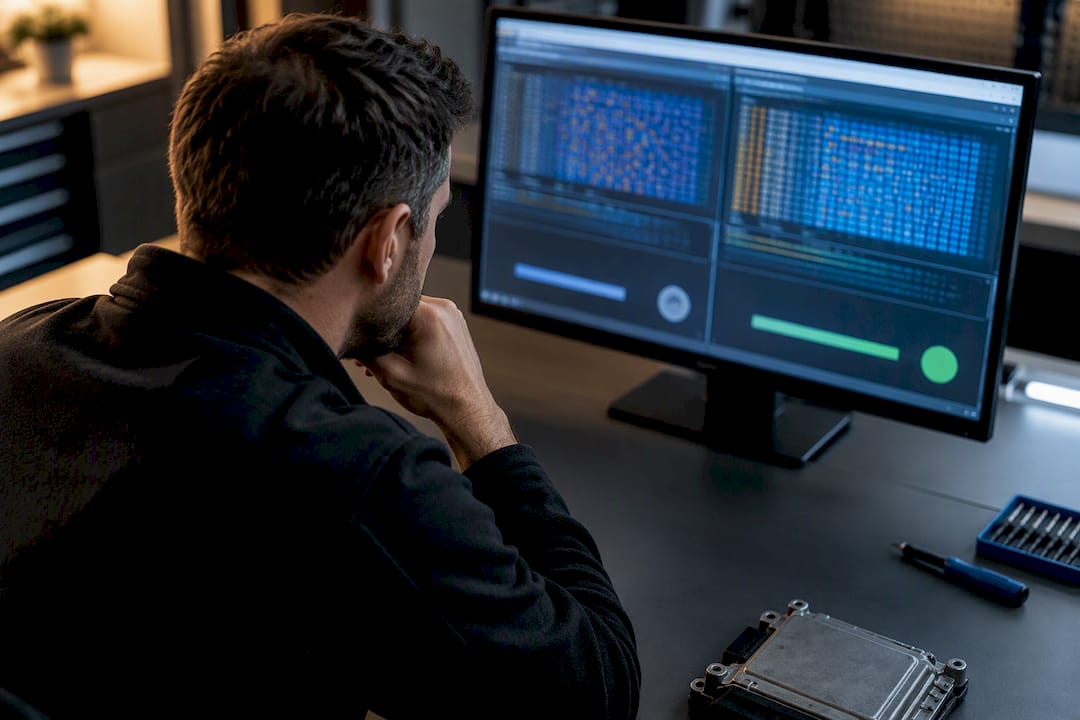
DTC table editing changes diagnostic configuration inside a particular ECU software application. A code description does not reveal its binary address or all of its effects. Reliable analysis starts with matching definitions, a documented purpose and a clear distinction between fault diagnosis and changing fault reporting.
DTC table editing requires matching definitions
ASAM MCD-2 MC, also called ASAP2, defines the A2L description format used for ECU measurement and calibration data. It can describe addresses, data types, record layouts and conversions. An A2L file is not automatically a complete diagnostic specification, and an unrelated software version can give misleading results.
Check the hardware and software identifiers, memory layout and definition provenance. Validate the particular objects needed for the task rather than assuming that a successful import proves every address correct.
SAE J2012 concerns diagnostic code definitions and structure. It does not provide a universal binary layout for every manufacturer’s diagnostic tables. A searchable code list helps interpret a reported fault; it cannot identify an editable address on its own.
Understand the diagnostic dependencies
A diagnostic event may involve detection conditions, debouncing, fault status, memory storage, warning-lamp behavior and functional responses. These can be spread across different data objects and software logic. Changing a visible code entry does not necessarily change all of those functions.
Several events can share a class or configuration object. An apparently small edit can therefore affect more than one reported code. Document the intended scope and the other functions that rely on the same objects before accepting the change.
Clearing stored fault memory through diagnostics is a different operation from modifying diagnostic behavior in a calibration. Neither action proves that the underlying mechanical or electrical condition has been repaired.
Treat automatic table detection as a hypothesis
A pattern match should be checked against the exact application, neighboring structures and independent definitions. A plausible sequence of codes is not enough to prove the table boundary or the meaning of each field.
The DTCController project linked below explicitly targets EDC16C34 PSA applications and describes assumptions used in its detection method. It is an example of implementation-specific analysis, not evidence that the same layout works on another ECU family.
Where definitions or validation evidence are missing, record the uncertainty. Do not invent an address, mask or universal disable value to make the workflow appear complete.
Compare the change set and integrity processing
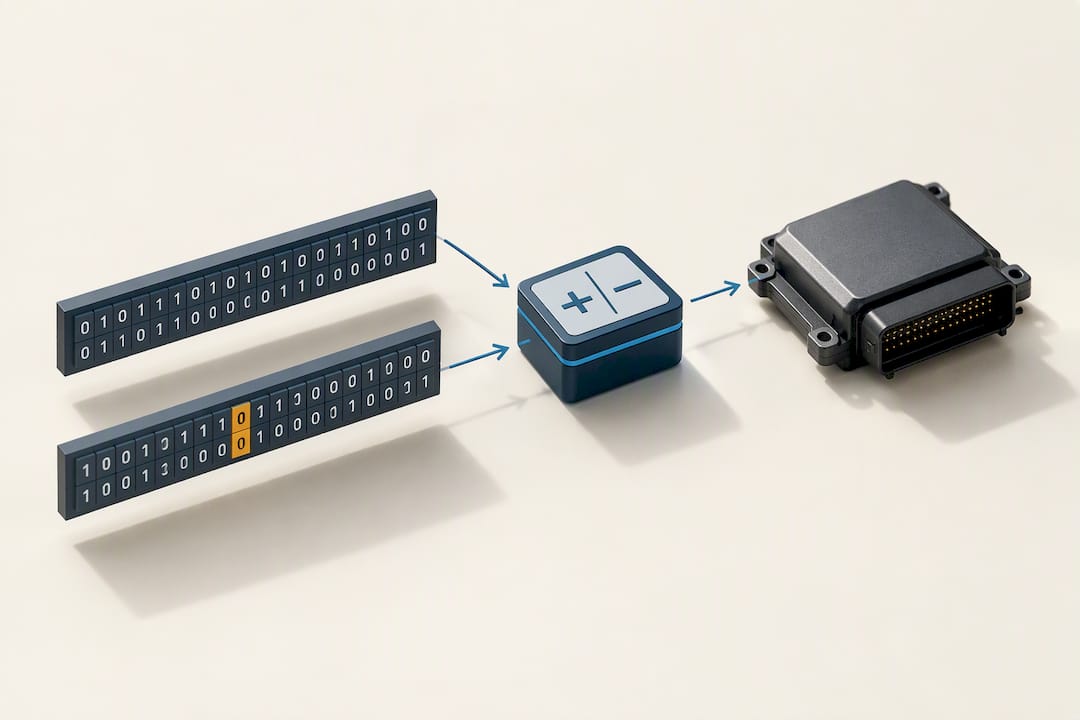
Keep the untouched original and create a separate working version. Compare the resulting file with the correct baseline, accounting for documented export transformations, metadata and integrity updates. Explain every changed region relevant to the operation.
A binary diff identifies changed bytes, but does not prove their meaning. Encrypted or repackaged files may not produce a directly useful byte-for-byte comparison; use the supported tool workflow and available reports.
Confirm how the affected regions are protected and who performs the required integrity processing. Checksums may be corrected by an editor, a supported service or the writing tool. It is inaccurate to claim that every byte edit necessarily requires the same manual correction, or that a valid checksum establishes correct diagnostic behavior.
Validate behavior rather than an empty fault list
Preserve the initial scan and relevant freeze-frame information. Define the expected behavior and the conditions needed to test it. Review detection, reporting and functional responses where applicable, using an appropriate controlled test arrangement.
An empty scan immediately after clearing codes is not an acceptance test. Some diagnostics require particular temperatures, loads or drive-cycle conditions. Confirm that unrelated diagnostics and protective responses still operate as intended.
Keep the file identity, change rationale and test observations together. The record should distinguish a confirmed outcome from behavior that was not tested.
Keep regulatory conclusions separate from file editing
For U.S. applications, EPA identifies emissions-related OBD functions among the elements covered by its tampering guidance. A diagnostic edit can affect that functionality even without removing a physical component.
The EPA’s 2020 enforcement policy discusses a documented reasonable basis and enforcement discretion. It is not an automatic exemption, and the absence of such documentation does not itself constitute a violation. A checksum result, customer consent or a clean fault scan does not settle regulatory compliance.
Use current requirements for the actual vehicle and jurisdiction. Do not represent a generic diagnostic-table workflow as approval to suppress emissions or safety-related monitoring.
Frequently asked questions
Does an A2L file guarantee that every DTC table is correctly identified?
No. It must match the software and contain the relevant definitions. The addresses and behavior still require validation.
Is clearing fault memory the same as DTC table editing?
No. Clearing stored faults is a diagnostic operation; table editing changes configuration or reporting behavior in the ECU file.
Does a valid checksum prove that a diagnostic edit is correct?
No. Integrity checks do not establish the meaning of the changes or the resulting diagnostic behavior.