

 EnglishEN
 ItalianoIT
 EspañolES
 PortuguêsPT
 FrançaisFR
 РусскийRU
Unter „Dyno tuning“ versteht man den Vorgang der Anpassung der ECU-Parameter eines Fahrzeugs auf einem Leistungsprüfstand, um die Motorleistung, die Kraftstoffeffizienz und die Zuverlässigkeit unter kontrollierten, messbaren Bedingungen zu maximieren. Im Gegensatz zu generischen Werkskalibrierungen werden bei einer professionellen Dyno-Abstimmung Live-Daten wie Leistung, Drehmoment, Luft-Kraftstoff-Verhältnis (AFR) und boost-Druck ausgelesen und anschließend gezielte Änderungen an den Kraftstoff- und Zündkennfeldern vorgenommen. Das Ergebnis ist eine Abstimmung, die speziell auf Ihren Motor, Ihre Modifikationen und Ihre Kraftstoffqualität zugeschnitten ist. Dieser Leitfaden behandelt den gesamten Dyno-tuning-Prozess, seine messbaren Vorteile, den Vergleich zum Straßen-tuning sowie die Frage, wann sich diese Maßnahme für Ihr Fahrzeug lohnt.
Was ist der Dyno tuning und wie funktioniert er?
„Dyno tuning“ ist der Fachbegriff für die Kalibrierung eines Steuergeräts auf einem Leistungsprüfstand – einer Maschine, die eine kontrollierte Last auf den Antriebsstrang ausübt und gleichzeitig die Leistungsabgabe in Echtzeit misst. Der Leistungsprüfstand ersetzt die Unvorhersehbarkeit der Straßenverhältnisse durch eine reproduzierbare Testumgebung. Genau diese Kontrollierbarkeit unterscheidet Dyno tuning von allen anderen Kalibrierungsmethoden.
Werkseitige Motorsteuergeräte-Kalibrierungen sind bewusst konservativ ausgelegt, um den weltweiten Schwankungen bei der Kraftstoffqualität und den Emissionsnormen Rechnung zu tragen. Das bedeutet, dass die meisten Serienfahrzeuge das Werk mit ungenutzter Leistung verlassen. Eine Dyno-Abstimmung nutzt diesen Spielraum, indem sie speziell auf den lokalen Kraftstoff, die Umgebungsbedingungen und etwaige nachgerüstete Komponenten abgestimmt wird.
Der Leistungsprüfstand misst die Leistung an den Rädern, nicht an der Kurbelwelle. Dieser Unterschied ist wichtig, da die Radleistung die Verluste im Antriebsstrang berücksichtigt und ein genaueres Bild davon vermittelt, was das Fahrzeug tatsächlich auf der Straße bringt.
Wie läuft der Prozess des Prüfstands tuning Schritt für Schritt ab?
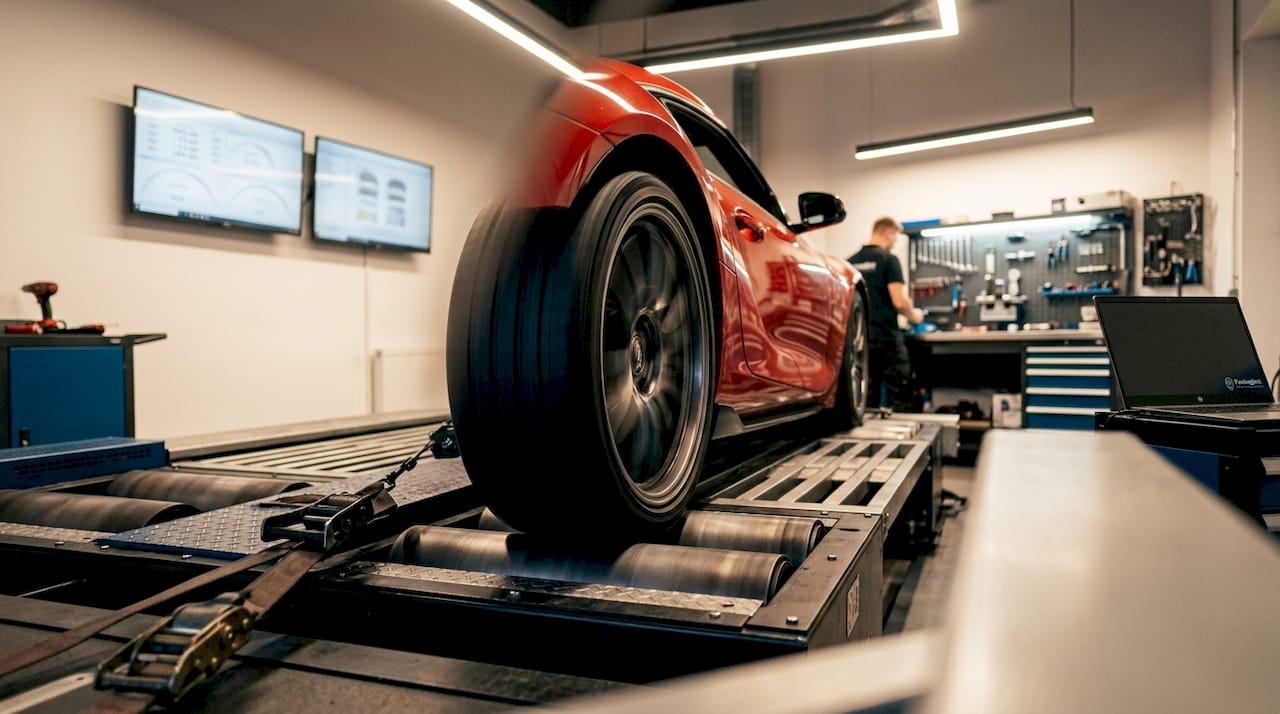
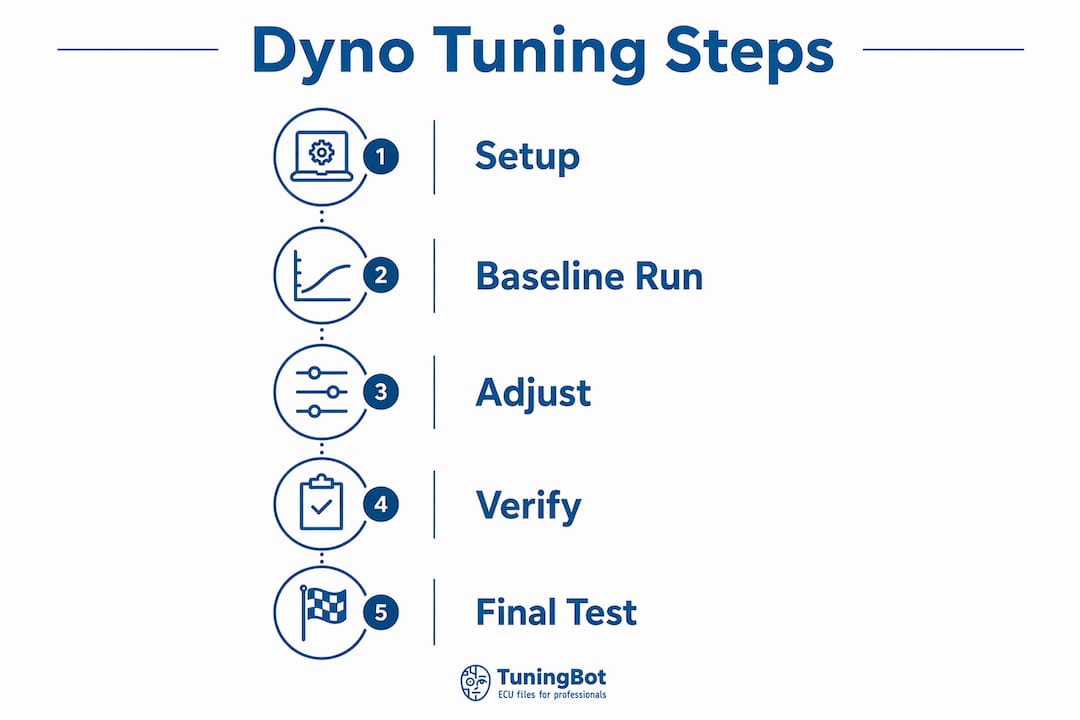
Eine professionelle tuning-Prüfstandssitzung folgt einem festgelegten Ablauf. Jeder Schritt baut auf dem vorherigen auf, und das Überspringen eines beliebigen stage-Schritts birgt Risiken.
Vor-Sitzungs-Inspektion. Das tuner überprüft den Zustand des Motors, bevor das Fahrzeug auf den Prüfstand fährt. Abgenutzte Zündkerzen, Undichtigkeiten am boost oder eine zu geringe Kompression verfälschen alle anschließend erfassten Messwerte.
Ausgangswert-Zug. Das Fahrzeug läuft über den gesamten Drehzahlbereich mit voll geöffneter Drosselklappe. Bei einem Basislauf werden die aktuellen Werte für Leistung, Drehmoment, Luft-Kraftstoff-Verhältnis (AFR), boost und Zündzeitpunkt aufgezeichnet. Dies dient als Bezugspunkt für alle nachfolgenden Änderungen.
Datenanalyse. Das tuner wertet die Basisprotokolle aus, um festzustellen, an welchen Stellen das Steuergerät im fetten oder mageren Betrieb läuft oder die Zündung unnötig verzögert. Problembereiche in den Kraftstoff- und Zündzeitpunktkurven stehen dabei im Mittelpunkt.
Iterative Motorsteuerungsanpassungen. Der Tuner passt Kraftstofftabellen, Zündvorverstellung und boost-Sollwerte in kleinen Schritten an. Jede Anpassung wird von einem Verifizierungslauf gefolgt, um zu bestätigen, dass die Änderung die Leistung verbessert hat, ohne die Abgastemperaturen zu erhöhen oder Klopfen auszulösen.
Durchgehende Sicherheitsüberwachung. Bei jedem Durchlauf werden die AFR-Werte, die Ansauglufttemperatur und die Klopfsensorwerte überwacht. Sicherheit und Langlebigkeit des Motors haben Vorrang vor dem Streben nach Spitzenwerten.
Letzte Verifikationsgierde. Sobald der tuner mit der Kalibrierung zufrieden ist, werden die Verstärkungswerte in einem abschließenden Testlauf bestätigt und die abgeschlossene Abstimmung dokumentiert.
Pro-Tipp: Fordern Sie am Ende Ihrer Sitzung stets ein gedrucktes oder digitales Prüfprotokoll an. Darin sind die Ausgangs- und Endleistungswerte dokumentiert, sodass Sie einen Anhaltspunkt für zukünftige tuning-Sitzungen oder zur Fehlerbehebung haben.
Die Sicherer Tuning-Workflow Der Weg von der Serie bis zur Stage 1 folgt derselben Struktur, wobei jeder Testlauf als Verifizierung dient, bevor die nächste Änderung vorgenommen wird.
Was sind die wichtigsten Vorteile des Prüfstands tuning?
Die Vorteile des Dyno tuning gehen weit über die Spitzenleistungswerte hinaus. Eine professionelle Abstimmung beeinflusst das gesamte Fahrverhalten des Motors über den gesamten Drehzahlbereich hinweg.
Leistungssteigerung bei Serienfahrzeugen. Ein maßgeschneiderter tuning-Prüfstand bei einem Serienfahrzeug kann je nachdem, wie konservativ die Werkskalibrierung war, eine Leistungssteigerung von 15 bis 40 Pferdestärken erzielen. Diese Spanne ergibt sich daraus, dass OEM-Abstimmungen weltweit die ungünstigsten Kraftstoff- und Umgebungsbedingungen berücksichtigen.
Höhere Gewinne bei modifizierten Fahrzeugen. Fahrzeuge mit Nachrüstteilen wie Sportluftfiltern, Leistungsauspuffanlagen oder Aufladung verzeichnen häufig 10–30% oder mehr Nach einer professionellen Abstimmung steigen Leistung und Drehmoment. Hardware-Modifikationen ohne eine darauf abgestimmte ECU-Abstimmung lassen einen Großteil dieses Potenzials ungenutzt.
Verbessertes Ansprechverhalten des Gaspedals und breiteres Drehmomentband. Eine Leistungsprüfstandabstimmung verbessert Drehmomentabgabe über das gesamte Drehzahlband, nicht nur bei Höchstdrehzahl. Das macht die Beschleunigung berechenbarer und das tägliche Fahren weniger anstrengend.
Bessere Kraftstoffeffizienz. Die Optimierung des Luft-Kraftstoff-Verhältnisses und des Zündzeitpunkts senkt den Kraftstoffverbrauch im Dauerbetrieb und bei Fahrten auf der Autobahn. Die weit verbreitete Annahme, dass tuning stets zu einem höheren Kraftstoffverbrauch führt, ist falsch. Ein gut abgestimmtes Luft-Kraftstoff-Verhältnis sorgt für eine vollständigere Verbrennung des Kraftstoffs, wodurch weniger Kraftstoff verschwendet wird.
Motorschutz. Die richtige Zündung verhindert Detonation. Das korrekte Luft-Kraftstoff-Verhältnis verhindert magere Bedingungen, die die Verbrennungstemperaturen erhöhen. Beide schützen den Motor vor Schäden, die sich mit der Zeit ansammeln.
Ein weit verbreitetes Missverständnis ist, dass die Dyno-Abstimmung tuning ausschließlich Rennwagen zugutekommt. Auch serienmäßige Alltagsfahrzeuge profitieren durch eine professionelle Abstimmung von messbaren Verbesserungen hinsichtlich Fahrverhalten und Effizienz, insbesondere wenn das Fahrzeug bereits eine hohe Laufleistung aufweist oder mit Kraftstoff mit höherer Oktanzahl betrieben wird, als bei der Werksabstimmung vorgesehen.
Für tuners, das eine Liste mit Leistungsteilen für die Rennstrecke zusammenstellt, ist eine Abstimmung auf dem Leistungsprüfstand der letzte Schritt, der die Hardware-Upgrades zu einer stimmigen Kalibrierung zusammenführt.
Wie schneidet der Dyno tuning im Vergleich zum Street tuning und zum E-tuning ab?
Dyno tuning, Street tuning und Remote e-tuning sind jeweils auf unterschiedliche Anforderungen zugeschnitten. Das Verständnis der Unterschiede hilft Werkstätten und tuners dabei, für jeden Auftrag die richtige Methode auszuwählen.
Der Prüfstand tuning ist sicherer und präziser als das Straßenmodell tuning, da der Leistungsprüfstand bestimmte Drehzahl- und Lastpunkte unbegrenzt lange beibehält. Das Modell tuner kann eine Änderung der Kraftstoffkennlinie vornehmen und denselben Betriebszustand sofort erneut testen. Das Straßenmodell tuning kann dies nicht nachbilden. Verkehrsregeln, Straßenverhältnisse und schwankende Drosselklappenstellungen machen konsistente Tests bei voll geöffneter Drosselklappe unpraktisch und gefährlich.
| Methode | Load control | Real-time adjustment | Safety | Bester Anwendungsfall |
|---|---|---|---|---|
| Dyno tuning | Vollständig | Ja | Hoch | Modified vehicles, forced induction, final calibration |
| Street tuning | Partial | Limited | Niedrig | Minor adjustments, data logging only |
| Remote e-tuning | None (log-based) | Nein | Mittel | Geographic constraints, mild calibration updates |
Street tuning works for light data logging and minor map corrections on mild setups. Remote e-tuning suits situations where a qualified dyno facility is not accessible, but it relies on driver-submitted logs rather than controlled pulls. Neither method matches the accuracy of a dyno session for vehicles with significant modifications or forced induction.
Dyno tuning allows tuners to hold a specific load point and make micro adjustments to ignition advance or fuel trim in real time. That capability is the core technical advantage over both alternatives.
Für wen und wann kommt der Prüfstand tuning in Frage?
Dyno tuning applies to a wider range of vehicles and situations than most tuners assume.
Stock vehicle owners. Factory calibrations leave measurable power and efficiency on the table. A dyno tune on an unmodified vehicle recalibrates for local fuel quality and ambient conditions, recovering gains the OEM tune never delivered.
Modified vehicle owners. Any vehicle with bolt-on modifications including cold air intakes, performance exhausts, intercoolers, or upgraded injectors needs a matching ECU calibration. Running modified hardware on a stock tune creates AFR and timing mismatches that reduce performance and increase engine wear.
Forced induction builds. Turbocharged and supercharged vehicles carry the highest risk from incorrect calibration. Boost pressure, intercooler efficiency, and fueling all interact. A dyno session is the only safe way to verify the calibration across the full boost curve.
Race and fleet vehicles. Professional workshops managing competition or fleet vehicles use dyno sessions to verify calibration consistency across multiple units and after any hardware change.
After major engine work. A rebuilt engine, new camshaft, or head work changes the volumetric efficiency of the engine. The existing tune no longer matches the hardware. A fresh dyno session re-establishes the correct calibration baseline.
Timing matters. A dyno tune should follow hardware installation, not precede it. Tuning before all planned modifications are installed means the calibration will be outdated as soon as the next part goes on. Workshops following a Stage 1 setup guide typically schedule the dyno session as the final step after all hardware is confirmed and the engine has passed a health check.
The “area under the curve” concept is worth understanding here. Torque delivery across the full RPM range matters more for real-world drivability than a single peak horsepower figure. A well-executed dyno tune builds torque from low RPM upward, which is what drivers actually feel during normal acceleration.
Wichtige Erkenntnisse
Dyno tuning is the most accurate method for ECU calibration because it combines controlled load testing, real-time data collection, and iterative verification in a single session.
| Punkt | Einzelheiten |
|---|---|
| Baseline pull is non-negotiable | Every session starts with a baseline run to establish current power, torque, and AFR before any ECU changes. |
| Stock vehicles gain measurable power | Factory calibrations are conservative; a dyno tune on a stock vehicle can recover 15–40 horsepower. |
| Modified vehicles need matching calibration | Hardware upgrades without an updated ECU tune leave most performance gains unrealized. |
| Dyno tuning outperforms street tuning | Controlled load points and real-time adjustments make dyno sessions safer and more accurate than road-based methods. |
| Fuel efficiency improves with correct AFR | Optimized air-fuel ratios reduce fuel waste during steady-state driving, disproving the myth that tuning always increases consumption. |
Unsere Einschätzung dazu, was der Motorprüfstand tuning tatsächlich leistet
The most common mistake we see in professional workshops is treating a dyno tune as a one-time event rather than a calibration process. Tuners who chase peak horsepower on a single pull often miss the broader picture. A calibration that produces a strong peak number but runs lean at partial throttle will cause more long-term engine damage than the power gain is worth.
The iterative approach to fuel and ignition maps is not optional. Each verification pull either confirms a change or reveals a new problem. Skipping verification pulls to save time on the dyno is the fastest way to deliver a calibration that fails in the real world.
We also see workshops underestimate the value of drivability tuning. A customer who gains 30 horsepower but experiences throttle surge at low RPM will not be satisfied. The torque curve shape, throttle tip-in response, and part-throttle fueling all define how the vehicle feels to drive. Peak power is the number on the dyno sheet. Drivability is what the customer experiences every day.
Avoiding Häufige Fehler bei der ECU-Abstimmung requires discipline at every stage of the session, from the pre-session inspection through the final verification pull. The workshops that consistently deliver strong results are the ones that follow the process without shortcuts.
— TuningBot Technisches Team
Wie TuningBot professionelle Arbeitsabläufe am tuning-Leistungsprüfstand unterstützt
TuningBot is built for dyno shops and professional tuners that already have the test cell, the diagnostic process, and the customer vehicle in front of them, but need a calibrated ECU or TCU file returned quickly without account friction. The dyno gives the workshop controlled measurement; TuningBot supplies the engineer-calibrated file that can be flashed, tested, logged, and refined inside that same workflow.
Workshops can upload ECU files directly through Datei tunen, check public service pricing on the TuningBot ECU tuning price list, and verify supported vehicles and ECU families through ECU-Service-Abdeckung. This is a major advantage over file services that hide pricing behind credit packs, dealer contact, or manual quotation steps before a job can even start.
The platform supports all major ECU and TCU hardware including Bosch, Continental, Delphi, Marelli, Denso, Siemens, and ZF, with compatibility for Alientech KESS3, AutoTuner, Magic Motorsport, CMD, Dimsport, and PCMFlash. Services include Stage 1, Stage 2, Stage 3, DSG/TCU tuning, DPF Off, EGR Off, AdBlue/SCR Off, DTC removal, IMMO Off, and additional ECU-Dienste for professional workshops.
For dyno tuning, the practical benefit is speed and clarity. There is no registration barrier, no prepaid-credit lock-in, and no need to hold customer cars while waiting for unclear pricing. The workshop keeps control of the dyno session, data logging, and validation pulls, while TuningBot provides engineer-backed calibration support that fits directly into the session. The Online-Workflow für den tuning-Dateidienst explains how to integrate file upload, calibration, flash, and validation into a repeatable shop process.
FAQ
Was ist „Dyno tuning“ in einfachen Worten?
Dyno tuning is the process of adjusting a vehicle’s ECU fuel and ignition maps on a dynamometer to improve power, torque, and fuel efficiency. The dynamometer provides controlled, repeatable test conditions that road tuning cannot replicate.
Wie viel Leistung kann der Dyno tuning zusätzlich liefern?
Serienfahrzeuge gewinnen durch eine professionelle Abstimmung auf dem Prüfstand in der Regel 15–40 Pferdestärken hinzu. Bei Fahrzeugen mit Aftermarket-Tuning lässt sich nach der Kalibrierung üblicherweise eine Steigerung der Leistung und des Drehmoments um 10–30% oder mehr erzielen.
Lohnt sich der Dyno tuning für ein Serienfahrzeug?
Ja. Die werkseitigen Motorsteuergerätekalibrierungen sind konservativ, um globale Emissions- und Kraftstoffqualitätsstandards zu erfüllen. Eine Prüfstandstimmung kalibriert das System für lokale Bedingungen neu und kann Leistung und Kraftstoffeffizienz wiederherstellen, die die OEM-Abstimmung nie geboten hat.
Inwiefern unterscheidet sich der Dyno tuning vom Chip tuning?
Der Begriff „Chip tuning“ bezieht sich auf den physischen Austausch oder die Neuprogrammierung eines ROM-Chips in älteren Steuergeräten, während „Dyno tuning“ die Kalibrierungsmethode beschreibt, mit der eine Anpassung des Steuergeräts auf einem Leistungsprüfstand überprüft und verfeinert wird. Moderne Steuergeräte vom Typ remapping nutzen OBD- oder Bench-Flashing anstelle eines Chip-Austauschs, doch die Prüfstandssitzung bleibt der Standard zur Überprüfung der Ergebnisse.
Wie lange dauert eine tuning-Prüfstandsmessung?
Eine Standard-Prüfstandssitzung mit dem tuning dauert in der Regel 3 bis 6 Stunden, abhängig von der Komplexität des Fahrzeugs, der Anzahl der installierten Modifikationen und der Anzahl der Prüfläufe, die der tuner zur Bestätigung der Kalibrierung benötigt.