

 EnglishEN
 ItalianoIT
 EspañolES
 PortuguêsPT
 FrançaisFR
 РусскийRU
Der Euro-5-Motor tuning bezeichnet die kontrollierte Neukalibrierung eines Motorsteuergeräts bei Fahrzeugen, die nach der Abgasnorm Euro 5 typgenehmigt sind. Ziel ist es, die Drehmomententfaltung, das Ansprechverhalten des Gaspedals und die Effizienz zu verbessern, ohne die für die Einhaltung der Straßenverkehrsvorschriften erforderlichen Strategien für DPF, EGR, SCR oder OBD-Überwachung zu deaktivieren. Eine professionelle Arbeit geht daher über Kraftstoff- und boost-Kennfelder hinaus: Sie muss die Drehmomententfaltung, den Einspritzzeitpunkt, die Abgastemperatur, die Regenerationslogik, die Bereitschaftsmonitore und den Zustand der Nachbehandlungshardware berücksichtigen.
Was ist der Euro-5-Motor tuning und inwiefern beeinflussen die Abgasnormen dessen Auslegung?
Euro 5 ist eine europäische Abgasnorm, die im September 2009 für neue Personenkraftwagen und bis Januar 2011 für alle Neuzulassungen in Kraft trat. Sie legt strenge Grenzwerte für Stickoxide, Feinstaub und Kohlenmonoxid sowohl bei Diesel- als auch bei Benzinmotoren fest. Diese Grenzwerte legen direkt fest, was ein tuner mit einem Steuergerät-Map tun darf und was nicht.
Die wichtigsten Emissionsgrenzwerte unter Euro 5 für Dieselmotoren umfassen:
- NOx: 180 mg/km, eine deutliche Reduzierung gegenüber dem Euro 4-Grenzwert von 250 mg/km
- Feinstaub 5 mg/km, was die Ausrüstung praktisch aller Dieselvarianten mit einem DPF erfordert
- Carbon monoxide: 500 mg/km für Diesel, 1.000 mg/km für Benzin
Jede dieser Einschränkungen erzwingt den Einsatz spezifischer Hardware im Motor. Der DPF fängt Ruß auf und erfordert aktive Regenerationszyklen, die von der ECU gesteuert werden. Das EGR-System führt Abgase zurück, um die Verbrennungstemperaturen und den NOx-Ausstoß zu senken. Das SCR-System, sofern es bei Euro-5-Dieselmotoren verbaut ist, spritzt AdBlue ein, um NOx in Stickstoff und Wasser umzuwandeln. Jeder Eingriff am tuning, der diese Systeme beeinträchtigt, birgt sowohl das Risiko einer Nichteinhaltung der Vorschriften als auch das Risiko von Hardware-Schäden.
Euro-4-Motoren hatten einfachere Anforderungen an die Abgasnachbehandlung. Tuner, die an Euro-4-Plattformen arbeiteten, beschäftigten sich in erster Linie mit Kraftstoff- und boost-Kennfeldern. Bei Euro 5 kommen die Sensorkalibrierung, die DPF-Regenerationslogik und die SCR-Dosierungskennfelder zu diesem Arbeitsaufwand hinzu. Der Anstieg der Komplexität ist erheblich.
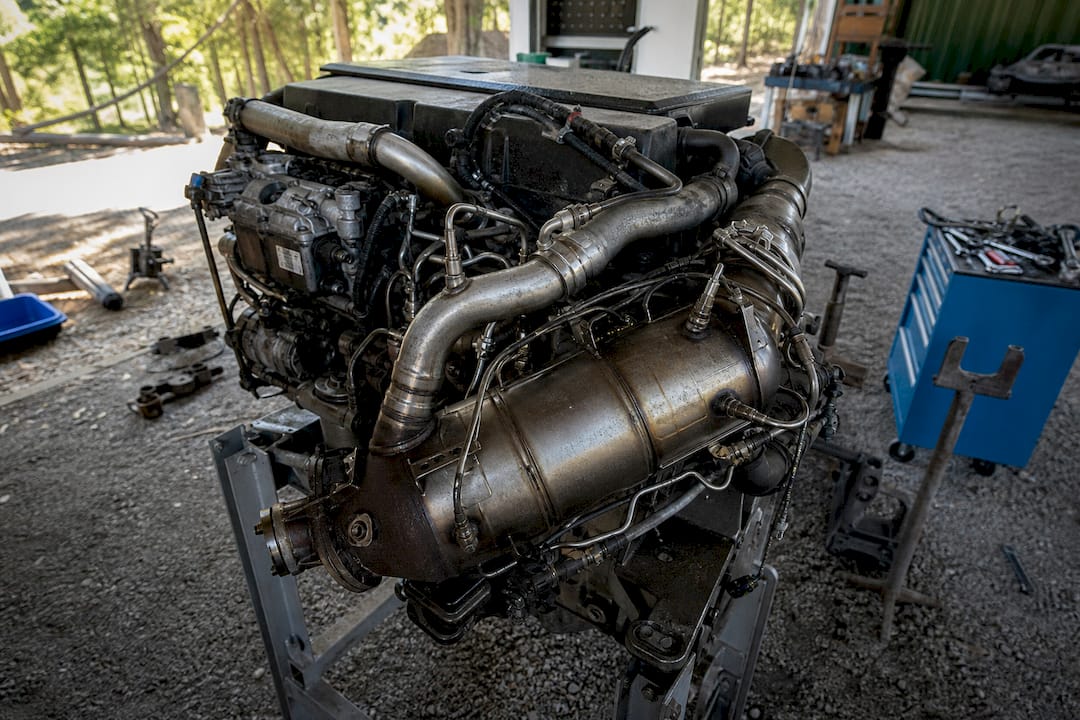
Kerntechniken tuning für Euro-5-Motoren
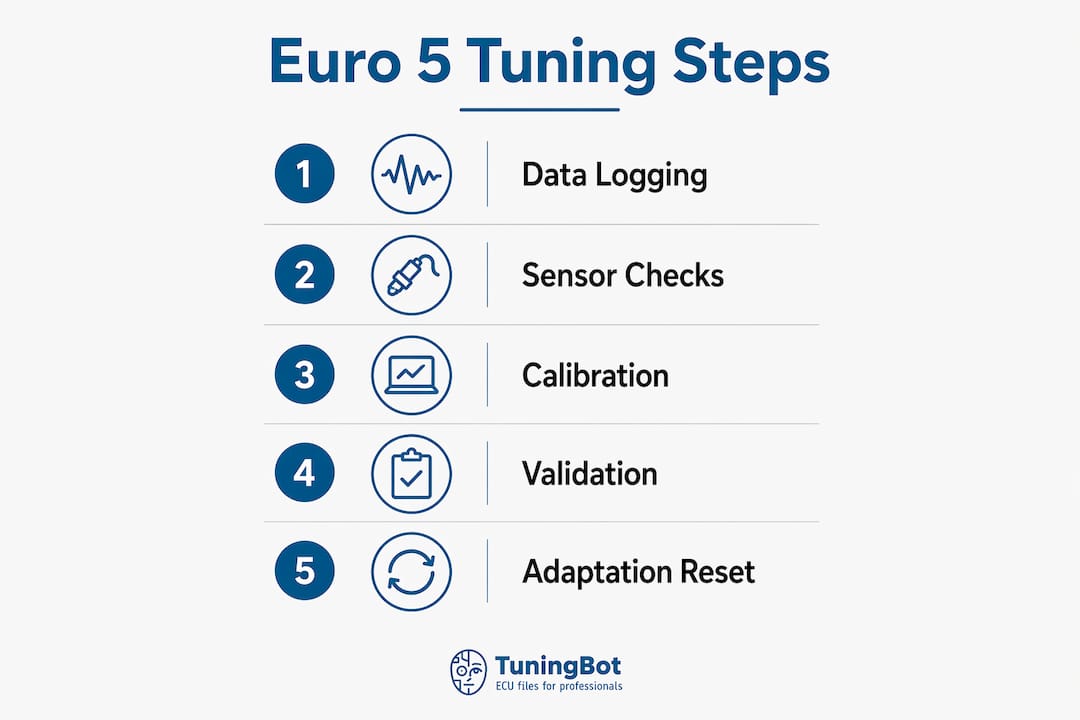
Der Euro-5-konforme Diesel tuning durchläuft einen strukturierten Kalibrierungsprozess. Das Überspringen von Schritten führt zu Verstößen gegen die Vorschriften oder zu Problemen bei der Fahrbarkeit, die im Nachhinein nur schwer zu diagnostizieren sind.
Ordnen Sie die Drehmoment-Kraftstoff-Kette ab. Die Bosch EDC17-Architektur nutzt einen „Driver’s Wish“, einen Drehmomentbegrenzer und eine FMTC-Kette, um die Eingaben des Fahrers in die eingespritzte Kraftstoffmenge umzuwandeln. Das Anpassen der Einspritzkennfelder ohne Verständnis dieser Kette führt zu Drehmomentspitzen, der Auslösung des „Limp“-Modus des Limp mode und fehlgeschlagenen OBD-II-Bereitschaftsprüfungen.
Einspritzzeitpunkt und Raildruck anpassen. Eine fortschrittlichere Einspritzzeit erhöht den Verbrennungswirkungsgrad und das Drehmoment. Anpassungen des Raildrucks beeinflussen die Zerstäubungsqualität. Beide Parameter interagieren mit der NOx-Emission, daher müssen Änderungen im Hinblick auf die Emissionsziele validiert werden, nicht nur auf die Leistungswerte.
Abgasrückführung (AGR) und AdBlue-Dosierung kalibrieren. SCR-Dosierkarten Dazu gehören Basis-, Temperatur-, Transienten- und Höhenkompensationsschichten. Das Steuergerät aktualisiert diese kontinuierlich anhand der Rückmeldungen des NOx-Sensors. Tuner müssen sicherstellen, dass die modifizierten Drehmoment- und Kraftstoffkennfelder die Abgastemperaturen nicht außerhalb des SCR-Betriebsfensters verschieben.
Luft-Kraftstoff-Verhältnis über den gesamten Lastbereich steuern. Lambda-Zielwerte bei Teillast, Volllast und im Schubbetrieb beeinflussen sowohl Leistung als auch Emissionen. Ein zu aggressives Abmagern des Gemisches bei hoher Last erhöht die Abgastemperaturen und belastet den DPF.
Bereitschaftsüberwachungsstatus des OBD-II-Systems beibehalten. Jede Euro-5-ECU überwacht die Effizienz des Katalysators, das Ansprechverhalten der Lambdasonde, den EGR-Durchfluss und den Differenzdruck des Partikelfilters (DPF). Eine getunte Datei, die diese Überwachungsfunktionen löscht oder deaktiviert, führt dazu, dass das Fahrzeug die Abgasuntersuchung nicht besteht, selbst wenn die tatsächlichen Emissionswerte innerhalb der Grenzwerte liegen.
Pro-Tipp: Protokollieren Sie reale Fahrdaten über verschiedene Gaspedalstellungen und thermische Zustände, bevor Sie eine endgültige Kalibrierung vornehmen. Eine qualitativ hochwertige Steuergerätekalibrierung beruht auf iterativer Verfeinerung unter Verwendung von Teillast-, thermischen und Schaltkennfeldern, nicht nur auf Spitzenleistungsläufen.
Was sind die größten Herausforderungen bei Euro 5 tuning?
Euro-5-Motoren reagieren empfindlicher auf äußere Einflüsse als ihre Vorgänger der Euro-4-Norm. Tuner, die sie als einfache „Kraftstoff-und-boost“-Plattformen behandeln, stoßen auf Fehler, die schwer zurückzuverfolgen sind.
Die häufigsten Herausforderungen sind:
- Kraftstoffqualitätsabhängigkeit. Euro 5-Motoren sind empfindlich gegenüber Kraftstoffverunreinigungen, mit minderwertigen Zusatzstoffen Gefahr der Verstopfung des Partikelfilters und Schäden am Einspritzsystem. Bestätigen Sie immer die Kraftstoffquelle des Endbenutzers, bevor Sie eine Kalibrierung abschließen.
- SCR Katalysator – Alterung. Ältere SCR-Katalysator-Einheiten weisen einen geringeren Umwandlungswirkungsgrad auf. Eine für ein neues Katalysator-Gerät kalibrierte Dosierungskarte führt bei einem gealterten Gerät zu einem NOx-Überschuss. Überprüfen Sie den Zustand des Katalysators vor dem tuning.
- Fehler beim Zurücksetzen der Anpassung. Nach dem Austausch eines Sensors oder nach Änderungen am SCR Katalysator ist eine Neuanpassung des Steuergeräts erforderlich. Wird dieser Schritt übersprungen, kommt es zu Sensor-Offset-Fehlern und Konformitätsfehlern, die erst Wochen nach der Abstimmung auftreten.
- Der Limp mode-Impuls wird durch ein Drehmomentüberschwingen ausgelöst. Aggressive Änderungen an der Drehmomentkennlinie, die die internen Drehmomentgrenzwerte model des Steuergeräts überschreiten, lösen Limp mode aus. Hierbei handelt es sich nicht um einen Hardwarefehler, sondern um eine Schutzmaßnahme der Software, die eine Korrektur der Kennlinie erfordert.
- Unzureichende Vorbereitung auf die Abgasuntersuchung. Die Ausführung von tuning führt nicht zwangsläufig zu einem Testfehler. sofern dies korrekt gehandhabt wird. Tuner, die das Luft-Kraftstoff-Verhältnis ausgleichen und die Software modes verwenden, die für Testzwecke auf emissionsfreundliche Einstellungen zurückgreift, bestehen die Prüfung ohne Probleme.
Pro-Tipp: Führen Sie vor dem Laden einer modifizierte Datei stets einen vollständigen DTC-Scan sowie eine Überprüfung der Echtzeitdaten des DPF-Differenzdrucksensors, des NOx-Sensors und des EGR-Positionssensors durch. Hardwarefehler, die während des normalen Fahrbetriebs nicht erkennbar sind, können bei einer optimierten Kalibrierung zu kritischen Ausfällen führen.
For tuners managing AdBlue system calibration on Euro 5 platforms, understanding the interaction between dosing maps and catalyst health is the single most important factor in avoiding post-tune compliance issues.
Inwiefern entspricht Euro 5 tuning den Euro-6-Anforderungen?
Euro 5 and Euro 6 share the same fundamental ECU calibration logic, but Euro 6 raises the technical bar considerably. Understanding the differences helps tuners working on Euro 5 engines today prepare for the platforms they will encounter tomorrow.
| Merkmal | Euro 5 | Euro 6 |
|---|---|---|
| NOx limit (diesel) | 180 mg/km | 80 mg/km |
| SCR requirement | Fitted on many diesels | Common on many applications; implementation varies by platform and Euro 6 sub-stage |
| AdBlue quality standard | General compliance | ISO 22241-compliant AdBlue where SCR is fitted |
| NOx sensor feedback | Basic on most platforms | More advanced feedback on many platforms; sensor count varies |
| OBD complexity | Moderat | High, with additional monitors |
Euro 6 tightens the diesel NOx limit to 80 mg/km. It also introduces more complex aftertreatment and diagnostic strategies on many platforms, but the exact sensor configuration and AdBlue implementation vary by vehicle and Euro 6 sub-stage.
The good news for experienced Euro 5 tuners is that the underlying torque-to-fuel map physics remain consistent across both standards. Tuners who understand Bosch EDC17 map chains on Euro 5 platforms adapt to Euro 6 variants with less difficulty than those starting from scratch. The core skill transfers. The tolerance for error shrinks.
Euro 6 compliance tuning steps add NOx sensor management, AdBlue quality monitoring, and additional OBD monitors to the Euro 5 workflow. Tuners who build disciplined habits on Euro 5 engines are better positioned for that transition.
Praktischer Arbeitsablauf für den sicheren Euro-5-Motor tuning
A structured workflow prevents the most common Euro 5 tuning failures. Each step builds on the previous one, and skipping any step increases risk.
Pre-tuning diagnostic scan. Read all live data and DTCs from the ECU, DPF, EGR, SCR, and NOx sensors. Resolve all faults before proceeding. A modified calibration on a faulty sensor platform will produce unpredictable results.
Baseline-Datenerfassung. Log stock ECU parameters across a defined drive cycle including cold start, part throttle, full load, and deceleration. This baseline is the reference point for every subsequent change.
Emissions baseline capture. Record stock tailpipe emissions or use OBD-II readiness monitor status as a proxy. Pre-validation routines including baseline emissions capture and OBD-II readiness flag checks are critical to prevent failed emissions tests after tuning.
Controlled ECU calibration. Modify maps in defined increments. Adjust the torque-to-fuel chain first, then injection timing, then boost targets. Validate each change against logged data before proceeding to the next parameter. Tools like Alientech KESS3, AutoTuner, and Magic Motorsport support this iterative process on Euro 5 platforms.
Post-tuning emissions and OBD-II verification. Run the full drive cycle again and confirm all OBD-II readiness monitors return to ready status. Check live NOx sensor values, DPF differential pressure, and EGR flow against expected ranges. Document all changes with version-controlled file records.
Tuners who follow a Sicherer Tuning-Workflow from stock to Stage 1 on Euro 5 diesel platforms consistently produce results that hold up under both performance and compliance scrutiny.
Wichtige Erkenntnisse
Euro 5 engine tuning requires calibrating the full ECU system, including SCR dosing, DPF logic, and OBD-II monitors, not just fuel and boost maps.
| Punkt | Einzelheiten |
|---|---|
| Define the full scope | Euro 5 tuning covers torque maps, SCR dosing, DPF regeneration, and OBD-II readiness, not just fuel delivery. |
| Adaptation resets matter | Always reset ECU adaptation after sensor or catalyst changes to prevent bias errors and compliance failures. |
| Fuel quality affects outcomes | Low-quality fuel risks DPF clogging and injection damage; confirm the fuel source before finalizing any calibration. |
| Euro 6 builds on Euro 5 skills | Core torque-to-fuel map logic transfers to Euro 6, but NOx limits and sensor complexity increase significantly. |
| Workflow discipline prevents failures | Pre-tuning diagnostics, baseline logging, and post-tuning OBD-II verification are non-negotiable steps in every session. |
Unsere Sichtweise darauf, was Euro 5 tuning tatsächlich verlangt
The most common mistake we see from workshops entering Euro 5 diesel tuning is treating it as a power exercise rather than a calibration exercise. A tuner who chases peak torque numbers without logging part-throttle behavior, thermal states, and SCR operating windows will produce a file that feels strong on a dyno and fails on the road within weeks.
Reliable Euro 5 work depends on iterative refinement using logged parameters rather than peak-power targets alone. Part-throttle behavior, thermal state, torque intervention and aftertreatment operation all need to remain coherent.
We also see tuners underestimate how much SCR catalyst condition affects the final result. A dosing map that works perfectly on a fresh catalyst will produce elevated NOx on a unit with 80,000 miles of use. That is not a tuning failure. It is a diagnostic failure that happened before the file was written.
The tuners who produce the best long-term results on Euro 5 platforms are the ones who treat the trade-offs between power and reliability as a core part of the calibration process, not an afterthought. Euro 5 rewards that mindset. Euro 6 will demand it.
— TuningBot Technisches Team
TuningBots professioneller Euro 5 ECU-Kalibrierungs-Workflow
TuningBot supports workshops working on Euro 5 petrol and diesel ECUs across Bosch, Continental, Delphi and Marelli platforms. The workshop remains responsible for diagnostics, legal use, flashing and post-write validation, while TuningBot provides the calibrated file and engineer support.
Vor der Bestellung können Werkstätten prüfen ECU-Service-Abdeckung, überprüfen Sie öffentliche Preisliste und durchsuchen die verfügbaren ECU-Dienste.
The original ECU file can then be submitted through Datei tunen without buying prepaid credits. TuningBot supports professional tools including Alientech KESS3, AutoTuner, Magic Motorsport, CMD, Dimsport and PCMFlash.
Für technische Referenzen siehe die professional remapping guide und die Anleitung zur Korrektur von checksum.
FAQ
Was ist der Euro-5-Motor tuning?
Der Euro-5-Motor tuning ist eine Kalibrierung des Motorsteuergeräts, die die Leistung verbessert und gleichzeitig die Einhaltung der Euro-5-Emissionsgrenzwerte für NOx, Feinstaub und CO gewährleistet. Dabei werden die Kraftstoffzufuhr, der Einspritzzeitpunkt, die boost-Sollwerte sowie die Nachbehandlungssysteme – einschließlich der DPF-Regeneration und der SCR-Dosierung – angepasst.
Beeinflusst Euro 5 tuning die Ergebnisse der Abgasuntersuchung?
It can. A road-compliant calibration must preserve the fitted emissions hardware, OBD readiness monitors and diagnostic behavior. Disabling monitors or aftertreatment functions can cause inspection failure and may make the vehicle illegal for road use.
Welche Steuergeräte sind am gebräuchlichsten in Euro 5 Dieselmotoren?
Bosch EDC17 ist das am weitesten verbreitete Steuergerät in Euro-5-Diesel-Pkw und leichten Nutzfahrzeugen. Steuergeräte von Continental, Delphi und Marelli sind ebenfalls in Euro-5-Plattformen zu finden, die jeweils unterschiedliche Drehmoment-zu-Kraftstoff-Kennfeldstrukturen aufweisen.
Inwiefern unterscheidet sich der Euro-5-Motor tuning vom Euro-6-Motor tuning?
Euro 6 lowers the diesel NOx limit from 180 mg/km to 80 mg/km and generally uses more complex aftertreatment and diagnostics. The core torque and fueling logic remains related, but the exact SCR and NOx-sensor architecture varies by vehicle and Euro 6 sub-stage.
Warum müssen bei Euro-5-Motoren nach tuning Anpassungsrücksetzungen durchgeführt werden?
Adaptation resets are not universally required after every remap. They are used when the manufacturer procedure or specific hardware change requires relearning, such as after replacing sensors, throttle components or aftertreatment hardware.