

 ItalianoIT
 DeutschDE
 EspañolES
 PortuguêsPT
 FrançaisFR
 РусскийRU

Used ECU programming begins with a compatibility decision: can this donor module be commissioned for this vehicle using a supported procedure? Flashing software, configuring options and authorizing engine starting are different operations. A matching connector or a successful VIN write does not establish that the replacement is ready to run.
Used ECU programming: establish compatibility first
Confirm the original fault before buying another controller. Loss of communication, a no-start or an internal-control-module code can require checks of power, grounds, wiring and connected components before the ECU itself is condemned. A replacement will not repair an external circuit that caused the original problem.
Record the vehicle identification, engine and transmission variant, original ECU hardware and software identifiers, coding and relevant diagnostic results. Check the manufacturer’s replacement information and any approved part-number supersessions. Identical numbers do not prove that a previously installed module can be reused; different numbers may be acceptable when an approved supersession applies.
Ask specifically whether the procedure supports a used unit. A routine for fitting a new or manufacturer-prepared replacement may not accept a donor that already holds another vehicle’s security data. Confirm required access, keys and ownership authorization before dismantling the vehicle.
Distinguish programming, coding and pairing
| Operation | What it addresses | What it does not establish |
|---|---|---|
| Software programming or flashing | Firmware or calibration for the supported application. | That vehicle identity and security pairing are complete. |
| Coding or configuration | Variant and equipment settings. | That incompatible hardware becomes suitable. |
| Security adaptation or pairing | Authorized relationships between relevant modules and keys. | That every donor ECU can be reused. |
| Relearn or initialization | Specified learned values or operating relationships. | That all vehicles need the same resets or sequence. |
Manufacturers and tools use these terms differently, and one guided routine may combine several operations. Select equipment by the exact required functions, not by a generic claim that it “programs ECUs.” A calibration editor is also not the same thing as a flashing interface or a security-access system.
Other repairs have their own calibration requirements. For example, the discussion of electronic recalibration after glass replacement concerns driver-assistance systems. It illustrates why the required vehicle procedure must be identified; camera calibration and engine ECU commissioning are separate jobs.
Evaluate the supported replacement route
Manufacturer-guided commissioning
Use the replacement procedure for the exact application, including its restrictions on donor reuse. Writing the VIN may be one step, but the VIN is not a substitute for security authorization, configuration or software compatibility. Some platforms require access to manufacturer systems or a replacement supplied in an appropriate initial state.
Data transfer or cloning
Cloning depends on compatible donor hardware and access to all data required by the supported method. Vehicle-specific information may be distributed across external memory, internal flash, emulated EEPROM or protected areas. It is inaccurate to assume that immobilizer data always resides in one EEPROM chip or that copying a calibration transfers the complete identity.
A readable original unit is useful, but readability alone does not prove a clone is possible. A failed original can sometimes be read by another supported method; in other cases essential data is unavailable. The EEPROM and ECU memory guide explains the distinctions without making a universal recovery promise.
Correct software as one part of the repair
A matching original calibration may be needed, but it is not an independent substitute for donor commissioning. Confirm the required software through the applicable procedure. A valid checksum checks a defined integrity condition; it does not prove hardware compatibility, a valid software signature or successful immobilizer pairing.
The ECU writing guide and checksum guide cover these separate stages.
Read replacement bulletins within their scope
Ross-Tech provides separate procedures for Immobilizer III ECU swapping and Immobilizer IV ECU swapping. Their prerequisites and supported systems matter. They are tool-provider instructions for specific Volkswagen Group systems, not permission to apply one PIN-based routine to every generation.
Nissan bulletin NTB12-035, issued in 2012, describes replacement work for its stated 2004-and-later scope, excluding LEAF/EV. It includes re-communication where supported, learning routines where applicable and VIN entry for the stated 2005-and-later applications. It also directs technicians to additional model-specific requirements. It does not establish that any used Nissan ECM is reusable.
The linked Toyota-issued smart-key bulletin S-SB-0022-15 applies to the 2016 Scion iA. Its PCM replacement and smart-key instructions, including key requirements, should not be generalized to all Toyota vehicles.
The GM bulletin 16001 concerns a power inverter module update on specified 2016 Chevrolet Volt inventory vehicles. Its programming precautions illustrate the importance of stable power, but it is not a used engine-ECU replacement procedure.
Prepare power, files and the completion checks
Use the power-support equipment, connection method and voltage range specified for the procedure. Do not infer a universal voltage or charger rule from an unrelated bulletin. Maintain reliable tool connections and follow the required ignition and network conditions.
Save the diagnostic baseline, identifiers, coding and whatever original memory data the supported tool can actually obtain. Record the read type and retain the original files unchanged. An OBD calibration read, a virtual read and a wider memory backup are different records. AutoTuner’s backup documentation, for example, distinguishes its bench/boot backup from an OBD read. Backup availability does not guarantee recovery of every failed controller.
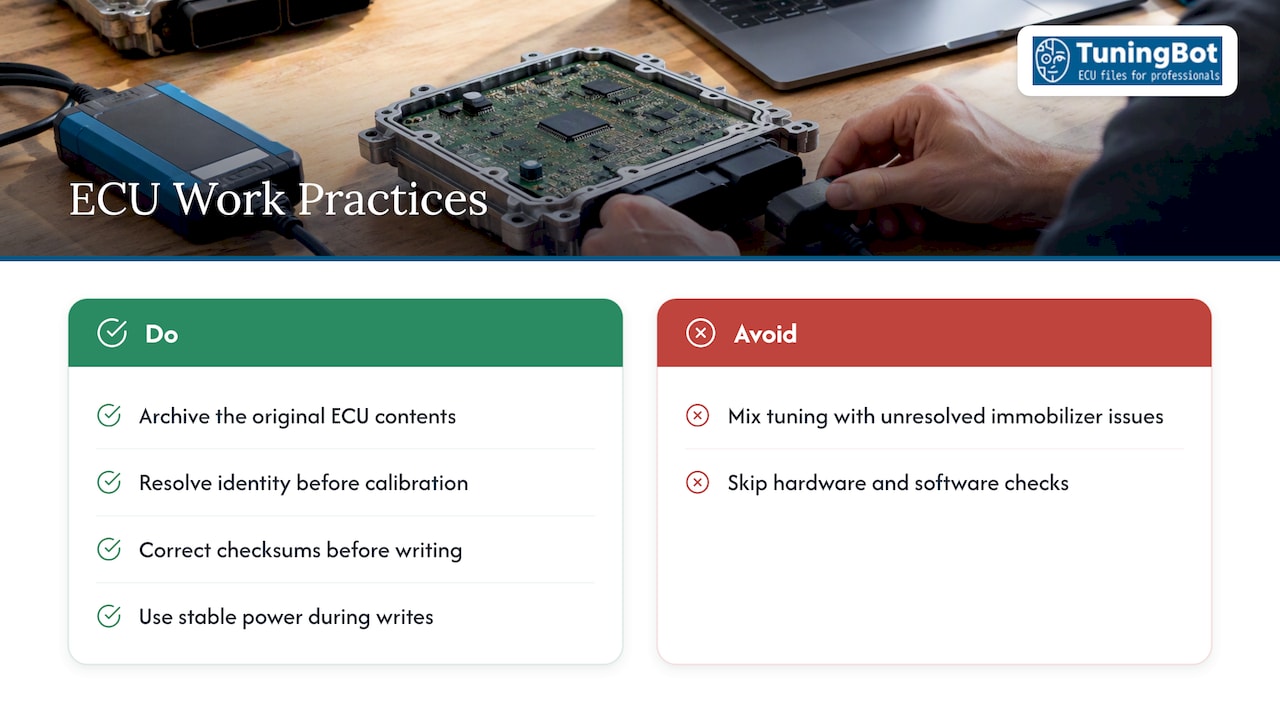
After programming, complete the specified coding, authorized pairing and learning routines. Recheck module identification, communication, faults and normal starting. Confirm relevant vehicle functions and operating behavior before calling the repair complete. A brief successful start is not the full acceptance test.
Diagnose a no-start from evidence
Keep the pre-repair and post-repair scans so new symptoms can be separated from existing ones. Investigate communication and supply faults, start authorization, cranking signals and fuel or ignition operation according to the vehicle’s diagnostic procedure. Security adaptation is one possible cause, not a proven “most common” cause across all vehicles.
On an applicable Volkswagen Group system, DTC 02241 can direct attention to immobilizer adaptation. That code and its interpretation are not universal. A matching VIN alone does not prove security pairing, and no communication alone does not identify whether wiring, module condition or programming is responsible.
Compare quotes by the actual work included
A useful quote separates diagnosis, donor supply, software access, programming, configuration, security work and final testing. It should also explain what happens if the supplied donor cannot be commissioned. Avoid treating a generic price range as a quotation for an unidentified vehicle.
The ECM replacement price guide from Highway 71 Auto Parts offers supplier context, but its figures are not a universal programming tariff. TuningBot’s current file-service price list describes file work; it should not be read as the total installed cost of replacing and commissioning an ECU.
Frequently asked questions
Can every used ECU be programmed for another vehicle?
No. Donor reuse depends on hardware, software, security architecture and the supported replacement procedure. A process intended for a new module may not accept a used one.
Is changing the VIN enough to make a used ECU work?
Not necessarily. Software, configuration, security pairing and specified relearns may also be required. A matching VIN alone does not establish start authorization.
Is cloning the same as writing an original calibration?
No. A calibration file may contain only part of the data needed for the ECU. A supported clone may require additional vehicle-specific memory data and compatible hardware.
How much does used ECU programming cost?
The price depends on the vehicle and the operations included. Ask for a quote separating diagnosis, donor supply, programming, configuration, security work and final testing.
What should be checked if the vehicle will not start after replacement?
Use the vehicle-specific diagnostic procedure to check communication, power, grounds, start authorization, cranking signals and fuel or ignition operation. Do not assume that the donor is defective or that the immobilizer is always responsible.