

 EnglishEN
 ItalianoIT
 DeutschDE
 EspañolES
 PortuguêsPT
 FrançaisFR
HDI engine remapping is the process of recalibrating the Engine Control Unit software used in High-pressure Direct Injection diesel engines. These engines are widely fitted to Peugeot, Citroën and other Stellantis vehicles. A professional HDI remap adjusts fuel delivery, injection timing, boost control, torque limits and throttle response while preserving the ECU’s protection strategies. The objective is not simply to chase a peak power figure, but to produce stronger mid-range torque, cleaner response and a calibration matched to the vehicle’s actual condition.
What is HDI engine remapping and how does it work?
ECU remapping rewrites the calibration tables stored inside the engine control unit. Those tables govern fuel quantity, injection timing, turbocharger control, torque ceilings and pedal response. Factory software is deliberately conservative because manufacturers must account for varying fuel quality, climates, maintenance standards and driving conditions across many markets. That conservative margin creates useful calibration headroom on a healthy engine.
Manufacturers calibrate diesel ECUs for broad operating conditions rather than a single vehicle’s actual fuel quality, maintenance history and intended use. A professional remap begins with the original binary file, modifies the relevant maps and writes a verified version back to the same ECU.
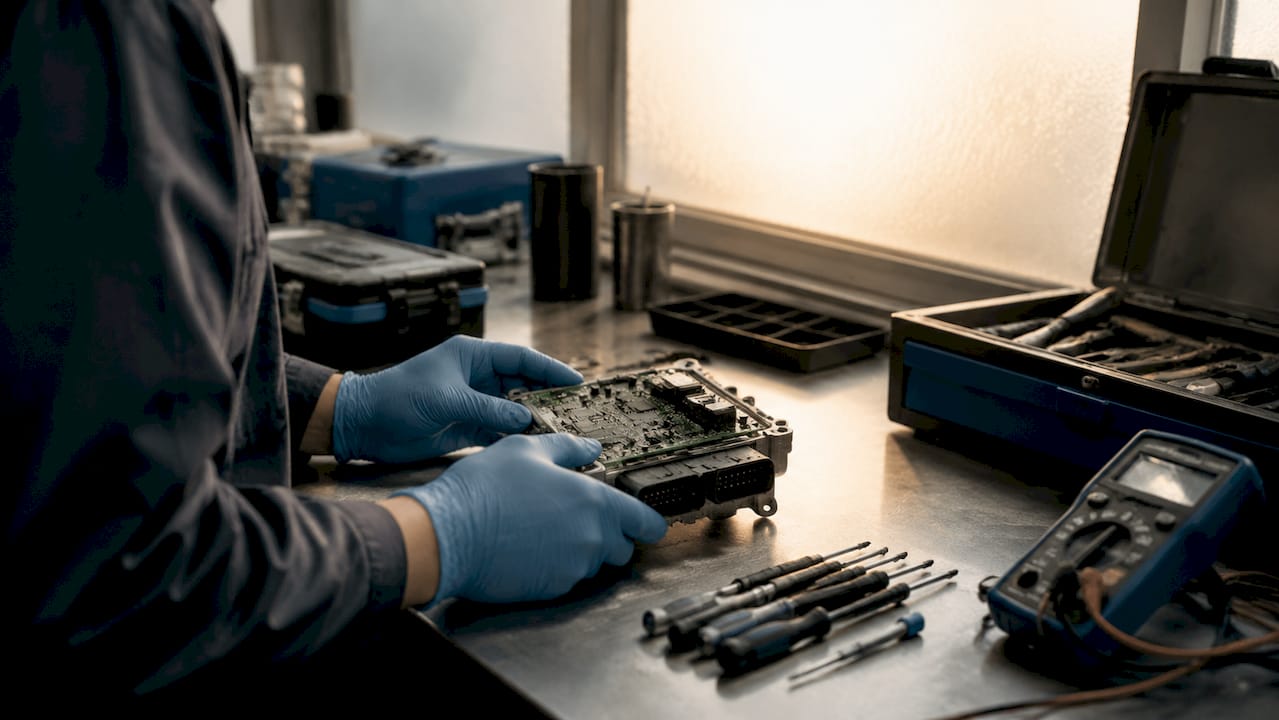
This differs fundamentally from a piggyback module. A piggyback device alters sensor signals before they reach the ECU, while a true remap changes the ECU’s own logic. Remapping therefore allows fuel, boost, torque and protection strategies to be calibrated as one coordinated system rather than by misleading individual sensors.
The ECU also retains closed-loop control after a correctly developed remap. It continues to react to live sensor data such as airflow, boost, lambda, temperature and pressure. This is why a good calibration behaves consistently in normal traffic, during motorway use and under sustained load.
Common HDI calibration targets include:
- Давление наддува: target pressure and variable-geometry turbo control across the RPM range.
- Injection timing: the point at which fuel is delivered relative to piston position.
- Injection quantity: the amount of fuel delivered at each speed and load point.
- Ограничители крутящего момента: engine, gearbox and gear-dependent limits that must remain coordinated.
- Driver demand: how pedal movement is converted into requested torque.
- Smoke and air-mass limiters: safeguards that keep fueling matched to available airflow.
Совет: Confirm that the workshop reads the ECU with a supported professional tool such as Alientech KESS3, AutoTuner, Magic Motorsport or PCMFlash. A device that only alters sensor signals is not performing a true ECU remap.
What are the real benefits of HDI remapping?
The most useful result is usually a broader, flatter torque curve. HDI engines respond well to carefully coordinated changes in boost, fueling and torque management, especially between approximately 1,500 and 3,000 RPM. This produces stronger overtaking performance and reduces the need for frequent downshifts.
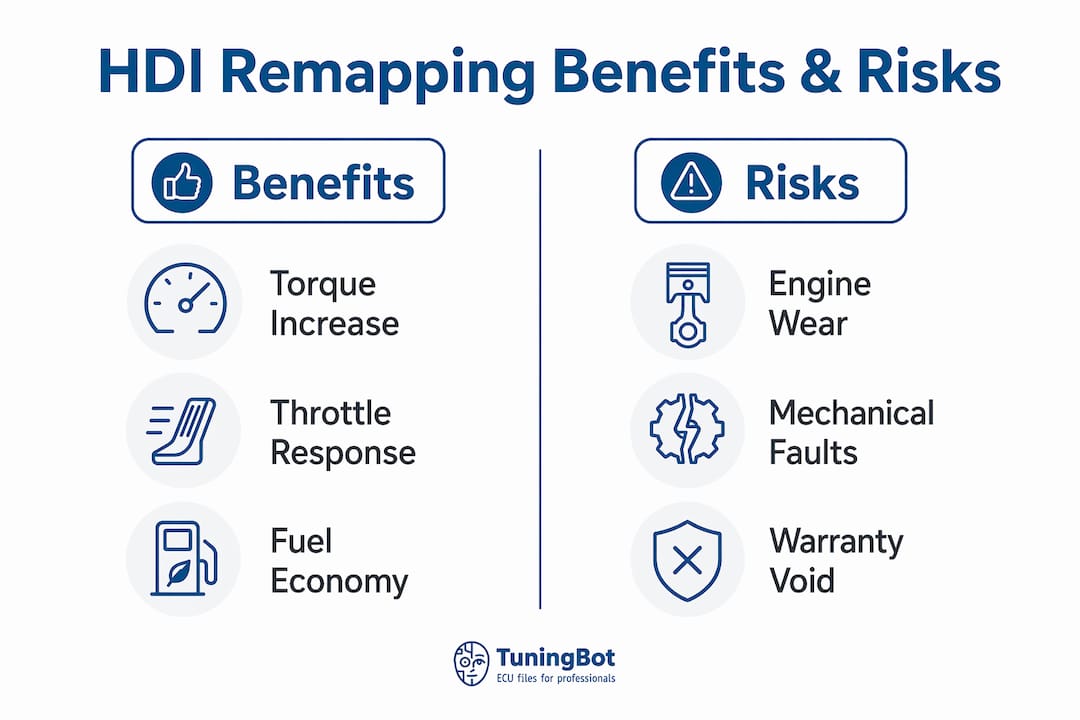
Throttle response can also improve. Factory maps often soften low-pedal torque demand for emissions, comfort and drivetrain protection. A professional calibration can make response more direct without producing an abrupt or artificial pedal curve.
Fuel consumption may improve when the driver uses the additional low-RPM torque to shift earlier and maintain speed with less throttle. It is not automatic: aggressive use of the additional performance can cancel any economy benefit. The detailed variables are covered in TuningBot’s guide to how remapping affects fuel consumption.
Typical benefits of a well-developed Stage 1 HDI calibration include:
- stronger and more consistent mid-range torque;
- reduced turbo lag and improved response;
- smoother acceleration under load;
- less frequent gear changing on motorway gradients;
- potential fuel savings during steady, conservative driving;
- calibration matched to the exact ECU software version rather than a generic engine family.
What are the risks and prerequisites for safe remapping?
Remapping does not repair mechanical faults. Increasing torque demand on worn injectors, a leaking intercooler or a tired turbocharger accelerates failure. A full diagnostic scan and mechanical inspection must therefore come before any file is modified.
Pre-remap diagnostics should identify active and pending DTCs, boost leaks, injector correction problems, airflow inconsistencies and DPF-related faults. A responsible calibrator will reject or postpone the job when the engine cannot safely support increased load.
Stage 1 is normally the safest option for a standard HDI vehicle because it is calibrated around stock hardware. Stage 2 and Stage 3 require supporting components and a new calibration developed around those changes. Installing more aggressive software without the required hardware creates unnecessary thermal and mechanical stress.
Minimum prerequisites include:
- Diagnostic scan: no unresolved engine or transmission fault codes.
- Injector assessment: correction values and rail-pressure behavior within acceptable limits.
- Turbo inspection: actuator operation, boost control and absence of excessive shaft play or oil leakage.
- Air-path inspection: no intake, intercooler or boost-hose leaks.
- DPF condition: soot loading and differential-pressure behavior checked before tuning.
- Recent maintenance: correct oil, fresh fuel and air filters and no overdue service work.
- Stable programming voltage: battery support during ECU reading and writing.
Совет: Keep the original ECU read in at least two separate storage locations. It is the recovery baseline and should never be overwritten by a modified file.
How does remapping apply specifically to HDI diesel engines?
HDI engines use high-pressure common-rail injection, commonly managed by Bosch, Delphi or Continental control units depending on the model and generation. This architecture gives the ECU precise control over rail pressure, injection duration, multiple injection events and turbocharger behavior.
Many HDI variants use a variable-geometry turbocharger. The ECU controls vane position to balance spool speed, boost pressure, exhaust temperature and soot production. Raising boost without recalibrating vane control, air-mass limits and fueling can create spikes, smoke or turbo overspeed. The maps must therefore be adjusted together.
Professional HDI calibration commonly involves Bosch EDC16, EDC17 and later diesel-control architectures. TuningBot’s Руководство по методам работы с ECU remapping explains the broader professional workflow, including torque-model coordination, checksum handling and validation.
| HDI calibration area | Factory strategy | Professional remap objective |
|---|---|---|
| Boost request | Conservative across temperature and fuel variations | Controlled mid-range increase within turbo limits |
| Ограничители крутящего момента | Multiple overlapping caps for engine and driveline protection | Coordinated increase without disabling protection |
| Injection quantity | Limited for emissions and worst-case operation | Matched precisely to airflow and smoke limits |
| Время впрыска | Balanced for emissions, noise and broad fuel quality | Refined for efficiency and controlled cylinder pressure |
| Driver demand | Softened pedal-to-torque response | More direct but progressive response |
Validation should include data logging under real load. Important parameters include boost target versus actual boost, rail pressure, air mass, injector behavior, exhaust temperature where available, DPF differential pressure and torque intervention. A file that merely starts the engine is not automatically a successful calibration.
Главное
| Точка | Детали |
|---|---|
| HDI remapping changes ECU software | It recalibrates boost, fueling, injection timing and torque management inside the control unit. |
| Stage 1 suits healthy standard vehicles | It uses stock hardware and should remain within the engine and drivetrain’s safe operating envelope. |
| Diagnostics come first | Injectors, turbo, air path, DPF and fault codes must be checked before increasing load. |
| Torque quality matters more than a headline figure | A broader mid-range improves daily drivability more than a narrow peak-power gain. |
| Generic files are not equivalent to custom calibration | The exact ECU ID, software version, vehicle condition and intended use must be considered. |
What we have learned from calibrating HDI engines
The biggest mistake is treating every HDI file as interchangeable. Two vehicles with the same engine code can have different software versions, injector condition, turbo behavior and maintenance history. A calibration that works well on one vehicle may be inappropriate for another.
The second mistake is chasing peak power while ignoring the shape of the torque curve. For a road-driven HDI, a smooth and sustained increase through the mid-range normally produces a better result than an aggressive spike that stresses the clutch, dual-mass flywheel and turbocharger.
Fuel economy expectations also need to be honest. The remap can make the engine more efficient at a given load, but the driver determines whether that advantage becomes a real saving. More available torque does not guarantee lower consumption when it is used aggressively.
— Техническая команда TuningBot
TuningBot’s professional HDI remapping services
TuningBot supplies professionally calibrated ECU files for HDI engines and related diesel platforms across Bosch, Delphi, Continental and Marelli control units. The service is built for workshops and professional tuners that need a clear, direct file workflow rather than generic software or opaque credit systems.
Workshops can:
- check supported vehicles and ECU services through Покрытие сервисов ЭБУ;
- просмотреть Публичный прайс-лист before ordering;
- browse available Услуги ЭБУ;
- upload the original ECU file directly without buying prepaid credits.
TuningBot supports Stage 1, Stage 2, checksum correction, DTC management, EGR-related and DPF-related services where applicable to the intended legal use, as well as other ECU and TCU calibrations. Files are developed for the submitted ECU software version and supported by real engineers. The workflow is compatible with tools including Alientech KESS3, AutoTuner, Magic Motorsport and PCMFlash.
ЧАСТО ЗАДАВАЕМЫЕ ВОПРОСЫ
What is HDI engine remapping in simple terms?
It is the process of rewriting the ECU calibration in a High-pressure Direct Injection diesel engine to change boost, injection and torque behavior while retaining the ECU’s safety logic.
Does HDI remapping improve fuel economy?
It can improve economy when the driver uses the added low-RPM torque to shift earlier and maintain speed with less throttle. Aggressive use of the additional power can remove the saving.
Is Stage 1 remapping safe for a standard HDI engine?
A professionally calibrated Stage 1 file is generally the lowest-risk option for a healthy standard engine. Safety depends on the mechanical condition of the vehicle, calibration quality and post-remap validation.
What is the difference between remapping and piggyback tuning?
Remapping changes the ECU’s internal calibration tables. A piggyback unit alters sensor signals without giving the calibrator full control over torque, fuel, boost and protection logic.
What checks are required before remapping an HDI engine?
The vehicle needs a diagnostic scan, injector assessment, turbo and air-path inspection, DPF-condition check and confirmation that servicing is current.