

 EnglishEN
 ItalianoIT
 DeutschDE
 EspañolES
 PortuguêsPT
 FrançaisFR
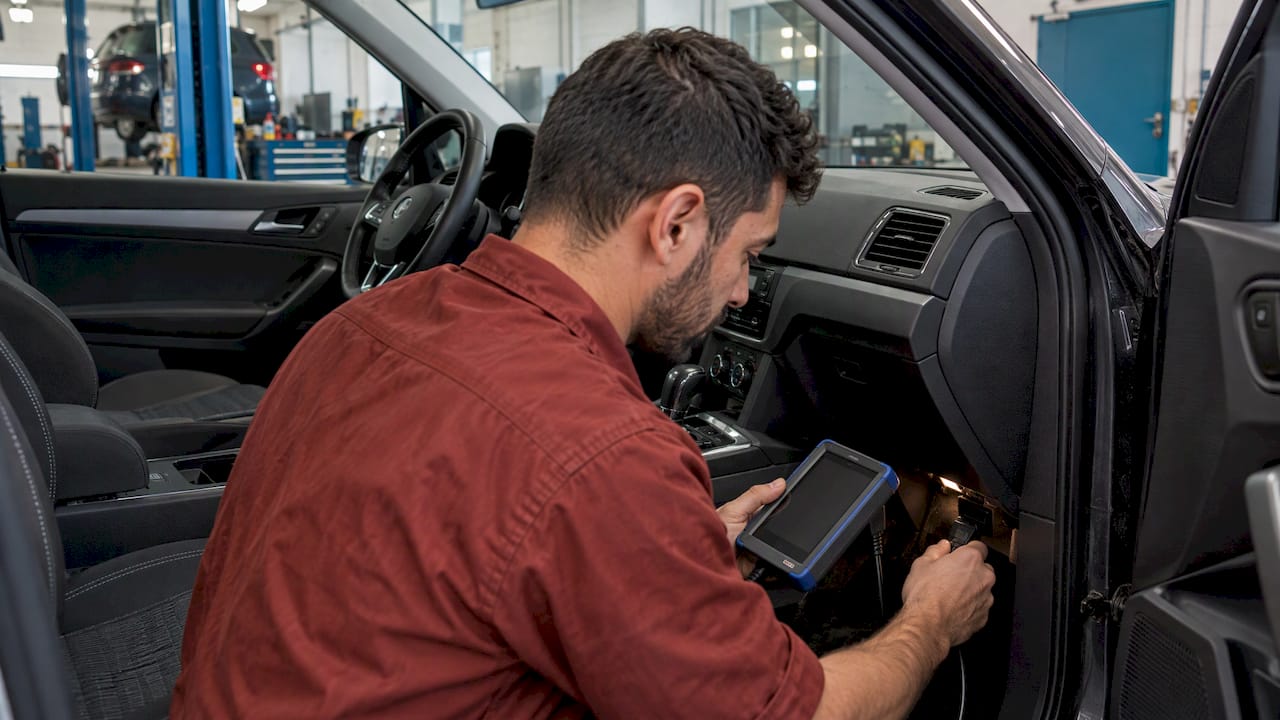
DSG tuning files contain changes for a dual-clutch transmission controller. Depending on the supported software, they may alter shift schedules, torque coordination, clutch control and related behavior. The file must match the actual TCU and installation; its name or advertised stage does not establish compatibility, mechanical capacity or the need for a gearbox tune.
DSG tuning files: identify the controller first
Record the gearbox designation, TCU hardware and software identifiers, calibration version, vehicle configuration and engine calibration. DQ200, DQ250, DQ381 and DQ500 identify different transmission families, not interchangeable files. Variants within a family can also require different protocols, formats and software.
Distinguish a current read from a verified factory file. A controller already modified by another workshop may return modified data. A virtual read, where supported, supplies a matching reference file rather than necessarily capturing what is currently stored. Keep the identification report and describe the read type accurately.
State the installed clutch hardware, relevant repairs, existing symptoms and intended use. A stage number is not a torque specification. Our DSG tuning guide covers the wider mechanical and control context.
Separate the functions being changed
| Функция | What it can affect | What it does not prove |
|---|---|---|
| Shift schedule | Gear selection in the supported driving modes. | That the physical shift completes faster. |
| Torque coordination | Requests, limits and interventions exchanged with the engine controller. | That a higher limit increases hardware capacity. |
| Clutch control | Engagement and torque transfer through the supported actuation strategy. | That software repairs worn friction surfaces or hydraulic faults. |
| Shift transition control | Coordination of clutches and engine torque during a gear change. | That a firmer shift is automatically a better shift. |
Dry-clutch and wet-clutch systems do not share one universal pressure strategy. Avoid copying pressure, current, timing or overlap values between controllers. Mechanical condition, thermal capacity, hydraulic operation where applicable and the operating software all matter.
Услуга shift map guide distinguishes schedules from other shift controls, while the DQ381 guide addresses a particular family. Neither establishes settings for every DSG.
Keep torque reporting and physical capacity distinct
Network channels called actual torque are commonly controller estimates, not direct shaft measurements. Their meaning and scaling must be understood before changing the engine or transmission calibration. Under-reporting engine torque can mislead transmission functions that use that signal; inflating a limit does not correct the model.
EcuTek’s DQ250 documentation links clutch-pressure targeting to engine torque information and describes post-programming learning for its documented workflow. Its example values and development observations are not universal safe torque ratings for every DQ250, and they should not be transferred to other gearbox families.
Review the ECU and TCU together when a change affects their interaction. That does not mean every engine remap automatically requires a TCU file. If the requested engine output cannot be supported by the installed drivetrain, reducing the request or changing suitable hardware can be necessary rather than simply raising a software limit.
Read tool support within its intended scope
Услуга MaxxECU DSG documentation describes integration with that engine-management system and its supported hardware and network arrangements. Its compatibility restrictions should not be read as a universal statement about whether a factory-controlled vehicle can be reflashed with a different tool.
Check the current tool documentation for the exact controller and operation. Availability of identification, calibration reading, writing and wider backup functions may differ. OBD, bench and boot describe access routes, not guaranteed coverage or equivalent file contents.
Program and complete only the required procedures
Preserve the original records, verify the output format and confirm the supported checksum or integrity handling before writing. Follow the specified supply, connection and ignition requirements. Retain the programming log and use the tool’s documented recovery route if an operation fails; a saved file alone is not a recovery guarantee.
After writing, perform the basic settings, adaptation or learning steps required for that gearbox, tool and calibration change. Do not reset every learned value by habit. A required routine may have temperature, fluid-level and fault-status prerequisites. Follow the actual sequence and confirm completion rather than repeatedly resetting a transmission that is showing an unresolved fault.
Услуга DSG TCU programming guide provides related workflow context. Harsh engagement or slip after a write needs diagnosis of the recorded conditions, not an automatic assumption that another adaptation reset will fix it.
Validate the behavior the file was intended to change
Compare before-and-after operation under suitable controlled conditions. Relevant channels can include selected and actual gear, engine and shaft speeds, clutch slip, torque requests and interventions, actuator values and temperatures. Confirm whether each displayed value is measured, modeled or commanded.
Distinguish intended slip during engagement from unintended slip when the clutch should be carrying torque. Stop a loaded test when abnormal slip or overheating appears. Check low-speed engagement, mode changes and affected shifts as well as high-load behavior, and retain the scan and logs with the file version.
The linked 2013 GM bulletin on aftermarket calibrations is historical manufacturer-specific information for listed GM vehicles, not a Volkswagen DSG warranty policy. Check the applicable vehicle terms and jurisdiction. Restoring a file does not guarantee removal of programming history or restoration of warranty coverage.
For commercial scope, refer to the current service list. File charges should be separated from diagnosis, physical repairs and vehicle testing.
Часто задаваемые вопросы
Does every engine remap require a DSG tune?
No. The need depends on the requested engine output, existing transmission software and installed drivetrain. A stage label alone does not establish a requirement.
Does raising a TCU torque limit increase clutch capacity?
No. A software limit does not increase the mechanical or thermal capacity of the clutch and cannot repair wear or a hydraulic fault.
Should adaptations always be reset after programming?
Follow the procedure required for the exact gearbox, tool and change. Do not reset learned values automatically when the applicable procedure does not call for it.