

 EnglishEN
 ItalianoIT
 DeutschDE
 EspañolES
 PortuguêsPT
 FrançaisFR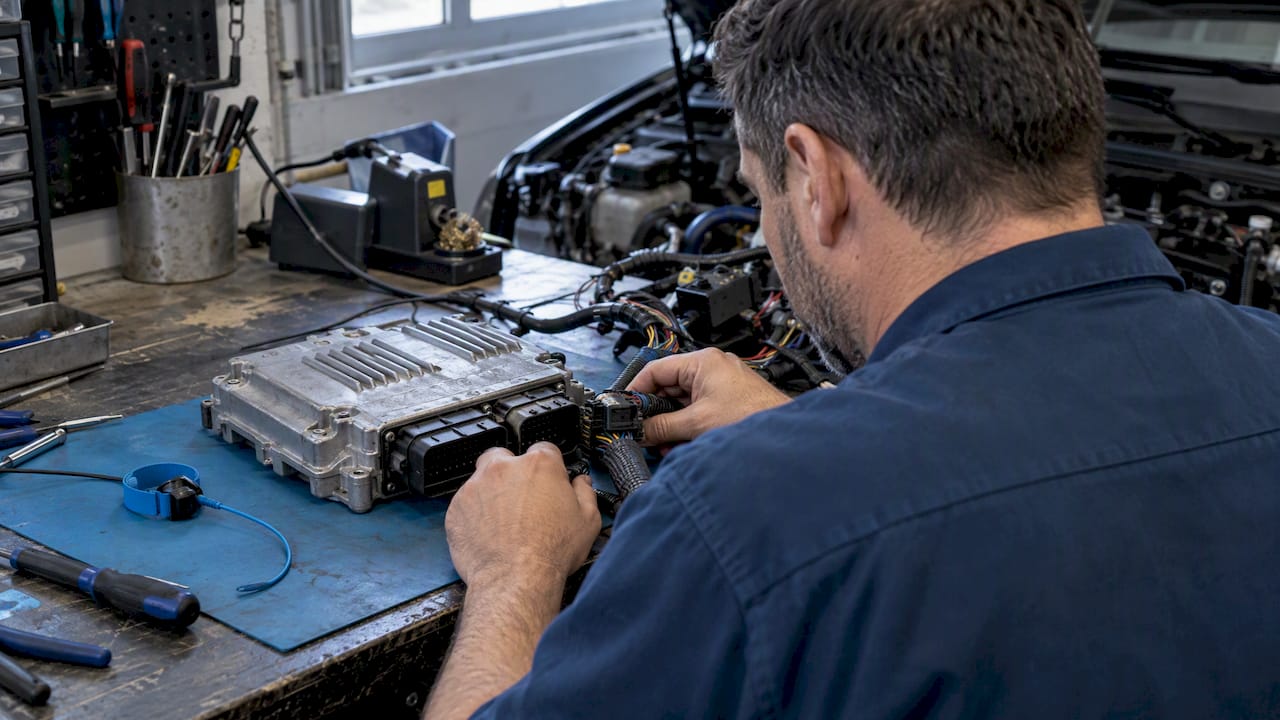
DCM6.2 tuning requires the exact ECU variant and software identity, not just the family name. Access methods, memory coverage and integrity handling depend on the controller and tool protocol. This guide focuses on assessing the file and programming workflow before interpreting the calibration.
DCM6.2 tuning starts with exact identification
Record the vehicle application, ECU label, hardware number and software identifiers returned by the tool. Names such as DCM6.2, DCM6.2A and DCM6.2V are not permission to interchange files. Matching the engine displacement or connector housing is insufficient.
Compare the reported identity with the expected vehicle configuration. A replacement ECU or previous software update can explain a difference, but that difference must be resolved before choosing a file or definition set.
Keep the original identification report with the read. A file described as original by its name alone is not evidence of its history or exact compatibility.
Confirm the supported access and memory coverage
Microtronik documents bench reading and writing for DCM6.2V with HexProg II. That support statement applies to its named tool and ECU application; it should not be generalized to every DCM6.2 variant or every programmer.
Bench access through the ECU connector is different from boot access that may require opening the housing. Do not assume all bench programmers connect to processor pins or require soldering. Use the selected tool’s diagram and instructions.
Check which memory regions the read includes and which operations are supported. A partial calibration read may be the correct file for a supported task, while still being inadequate for a different recovery operation. Preserve every available original region needed by the documented workflow.
Verify file integrity without inventing a universal algorithm
Confirm the expected file format and memory layout. File size is a useful screening check, not proof of correct content. For an edited file, inspect the scope of changes against the matching original and account for any documented container conversion.
Determine whether the tool or a separate supported service handles checksums and at what stage. There is no universal DCM6.2 checksum location or correction procedure established by the family name alone. Digital signatures are also distinct from ordinary checksums.
A successful checksum operation does not verify map definitions or engine suitability. Do not promise that every delivered TuningBot file includes checksum correction; confirm the service purchased and the tool’s own handling.
Use the protocol procedure for writing and recovery
Follow the specified supply range, connection order and programming sequence. A generic minimum battery voltage does not replace the requirements for the selected operation. Do not split a write into manually chosen blocks unless the tool procedure explicitly requires it.
After a failure, record the error, stage and remaining communication. Follow the tool’s recovery instructions before changing power state, restoring a file or switching methods. An immediate rewrite of the original is not a universal recovery procedure.
Persistent errors need tool-specific diagnosis. A fixed allowance of two or three retries says nothing about whether another attempt is appropriate. Provide the tool supplier with identification and logs rather than treating a calibration-file service as a substitute for hardware recovery support.
Assess diesel calibration behavior as an interacting system
Torque requests, injected quantity, air availability, boost control, rail pressure and injection timing interact. Identify map definitions and active limits before changing values. There is no universal requirement to increase rail pressure or every torque limiter when altering fueling.
Record available requested and measured pressure channels, air-mass information, injection data, temperatures and intervention states with their units. Include the operating conditions and fuel specification so comparisons remain interpretable.
Visible smoke alone cannot establish emissions compliance or acceptable combustion behavior. Likewise, an exhaust-temperature estimate is not interchangeable with a sensor measurement at a known location. Assess aftertreatment operation and diagnostic behavior where relevant to the application.
Separate completed programming from validated operation
Confirm ECU identification, diagnostic communication and the required post-write operations. Review fault records, starting and idle behavior before extending the test envelope. Use repeatable conditions to compare the modified operation with the baseline.
OBD readiness and the absence of warning lights are limited diagnostic observations, not universal approval of a modification. U.S. emissions requirements and EPA guidance are linked below; other jurisdictions require their own review.
Keep the accepted file version and test record. A successful write cannot establish long-term mechanical durability, automatic warranty coverage or a guaranteed performance result.
Часто задаваемые вопросы
Can DCM6.2A and DCM6.2V files be treated as interchangeable?
No. Confirm the exact hardware, software, memory layout and supported tool operation before selecting a file.
Does bench access always require opening or soldering the ECU?
No. Some supported bench methods use the external connector. Follow the exact tool and ECU instructions.
Does successful programming prove the calibration is correct?
No. File acceptance must be followed by application-specific diagnostic and operating checks.