

 EnglishEN
 ItalianoIT
 DeutschDE
 EspañolES
 FrançaisFR
 РусскийRU
Speed limiter removal changes an enforced vehicle-speed ceiling where the controller and software support that adjustment. It is different from disabling a dashboard warning or increasing an engine-speed limit. Start by identifying the active restriction, the vehicle architecture and the requirements that apply to the intended use.
Speed limiter removal is different from an RPM-limit change
A Vmax function responds to vehicle speed. An engine-speed limit responds to RPM, while a driver-selectable limiter or speed warning may be a separate feature. A warning message is not evidence that the engine controller is enforcing the same threshold.
Electronic control can reduce requested torque through application-specific interventions. The restriction need not be one scalar in one ECU: gear-dependent values, another controller or an operating mode may also be involved. An engine power limit, fault-related derating or insufficient power against aerodynamic resistance can prevent further acceleration without an active Vmax intervention.
O HowStuffWorks speed-limiter overview provides background. Use vehicle documentation and logs to determine what actually limits the specific application.
Establish the controller and the available programming path
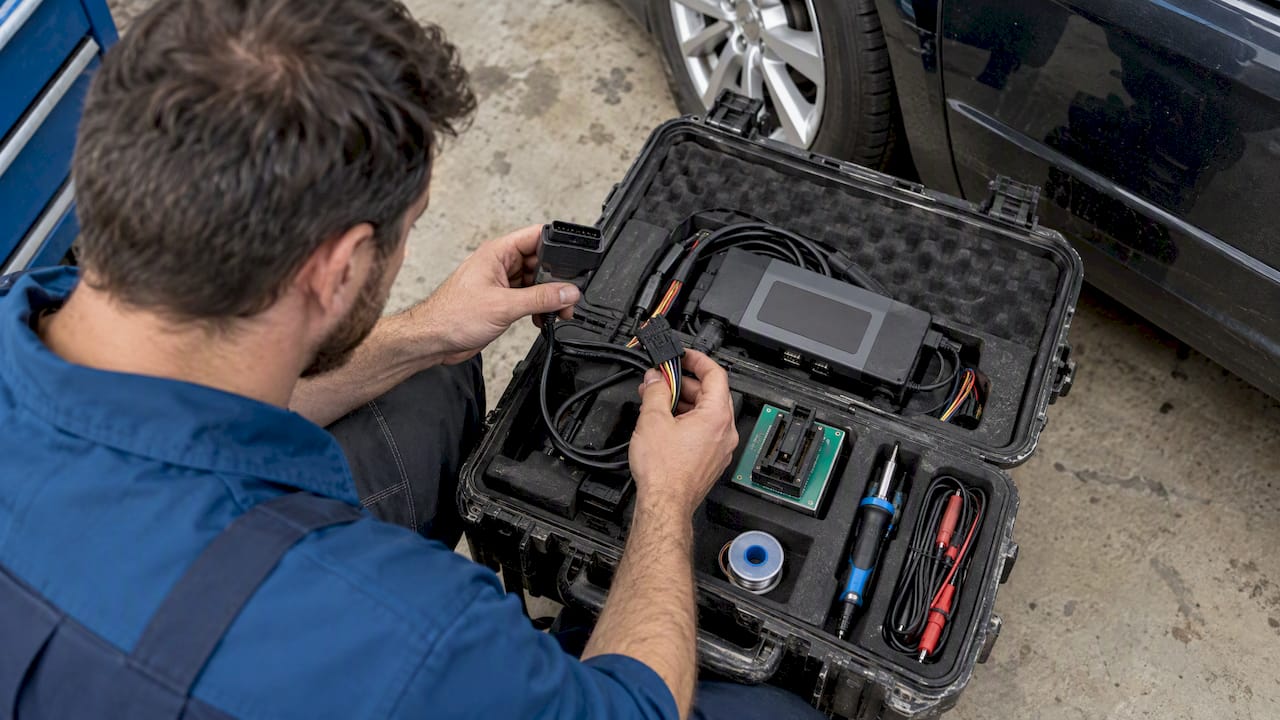
Record the vehicle specification, controller hardware and software IDs, transmission and existing modifications. Verify tool coverage for that exact combination. OBD, bench access, unlocking and file availability are not interchangeable capabilities; support for identifying a controller does not automatically include reading and writing it.
Retain the current coding, diagnostic report and original file where a read is supported. State whether that file is a calibration read, a full accessible-memory read or a supplied reference file. Do not call every read a complete backup or promise recovery from every interruption.
If the work is a supported binary modification, establish the relevant parameter definitions and required file validation before programming. Checksum correction must occur at the appropriate stage in the documented workflow, potentially within the programming tool. It is not a generic step performed after an already completed flash, nor a guarantee that the file will operate correctly.
Verify the scope without treating a higher limit as a rating
Changing a software ceiling does not establish a new validated maximum speed for the vehicle. Tire capability depends on specification, load and operating conditions; drivetrain, cooling, brakes, steering and vehicle stability also require assessment. A tire speed symbol alone is not approval of the complete vehicle.
Confirm that the intended settings or file were applied, check relevant faults and compare available operating data with the baseline. Preserve unrelated protection functions. A short drive or absence of DTCs cannot validate behavior at speeds and loads that were never tested.
Any maximum-speed validation needs an appropriate controlled test facility and a vehicle-specific test plan. Ordinary road-speed limits remain applicable regardless of the software setting. For the separate engine-speed question, see the RPM limiter calibration guide.
U.S. truck proposals are not an enacted limiter mandate
O 2016 NHTSA/FMCSA speed-limiter document was a proposal concerning specified heavy vehicles. It must not be cited as proof that the proposed requirement became law.
In a withdrawal published on July 24, 2025, FMCSA and NHTSA withdrew the 2016 joint proposal; FMCSA also withdrew its 2022 advance notice of supplemental proposed rulemaking. The official withdrawal notice documents that change.
That withdrawal does not establish unrestricted permission to modify every commercial vehicle. Assess the actual jurisdiction, vehicle category, operating requirements and fleet or contractual restrictions. It also does not change posted speed limits or resolve other requirements affected by a modification. Regulatory context reviewed October 9, 2026.
Read the federal e-bike definition with its test conditions
The definition in 15 U.S.C. §2085 concerns low-speed electric bicycles as consumer products. It specifies two or three wheels, operable pedals, motor power below 750 W and a motor-only maximum below 20 mph under stated conditions: a paved, level surface and a rider weighing 170 lb.
Those details matter. This is not a universal ban on a bicycle ever exceeding 20 mph, and it should not be reduced to an unqualified 750 W/20 mph label. Product classification and the rules governing where and how a bicycle may be used are separate questions.
A controller or hardware change can affect classification, but road access and any registration or equipment requirements need assessment under the applicable rules. Do not apply automotive Vmax procedures to an e-bike or assume that changing a display setting identifies every active controller restriction.
Document costs, support and the limits of verification
Separate diagnosis, controller access, any supported file edit, programming and testing in the work order. A price for an online file is not a price for a completed workshop job. Compatibility, unlock requirements and the available read method can change the scope substantially.
Consult the current Tabela de preços do TuningBot for the listed services and charges. Checksum correction is a separate service when required and purchased; do not describe it as automatically included in every file request. Avoid assuming a fixed turnaround or universal revision coverage.
Keep the exact file and software identification, changes requested, checks performed and unresolved limitations. A competition-use statement, restored original file or clean diagnostic scan does not by itself establish regulatory compliance or warranty coverage.
Perguntas frequentes
Can every car have its speed limiter removed?
No. Support depends on the vehicle, controller software, active limiting strategy and available programming method. A dashboard warning may be unrelated to the enforced speed ceiling.
Does increasing Vmax also increase the RPM limit?
Not necessarily. Vehicle-speed and engine-speed limits are different functions and must be evaluated separately.
Did the 2016 U.S. truck speed-limiter proposal become the requirement cited here?
No. FMCSA and NHTSA withdrew the 2016 proposal in July 2025, and FMCSA also withdrew its 2022 advance notice. The original proposal is not evidence of an enacted mandate.
Does the federal e-bike definition simply mean 750 W and 20 mph?
No. It specifies power below 750 W and motor-only speed below 20 mph, together with operable pedals, wheel-count and stated test conditions. Applicable use rules require a separate assessment.