

 EnglishEN
 ItalianoIT
 DeutschDE
 EspañolES
 FrançaisFR
 РусскийRU
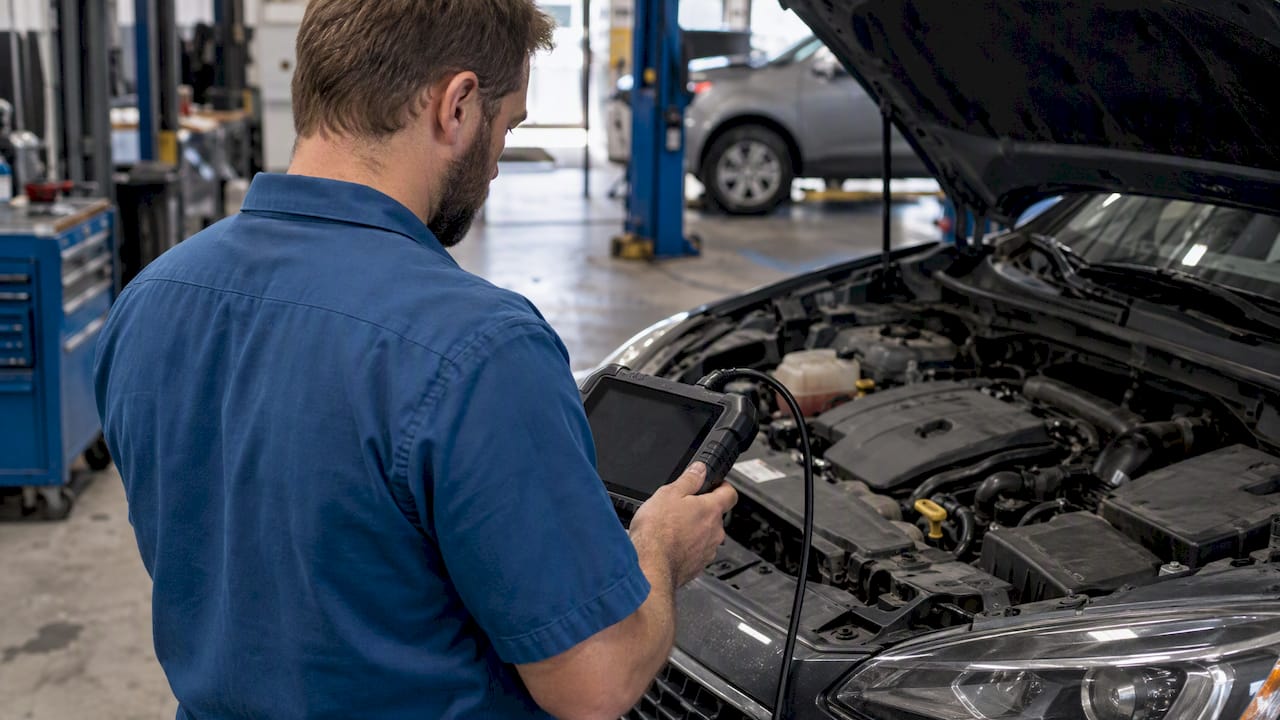
A hot start fix should address the reason an engine fails to restart when warm. Begin by distinguishing no cranking, slow cranking, normal-speed cranking without combustion, and starting followed by a stall. These symptoms require different tests. A warm-only pattern is useful evidence, but it does not identify a sensor, starter or calibration fault by itself.
Hot start fix: record the failure before changing parts
Record the vehicle, engine code, ECU software, fuel type and recent repairs or modifications. Note the run before shutdown, soak duration, ambient conditions and reported coolant or fuel temperature where available. Compare a failed attempt with a successful one under documented conditions.
Read relevant modules for stored and pending faults, keeping status and freeze-frame data before clearing them. A code identifies a monitored condition; it is not automatic proof that the component named in its description has failed.
Do not impose a fixed replacement order of wiring, sensors, starter and injectors. Choose the next test from the measured symptom and the manufacturer’s diagnostic information.
Check cranking speed and electrical supply together
Measure cranking speed, battery behavior and the relevant supply and ground paths during the fault. Compare with application-specific requirements. There is no universal RPM or voltage threshold for every starter, engine and ECU.
An engine that appears to crank normally can still have a voltage drop affecting the controller or another circuit. Conversely, slow cranking does not automatically prove a defective starter: battery condition, connections, cable losses and mechanical resistance can contribute.
Use current and voltage-drop tests appropriate to the circuit. Starter temperature alone is not a diagnosis, and repeated extended cranking can add heat during testing. Follow the specified duty cycle and cooling intervals rather than prescribing a universal number of attempts.
Verify synchronization and start authorization
Check engine-speed and synchronization status during the failed attempt. A scan-tool RPM value does not necessarily reveal a brief signal dropout, a damaged trigger pattern or a crank/cam correlation problem. A suitable oscilloscope test can provide evidence that a slow data stream misses.
Identify the sensor type and test procedure before electrical checks. HELLA’s crankshaft-sensor guidance emphasizes checking wiring, connections and the trigger system as well as the sensor. A waveform problem can originate outside the sensor itself.
Also inspect available start-authorization and relevant network status. Missing injection or spark commands can result from an interlock, immobilizer decision, supply issue or lost synchronization. They are not sufficient evidence of a bad fuel map.
For an application-specific example, this Ford instrument-cluster article discussing U1900, U2510 and P1260 covers communication and security-related symptoms. It is not a universal explanation for warm starting faults.
Match fuel and ignition tests to the engine
On common-rail diesels, compare requested and measured pressure during cranking and assess the low-pressure feed, pressure control and injector return leakage using the appropriate procedure. Do not apply common-rail pressure thresholds to a different injection architecture.
Delphi’s linked diagnostic example concerns particular 2.0 HDi applications. It illustrates checking supply and pressure generation, but its numerical thresholds must not be reused as universal specifications. Plausible scan data should be corroborated when the sensor or circuit is suspect.
Gasoline applications may require separate checks of fuel pressure, mixture condition, injection command and ignition. A leaking injector can cause excess fuel rather than simply starving the engine. A tank-vent fault is one possibility only where the evidence supports it.
Where the electrical and fuel evidence does not explain the symptom, mechanical timing, compression and relevant temperature inputs may require examination. A short list of healthy sensors does not prove that every non-software cause has been excluded.
Establish evidence for a calibration change
Review applicable manufacturer information, software updates and the vehicle’s modification history. A calibration issue becomes a supported hypothesis when the observed behavior can be tied to the identified software strategy, not merely because several replacement parts failed to solve it.
Starting fuel quantity, enable conditions and timing logic differ across engines. A diesel does not use spark timing, and a generic hot-start fix should not be described as the same ignition-and-fueling adjustment for every powertrain.
An edit that improves starting does not by itself prove the starter, fuel system or temperature measurement is healthy. It may compensate for a marginal condition. Document the diagnosis and why the proposed change addresses the cause rather than hiding it.
Nosso start of injection guide explains related timing concepts. It does not supply universal hot-start values or establish that every controller supports the same modification.
Repeat the original conditions and document the result
After the justified repair or supported software update, repeat the conditions that produced the failure and compare the same channels. Include relevant cold and warm behavior so that solving one restart condition does not conceal a new symptom elsewhere. Test coverage depends on the fault and application.
If programming is involved, retain the original read and settings where available, confirm supported access and required checksum handling, and document the restoration method. Do not assume that a partial read is a complete recovery backup.
Consult the current Tabela de preços do TuningBot for service terms and application support. This guide does not promise a fixed price, turnaround, included diagnostic review or guaranteed cure for every hot-start complaint.
Perguntas frequentes
Does normal cranking speed rule out an electrical problem?
No. Supply or ground problems can affect control circuits even when the engine appears to crank normally. Measure the relevant circuits during the failure.
Does a crankshaft-sensor code prove the sensor is defective?
No. Wiring, connections, signal generation and mechanical correlation may also require investigation.
Do missing injection commands prove that a remap is needed?
No. Check authorization, synchronization, supply and other enable conditions before attributing missing commands to the calibration.
Is there one cranking pressure or RPM threshold for all engines?
No. Use the specifications and test conditions for the actual engine, injection system and controller.