

 EnglishEN
 ItalianoIT
 DeutschDE
 EspañolES
 FrançaisFR
 РусскийRU
Examples of Volkswagen fleet remapping are most useful when they show how a calibration is tested, measured and rolled out across vehicles with the same engine, ECU and gearbox configuration. A fleet project should not promise a fixed fuel-saving percentage or assume that one file fits every Transporter, Crafter or Caddy. The professional approach is pilot first, compare matched operating data, confirm drivability and emissions compliance, then expand only to vehicles that genuinely match the validated configuration.
- Pilot before rollout: validate one or more representative vehicles before scaling across the fleet.
- Measure under matched conditions: compare fuel use, route, payload, driver behavior and fault history rather than relying on headline percentages.
- Standardize only where hardware matches: engine code, ECU/TCU software, gearbox and vehicle duty cycle all matter.
- Keep emissions systems compliant: do not treat DPF, EGR or SCR/AdBlue changes as a routine fleet-efficiency shortcut.
- Track calibration revisions: record which vehicle received which file and when.
Fuel-consumption results vary substantially with route profile, payload, driver behavior, maintenance condition, gearing and baseline calibration. Treat any published percentage as a case-specific result rather than a universal fleet-remapping expectation.
Examples of Volkswagen Fleet Remapping: Key Takeaways
The strongest examples of Volkswagen fleet remapping use a pilot-and-measure approach: establish a baseline, tune a representative vehicle, validate the result under comparable duty, and scale only across genuinely matching engine/ECU/gearbox variants.
| Ponto | Detalhes |
|---|---|
| Fuel savings are not guaranteed | Use pilot data from matched routes and payloads instead of a universal percentage. |
| Standardize carefully | Reuse a calibration only where engine, ECU/TCU software, hardware and duty cycle are compatible. |
| Health checks come first | Sensor, boost, fuel, DPF and drivetrain issues can distort both performance and economy data. |
| Emissions compliance stays separate | Do not use fleet-economy goals to justify unlawful emissions-control changes. |
| Version control matters | Record the source file, calibration revision, vehicle ID, date and validation result. |
| This page remains informational | It supports TuningBot service pages without targeting the same transactional keywords. |
Examples of Volkswagen Fleet Remapping in Real Workshop Scenarios
Examples of Volkswagen fleet remapping differ by route, load, gearbox, engine family and operating environment. The scenarios below are planning examples, not universal performance claims.
Case 1: Urban-delivery Transporter. A useful pilot would target smoother low-speed torque delivery and reduced unnecessary throttle demand, then compare matched urban routes for fuel use, shift behavior, DPF events and driver feedback.
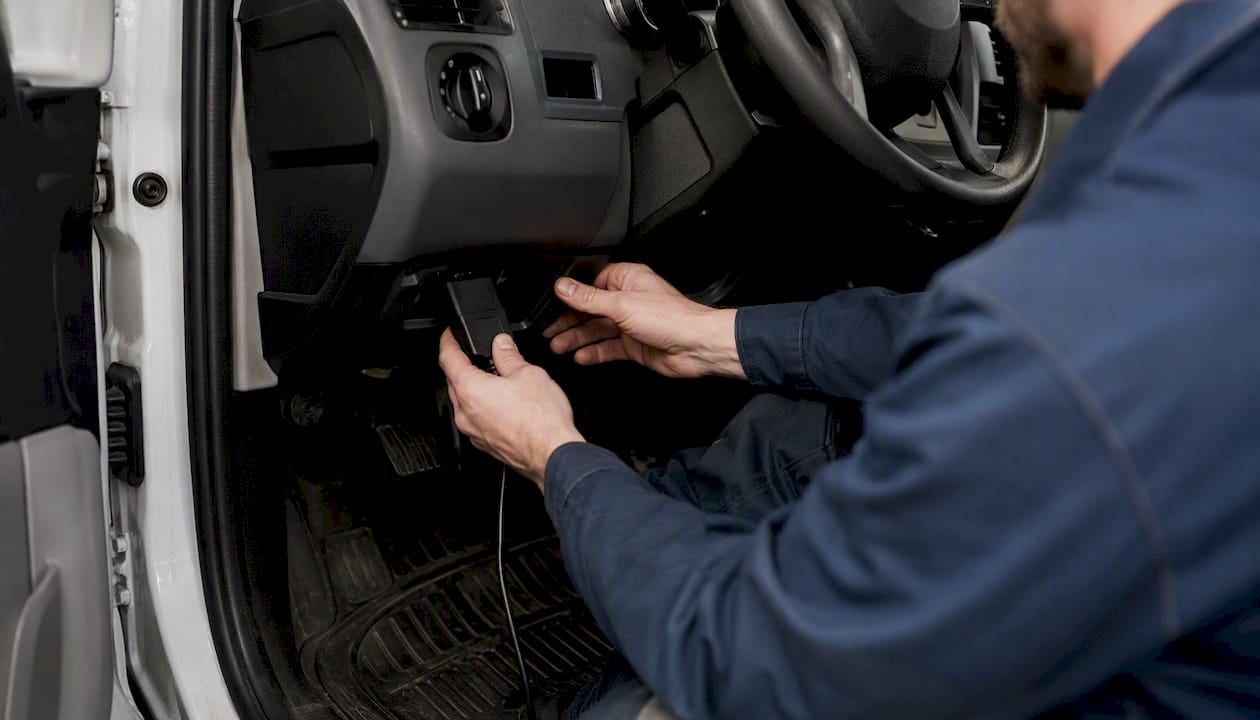
Case 2: Long-distance Crafter. A motorway-focused calibration can prioritize mid-range torque and part-load drivability, but power and torque gains must be measured on the actual vehicle rather than copied from another commercial-vehicle example.
Case 3: High-mileage van with frequent DPF regeneration. Diagnose the cause before tuning. Frequent regeneration can result from duty cycle, sensor faults, air/fuel problems, oil consumption or a loaded/damaged DPF.
Case 4: Mixed-use fleet standardization. A validated calibration may be reused only where the target vehicles genuinely match the engine, ECU/TCU software, hardware and operating assumptions. The retained FleetNews case study supports the broader pilot-then-scale principle, not a specific remap result.
Dica de Mestre: Log at least three matched round trips before and after any remap. One good day of driving tells you nothing about consistency across weather, traffic, and payload variation.
Common Remap Types for Volkswagen Fleet Vehicles
Not every remap does the same job, and mixing them up leads to mismatched expectations.
- Eco / drivability calibration: focuses on part-load response and efficiency objectives; gains must be demonstrated on the fleet’s actual duty cycle.
- Performance-oriented calibration: prioritizes torque/power and may increase thermal or drivetrain load; not inherently the correct choice for a fleet.
- DPF-related diagnosis/calibration: treat regeneration problems as a diagnostic issue first and preserve lawful emissions-control operation.
- EGR/SCR/AdBlue-related work: requires separate legal/compliance review and should not be presented as an economy-tuning feature.
- DSG/TCU calibration: may change shift scheduling and torque limits where the exact gearbox supports it; validate temperatures, clutch behavior and drivability.
Dica de Mestre: Keep emissions-adjacent calibrations off the table for any vehicle operating in a jurisdiction with strict roadworthiness or emissions inspections, unless the provider documents compliance handling explicitly.
How a Fleet Remap Rollout Actually Works
A pilot-first approach reduces rollout risk and gives the fleet manager real operational data before wider deployment.
- Select representative pilot vehicles for each genuinely distinct engine/ECU/TCU configuration.
- Capture enough baseline fuel, route, payload, driver, fault and maintenance data to support a meaningful comparison.
- Resolve active faults and verify air, fuel, boost, emissions and drivetrain condition before tuning.
- Prepare the calibration from the exact ECU/TCU source file; Bench testing is not mandatory unless the protocol or project requires it.
- Validate in the vehicle under representative operating conditions before expanding the pilot.
- Roll out by compatible vehicle group with revision tracking and a documented recovery process.
Pilot duration should be long enough to capture representative routes, payloads, drivers and operating temperatures. Depending on the fleet, useful validation may take several days or several weeks.
Dica de Mestre: Bundle remap installation into a scheduled oil change or inspection. It saves a separate downtime slot and keeps drivers on their routes.
Before-and-After Metrics That Actually Prove the Remap Worked
Before/after data is meaningful only when measurement conditions are comparable. Fuel consumption, route, payload, driver assignment, ambient conditions, maintenance state and DPF events should be tracked together.
Telematics and route-matched logging can improve comparison quality, but no single parameter proves that a fuel saving came from the calibration.
| Métrica | Baseline | Pilot comparison | Notas |
|---|---|---|---|
| Consumo de combustível | Measured fleet average | Compare actual change | Normalize route, payload, driver and measurement period |
| Drivability / torque delivery | Stock logs and driver feedback | Compare part-load response | Use logs where available; avoid subjective-only conclusions |
| DPF / emissions events | Baseline regeneration and DTC history | Confirm no abnormal deterioration | Investigate mechanical/emissions faults separately |
| Gearbox behavior | Stock shift/temperature behavior | Compare shift quality and temperatures | Relevant only where TCU calibration is part of the project |
| Maintenance / faults | Pre-pilot service record | Track new faults or comeback rate | Essential before scaling to the rest of the fleet |
For consistency, use comparable routes, payload classes, drivers where practical, fuel-accounting methods and measurement periods.
Fleet-Level Considerations Beyond the Calibration Itself
Standardization can reduce administration, but only after compatibility is established for each vehicle. Matching an engine code alone is not enough when ECU software, gearbox, emissions hardware or vehicle configuration differ.
- Maintain file/revision traceability for every vehicle.
- Use an internal approval step before moving a calibration from pilot to wider fleet deployment.
- Document the recovery/restoration process supported by the selected tool and protocol.
- Record ECU/TCU IDs, calibration revision, install date and validation status per vehicle.
For cost modeling, a simple ROI checklist keeps the numbers honest:
- Projected annual fuel effect based on measured pilot data, with route/payload assumptions stated.
- Maintenance-cost changes supported by actual service records; do not assume a remap will reduce DPF costs.
- Implementation and validation time per vehicle.
- Downtime effects, including any benefit from combining work with planned maintenance.
Compliance is a separate gate. Fleet efficiency work should preserve required emissions-control and diagnostic functions unless a lawful application-specific pathway exists.
How to Evaluate Examples of Volkswagen Fleet Remapping
When evaluating examples of Volkswagen fleet remapping, choose a provider by exact ECU/TCU coverage, file compatibility, support, commercial terms and the quality of the pilot/revision workflow.
- Confirm exact ECU/TCU and software coverage for the Volkswagen variants in the fleet.
- Ask how pilot results and revisions are measured and documented.
- Treat case studies as examples; verify claims against your own pilot.
- Verify file/read/write compatibility with the workshop’s actual flashing tools and Master/Slave workflow.
- Confirm revision handling, technical support and the recovery process before rollout.
Sinais de alerta a observar:
- Files supplied without exact control-unit identification or source-file matching.
- No willingness to define measurable pilot acceptance criteria.
- No clear revision, recovery or support path if the pilot fails acceptance.
- Vague control-unit, file-format or tool compatibility.
Define pilot acceptance criteria before the first file is written: baseline period, measurement method, vehicle configuration, target drivability, fault-free operation and minimum observation window.
How TuningBot Supports Volkswagen Fleet Remapping Pilots
TuningBot can provide ECU and TCU calibration files for supported Volkswagen fleet projects while the workshop controls vehicle diagnosis, reading, writing and validation.
Before starting a pilot, check Cobertura do serviço de ECU, revise Lista de preços pública and browse Serviços de ECU.
For an actual fleet pilot, submit the representative source file through Remapeie seu arquivo after defining the pilot vehicle, intended calibration objective and measurement window.
This article remains focused on examples, rollout and measurement intent so it supports rather than competes with TuningBot’s transactional service pages.
Connecting Remap Results to Fleet Management Software
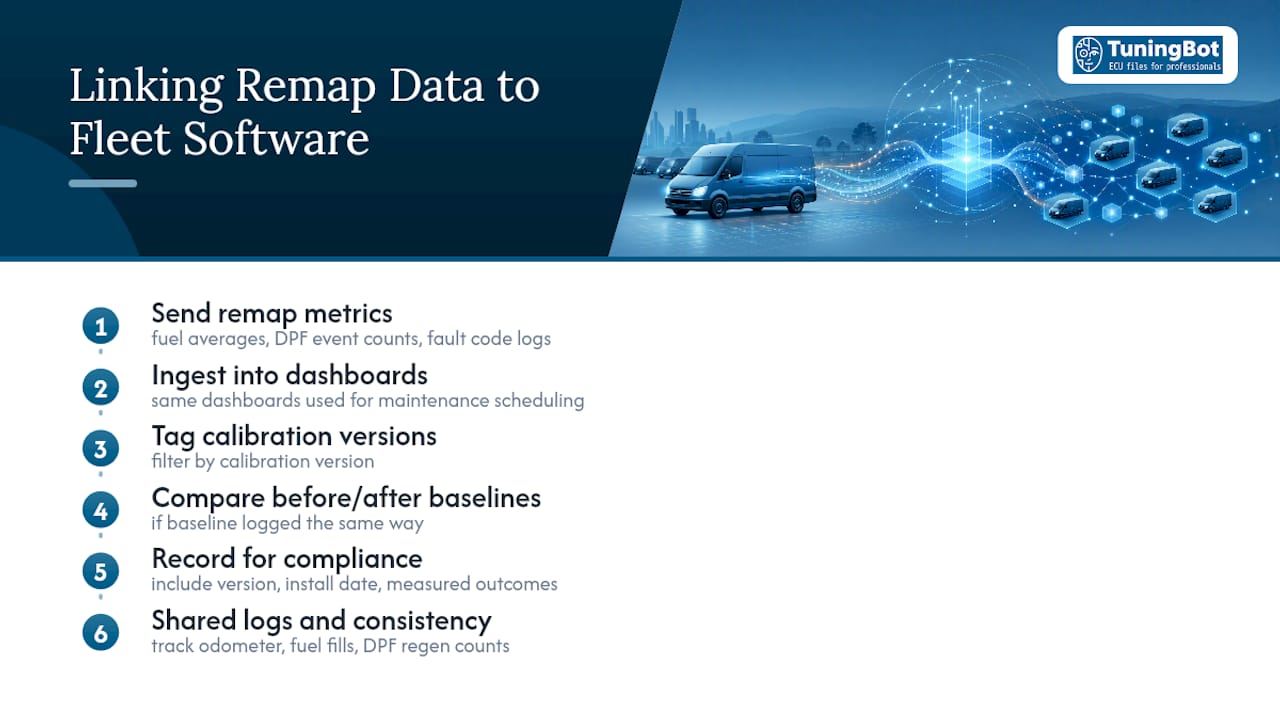
Fleet projects benefit from a reporting trail that connects calibration revision, vehicle ID, fuel consumption, fault history and maintenance events.
Where telematics is available, tag vehicles by calibration revision so results can be compared against stock or previous versions using the same operational metrics.
Calibration records should sit alongside normal maintenance and compliance records so the exact software state can be reconstructed later.
Without telematics, a consistent manual log of odometer, fuel fill, route/payload class, faults and maintenance can still support useful before/after analysis.
Helping Drivers Adapt After a Remap
If torque delivery or gearbox behavior changes, brief drivers on what to expect and what symptoms should be reported rather than assuming the tune will automatically change driving habits.
Driver communication should focus on normal drivability, shift behavior and fault reporting. Do not normalize unusual DPF warnings or regeneration behavior as an expected consequence of tuning.
Driver behavior can materially affect measured fuel economy, so include driver communication and rotation in the interpretation of pilot data.
What Surprises Fleet Clients Most About Remapping
Vehicle health is one of the largest confounders in a fleet-remapping pilot. Existing air, fuel, emissions, sensor or drivetrain faults must be resolved before results are attributed to calibration.
Reliable rollouts share three traits: a genuine pre-tune health check, staged deployment and consistent before/after data collection.
How to Start a Volkswagen Fleet Remapping Pilot
Start with a representative vehicle and a baseline period long enough to capture normal route, payload and driver variation.
Define success criteria before calibration: fault-free operation, acceptable drivability, no adverse emissions-system behavior, and an agreed fuel-consumption measurement method.
Once the pilot vehicle and ECU/TCU are identified, use Cobertura do serviço de ECU to check compatibility and Remapeie seu arquivo to submit the source file.
Scale only after the measured data supports the result and the remaining vehicles match the validated configuration.
Sources and Further Reading
- FleetNews — fleet cost-saving initiative case study — external fleet-management case study; not a remap-performance benchmark.
- Haldex Parts — multi-vehicle service planning — external fleet/workshop batching reference retained as requested.
- Cobertura de Serviço da ECU TuningBot — verified internal compatibility reference.
- TuningBot ECU Tuning Price List — verified internal pricing reference.
- TuningBot Tune Your File — verified internal file-submission page.
PERGUNTAS FREQUENTES
What Fuel Savings Can a Volkswagen Fleet Expect From Remapping?
There is no universal percentage. Fuel results depend on route, payload, driver behavior, maintenance condition, gearbox, engine and baseline calibration. Use a representative pilot to establish the fleet’s own result.
Is DPF or AdBlue Remapping Legal for Commercial Fleets?
Legality depends on the exact modification and jurisdiction. Road-use software that tampers with required emissions controls can violate applicable law; fleet use does not create an automatic exemption.
How Long Does a Fleet Remapping Pilot Take?
The pilot should last long enough to capture representative operation. Depending on fleet duty and data quality, this may range from several days to several weeks.
Which Tools Does TuningBot Support for Volkswagen ECU Files?
Compatibility depends on the exact ECU/TCU, source-file type, read/write protocol and Master/Slave configuration. Check the specific job in TuningBot ECU Service Coverage before ordering.
Do Drivers Need Training After a Fleet Remap?
A short driver briefing is useful when torque delivery or shift behavior changes, and drivers should be told to report any new warning, fault or drivability issue during the pilot.