

 ItalianoIT
 DeutschDE
 EspañolES
 PortuguêsPT
 FrançaisFR
 РусскийRU
A limp mode removal file is a calibration change, not a repair. It changes how the ECU reacts to a fault or a limit, but it does not remove the physical condition that triggered the reaction. For a workshop, the useful question is therefore never “can the file hide limp mode?” but “which strategy is firing, is the fault real, and does the calibration belong in the fix at all?” This article covers that decision in the order a technician meets it: read the cause, classify it, then decide whether a modified file is justified.
We provide custom ECU and TCU calibration files to workshops and tuners, so the notes below are written from the file-service side of the bench: what is in the original file, what the tool can read, and what a calibration can legitimately change.
TL;DR
- Limp mode is a protective strategy: the ECU limits torque, boost, engine speed or gear selection when a monitored value leaves its allowed window.
- A file can change the thresholds, the monitoring or the fault reaction for a specific function. It cannot repair a failed sensor, a leaking intercooler pipe or a clogged filter.
- Codes such as P0401, P2002, P0420 and P0299 point to EGR, particulate filter, catalyst and boost systems. Diagnose and confirm the root cause before ordering any file.
- Original-file read quality, ECU family and software version decide what is possible, so availability is always confirmed per file.
- Emissions-related modifications are intended only for applications where they are permitted by applicable law, such as off-road and motorsport use.
Table of Contents
- What limp mode actually is inside the ECU
- Read the cause before you touch the file
- The codes behind the searches
- What a file can change, and what it cannot
- Why tuned files sometimes trigger limp mode themselves
- Commercial vehicles and agricultural equipment
- How the file is written matters as much as what is in it
- How we handle these orders
- Perspective
- Order the file for the job
- FAQ
- Sources
What limp mode actually is inside the ECU
Limp mode is not one switch. It is the visible result of several independent strategies that each reduce performance when a plausibility or protection check fails. In the calibration these appear as separate maps and parameters:
- Torque limitation. A torque structure caps the driver request, usually through a limiter that is reduced when a fault flag is set.
- Boost and air-path monitoring. The ECU compares requested boost with actual boost. A sustained deviation sets an underboost or overboost fault and drops the boost target.
- Fuel system monitoring. Rail pressure or fuel quantity deviations reduce injection quantity.
- Component protection. Exhaust temperature, turbine speed or transmission temperature limits reduce load before hardware is damaged.
- Transmission fallback. On a TCU, a fixed gear or a locked selector range is selected when a sensor or clutch adaptation is out of range.
Because the strategies are separate, a “limp mode file” that works on one ECU family may do nothing on another. Each ECU family and software version organizes these functions differently, which is why we never treat compatibility as universal.
Read the cause before you touch the file
A car that enters limp mode has already told you why, in most cases. The stored fault code, the freeze frame and the live data around the event identify the strategy that fired. Before any file is considered, a sound workflow looks like this:
- Read all control units, not only the engine ECU. Transmission, ABS and body modules can request torque reduction through the CAN bus.
- Record freeze frame data. Engine speed, load, coolant temperature and rail or boost values at the moment of the fault show whether it is load dependent.
- Log the relevant channels under load: requested versus actual boost, rail pressure, air mass, differential pressure across the particulate filter, EGR position.
- Check the physical path. Hoses, intercooler connections, vacuum lines, connectors and the actuator itself cause more repeat faults than the ECU does.
- Clear and road test only after the suspected fault is corrected, and confirm the code does not return.
Only after that does the question of a calibration arise. If the fault is real, a modified file is not the repair. If the fault is the result of a deliberately changed system, such as a delete on an off-road or competition vehicle, the file is what makes the ECU consistent with the hardware.
The codes behind the searches
Four codes come up repeatedly when workshops ask about removal files. Each belongs to a different system, and each needs a different line of thinking.
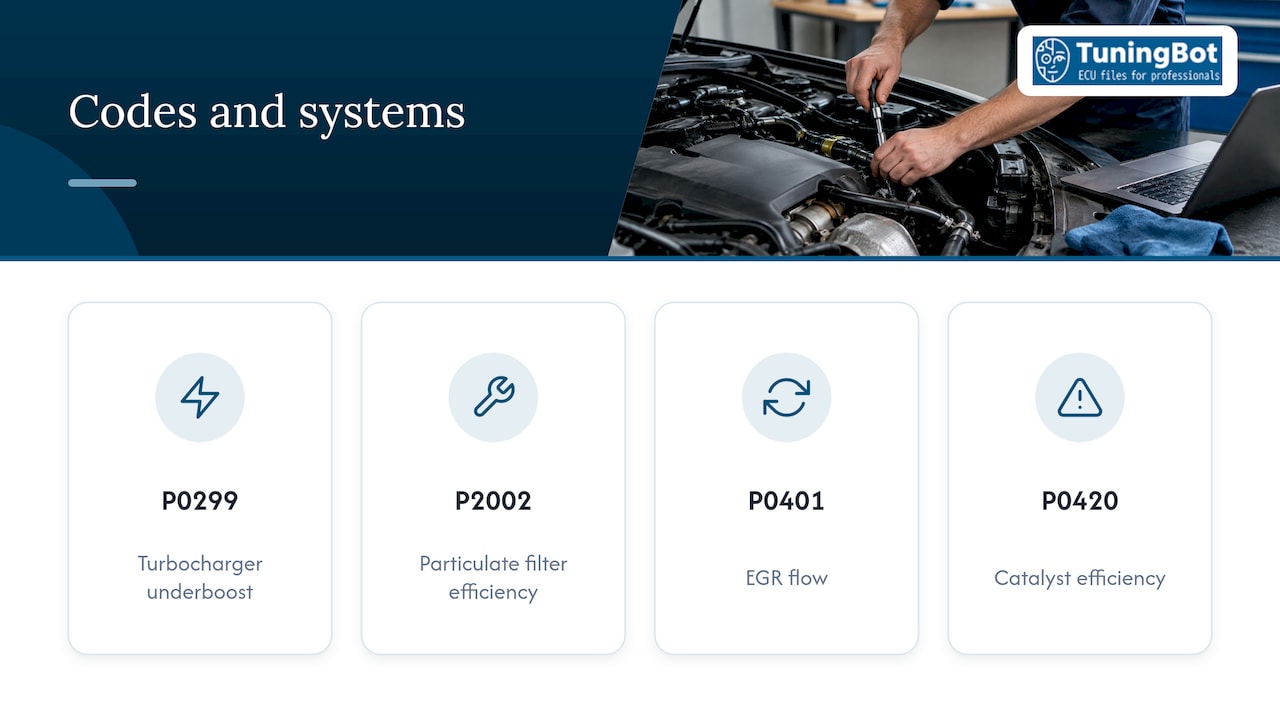
P0299: turbocharger underboost
This family describes boost that stays below the requested value. The usual causes are physical: a leaking charge pipe, a sticking variable-geometry actuator, a worn wastegate linkage, a failed boost sensor or an exhaust restriction. Lowering the monitoring threshold in a file can stop the code, but the engine is still making less boost than requested, so drivability does not improve. The correct first step is a leak test and an actuator check. A calibration is appropriate when the hardware has been changed (for example a different turbo or intercooler) and the target maps, limiters and monitoring need to match it.
P2002: particulate filter efficiency
This code points to the diesel particulate filter system. It is commonly raised by a blocked or cracked filter, a faulty differential pressure sensor or pipes, or a failed regeneration. Limp mode on these engines often comes from soot load calculations rather than from the code alone. Where the filter has been removed on a vehicle used off-road or in competition, the file has to deal with the differential pressure plausibility, regeneration logic and the related torque limiter together, which is the purpose of a DPF Off calibration. Our price list shows DPF Off at €39.99 per file.
P0401: EGR flow
Insufficient EGR flow typically comes from a carbon-clogged valve or passages, a sticking actuator or a failed position sensor. On a road vehicle, cleaning or replacing the valve is the repair. On an off-road or competition application where the EGR system has been blocked, an EGR Off calibration removes the function and its monitoring so the ECU does not keep requesting flow. EGR Off is listed at €39.99 per file.
P0420: catalyst efficiency
This is a generic powertrain code defined for vehicles from 1996 onward, and it relates to catalyst efficiency measured by comparing upstream and downstream oxygen sensors. It does not by itself cause limp mode on most engines, but it is often found in the same session as a power complaint. Failing sensors, exhaust leaks and exhaust misfires are as likely as a worn catalyst. A file that removes the monitoring is a different job from a sensor replacement and should only be considered where the application permits it.
What a file can change, and what it cannot
The table separates what belongs to a calibration from what belongs to the workshop floor.
| Situation | Calibration helps | Hardware or diagnosis needed |
|---|---|---|
| Hardware removed on a permitted off-road or competition vehicle | Yes: remove the function, its monitoring and the related torque limiter | Confirm the physical system matches the file |
| Torque monitoring conflicts after tuning (torque request versus modelled torque) | Yes: Torque Monitoring OFF (TMoff) where available | Check that the base calibration is stable first |
| Fault code remains after a repair | Sometimes: DTC Removal for a specific code, where the ECU family allows it | Repair must be complete and verified |
| Underboost from a split pipe or sticking actuator | No | Replace or repair, then re-log |
| Clogged DPF or EGR on a road vehicle | No | Cleaning, regeneration or replacement |
| Failed sensor or wiring fault | No | Replace the sensor, check the harness |
| Corrupt or mismatched file after writing | Checksum Correction where the tool did not handle it | Verify the read and the write |
The pattern is consistent: the file adjusts logic, the workshop restores physics. When a technician orders a file to cover a physical fault, the symptom may disappear from the dashboard and return as a damaged turbo, a fouled engine or a transmission with worn clutches.
Why tuned files sometimes trigger limp mode themselves
A frequent cause of limp mode on tuned vehicles is a mismatch between the new calibration and the monitoring functions that were left untouched. Common examples:
- Torque monitoring. The ECU calculates a torque value from its own model and compares it with the driver request and with the limit. When a performance calibration pushes actual torque above the modelled value, a torque monitoring fault reduces power. A TMoff modification addresses this specific conflict, listed at €29.99 per file.
- Boost target versus hardware. Raising a target beyond what the turbo and actuator can deliver leads to a control deviation and an underboost reaction.
- Checksum errors. If a modified file is written with an invalid checksum, the ECU may refuse to start or fall back to a limited state. Our guide on ECU file checksum correction covers where checksums sit and when the tool handles them. Checksum Correction is €29.99 per file.
- Hotstart behavior. On some platforms, restart faults after tuning appear as power loss. The Hotstart Fix is listed at €19.99 per file.
- Adaptations after flashing. Throttle, injector and turbo adaptations may need relearning, and a transmission may need its own adaptation procedure.
If a tuned car is in limp mode, a careful workshop first checks the file against the logs, because the correction may be a revised calibration and not a removal.
Commercial vehicles and agricultural equipment
Heavy vehicles add two layers: aftertreatment derating strategies and strict operating duty cycles. A derate on a truck or tractor can come from a urea quality or dosing fault, a particulate filter load, or a failed NOx sensor. The mechanical side often needs a proper heavy-vehicle workshop, for example a commercial vehicle repair workshop that services fleet trucks, while the calibration side is handled in the ECU file. For equipment used strictly off-road, AdBlue / SCR Off is available at €59.99 per file, subject to ECU compatibility and the application being permitted. Emissions-related modifications are intended only for applications where permitted by applicable law.
How the file is written matters as much as what is in it
A correct modification written badly still produces faults. The read method, the ECU identification and the write procedure all affect the result. Our technical guide on how an ECU file is written, including UDS, checksums and flashing explains the sequence. Practical habits that avoid self-inflicted limp mode:
- Keep the original file and verify it reads identically twice where the tool allows.
- Record the software version and hardware number before ordering, so the file matches the exact ECU.
- Maintain stable supply voltage during reading and writing.
- After writing, cycle ignition, clear adaptations as the platform requires and road test with logging.
- Keep a log of what was changed so a later fault can be traced.
For a broader view of calibration workflow, see our ECU remapping techniques guide and the wider tuning section.
How we handle these orders
Workshops upload the original ECU or TCU file, select the services they need and receive a calibrated file ready for writing with their compatible tool. Most standard files are delivered within approximately 15 to 20 minutes during published operating hours, depending on complexity and workload. We work with files read with professional tools such as Alientech KESS3, AutoTuner, FLEX, CMD and Dimsport, and support Bosch, Continental, Siemens, Delphi, Marelli, Denso and ZF platforms. Availability depends on the ECU family, software version and reading method.
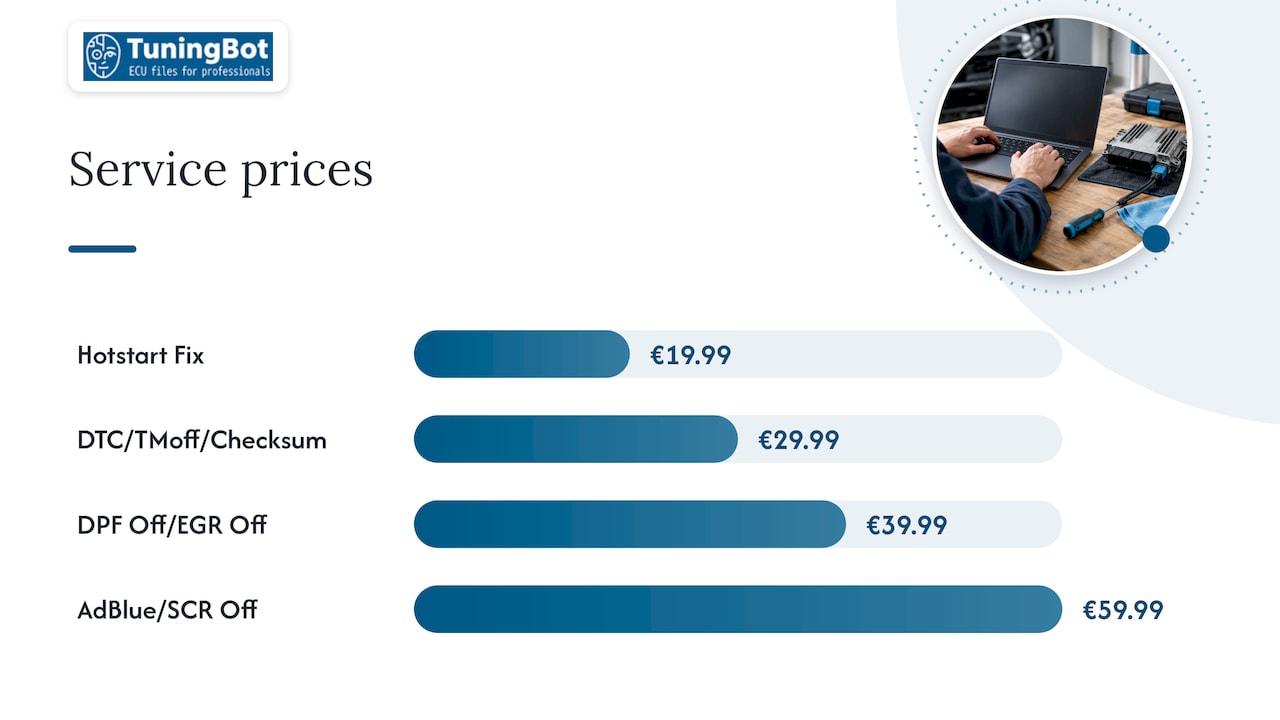
For limp mode related jobs, the relevant services on our price list include DTC Removal (€29.99), DPF Off (€39.99), EGR Off (€39.99), AdBlue / SCR Off (€59.99), TMoff (€29.99), Checksum Correction (€29.99) and Hotstart Fix (€19.99), each priced per file. No registration is required for standard file orders, and our support portal is available for technical questions about a specific file.
Perspective
Limp mode requests tend to arrive with a symptom and a code, and the useful conversation starts with the file and the log. Every protective strategy in an ECU has a purpose, so we treat a removal as a calibration decision that has to match the hardware on the vehicle.
Our approach is to keep the work specific: one function, one set of maps, one confirmed ECU family and software version. That is why we price services per file and describe availability per ECU, and why we back them with technical support through our portal, with corrections under the published service terms.
For workshops that handle tuned, modified or off-road vehicles, the benefit of a professional file service is consistency: the torque limiter, the monitoring and the fault reaction are changed together, so the ECU does not contradict itself after the write.
TuningBot Technical Team
Order the file for the job
When the diagnosis confirms that the hardware is changed or the application is off-road or competition use, the calibration is the correct next step. Upload the original file, select the function and receive the finished file for your tool. Start from the TuningBot price list and choose the services that match your diagnosis.
FAQ
Can a file remove limp mode permanently?
A file can change the thresholds and reactions that cause a specific limp mode strategy, but it cannot remove the cause. If the cause is a leak, a failed sensor or a blocked filter, the problem remains and may worsen. The file is justified when the hardware or the application has changed and the calibration has to follow.
Is a DTC removal file the same as a limp mode removal file?
No. DTC Removal disables the reporting of a specific code. Limp mode is a reaction, often tied to torque or boost limiters, and may need those parameters changed too. Which is needed depends on the ECU family and software version.
Why does the car enter limp mode again after a clean write?
Common causes are a remaining physical fault, adaptation values that need relearning, a torque monitoring conflict with the new calibration, or an invalid checksum. Read the codes, compare logs with the targets and check the file against the original.
Do P0401, P2002, P0420 and P0299 need the same file?
No. They relate to EGR flow, particulate filter efficiency, catalyst efficiency and boost, which are separate systems with separate monitoring. Each is assessed on its own, and the matching service depends on the ECU and the application. Emissions-related modifications are for permitted applications only, such as off-road or motorsport use.