

 ItalianoIT
 DeutschDE
 EspañolES
 PortuguêsPT
 FrançaisFR
 РусскийRU

Launch control tuning calibrates how an engine and, where applicable, its transmission prepare for and transition out of a standing start. The useful question is how the complete vehicle manages traction, torque and heat—not which RPM another car uses. Available functions depend on the ECU software, transmission, sensors and hardware.
Launch control tuning starts with the supported strategy
A stationary rev limiter is not automatically a complete launch strategy. Depending on the platform, launch control can combine a temporary speed limit, throttle control, fuel or ignition intervention, activation conditions and a controlled transition into normal torque delivery. Some systems also coordinate clutch engagement or converter loading. A calibration editor displaying a limiter does not prove that all these functions exist.
Haltech’s launch-control documentation illustrates configurable inputs and operating conditions on its own products. Those settings are examples of one implementation, not a menu that can be assumed available in every production ECU. Confirm the exact software and tooling before defining the job.
Record the ECU identification, transmission version and existing calibration. Determine whether the request concerns an existing factory feature, supported aftermarket functionality or software development beyond ordinary map editing.
Select RPM from vehicle behavior
Turbo size alone cannot define a useful launch RPM. Engine torque characteristics, clutch or converter behavior, gearing, tire grip, vehicle mass and surface conditions all affect the result. Naturally aspirated, turbocharged, manual and automatic combinations can require different approaches.
The original ME7 feature walkthrough and its alternate host URL remain useful context for that tool. Numerical examples from a walkthrough should not become workshop-wide starting values or component limits.
Assess wheel slip, engine-speed recovery, delivered torque and the transition after release under controlled test conditions. A higher setpoint can increase wheelspin or clutch energy without improving acceleration. A launch that initially feels stronger can also produce worse repeatability once temperatures rise.
Separate boost preparation from thermal protection
Some turbocharged spark-ignition strategies use ignition retard to increase exhaust energy while staged. That does not make retard necessary or beneficial on every combination. A torque converter already loads the engine, and a strategy that reduces engine torque may work against the required operating point. Fuel-cut and ignition-cut behavior also differ between implementations.
There is no single exhaust-temperature number that defines a safe launch for all engines. Sensor location, measured versus modeled temperature, exposure duration and component specifications matter. Use supported time limits, temperature conditions and cancellation logic, and establish what the ECU actually measures. An absent sensor cannot provide direct thermal feedback.
The historical ME7 launch and no-lift-shift document highlights implementation-specific risks. Our antilag guide and spark advance guide explain related concepts. None establishes safe limits for an unidentified vehicle.
For custom hardware, material, fit and thermal requirements must come from the component design. This overview of CNC machining for motorsport applications provides manufacturing context; machining alone does not establish a part’s temperature or fatigue rating.
Check ECU and transmission coordination
On automatic and dual-clutch platforms, requested engine torque must be compatible with the transmission’s supported launch behavior. Clutch pressure, slip control, torque reporting and shift intervention interact. Raising pressure or torque limits indiscriminately is not a substitute for diagnosing wear or an inaccurate torque model.
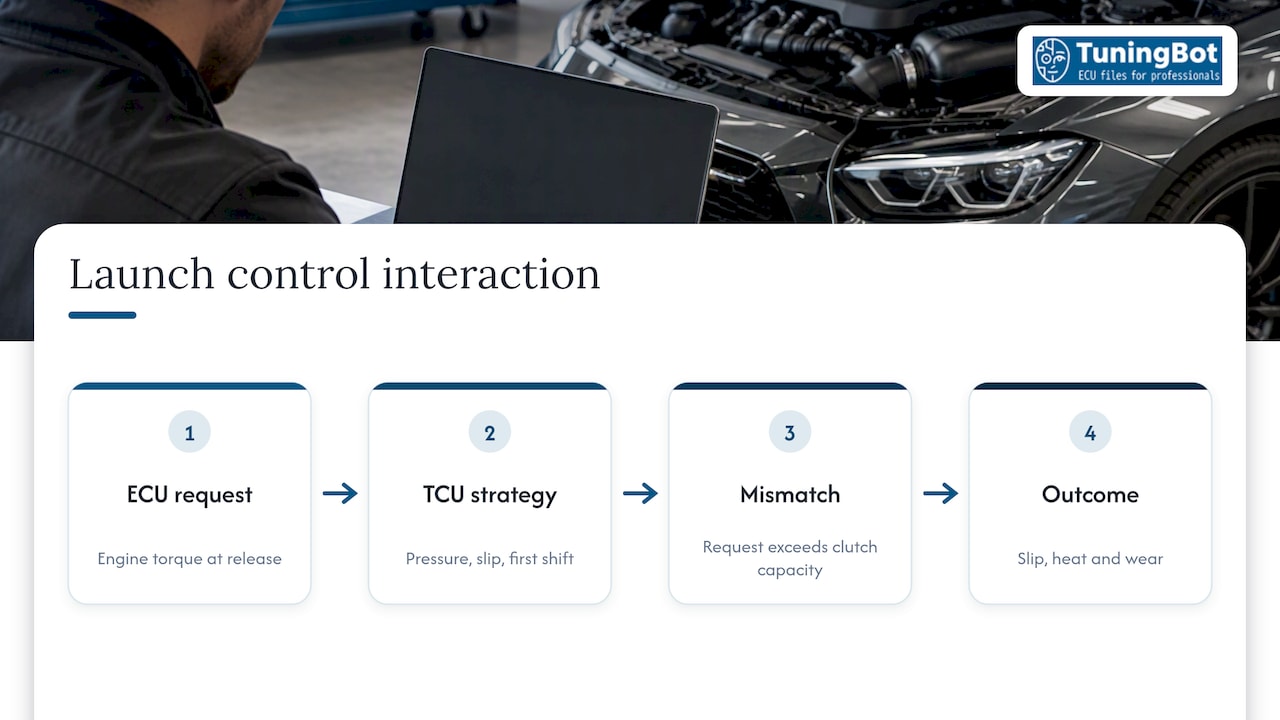
Review the shift-map checks alongside the explanation of TCU remapping. A manual transmission still needs assessment of clutch condition and driveline loading; the absence of a TCU does not remove these limits.
Validate activation, release and repeatability
- Confirm that clutch, brake, gear, throttle and speed inputs are plausible where the strategy uses them.
- Check entry and exit behavior, including cancellation, input faults and return to normal operation.
- Log available engine, transmission and wheel-speed channels with sufficient sampling to assess the event. Identify calculated channels and their limitations.
- Investigate abnormal slip, torque intervention, knock or temperature behavior before further testing.
- Document software versions, hardware, fuel, test conditions and the limits of the validation performed.
Archive the original read and identify what memory it includes. Confirm the tool’s required file format and checksum handling. A valid checksum checks data integrity within its scope; it does not prove mechanical suitability or guarantee recovery.
Keep technical scope and service terms separate
Launch control is not automatically road-legal merely because emissions hardware remains installed. Check the requirements applicable to the actual modification and vehicle. The EPA and DOJ links below are regulatory and case-history references, not approval of an individual calibration. See the emissions compliance guide for the distinction between claims and evidence.
For a service inquiry, provide the software identity, hardware specification and intended function. Confirm availability and terms for that specific request using the current service information. This guide does not promise a delivery time, universal tool compatibility or a number of safe launches.
Frequently asked questions
What does launch control tuning change?
It can change activation conditions, the launch RPM limit and torque delivery during a standing start. The available functions depend on the ECU, software and transmission.
Is there a universal launch RPM for each turbo size?
No. Engine behavior, gearing, clutch or converter characteristics, grip and vehicle conditions all affect the useful setpoint.
Does every launch strategy need ignition retard?
No. The appropriate method depends on the engine and how it is loaded. Retard-based boost preparation is not suitable for every combination.
Can launch control be added through any remap?
No. A stationary limiter or visible calibration table does not establish that the necessary software functions and inputs are supported.
Does a successful launch prove that the calibration is safe?
No. Repeatability, temperatures, drivetrain behavior and operating limits still need assessment. Repeated launches can cause wear or damage even when the function operates as intended.
Sources and further reading
Related TuningBot reading
- EDC17 Stage 1 Tuning Guide: 7 Critical Calibration Checks
- ECU Tuning Reliability — Why 100% Guarantees Don’t Exist
- ECU Services Update August 2026 | 800+ Solutions
- Stage 1 Tune Workshop Setup: Tools, Process & Checklist
- Rev Matching Tuning Guide: 7 Critical Calibration Checks
- Start of Injection Tuning Guide: 7 Critical SOI Checks
- Lambda Target Tuning Guide: 7 Critical Fuel Calibration Checks