
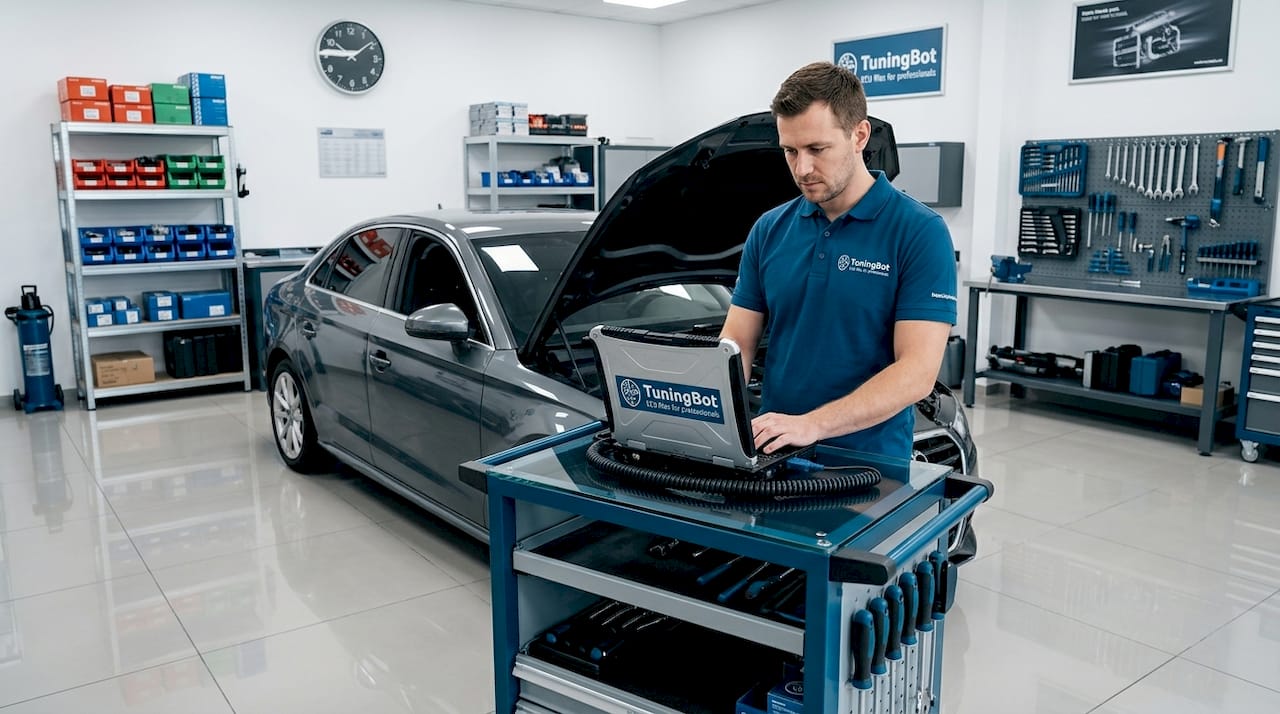
Most automotive enthusiasts focus heavily on ECU tuning when planning a performance build, while the Transmission Control Unit is often left untouched. That can create an incomplete result. What is TCU remapping? It is the process of recalibrating the software that manages the automatic gearbox, including shift timing, clutch pressure strategies, torque limiters and drive-mode behavior. While engine remapping addresses power generation, TCU remapping influences how effectively that power is transferred through the drivetrain. Understanding both sides of the equation is what separates a balanced performance build from a car that feels strong on paper but inconsistent on the road.
Table of Contents
- Key Takeaways
- Understanding the Transmission Control Unit
- What TCU remapping is and how it works
- The professional TCU remapping process
- Full recalibration vs. basic map edits
- When TCU remapping makes the most sense
- Why TCU remapping matters in a complete build
- Professional TCU and ECU remapping files from TuningBot
- FAQ
Key Takeaways
| Point | Details |
|---|---|
| TCU controls transmission behavior | The Transmission Control Unit manages shift timing, clutch pressure strategies, torque limiters and drive-mode behavior in many automatic gearboxes. |
| Factory maps are conservative by design | Original calibrations are normally designed for broad market use, comfort, warranty protection and varying maintenance conditions, not only for maximum performance. |
| TCU work must match the vehicle | The correct approach depends on gearbox type, TCU software version, ECU torque output, vehicle condition and the requested tuning stage. |
| Pre-tune diagnostics are non-negotiable | Hidden fluid issues, clutch wear, adaptation problems or stored transmission faults should be checked before remapping. |
| TCU remapping complements ECU tuning | Pairing ECU and TCU calibration can improve drivability, shift response and torque delivery, but it cannot compensate for mechanical wear or poor maintenance. |
Understanding the Transmission Control Unit
Before addressing what TCU remapping does, it is important to understand what the TCU actually controls. The Transmission Control Unit is the dedicated electronic module responsible for managing many aspects of an automatic gearbox’s behavior. It processes data such as throttle position, wheel speed, engine load, selected driving mode, temperature and torque request, then uses that information to determine when and how the transmission shifts.
The TCU can govern several types of modern automatic gearboxes, each with different calibration requirements:
- DSG / dual-clutch gearboxes: common on Volkswagen Group and other platforms. These units rely on precise clutch pressure, shift timing and torque management.
- ZF 8-speed automatic transmissions: widely used across many premium and performance vehicles. TCU calibration can influence shift speed, lockup behavior and sport-mode response.
- PDK and other high-performance dual-clutch units: used in performance-oriented vehicles where gearbox calibration has a direct effect on response and consistency.
- Torque converter automatics: common across many vehicles; TCU remapping may address shift firmness, converter lockup strategy and torque delivery.
Manufacturers typically calibrate factory TCU software to suit a very wide range of drivers, climates, fuel qualities, service histories and warranty conditions. The result can be conservative shift points, delayed downshifts and torque interventions that make sense for a stock vehicle, but may feel restrictive after an ECU remap.
What TCU remapping is and how it works
TCU remapping is the process of reading the existing software from the Transmission Control Unit, modifying the relevant calibration areas and writing the updated file back to the TCU. The goal is not to remove safety logic blindly, but to recalibrate the transmission so that it works coherently with the vehicle’s real torque output, mechanical condition and intended use.
The parameters commonly reviewed during a professional TCU remap include:
- Shift speed: the time and strategy used during a gear change. Faster shifts can improve response, but they must remain appropriate for the gearbox hardware.
- Clutch pressure: the clamping strategy used during gear changes and torque transfer. Incorrect pressure can cause slip or unnecessary stress.
- Torque limiters: many TCUs contain torque limits that may cause ECU torque reductions if the engine calibration exceeds the gearbox’s stock software expectations.
- Shift points: the RPM and load thresholds at which upshifts and downshifts occur in normal, sport and manual modes.
- Torque converter lockup: on torque-converter automatics, lockup behavior influences efficiency, heat generation and drivability.
The practical difference can be significant. A correctly matched ECU and TCU calibration may reduce hesitation, improve gear selection and make torque delivery feel more direct. The exact result depends on gearbox type, file quality, vehicle condition and how the car is driven.
Pro Tip: Do not treat the TCU as an afterthought after an ECU power upgrade. If the engine is producing more torque than the stock TCU logic expects, the transmission software may request torque reductions, delay shifts or behave inconsistently under load.
Stock vs. remapped TCU behavior is not only about maximum acceleration. A well-calibrated TCU can improve part-throttle response, kickdown behavior, manual-mode control, sport-mode aggression and consistency between gear changes. A poor or mismatched file can do the opposite.

The professional TCU remapping process
A professional TCU tuning process follows a structured workflow. This helps workshops set accurate client expectations and reduces avoidable failures.
Pre-tune health check: transmission faults, low fluid level, poor fluid condition, clutch adaptation issues or stored DTCs should be addressed before remapping. Remapping can increase torque transfer and change shift behavior; any pre-existing weakness may become more visible after the calibration is changed.
Baseline measurement: road or dyno testing establishes shift behavior, torque response and gear-change quality before the remap. This gives the technician a reference point for post-tune verification.
| Stage | Method | Purpose |
|---|---|---|
| Health check | DTC scan, live data, adaptation review, fluid and service-history check where applicable | Identifies mechanical or maintenance issues before software changes |
| Baseline test | Road or dyno run | Documents pre-remap shift behavior and response |
| File read | OBD, bench or boot connection depending on the unit and tool protocol | Extracts the existing TCU software/calibration where supported |
| File write | OBD, bench or boot connection with stable power supply | Installs the modified calibration to the TCU |
| Verification test | Road or dyno run | Checks shift behavior, fault codes, temperatures and torque delivery after the remap |
Software installation methods: OBD-port reading and writing can be faster when supported. Bench or boot connection may be required when OBD access is restricted or when a fuller memory operation is needed. Professional tools such as Alientech KESS3, AutoTuner and Magicmotorsport Flex are commonly used in professional ECU/TCU workflows, depending on the unit, protocol and activation available to the workshop.
The full process, including health check, baseline, file work and verification, can vary significantly depending on gearbox type, access method and the condition of the vehicle. A simple supported OBD operation is not the same as a bench job requiring module access and deeper recovery precautions.
Pro Tip: Always test post-remap behavior under conditions that match the vehicle’s intended use. A car calibrated for spirited road use, track use or daily commuting should be checked in the relevant driving modes and temperature ranges before delivery.
Full recalibration vs. basic map edits
There is a real technical difference between basic map edits and a more complete TCU recalibration. Basic edits may adjust only a narrow set of static tables, such as a torque limiter, a shift RPM threshold or a pressure offset. This may be enough for some mild cases, but it can be insufficient when ECU torque output, gearbox behavior and driver expectations are not aligned.
A more complete recalibration reviews the interaction between torque request, torque monitoring, shift strategy, clutch pressure, temperature compensation and drive-mode behavior. The objective is not simply to make shifts harsher, but to make the gearbox respond consistently and predictably to the engine calibration.
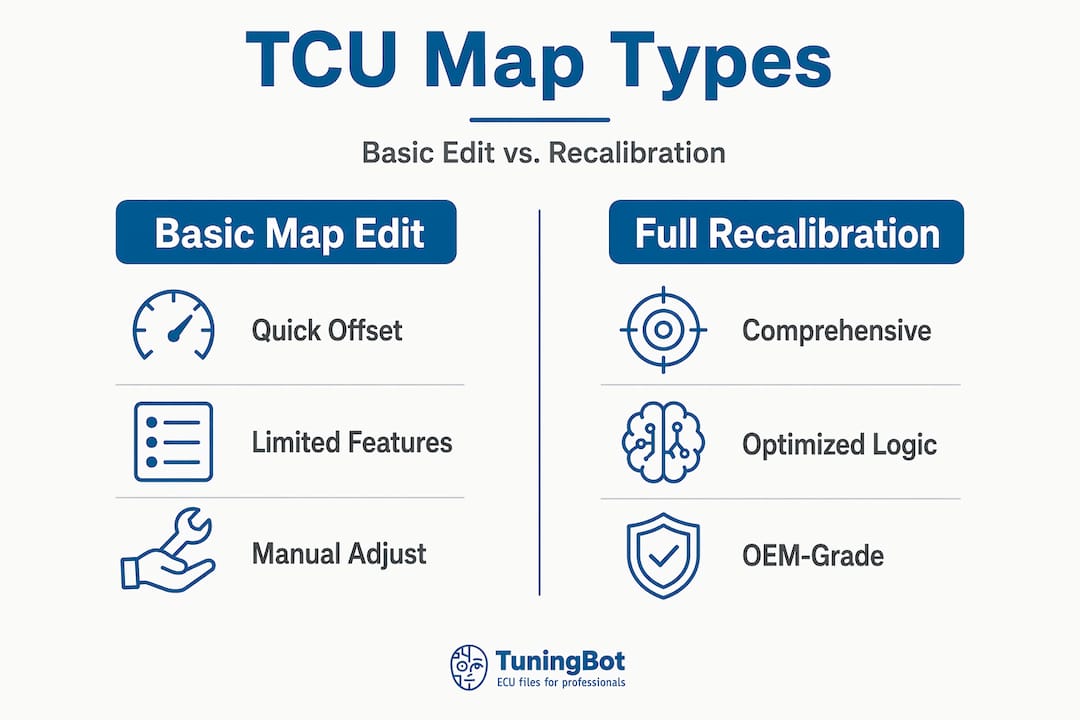
| Feature | Basic map edit | Broader TCU recalibration |
|---|---|---|
| Shift speed adjustment | Often a static change | Reviewed across RPM, load and drive modes |
| Clutch pressure control | May use a fixed increase | Matched to torque demand and gearbox behavior where supported |
| Torque limit handling | Raised or modified in limited areas | Checked against ECU torque request and gearbox protection logic |
| Compatibility with ECU stages | May be adequate for mild changes | Better suited to vehicles with a clear ECU/TCU tuning plan |
| Long-term consistency | Can require revision if the build changes | Can be planned around the intended tuning stage and hardware setup |
The practical advantage for workshops is consistency. When the ECU file and TCU file are planned together, the vehicle is less likely to suffer from torque reductions, late shifts, excessive slip or a mismatch between power delivery and gearbox behavior. The exact scope of the file should still be confirmed from the vehicle data, TCU identification and requested service.
When TCU remapping makes the most sense
Not every vehicle benefits equally from TCU remapping. The highest return usually comes from automatic vehicles already running or planning ECU remaps, especially where the stock transmission calibration limits how the additional torque is delivered.
The most common indicators that a TCU remap may be appropriate include:
- Shift hesitation under load: noticeable delay between throttle input and downshift execution, especially at higher road speeds.
- Torque cutback during hard acceleration: the engine pulls cleanly and then feels artificially reduced, often because torque management intervenes.
- Soft shift feel in sport mode: aggressive driving modes still feel delayed, vague or inconsistent.
- Mismatch after ECU remap: a remapped engine paired with stock TCU logic may create a conflict between engine output and gearbox software.
TCU tuning is usually most noticeable in sport and manual modes, where shift timing, shift firmness and gear-holding behavior are more apparent. Comfort-oriented drive modes may still remain smoother by design, depending on the calibration goal.
Vehicle owners often focus entirely on ECU output, but the transmission is the final control layer between engine torque and wheel torque. Leaving it calibrated for a stock engine while increasing torque output can make the car feel less coherent than it should.
Why TCU remapping matters in a complete build
In many automatic transmission builds, disappointment after an ECU remap does not come from the engine file itself. The car may produce stronger numbers, but the gearbox still shifts like a stock vehicle, delays downshifts or requests torque reductions at the wrong moment. The result is a car that is technically more powerful but not fully integrated.
For that reason, TCU calibration should be considered early when planning a serious automatic transmission build. It is not always mandatory, and it should not be sold blindly, but it becomes highly relevant when ECU torque increases exceed what the stock transmission software was designed to handle comfortably.
The correct approach is diagnostic and vehicle-specific: identify the gearbox, read the TCU data where possible, check service history and adaptations, confirm the ECU tuning stage, then decide whether a TCU file is technically justified. This is the difference between a professional tuning workflow and a generic “more aggressive shifts” approach.
Professional TCU and ECU remapping files from TuningBot
If your workshop needs a structured file-service workflow for ECU and TCU work, TuningBot provides professional online tuning file services with no prepaid credits and no registration barrier. The correct upload page is Tune Your File, where customers can submit the required file and technical information for processing.
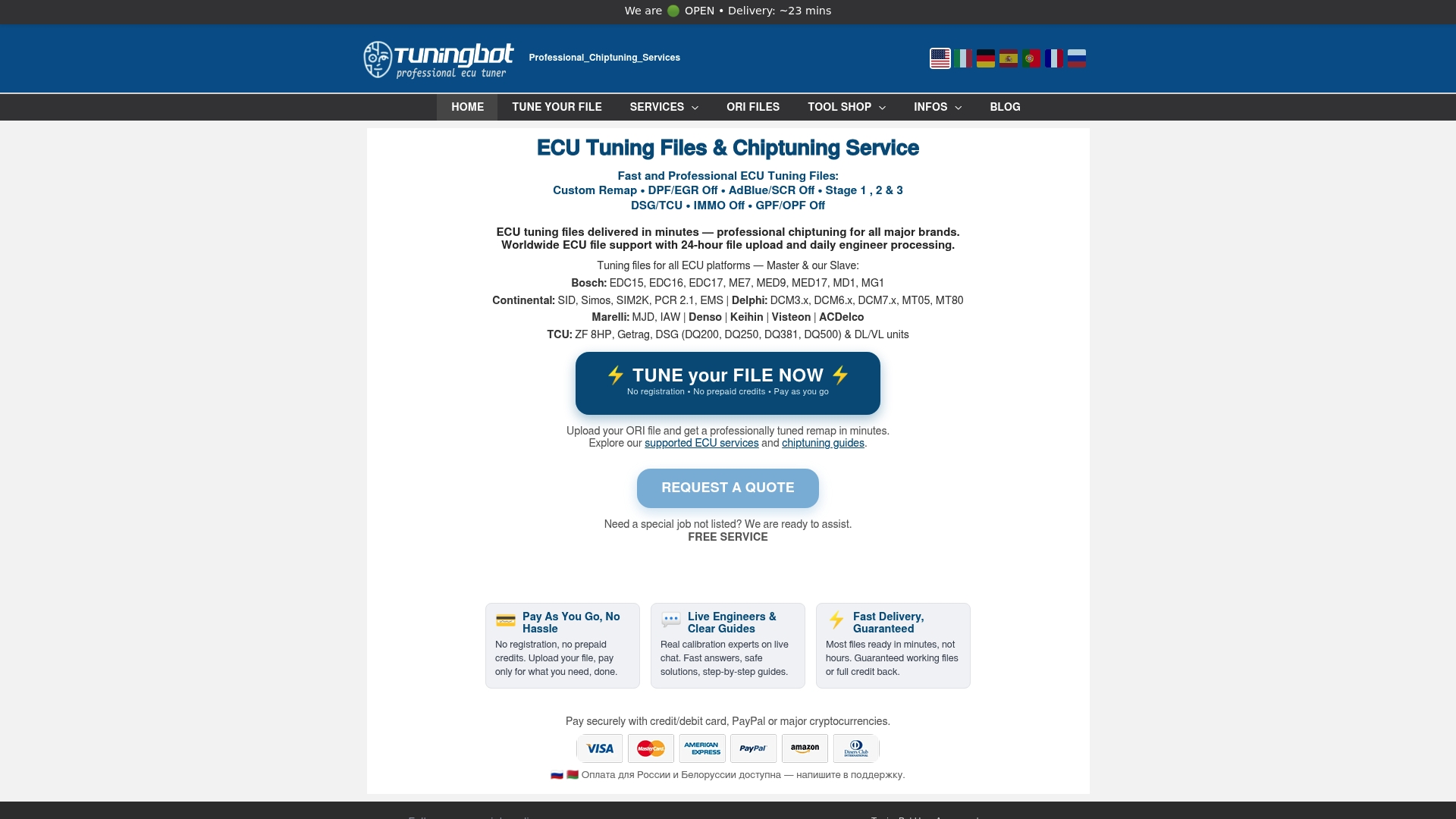
TuningBot supports ECU file services across major ECU families and also lists DSG / TCU gearbox tuning among its available tuning and remapping services. Before submitting a request, workshops should check the ECU Service Coverage page and provide accurate vehicle, ECU/TCU, software and tool information. This reduces variant mismatch, avoids unsupported requests and keeps the workflow clear from the first submission.
For workshops, the advantage is operational simplicity: no prepaid credit system, no unnecessary registration step and a direct upload workflow. Upload the original file, provide accurate technical data, select the correct service and manage support through the official TuningBot workflow when needed.
FAQ
What does TCU remapping do to a car?
TCU remapping modifies the software within the Transmission Control Unit to adjust transmission behavior such as shift timing, clutch pressure strategy, torque limiters and drive-mode response. The goal is to make the gearbox work coherently with the engine’s torque output and the vehicle’s intended use.
Is TCU remapping safe for the transmission?
TCU remapping can be safe when performed with proper diagnostics, correct vehicle identification, a suitable file and a healthy transmission. It is not a repair for worn clutches, contaminated fluid, adaptation problems or existing gearbox faults.
What is the difference between TCU remapping and ECU tuning?
ECU tuning modifies engine management to change power and torque delivery. TCU remapping recalibrates the transmission software so the gearbox can manage that torque more effectively. On many automatic vehicles, the best result comes from planning both together.
How long does a TCU remap take?
The time required depends on gearbox type, tool access, reading/writing method and whether diagnostics or bench work are needed. A supported OBD process can be relatively quick, while bench or boot operations may require more time and preparation.
Which vehicles benefit most from TCU remapping?
Vehicles with dual-clutch or torque converter automatic transmissions often benefit most, especially when already running ECU remaps. DSG-equipped Volkswagen Group vehicles, ZF 8-speed applications and other performance automatic platforms are common examples, subject to file availability and correct vehicle identification.